
As of July 23, 2026, the legal problem in the Bab al-Mandab Strait shipping disruption is no longer just whether a vessel can avoid one dangerous passage. It is whether contracts, war-risk insurance, and AI risk assessment tools can still make reliable judgments when the Strait of Hormuz and Bab al-Mandab are both stressed in the same commercial window.
That distinction matters. A single chokepoint disruption can often be treated as an unpleasant routing problem: delay the voyage, go around, argue over cost, preserve notices, and wait for insurers or counterparties to take a position. A dual-chokepoint crisis is different. Safety4Sea, citing Diaplous, reported a 97% traffic reduction through Hormuz, while Windward described Bab al-Mandab as a “zero-transit zone for Western-linked commerce.” Middle East Monitor reported that the Houthis declared a maritime blockade on Saudi Arabia on July 20, 2026, and that Saudi Red Sea loadings fell 36% in two weeks.[1][2][3]
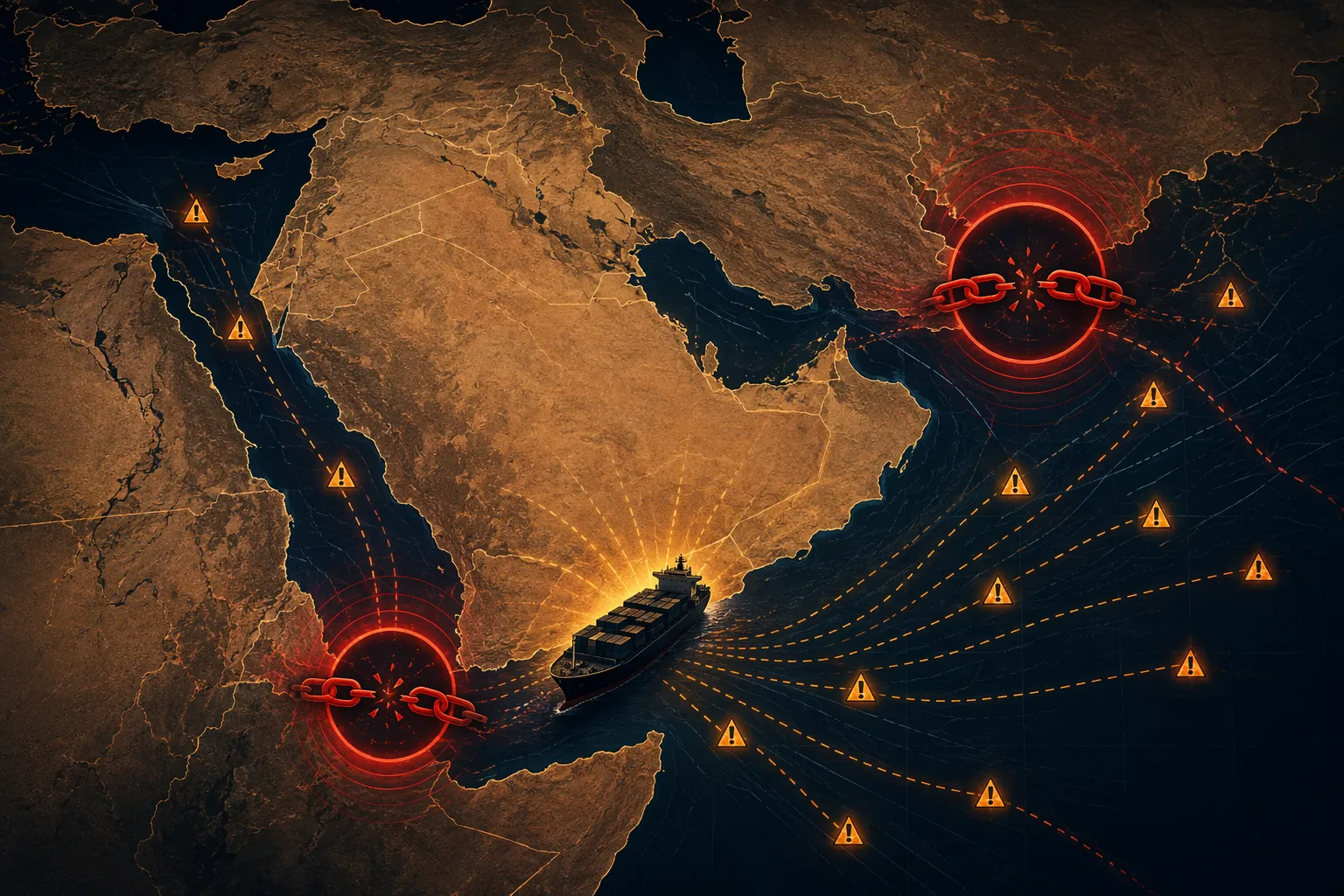
Those figures do not prove that every Asia-Europe contract has become impossible to perform. They do show why ordinary clause-by-clause review is too narrow. The same company may be asking, at once, whether the nominated vessel can lawfully and safely sail, whether a deviation is reasonable, whether delay defeats the commercial purpose of the transaction, whether sanctions or attribution rules affect the route, whether a war-risk premium can be passed through, and whether the dashboard feeding the escalation meeting is measuring a market that still exists.
The Load-Bearing Fact Is Simultaneity
Most maritime risk tools and most contract playbooks are organized around separable causes. A port closes. A canal becomes unsafe. A named war-risk area expands. A carrier announces a surcharge. The legal team then traces a line from event to obligation: notice, mitigation, excuse, price adjustment, termination, insurance tender.
The Q3 2026 chokepoint condition does not fit that shape. Hormuz pressure affects Gulf-origin energy and petrochemical flows. Bab al-Mandab pressure affects Red Sea access and the Asia-Europe route structure. Together, they can turn what would normally be a deviation analysis into a corridor viability analysis. The International Energy Agency’s reported estimate that cumulative oil supply losses from Middle East producers exceed 1.3 billion barrels, together with Middle East Monitor’s calculation that 15% to 17% of global oil supply is now threatened, is relevant not because oil prices answer contract law questions, but because they frame the commercial scale of the disruption.[4][3]
The legal implication is uncomfortable: there may be no clean single cause to plead. Delay may result from security restrictions, insurer refusal, premium spikes, flag-state risk, crew safety concerns, port nomination changes, sanctions screening, and counterparties refusing revised delivery windows. A force majeure notice that names only “Red Sea attacks” may preserve less than the business thinks it preserves. A memo that asks only whether Bab al-Mandab is blocked may miss that the shipment’s origin economics have already been distorted by Hormuz.
Why Force Majeure Analysis Becomes Less Clean
Freshfields’ earlier Red Sea analysis treated Houthi attacks as a possible basis for force majeure depending on the wording of the clause, the causal link between the event and non-performance, notice compliance, mitigation, and whether performance was prevented or merely made more expensive.[5] That framework remains the correct starting point. It is just no longer enough by itself.
The first difficulty is causation. In a single-route crisis, the affected party can often say: this event made this route unavailable, and that prevented this performance. In a simultaneous Hormuz and Bab al-Mandab disruption, the same non-performance may be overdetermined. A buyer may not receive cargo because the vessel avoided Bab al-Mandab, because the originating supply was delayed by Hormuz disruption, because war-risk cover was unavailable at an acceptable price, or because the carrier declined a Western-linked transit. If the contract requires the event to be the direct cause of non-performance, the legal argument becomes more fragile.
The second difficulty is the line between impossibility and commercial hardship. Freshfields’ point that increased cost is usually not enough for force majeure remains important.[5] But the current market facts are testing that boundary. North Sea Dated crude was reported at $144 per barrel, war-risk premiums moved sharply, and regional supply disruption reached a scale that may change the economics of performance rather than merely raise a line item.[3][4] That still does not automatically excuse performance. It does mean counsel should be wary of any internal conclusion that treats the crisis as ordinary price volatility.
The third difficulty is mitigation. A contract counterparty may ask why the carrier did not reroute, transship, delay sailing, use a different vessel, or accept a premium. Those are fair questions only if the alternatives were actually available on the relevant date, for that vessel, cargo, flag, beneficial ownership profile, and insurance tower. In this environment, a generic “route around the Cape” answer can be too blunt. A reroute may solve Bab al-Mandab exposure while leaving the company with delivery failure, fuel cost disputes, sanctions screening issues, or coverage gaps elsewhere.
The practical legal file therefore needs more than the clause and the news alert. It needs a dated record of what was known when the decision was made: vessel identity, flag, ownership exposure, cargo, contractual delivery window, insurer communications, broker quotes, port instructions, security advisories, and the alternatives rejected. Courts and arbitral tribunals may later prefer a cleaner story. The business will not have had one.
War Risk Clauses Were Not Drafted for Corridor Fragmentation
BIMCO-style war clauses, including CONWARTIME and VOYWAR forms, are built to allocate risk where war, hostilities, warlike operations, terrorism, or similar dangers affect the vessel or voyage. They are useful because they move the discussion from abstract danger to contractual consequences: refusal to proceed, deviation, discharge at another port, additional expenses, and related rights.
The harder Q3 2026 question is not whether the clauses are relevant. They plainly may be. The harder question is whether the factual predicate can be established in a way the clause recognizes. If Bab al-Mandab is described operationally as unavailable to Western-linked commerce, but not necessarily unavailable to every vessel, the risk is not geographically uniform. If Hormuz traffic collapses but later partially resumes, the danger is not static. If a vessel’s profile determines whether it is targeted, the clause analysis depends on more than coordinates.
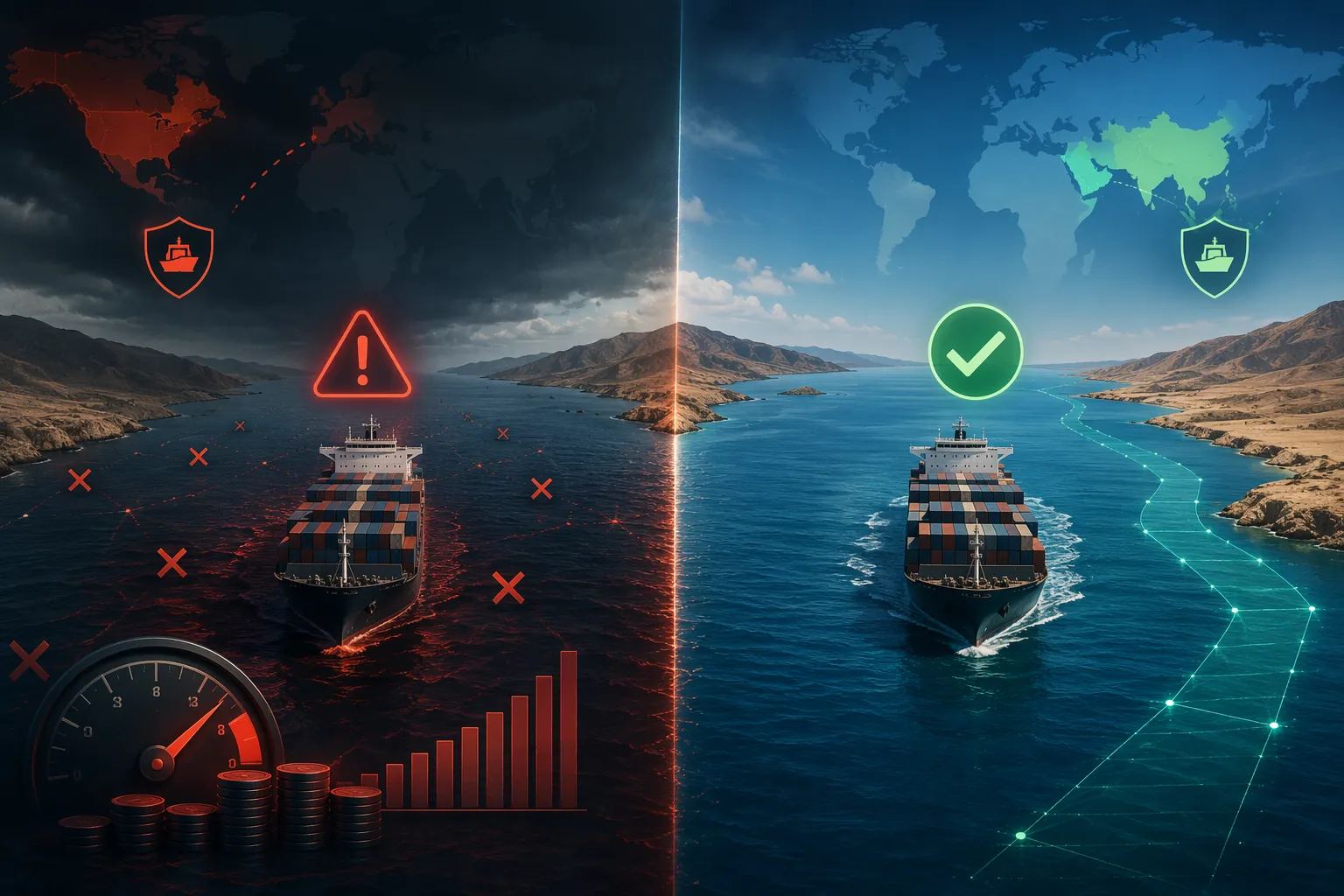
That is where legal drafting and operations often start talking past each other. The lawyer asks whether the contractual war-risk threshold has been met. The operator asks whether the vessel can sail tonight without losing cover. Both questions are necessary. Neither question answers the other.
The Houthi blockade declaration adds another layer because its legal status is unsettled. Non-state actor blockades remain difficult to classify under existing international-law frameworks, including the San Remo Manual and the Declaration of Paris. That uncertainty matters for attribution, state responsibility, self-defense analysis, and the legal characterization of interference with navigation. A fuller treatment of those classification issues sits in the separate analysis of whether the Houthis can lawfully close the Bab al-Mandab Strait, but the contract consequence is immediate: parties should be careful about treating the word “blockade” as if it automatically produces one settled legal result.[3]
Internal analysis should distinguish the operational fact of threatened transit from the legal status of the declared blockade. A vessel may be commercially unable to transit long before an international tribunal, regulator, or flag state supplies a definitive classification. That gap is exactly where disputes over notices, deviation, demurrage, frustration, and insurance tend to grow.
Insurance Bifurcation Is the Bridge Between Law and Data
Insurance is where the dual chokepoint crisis stops being theoretical. KJ Reports described a bifurcated environment in which “non-Western” hulls may transit unmolested while Western-linked vessels face prohibitive costs.[6] Reuters reporting carried by S&P Global placed Bab al-Mandab war-risk premiums rising from 0.3% to 0.75% of vessel value in a single week after the Houthi blockade declaration.[7]
Those are not just insurance-market details. They affect whether performance is economically viable, whether an owner can refuse orders, whether a charterer can insist on a route, whether added premiums can be passed through, and whether a mitigation proposal is realistic. A clause may say one thing about additional war-risk premium. The market may make that premium unavailable, unstable, or different for vessels that look similar on a spreadsheet but different to an underwriter.
The bifurcation also complicates evidence. If one vessel transits and another does not, the fact of successful transit does not necessarily prove that the second vessel acted unreasonably. It may only prove that the first vessel carried a different flag, ownership profile, cargo, insurer appetite, or perceived geopolitical exposure. In a later dispute, the comparison vessel will matter only if it is genuinely comparable.
For legal teams, the useful record is not merely “premium increased.” It is who quoted it, when, for which vessel, on what assumptions, with what exclusions, and whether the quote remained open long enough to support the operational decision. That evidence may become central to frustration arguments, war-risk expense claims, mitigation defenses, and disputes over whether the affected party acted reasonably.
Frustration Is Tempting, but the Bar Remains High
The phrase “structurally unprecedented” should not be mistaken for a conclusion that contracts are automatically frustrated. Frustration remains a narrow doctrine in common-law systems. It typically requires performance to become impossible, illegal, or radically different from what was agreed, not merely more expensive or inconvenient.
The current facts are still relevant because they may support the “radically different” inquiry in some contracts. A sale tied to Gulf-origin supply, a charter requiring a particular route or delivery window, and a long-term supply arrangement dependent on predictable Red Sea transit do not all face the same legal analysis. The IEA oil-supply loss figure, crude price data, transit reductions, and premium jumps may help show the scale of market disruption.[1][3][4][7] They do not eliminate the need to examine the contract’s allocation of risk.
The absence of direct case law or regulatory guidance on simultaneous Hormuz and Bab al-Mandab disruption is not a minor caveat. It is one of the controlling facts of the analysis. Any confident answer that treats the dual crisis as already solved by Red Sea precedent, canal-closure history, pandemic-era supply-chain disputes, or generic war-risk wording is doing more smoothing than the facts allow.
Attribution Problems Do Not Stay in Public International Law
Attribution looks like a public-law problem until it lands inside a contract notice. The International Institute for Strategic Studies has characterized the Iran-Houthi relationship as a “partnership rather than a direct command structure.”[8] That framing makes it harder to move casually from Houthi conduct to Iranian responsibility, or from regional military escalation to a specific contractual trigger.
For force majeure, attribution may affect whether the event falls within the clause language. For war-risk clauses, it may affect whether the danger is treated as war, warlike operations, terrorism, piracy, hostile acts, or something else. For sanctions and compliance teams, it may affect which counterparties, ports, cargoes, insurers, or vessels require enhanced screening. For insurers, it may affect exclusions and aggregation.
The recent regional pattern also shows why clean labels can mislead. The legal uncertainty around Houthi Red Sea actions, flag-state rights, and self-defense claims is not abstract when commercial decisions have to be made before authoritative legal classification arrives. The same theater has already produced difficult classification questions in incidents such as the Asana chemical tanker hijacking, where maritime piracy law, armed conflict framing, and operational risk overlapped.
AI Risk Assessment Can See Faster, Not Decide Better
AI-enabled maritime risk systems are useful in exactly the place spreadsheets are weakest: speed, pattern detection, vessel behavior, anomaly alerts, AIS gaps, route exposure, port congestion, and supplier-risk signals. Windward, RightShip, Everstream, and Eagle Intelligence can help a legal or operations team see exposure faster, especially when vessel movements, sanctions indicators, weather, port risk, and security events are changing across jurisdictions.
The danger is the next step: treating a platform score as if it answers a legal question. A model can flag that a vessel entered a risk zone. It cannot decide whether a force majeure clause was triggered. It can show that comparable vessels changed route. It cannot decide whether deviation was reasonable under a charterparty. It can surface a premium trend. It cannot decide whether a party’s refusal to perform was excused.

Xeneta’s 2026 warning is the right restraint: “AI performs best in stable, repeatable systems. Freight markets are neither.”[9] That is not an anti-AI argument. It is a warning about model domain. A system trained or calibrated on ordinary volatility, single-chokepoint disruptions, historical premium behavior, or past rerouting cycles may still produce confident outputs during a structurally different event. Confidence is not the same as legal reliability.
This matters most when AI output becomes part of the decision record. If a legal team relies on a dashboard to approve non-performance, reject a deviation, trigger a notice, or characterize a route as unavailable, the later question will not be whether AI was generally useful. It will be whether the specific data was current, relevant to that vessel and contract, and understood with its limitations. In unstable markets, a stale pattern can look authoritative because it is visual.
Windward’s reporting on AIS blackout behavior and zero-transit conditions is valuable because it can help identify operational stress that would otherwise be invisible until after the commercial damage is done.[2] But the legal file should separate observation from conclusion. “AIS behavior changed” is evidence. “The route was legally impossible” is an argument. “Western-linked commerce faces a different risk environment” is a risk classification. “Our counterparty was excused” is a contract conclusion.
The Baseline May Not Snap Back
A temporary disruption can be handled with temporary tools. Chatham House’s June 2026 analysis makes that assumption harder to sustain. It warned that even if Hormuz reopens, Iran retains the ability to close it again, and it described the Bab al-Mandab threat as a form of institutionalized readiness rather than a passing active crisis.[10]
That has consequences for contract drafting and risk assessment. If elevated chokepoint risk becomes part of the commercial baseline, parties may find it harder to argue that later disruptions were unforeseeable. At the same time, foreseeability does not mean a party assumed unlimited exposure. The better question is what risk was allocated, to whom, at what price, and with what operational assumptions.
This is where many legal memos become too tidy. They put force majeure, frustration, war risk, sanctions, deviation, and insurance into separate boxes. The business problem will not stay in those boxes. A vessel that cannot obtain survivable war-risk cover may trigger a deviation issue. A deviation may create delivery delay. Delivery delay may trigger liquidated damages or termination rights. A sanctions review may slow substitute performance. An AI alert may become part of the record that proves what the company knew and when it knew it.
What a Defensible Q3 2026 Assessment Should Contain
This is not a checklist for legal advice. It is a description of the evidentiary shape a defensible assessment is likely to need. The first element is time. A conclusion reached on July 13 may not survive facts reported by July 21. The Houthi escalation from threats to a declared maritime blockade occurred within that window, alongside reported U.S.-Iran strikes in the same period.[3] A file that says only “current position” without a timestamp is already weak.
The second element is source specificity. Market intelligence, broker reports, insurer communications, government advisories, carrier notices, AIS analytics, and legal analysis do different jobs. They should not be blended into one undifferentiated risk conclusion. A broker quote is not a judicial finding. A vendor alert is not a clause trigger. A news report is not a sanctions determination.
The third element is vessel and counterparty specificity. In a bifurcated market, the legal relevance of a transit example depends on whether the comparison vessel is actually comparable. Western linkage, flag, ownership, cargo, insurer appetite, crew arrangements, route, and timing may all matter. The fact that “ships are still moving” is not, by itself, an answer to whether this ship can move on this contract.
The fourth element is model limitation. If AI risk output is used, the file should identify what the system measured, when the data was refreshed, what assumptions were visible, and which legal questions remained outside the model. That discipline protects the business from two opposite errors: ignoring useful signals because they are machine-generated, or accepting a machine-generated confidence level as a substitute for legal judgment.
The Bab al-Mandab disruption is therefore not reducible to whether one clause has been triggered. In Q3 2026, the better assessment maps interdependent exposure across contracts, insurance, routing, attribution, data reliability, and AI-model limits. Because the facts are moving quickly and the legal status of the blockade remains unsettled, any conclusion should be timestamped, source-specific, and treated as a systemic risk evaluation rather than a final legal answer.
References
- Middle East threat overview: Key maritime updates, Safety4Sea.
- A Gulf in Crisis: Maritime Fallout of the Iran Attack, Windward.
- Bab el-Mandeb and the coming age of chokepoint warfare, Middle East Monitor, July 21, 2026.
- IEA oil supply loss data, International Energy Agency.
- Disruptions to supply chains: can the Houthi's attacks in the Red Sea give rise to force majeure?, Freshfields.
- The Bab al-Mandeb Trap: Chokepoint War as Global Attrition, KJ Reports, July 2026.
- Bab al-Mandab war risk premium reporting, Reuters via S&P Global.
- Iran-Houthi partnership characterization, International Institute for Strategic Studies.
- The Biggest Supply Chain Risks of 2026, Xeneta.
- The next Strait of Hormuz crisis could be even worse, Chatham House, June 2026.
Comments
Join the discussion with an anonymous comment.