
The July 2025 Bedminster airspace story was easy to read as a fighter-jet spectacle: a civilian aircraft crossed into restricted airspace near President Donald Trump’s New Jersey golf club, an F-16 escorted it out, and flares were deployed during the response. Reuters reported 11 violations over the July Fourth weekend, with NORAD aircraft responding to airspace incursions around Bedminster while Trump was present at the property.[1]
That is the visible part. The more useful legal analysis starts after the airplane is no longer in the restricted area. By late June, before the July Fourth weekend, the Palm Beach Daily News had already reported more than 12 Bedminster TFR violations since January 2025. The same report quoted NORAD Commander Gen. Gregory Guillot saying that “the excessive number of TFR violations indicates many civil aviators are not reading NOTAMs before each flight.”[2] In an enforcement file, that sentence does not read like color commentary. It reads like the beginning of a theory.
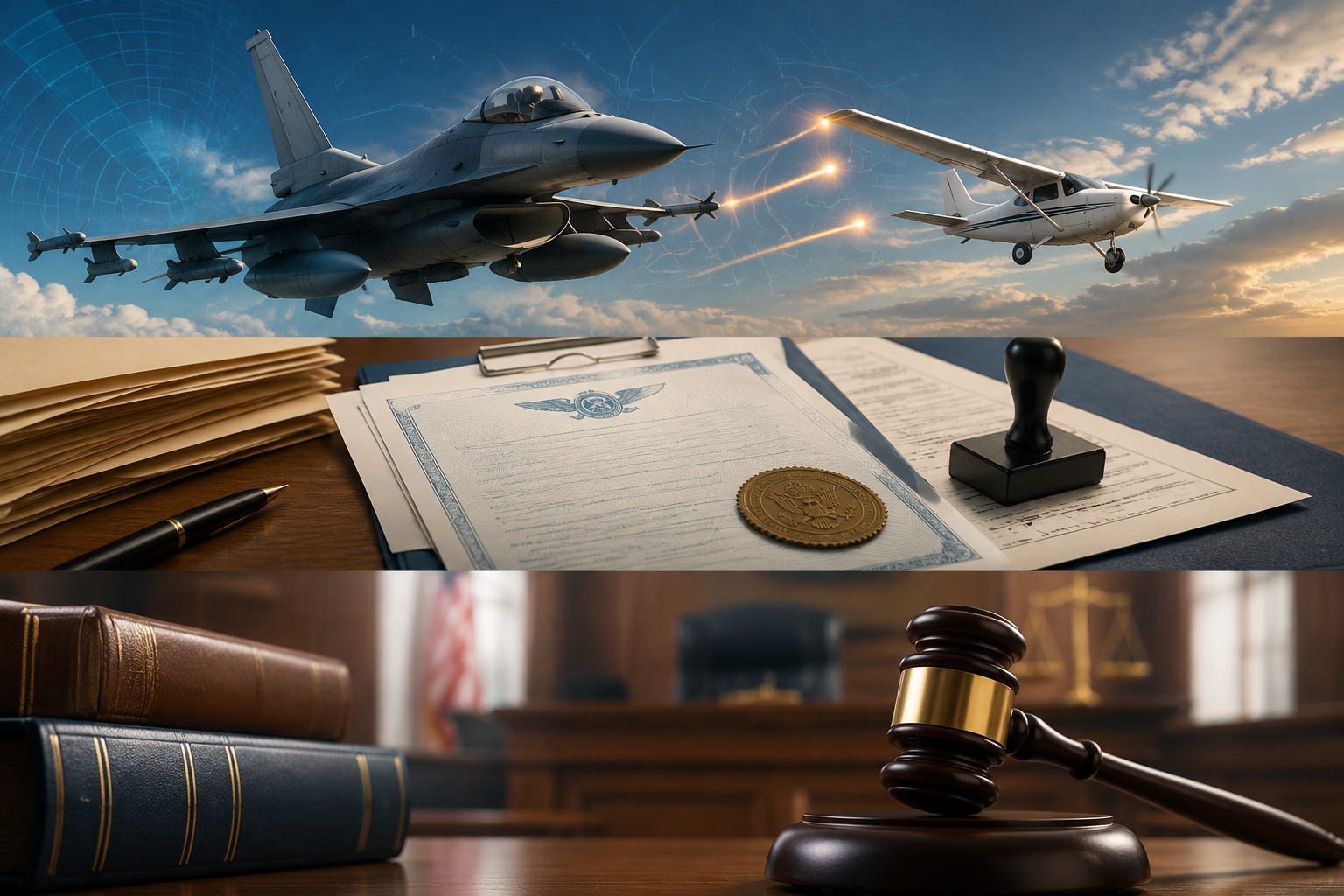
This is not a report of named FAA outcomes from the Bedminster pilots. Publicly available records located for this analysis do not identify individual pilots, certificate numbers, case numbers, settlements, suspensions, civil penalties, or criminal dispositions arising from those specific incidents. Bedminster is useful for a narrower and more important reason: the documented pattern makes the full enforcement pipeline visible.
For a pilot or counsel handling the aftermath of a presidential TFR violation, the matter is not “an FAA issue” in any tidy sense. It moves through at least three distinct layers: the immediate air-defense response, the FAA’s certificate and civil penalty process, and the criminal statute that can sit behind the administrative case when facts become more serious.
The intercept is already a consequence
Pilots sometimes talk about an intercept as though it were an unusually loud warning. That badly understates the event. Once a protected presidential TFR is penetrated, the first institutional response is not a letter from an FAA lawyer. It is an air-defense response already in motion before the pilot has explained the route, the briefing, or the cockpit confusion.
The July Bedminster reporting shows why that distinction matters. Reuters described an F-16 escorting an aircraft out of the restricted area and reported that flares were used during the NORAD response.[1] NORAD responses to restricted-airspace incursions may include radio calls, visual identification, escort, and visual signaling. In some presidential TFR events, that may also include aggressive positioning or “headbutt” maneuvers intended to get the pilot’s attention. The point is not whether every incursion produces the same sequence. The point is that the pilot’s mistake has already consumed national-defense resources and created a record outside ordinary FAA compliance handling.
That record will matter later. The intercept establishes timing, location, radar track, communications attempts, pilot response, and whether the aircraft exited promptly. If flares were deployed, the file is no longer just a dry airspace chart problem. It contains evidence that military responders believed additional visual signaling was necessary. Counsel trying to reduce the event to embarrassment and corrective training will have to deal with that operational history.
The FAA file starts with preflight, not with the border crossing
A presidential TFR violation is normally discussed as an airspace violation, but the FAA case often begins earlier. The agency will want to know how the flight was planned, what briefing was obtained, whether the pilot reviewed applicable NOTAMs, what tools were used, and whether the pilot had reason to know the route would pass near protected airspace. That is why Guillot’s NOTAM remark is so uncomfortable for defense counsel: it points directly to preflight preparation, not merely to in-flight navigation.
The regulatory basis matters. 14 CFR 91.137 establishes flight restrictions in designated areas and makes it unlawful to operate within covered restricted airspace unless the operation fits an authorized category or complies with the restrictions in the notice.[3] In a TFR case, the NOTAM is not background reading. It is the document that turns a patch of airspace on a familiar route into a legally restricted area for a defined time, altitude, geography, and set of permitted operations.
The FAA’s enforcement materials point counsel to Order 2150.3C, which provides sanction guidance and penalty frameworks used in legal enforcement actions.[4] Those materials identify a 30-to-90-day certificate suspension baseline and civil penalty exposure that can reach $100,000 when the FAA stacks violations under the TFR rule and the preflight-action obligation.[4] That does not mean every Bedminster pilot received that sanction. It means that, before anyone predicts a warning letter or a modest fine, counsel should be modeling the case against the FAA’s sanction framework rather than against the pilot’s personal sense that the flight was harmless.
| Stage | What it measures | Why it matters in a Bedminster-type case |
|---|---|---|
| NORAD response | Whether the aircraft entered protected airspace and how responders removed or identified it | Creates an operational record before the FAA enforcement theory is fully developed |
| FAA certificate action | Whether the pilot violated the TFR and failed to conduct adequate preflight planning | Can put the pilot’s certificate at risk, with sanction baselines counsel should evaluate early |
| FAA civil penalty | Whether monetary penalties are pursued in addition to or instead of certificate action | Can expand exposure when the agency pleads multiple regulatory violations |
| Criminal statute | Whether the facts support knowing or willful violation of national-defense airspace restrictions | Changes the advice when there are repeat violations, aggravating facts, or prosecutorial interest |
The most dangerous client statement after an intercept is often some version of “I didn’t know.” That may be true. It may also be the very fact the FAA uses to prove inadequate preflight action. A pilot who did not review NOTAMs before a route near a repeatedly active presidential property has not necessarily given counsel a defense. The pilot may have supplied the agency with the cleanest part of its case.
What counsel should collect before the explanation hardens
The first interview after a TFR bust should not be a search for a sympathetic narrative. It should be evidence preservation. The enforcement file will turn on ordinary details that become hard to reconstruct once the pilot has talked to too many people, refreshed a flight-planning app, or replaced memory with embarrassment.
- The exact preflight briefing source, time, and route inputs.
- Screenshots or records from the flight-planning tool as it appeared before departure, if available.
- Whether the pilot obtained a formal briefing or relied on habit, weather-only review, cockpit avionics, or a stale route.
- ATC communications before, during, and after the incursion.
- Whether the pilot complied immediately with intercept procedures and exited the restricted area without delay.
- Any prior airspace deviations, warnings, remedial training, or enforcement contacts.
Those facts do not erase the violation. They determine whether the matter is framed as an isolated lapse, a careless preflight process, a repeat problem, or something worse. They also determine whether counsel can credibly argue for mitigation inside the FAA process before the agency’s narrative becomes fixed.
Certificate suspension and civil penalties are different problems
Aviation clients often collapse FAA enforcement into one bucket: “Will I be fined?” or “Will I lose my certificate?” In a TFR matter, those are related but separate questions. A certificate action targets the pilot’s authority to operate. A civil penalty targets money. The same event may support both theories depending on the facts, the pilot’s status, the aircraft operation, and the FAA’s charging decision.
The certificate action is the more immediate professional threat for many general aviation pilots. A 30-to-90-day suspension baseline is not a minor inconvenience for a pilot who flies for business, instructs, rents aircraft, or must disclose enforcement history to an insurer, employer, school, or club.[4] Even where the sanction is negotiated downward or resolved through other means, the opening range shapes the conversation.
Civil penalty analysis is more mechanical and, for that reason, easy to underestimate. A single flight can generate more than one alleged violation. The FAA may look not only at entry into the restricted area but also at whether the pilot complied with preflight duties. That is the practical significance of stacking under the TFR rule and the preflight-action rule: the agency is not limited to the pilot’s preferred description of one wrong turn.
This is where Bedminster should be handled carefully. The public reports support the existence of repeated incursions near the property in 2025; they do not support confident statements about final FAA sanctions for named pilots. No responsible legal analysis should invent a Bedminster penalty table from partial incident counts. The correct use of the Bedminster facts is to show how quickly an operational mistake can become an FAA enforcement matter with both certificate and monetary exposure.
For broader 2026 restricted-airspace penalty context, the related analysis of new penalties for violating restricted airspace is a useful companion. The Bedminster point is narrower: a presidential TFR bust should be evaluated across the whole enforcement chain, not just the most familiar FAA form letter.
The criminal statute is not the usual outcome, but it changes the ceiling
Criminal exposure should not be exaggerated. The available Bedminster reporting does not establish that every pilot, or any identified pilot, faced criminal prosecution. Most aviation enforcement counseling still begins with operational facts and the FAA process. But counsel should not ignore 49 USC 46307 simply because the client is a private pilot in a small aircraft rather than a deliberate security threat.
Section 46307 addresses knowing or willful violations of national-defense airspace restrictions and provides for fines, imprisonment, or both. The important 2026 development is the December 18, 2025 amendment in Pub. L. 119–60: for repeat violations, the maximum imprisonment term was raised to 5 years.[5] That change does not convert every TFR mistake into a criminal case. It changes the outer boundary of advice when a pilot has prior violations, ignores warnings, acts in a way that appears intentional, or creates facts that a prosecutor could characterize as knowing or willful.
The repeat-offender language is especially important in a recurring presidential-property environment. A pilot with no enforcement history who clipped a TFR after a deficient briefing presents one problem. A pilot who has previously violated restricted airspace, received prior counseling, or continued toward protected airspace after warning presents a different one. The amendment gives that difference sharper consequences.
That is also why early statements matter. A careless explanation can create admissions about notice, prior awareness, or disregard. A lawyer does not need to treat every client like a criminal defendant to recognize that the FAA file and the criminal statute may be looking at overlapping facts. The safest advice is built before those facts are casually characterized.
The pattern continued after July
The Bedminster incidents did not stop being relevant after the July Fourth weekend. CBS News later reported that fighter jets were scrambled after five more aircraft violated restricted airspace near Trump’s Bedminster property over the August 3–4 weekend.[6] Again, that does not prove a particular sanction for a particular pilot. It does show that the problem was not a single holiday-weekend anomaly.
A comparison from Florida shows why persistent presidential-property violations draw regulatory attention. General Aviation News reported in December 2025 that there had been more than 40 West Palm Beach TFR violations and that the FAA had established a permanent 1-nautical-mile restriction at Mar-a-Lago in October 2025.[7] Bedminster and Mar-a-Lago are not interchangeable legal records, and one should not use the Florida restriction to infer a Bedminster sanction. The comparison is useful for a more modest point: repeated incursions around a protected site can produce escalation beyond individual pilot discipline.
Cost figures should be handled with the same caution. NBC Miami reported a $50,000-per-scramble figure attributed through WPTV to NORAD Vice Director Steven Armstrong.[8] Because the underlying interview was not independently available in the public sources cited here, that number should not be treated as a verified accounting record for each Bedminster response. It is still useful as a reminder that an intercept is not free background noise. It represents personnel, aircraft, fuel, readiness, and command attention that the pilot’s enforcement file may not fully price but the government plainly notices.
How the client conversation should change
The right first conversation after a presidential TFR bust is not a prediction. It is a map. The pilot needs to understand that several institutions may care about the same flight for different reasons. NORAD cares about the protected airspace and immediate response. The FAA cares about the regulatory violation, the preflight process, and sanction policy. Prosecutors may care if the facts suggest knowing or willful conduct, especially after prior violations. Insurers, employers, aircraft owners, flight schools, and airport authorities may care for still other reasons.
That map changes the advice. A pilot should not casually submit a written statement before counsel understands the briefing record, communications, intercept details, and prior history. A flight school should not treat a student or renter TFR bust as only a remedial training issue until it understands whether the FAA has opened an enforcement matter. An insurer should not evaluate the event only by damage or injury, because a no-damage intercept can still create certificate, civil, and disclosure consequences.
None of this requires melodrama. Most pilots who violate TFRs are not trying to penetrate protected airspace. Many are casual, rushed, overconfident on familiar routes, or too trusting of an incomplete briefing habit. That explanation may help mitigation. It does not make the event ordinary. Presidential TFRs sit in a different enforcement environment because the government has already treated the protected airspace as a national-security matter before the pilot ever receives a notice of proposed certificate action.
Where the Bedminster analysis stops
The documented Bedminster facts support a strong but bounded conclusion. Public reporting shows repeated 2025 TFR violations near the property, including the July Fourth weekend incidents involving F-16 response and flares, and later August violations.[1][6] FAA materials and federal law show the enforcement architecture that can follow: certificate suspension baselines, civil penalty exposure, and criminal penalties for knowing or willful national-defense airspace violations, with a higher repeat-offender maximum after the December 2025 amendment.[4][5]
What the public record does not show is equally important. It does not show final FAA orders for the Bedminster pilots, negotiated settlements, criminal charging decisions, or individualized findings about intent. Treating the incidents as though those outcomes are known would make the analysis less useful, not more.
The practical conclusion is still firm: a presidential TFR bust is not a single-agency event and not merely a suspension-or-fine problem. Bedminster reveals an enforcement chain whose cumulative exposure is larger than many general aviation pilots expect, and larger than counsel should assume when the first call comes in after the intercept.
This article is for legal and compliance analysis only and is not legal advice. Pilots, operators, schools, and insurers facing a specific TFR incident should consult qualified aviation counsel.
References
- F-16 escorts plane out of area after airspace incursion near Trump's golf course, Reuters, July 5, 2025.
- NORAD jets intercept multiple planes near Trump's New Jersey club, Palm Beach Daily News, June 23, 2025.
- 14 CFR § 91.137 - Temporary flight restrictions in the vicinity of disaster/hazard areas, eCFR.
- Enforcement Actions, Federal Aviation Administration.
- 49 U.S. Code § 46307 - Violation of national defense airspace, Legal Information Institute, Cornell Law School.
- Fighter jets scrambled after planes violate Trump airspace in Bedminster, New Jersey, CBS News, August 2025.
- Flares shot to alert GA pilot to TFR violation, General Aviation News, December 2, 2025.
- Temporary flight restrictions violations over Mar-a-Lago: What to know about restricted airspace, NBC Miami.
Comments
Join the discussion with an anonymous comment.