
The useful way into the Bedminster airspace problem is not the flare itself. It is the timestamp attached to it. On September 14, 2025, NORAD said it had responded to four unauthorized incursions into the temporary flight restriction over Bedminster, New Jersey, during September 13–14, and that an F-16 had deployed flares at 1:55 p.m. Eastern time to get the attention of a general aviation aircraft that had entered the restricted area.[1] That is the kind of operational fact lawyers should resist sanding down into abstraction: a pilot missed or disregarded a presidential TFR, controllers and defense personnel had to react in real time, and the response used a visible warning measure designed to be unmistakable from the cockpit.
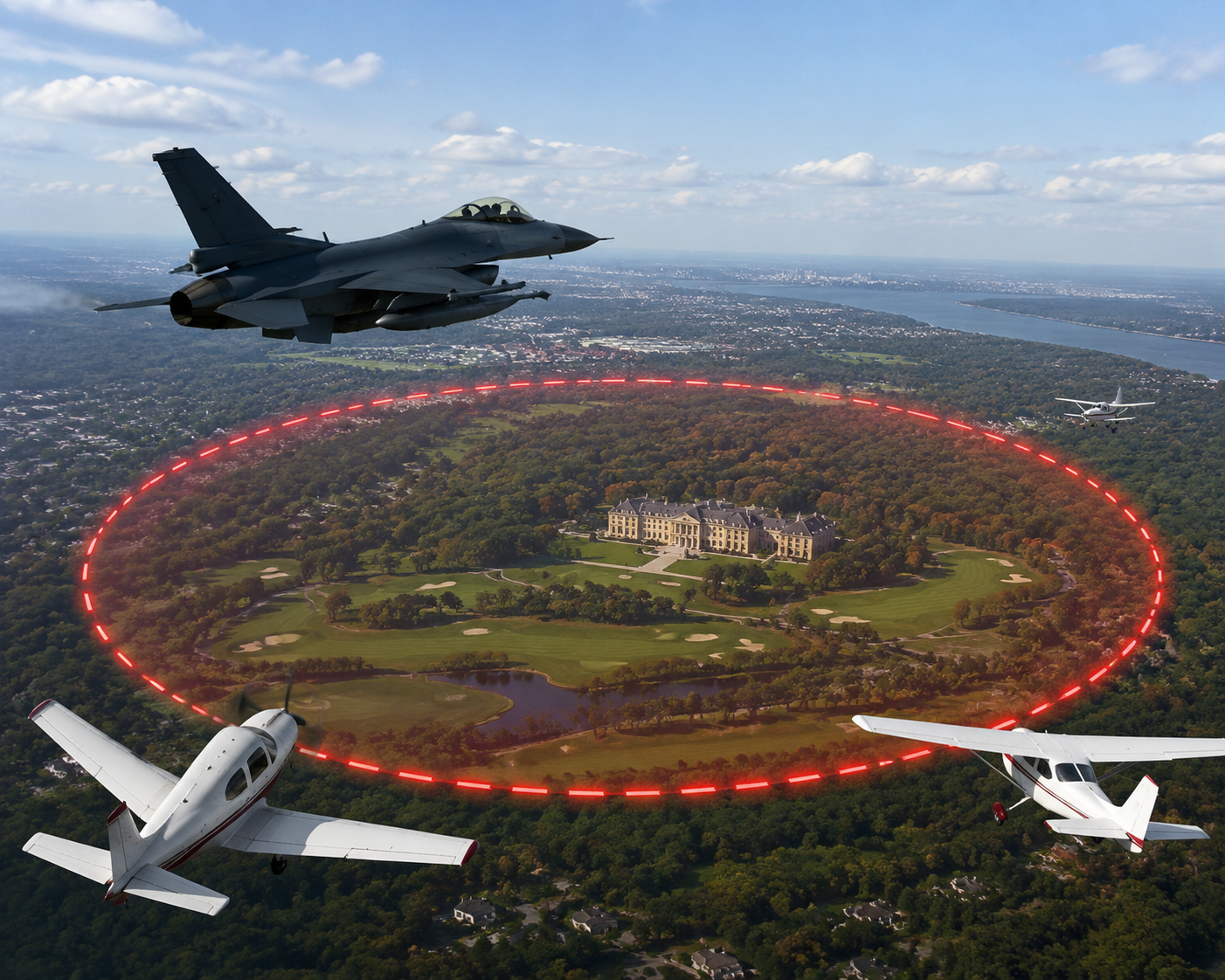
Flares make headlines because they are visible from the ground. In the legal analysis, their significance is narrower and more important. They show that the compliance failure had already moved past the quiet end of aviation enforcement. By September, the system was no longer merely publishing a notice and hoping pilots read it. It was putting fighter aircraft into the problem.
Nor was September an isolated bad weekend. NORAD had already reported a July 5, 2025 response over Bedminster in which an F-16 used a “headbutt maneuver” at 2:39 p.m. Eastern time to intercept an aircraft that violated the TFR.[2] The point is not that every incursion produced the same tactic. Flares and headbutt maneuvers are different forms of intercept communication. The common feature is that both are conspicuous operational responses to an aircraft being somewhere the national defense airspace rules said it should not be.
Why the Bedminster TFR was not just another restricted area
The governing regulatory hook matters. Presidential VIP TFRs are not best analyzed as ordinary hazard-area restrictions. The authority generally invoked for these security restrictions is 14 CFR § 99.7, which allows the FAA, in the interest of national security, to issue special security instructions that apply to aircraft operating in specified airspace.[3] That is a different legal animal from the familiar disaster or hazard TFRs pilots may associate with wildfires, emergencies, or relief operations.
That distinction is not pedantic. A presidential TFR is built around protective security, not merely traffic separation from a temporary hazard. The operating question is not only whether a flight interferes with responders or creates a local safety issue; it is whether an unidentified or noncompliant aircraft has entered airspace the federal government has treated as a national security perimeter.
The FAA’s public TFR materials describe the basic architecture pilots are supposed to consult through the NOTAM system and identify the common VIP TFR structure as a 10 nautical mile inner ring and a 30 nautical mile outer ring.[4] The rings matter because they usually do not impose a single flat prohibition across the whole area. They create different operating conditions depending on location, flight purpose, communications, authorization, and screening requirements. A pilot who treats the outer ring as a casual warning circle is already misunderstanding the legal design.
| Feature | Legal significance |
|---|---|
| 14 CFR § 99.7 special security instructions | Places the restriction in the national security framework rather than the ordinary hazard-area TFR framework. |
| NOTAM publication | Supplies the operative notice pilots are expected to check before flight. |
| Inner and outer rings | Creates layered requirements rather than one undifferentiated no-fly circle. |
| NORAD intercept response | Shows that a violation can become an active defense event before any later FAA or criminal enforcement decision. |
That is the compliance posture against which the Bedminster events have to be measured. The legal problem was not a single pilot making a wrong turn over an obscure boundary. The record available from 2025 shows repeated incursions into a published security restriction around a recurring presidential location, with the defense system repeatedly forced to sort out whether the aircraft was inattentive, confused, or something worse.
The dated pattern matters more than the spectacle
By late June 2025, Bedminster had already produced at least 12 TFR violations, according to later reporting on the enforcement response.[6] Over the July 4 weekend alone, the reported count was 11 violations.[6] Then came the July 5 headbutt maneuver reported by NORAD.[2] In September, NORAD’s own release counted four unauthorized incursions over the September 13–14 weekend, while other reports described six, apparently using a different counting window or capturing follow-up incidents not included in NORAD’s initial release.[1][6]
For legal purposes, that discrepancy is worth preserving rather than smoothing over. Four and six are not interchangeable if one is reconstructing an incident log. But the discrepancy does not disturb the narrower conclusion the sourced record supports: Bedminster had repeated presidential TFR incursions across the summer and into September 2025, including incidents that triggered NORAD fighter responses.
The national context was not comforting. General Aviation News reported more than 40 West Palm Beach-area TFR violations since January 2025, while NBC Miami reported 24 fighter scrambles in Palm Beach County in connection with Mar-a-Lago restricted airspace enforcement.[6][7] Those are not Bedminster numbers, and they should not be folded into the Bedminster count. They do show that the Bedminster problem was not occurring in a vacuum. Presidential-location TFR compliance had become a recurring operational burden in more than one region.
The burden is not merely administrative. General Aviation News reported NORAD Vice Director Steven Armstrong’s estimate that a fighter scramble costs at least $50,000, with the obvious caveat that actual cost depends on variables such as duration, aircraft involved, fuel, and mission details.[6] Even taking the estimate only as a floor, the economics are backward: a preventable preflight compliance failure can require a national defense response that is vastly more expensive and operationally serious than the flight that caused it.
The enforcement ladder before Congress changed the stakes
Before the December 2025 change, the legal ladder had three familiar rungs: FAA civil penalty, certificate action, and criminal prosecution. That sounds substantial until it is measured against repeated violations of presidential security airspace.
At the civil end, General Aviation News reported FAA civil penalties of $1,414 per occurrence for TFR violations.[6] The FAA also had certificate consequences available, and the same reporting described an escalation toward 90- to 150-day certificate suspensions for repeat inadvertent violations.[6] Those tools matter. A suspension can ground a pilot. A civil penalty can hurt. But neither necessarily carries the kind of deterrent force one would expect for conduct that repeatedly causes fighter intercepts around presidential airspace.
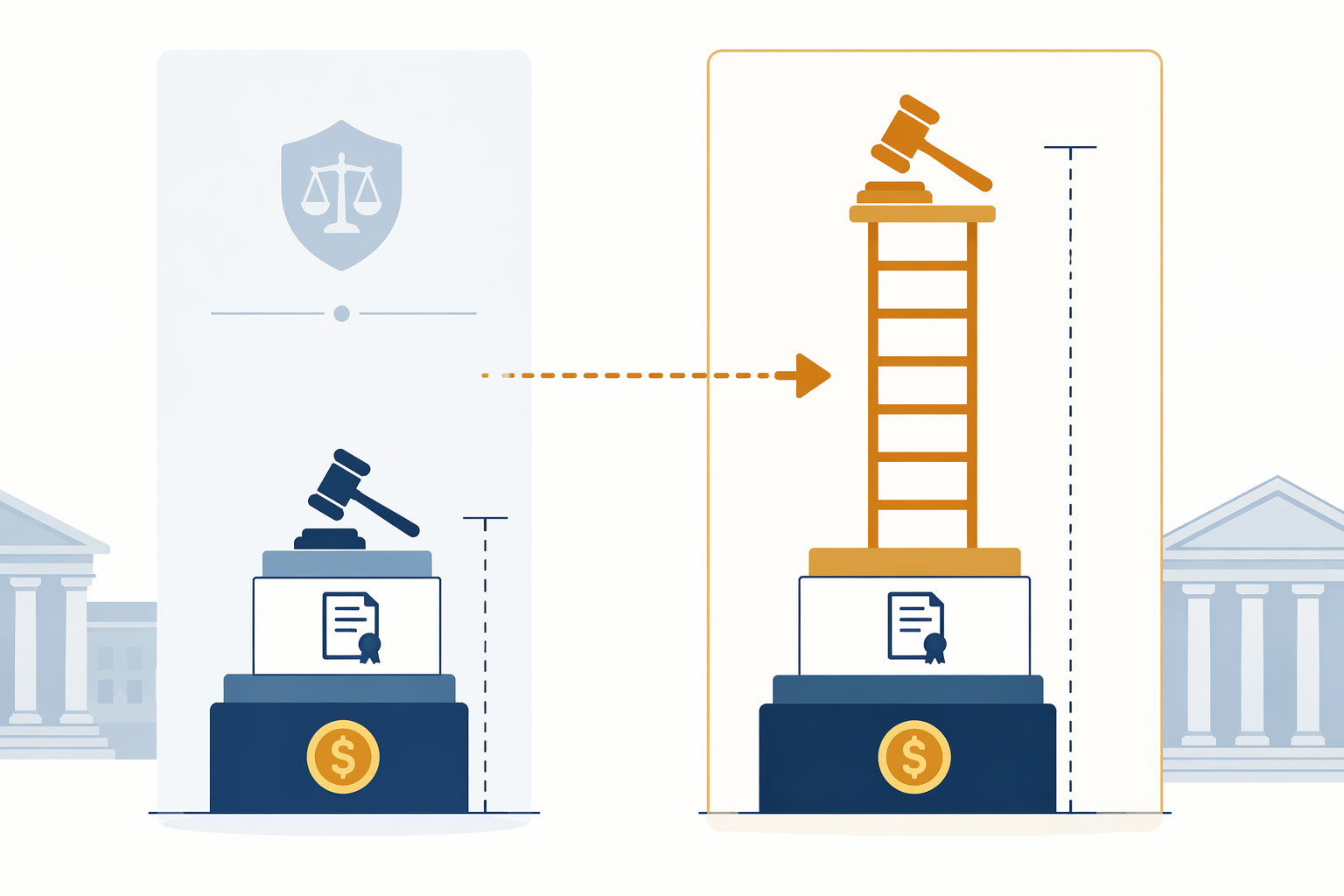
The criminal rung was 49 USC § 46307, the national defense airspace provision. The statute makes it unlawful to knowingly or willfully violate airspace regulations or orders issued under the relevant national defense airspace authority, and the pre-amendment penalty structure treated the offense as a Class A misdemeanor, carrying up to one year of imprisonment and a fine of up to $100,000.[5] That is not trivial exposure, particularly for a certificate holder with professional or insurance consequences riding alongside it.
Still, the structure had a mismatch. The operational system had already escalated visibly: intercepts, flares, headbutt maneuvers, repeated scrambles. The legal system, for a repeat violator, still topped out at the same misdemeanor ceiling unless some other charge or fact pattern changed the case. A ladder that treats the second knowing or willful presidential TFR violation too much like the first one invites Congress to ask whether the ladder is doing deterrence or merely documenting noncompliance.
What the December 2025 amendment changed
Congress answered that question by increasing the second-offense penalty. General Aviation News reported in December 2025 that 49 USC § 46307 had been amended to impose up to five years of imprisonment for a second offense, a fivefold increase from the prior one-year maximum.[6] The change did not rewrite the entire TFR system. It did not alter the NOTAM process, redraw VIP TFR rings, or make every mistaken incursion a five-year case. Its targeted function was to make repetition legally different.
That is the important mechanism. Deterrence does not travel through a press release saying the government is serious. It travels through changed expected consequences. After the amendment, a pilot who has already been convicted under the national defense airspace provision faces a materially different criminal exposure if the conduct happens again. Prosecutors, defense counsel, insurers, employers, and certificate holders can all see the new cliff.
The five-year ceiling also changes the bargaining environment. A first-time case may still be resolved through civil enforcement, certificate action, or misdemeanor treatment depending on the facts and proof. A second-offense case now carries a statutory consequence severe enough to affect charging decisions, plea posture, and the practical advice counsel gives pilots who operate near recurring presidential locations.
What changed, then, was not the government’s authority to intercept an aircraft in restricted presidential airspace. NORAD already had shown that operational capability in July and September.[1][2] The change was the punishment attached to repeat criminal violation. Congress did not invent the security perimeter after Bedminster. It increased the cost of coming back into it unlawfully after the first criminal trip through the system.
The amendment answers deterrence, not awareness
The hard part is that the Bedminster record can support two conclusions at once. The first is that the old penalty structure was too soft for repeat violations of presidential national defense airspace. A second offense that can again trigger controllers, intercept crews, and military aircraft is not just another paperwork failure. The fivefold increase is proportionate to that repeat-offense problem.
The second conclusion is less satisfying for anyone looking for a clean legislative ending. Stronger punishment does not itself prove that pilots will better absorb NOTAMs, understand VIP TFR ring structures, or recognize when a presidential location has turned familiar local airspace into a security problem. A five-year maximum can change the consequence after a qualifying violation. It does not, by itself, repair the communication path before takeoff.
That limitation does not make the amendment performative. It puts it in the right box. Bedminster exposed a deterrence gap serious enough to justify treating a second national defense airspace offense more severely than the first. The remaining compliance problem sits underneath the statute: pilots still have to receive, check, understand, and obey the restriction before the F-16 is already close enough for a flare to matter.
References
- NORAD intercepts violator of temporary flight restrictions over Bedminster, New Jersey, DVIDS, September 14, 2025
- NORAD responds to airspace violation of Temporary Flight Restriction over Bedminster, New Jersey, DVIDS, July 2025
- 14 CFR § 99.7 — Special security instructions, Electronic Code of Federal Regulations
- Temporary Flight Restrictions, Federal Aviation Administration
- 49 U.S. Code § 46307 — Violation of national defense airspace, Cornell Legal Information Institute
- Flares shot to alert GA pilot to TFR violation, General Aviation News, December 2, 2025
- Temporary flight restrictions violations over Mar-a-Lago: What to know about restricted airspace, NBC Miami
Comments
Join the discussion with an anonymous comment.