
Netflix's disclosed $587 million cash consideration for InterPositive gives the acquisition of Ben Affleck's AI startup legal implications beyond the usual celebrity-founder transaction cycle. The number came through Netflix's quarterly SEC filing, while the earn-out structure and performance targets remain undisclosed publicly.[1] For an acquirer, that combination is more interesting than the headline price: a large cash payment, an AI production workflow, a patent portfolio still partly in prosecution, and a founder whose public profile changes the stakeholder map.
The first diligence question is not whether the tool is impressive. It is whether the lawyer asked to sign off on the transaction can describe, with enough specificity to survive a bring-down certificate, what was acquired, who owns the inputs, what is still contingent, and which outside constituencies will treat the operating plan as a threat rather than a productivity story.

The Asset Is Not Just the Model
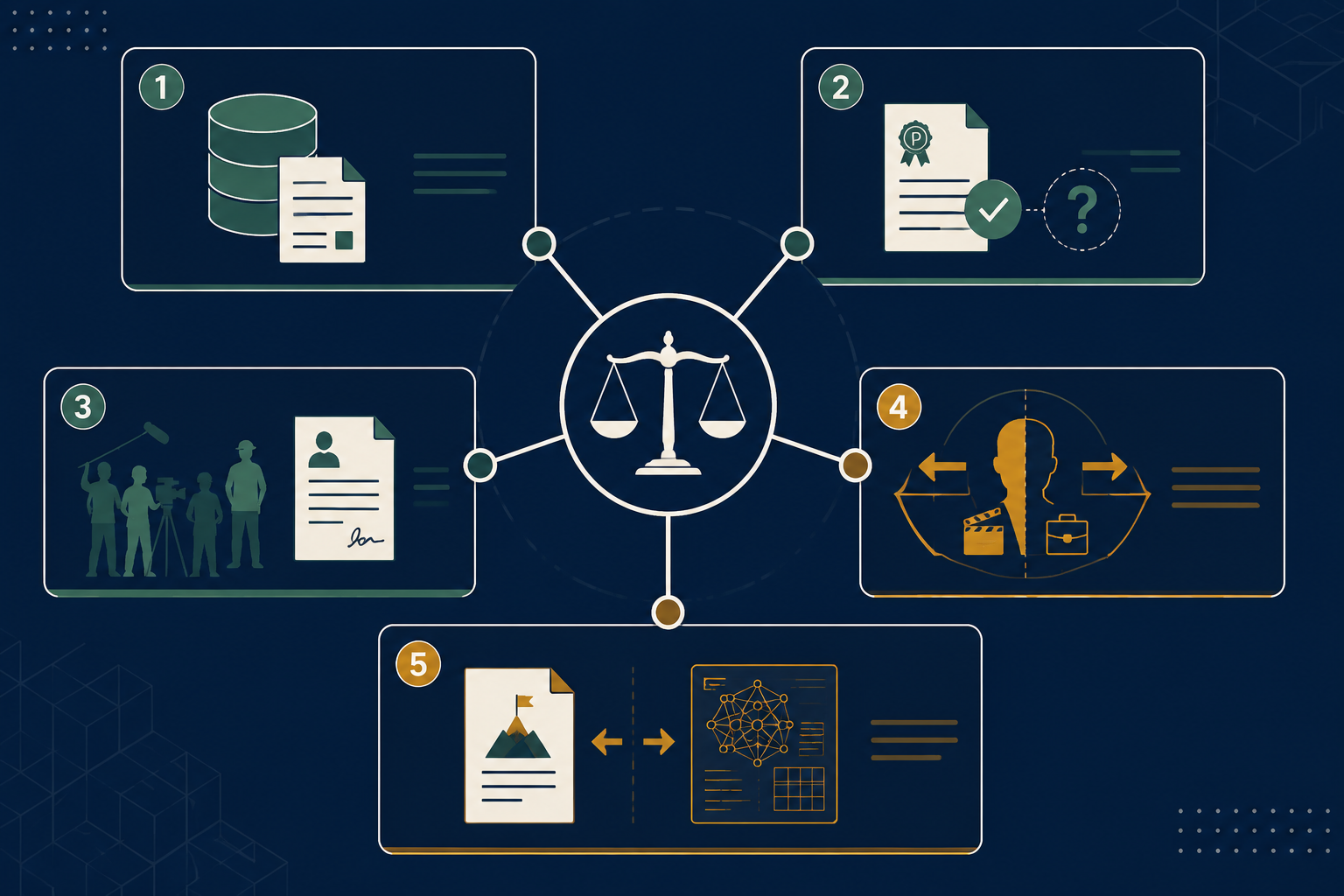
InterPositive matters because its strongest diligence fact is unusually concrete for an AI target: it reportedly uses a controlled-soundstage dataset rather than a model narrative built around broad scraping. That changes the first hour of legal diligence. Instead of beginning with a defensive memo about whether mass ingestion of third-party works is fair use, counsel can begin with chain of title, consent language, work-made-for-hire terms, performer releases, location agreements, metadata retention, and restrictions on downstream reuse.
That distinction should not be softened into a general statement that proprietary data is always safer. It is safer only if the paper trail says what the investment deck says. A controlled dataset can reduce copyright ambiguity, but it also creates diligence work that scraped-data companies often cannot even offer: schedules of captured performances, production logs, release forms, vendor agreements, contributor compensation terms, and technical records showing which assets were used to train which system components.
That is why the provenance schedule should sit near the front of the request list, not in an appendix after generic IP ownership. The broader AI copyright litigation wave has turned training data into transaction risk, and existing coverage of AI fair use disputes has shown how sharply courts and litigants can diverge on what ingestion, copying, and output similarity mean. In that environment, a rights-clean dataset is not marketing polish. It is a change in the indemnity negotiation before the indemnity provision is even drafted.
| Diligence Area | What Counsel Should Ask For | Why It Matters |
|---|---|---|
| Training inputs | Dataset inventory, source logs, capture dates, and records tying inputs to model versions | Confirms whether the proprietary-data claim can be tested rather than merely repeated |
| Contributor rights | Performer, crew, vendor, and work-made-for-hire agreements | Determines whether captured material can be reused for training, simulation, synthetic production, and licensing |
| Usage restrictions | Side letters, guild-related limitations, privacy terms, and revocation provisions | Identifies rights that may be owned but not freely exploitable |
| Technical controls | Access logs, dataset governance policies, retention rules, and model cards if maintained | Shows whether the company can prove separation between authorized and unauthorized inputs |
The point is not to reward a target for saying the right words. It is to make the representation operational: no undisclosed third-party training inputs; no contributor claims inconsistent with model use; no restrictions that would materially impair commercialization; no open-ended vendor right that makes exclusivity illusory. If those statements cannot be made without long disclosure exceptions, the asset is different from the one described in the business case.
Patent Value Depends on What Survives Prosecution
The second diligence question is how much of the price is being paid for granted rights and how much is being paid for expectations. Stephen Follows' analysis identifies three granted U.S. patents - US12438995B1, US12511904B1, and US12511837B1 - alongside 11 WIPO/PCT applications.[3] That is not a trivial portfolio. It is also not the same thing as a fully hardened international patent estate.
Pending international applications can support valuation, but they should not be treated as if they already block competitors. The diligence file needs prosecution histories, office actions, claim charts against the target product, prior art searches, freedom-to-operate analysis, maintenance-fee calendars, inventor assignments, and any encumbrances created by outside development partners. If the earn-out is tied to product deployment, patent allowance, licensing revenue, or production savings, counsel also needs to know whether a narrowing claim amendment could make the commercial milestone harder to reach.
Marshall, Gerstein & Borun has described an accelerated international patent strategy for the company on a client-success page.[4] That is useful evidence of intentional portfolio building, but it is still a law-firm account of client work, not an independent validity opinion. In diligence terms, it supports the question; it does not answer it.
Patent filings also matter because they say things public statements sometimes avoid. Deadline reported that InterPositive patent materials projected production savings of 50% in VFX, a 70% reduction in background-actor costs, and 30% to 40% reductions in art department costs.[2] Those figures are not merely financial assumptions. In a media transaction, they are stakeholder facts.
Labor Exposure Starts in the Patent Claims and the Budget Model
An AI production company does not create labor exposure only when it announces layoffs. It creates labor exposure when its core technology is valued on the premise that fewer people, fewer days, or fewer departments will be needed to produce the same screen result. That makes the patent-specified savings projections central to diligence, not an uncomfortable sidebar.
The 70% background-actor cost-reduction projection is the hardest number to treat as abstract.[2] Background work is performed by people covered by bargaining relationships, production customs, and reputational expectations. With SAG-AFTRA's contract reaching its June 30, 2026 expiration point as the deal moved through public attention, the diligence question becomes practical: who at the buyer has modeled union response, bargaining constraints, publicity risk, and possible restrictions on implementation timing?[7]
This does not require assuming a labor violation. It requires refusing to file labor under communications strategy. A buyer should ask for every analysis, board presentation, investor communication, customer deck, and patent memorandum that describes headcount substitution, synthetic extras, virtual departments, automated VFX, or reduced crew needs. The labor representation should then be drafted against those materials, not against a generic statement that the target is in compliance with applicable law.
- Which roles are the savings assumptions tied to: background performers, VFX vendors, art department staff, or post-production labor?
- Does any customer contract require the tool to be used in a way that could conflict with guild, union, or production-company commitments?
- Were any performers or crew members told their captured work would be used only for a particular production, test, or limited research purpose?
- Do public assurances about human creative control match the internal cost model used to price the acquisition?
The M&A agreement cannot solve collective bargaining politics by itself. It can, however, force disclosure of the facts the buyer will otherwise discover after closing, when a product launch, guild negotiation, or employee-relations event turns a technical feature into a governance problem.
The Founder Question Is About Process, Not Celebrity
Ben Affleck's involvement makes the deal easier to cover and harder to diligence. Variety and Reuters reported the acquisition as a strategic move by Netflix into AI film technology.[8] Vanity Fair later captured the Hollywood argument that Affleck's AI was seen by some sources as being worth roughly the $600 million neighborhood because it came from someone who understood production rather than from an outside software vendor.[7]
That may be strategically relevant. It is not, by itself, a legal answer. If a founder is also a Netflix senior advisor and an active producer, the diligence file should show how conflicts were identified, disclosed, and managed. The correct framing is not accusation; it is recordkeeping. Who approved negotiations? Which role was Affleck acting in when information was exchanged? Were any Netflix opportunities, production relationships, or confidential insights relevant to the target's formation, product roadmap, customer pipeline, or valuation?
Those questions matter because fiduciary-duty and corporate-opportunity issues are often reconstructed after the fact from calendars, emails, board minutes, and banker materials. In a conventional AI startup acquisition, counsel worries about founder IP assignment, open-source use, customer concentration, and retention. Here, counsel also needs a clean chronology of roles. If the chronology exists, the risk may be manageable. If it does not, the buyer may be paying for a story that its own files cannot comfortably tell.
The Ethics Representation Gap
AI ethics language becomes legally interesting when it is specific enough to be relied upon and inconsistent enough to be challenged. Public positioning around protecting human judgment sits uneasily beside patent materials that describe large cost reductions in VFX, background actors, and art departments.[2][7] The issue is not that cost savings are improper. Most acquisition models depend on them. The issue is whether the company's external assurances, investor materials, union-facing statements, employee messaging, and technical filings all describe the same business.
A buyer should therefore diligence ethics statements the same way it diligences privacy notices: collect them, compare them with product behavior, and decide which ones need to be carved out, qualified, or remediated. A vague mission statement may not carry much legal weight. A repeated claim about preserving human creative control, if used to persuade investors, partners, workers, or regulators, is different. State consumer protection theories, securities-law theories, labor-relations arguments, and contractual misrepresentation claims do not all require the same elements, but they all become easier to plead when the paper record contains a visible gap.
This is where general AI acquisition frameworks are useful but insufficient. MinterEllison's guide to acquiring AI companies highlights IP, data privacy, third-party dependencies, liability, and ethical governance as legal diligence categories.[5] Columbia's Blue Sky Blog has separately examined who bears risk from AI use in M&A, including the allocation of risk through representations, warranties, and deal process.[6] Those frameworks help structure the room. InterPositive shows why media AI targets need a more granular annex: performer rights, guild exposure, synthetic production outputs, dataset provenance, and the difference between public ethics language and patent economics.
What the Diligence Request List Should Look Like
Traditional M&A diligence asks whether the target owns its IP, complies with law, has disclosed material contracts, and has no undisclosed liabilities. An AI production target forces a different sequencing. The first requests should test whether the asset can be lawfully trained, deployed, defended, and explained to the people whose work it may replace or transform.
| Question | Transaction Document Consequence |
|---|---|
| Can the target prove the source, permissions, and restrictions for every material training dataset? | Specific data-provenance representations, disclosure schedules by dataset, and indemnity for undisclosed third-party inputs |
| How much of the patent value is granted, pending, jurisdiction-limited, or vulnerable to narrowing? | Patent-specific schedules, prosecution covenants, valuation adjustments, and earn-out provisions tied to enforceable rights rather than filings alone |
| Do projected savings depend on reducing covered labor or changing production practices governed by guild or union arrangements? | Labor disclosure schedules, implementation covenants, consultation obligations, and post-closing governance approvals |
| Was the founder operating in multiple roles that could affect opportunity, valuation, or information access? | Conflict disclosures, board approvals, role chronology, fiduciary-duty releases where available, and special indemnities if warranted |
| Do public ethics claims match technical filings, investor materials, and customer commitments? | Bring-down conditions, communications covenants, no-inconsistent-statements representations, and remediation plans |
The disclosure schedule for an AI acquisition should not read like a software-company schedule with a few extra privacy questions attached. It should identify each dataset, each material model version, each patent family, each third-party dependency, each category of synthetic output, each restricted use, and each stakeholder representation that could be contradicted by technical or financial records.
Post-closing governance also needs to be part of the legal architecture. If a buyer acquires an AI production tool and immediately integrates it across productions, the most important legal decisions may occur after closing: which datasets are combined, which outputs are approved for use, which productions rely on synthetic performers or environments, which labor groups receive notice, and which public claims marketing teams are allowed to repeat. A covenant that merely requires ordinary-course operation until closing will not manage that risk.
The Question Counsel Has to Answer
InterPositive may prove to be a valuable acquisition for Netflix. It may also prove to be a hard test of how well conventional deal process handles AI assets that sit inside an already sensitive labor market. The available public record supports neither a victory lap nor a panic memo. It supports a sharper request list.
For in-house counsel, the practical question is not whether to believe the founder story. It is whether the story can be converted into schedules, covenants, disclosure exceptions, representations, indemnities, and post-closing controls without discovering that the most valuable part of the company was also the least documented.
References
- Netflix Paid $587 Million For Ben Affleck AI Firm InterPositive, Deadline, July 2026.
- Netflix, Ben Affleck AI Firm InterPositive Film Production Savings, Deadline, April 2026.
- Netflix Ben Affleck AI Patent Explained, Stephen Follows.
- Patent Strategy Behind a Breakout AI Company, Marshall, Gerstein & Borun LLP.
- Expert Guide: Legal Issues in Acquiring AI Companies, MinterEllison.
- Who Bears the Risk of AI Use in Mergers & Acquisitions?, Columbia Law School Blue Sky Blog, February 2026.
- Ben Affleck, Netflix, Celebrities Using AI, Vanity Fair.
- Netflix Paid $587 Million for Ben Affleck AI InterPositive, Variety.
Comments
Join the discussion with an anonymous comment.