
Sen. Bernie Moreno’s birthright citizenship legislation arrives in the awkward space left after Trump v. Barbara: the Supreme Court has already said the executive branch cannot deny citizenship to children born in the United States to parents who are unlawfully or temporarily present, and Moreno now asks whether Congress can reach the same destination by statute.
Moreno announced the Harry Reid Immigration Stabilization Act on July 15, 2026, describing it as a bill to “eliminate birthright citizenship” for children born in the United States unless at least one parent is a U.S. citizen, lawful permanent resident, or active-duty member of the armed forces.[1] Public summaries describe the proposal as a statutory amendment to the Immigration and Nationality Act rather than a proposed constitutional amendment.[1][2]
That distinction is the core legal issue. If the Citizenship Clause itself confers citizenship at birth on the affected children, ordinary legislation cannot subtract it. If the clause leaves Congress room to define exceptions, Moreno’s bill has something to work with. The full bill text was not available for direct review from the materials used here, so the analysis necessarily rests on Moreno’s press release and public section-by-section summaries. Even with that caveat, the constitutional problem is not subtle.
The holding Moreno has to get around
The controlling opinion in Trump v. Barbara did not merely reject President Trump’s executive order as procedurally defective or inconsistent with an existing statute. Chief Justice Roberts, writing for a six-justice majority, treated the 14th Amendment’s Citizenship Clause as doing the legal work directly. The Court held that children born in the United States to parents who are unlawfully or temporarily present satisfy the clause’s two requirements: they are born “in the United States” and are “subject to the jurisdiction thereof.” The opinion then stated the consequence in constitutional terms: those children “are citizens at birth.”[3]
That language matters more than the fact that the challenged instrument was an executive order. A decision could have been written narrowly: the order conflicts with the Immigration and Nationality Act; the president lacked delegated authority; agencies must follow existing statutory citizenship rules until Congress says otherwise. But the Roberts majority went further. It placed the entitlement in the Constitution, not merely in the INA. SCOTUSblog summarized the result the same way: the Court struck down Trump’s order and held that the 14th Amendment guarantees birthright citizenship to the children covered by the order.[4]
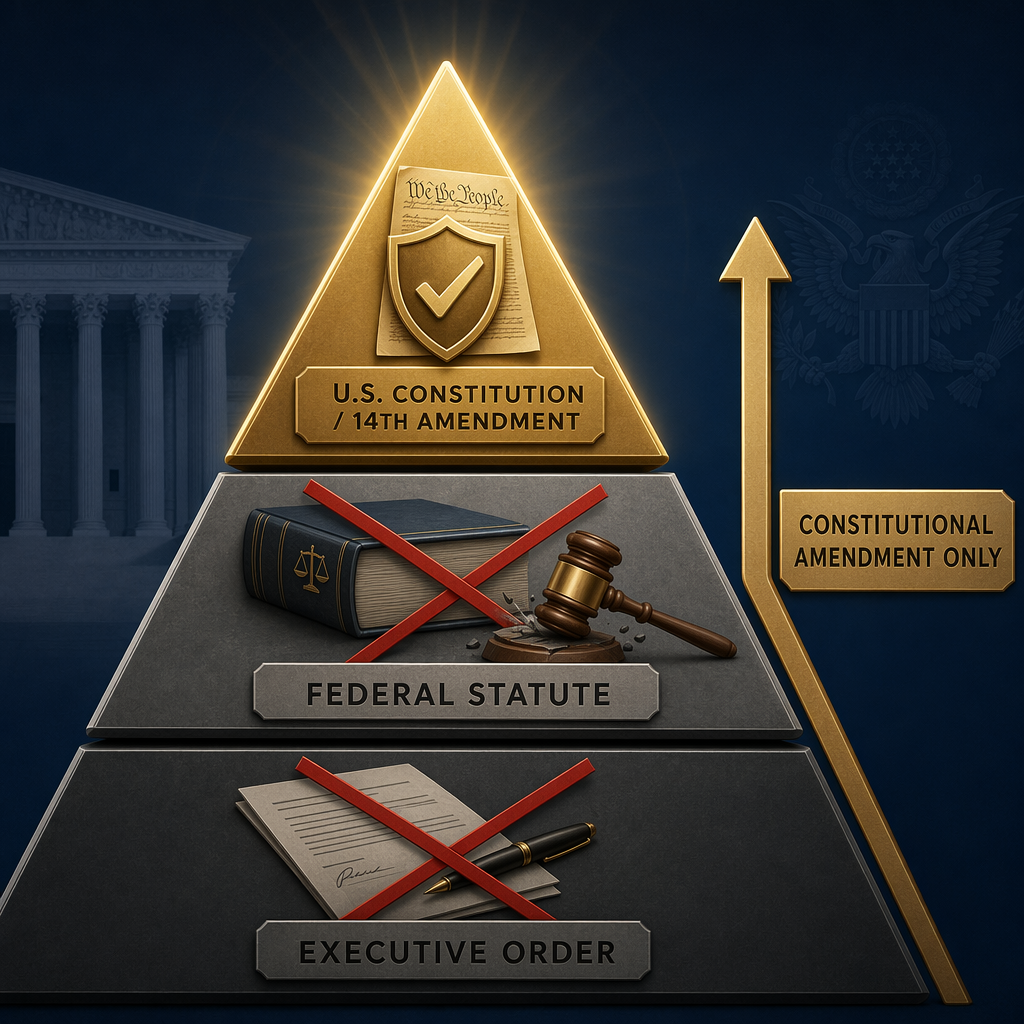
Once the rule is located there, Congress does not gain power by reenacting the executive order’s substance in statutory form. Congress can enforce the 14th Amendment through appropriate legislation, and it can legislate immigration and naturalization rules within broad bounds. But it cannot pass an ordinary statute that contradicts a constitutional rule as interpreted by the Court. Moreno’s proposal, as publicly described, would deny citizenship to a category of U.S.-born children whom the Court has just described as citizens at birth under the Constitution.[1][3]
| Legal source | What it can do after Trump v. Barbara |
|---|---|
| Executive order | Cannot deny citizenship to covered U.S.-born children after the Court’s ruling. |
| Ordinary federal statute | Can regulate immigration and naturalization, but cannot override the Citizenship Clause as the Court interpreted it. |
| Constitutional amendment | Can change the constitutional rule if adopted through Article V. |
The statutory theory depends on treating the majority opinion as narrower than it was
The best version of Moreno’s argument is not that a press release can overrule a Supreme Court holding. It is that Congress, unlike the president, has independent authority over immigration and naturalization, and that the Court’s judgment against an executive order should not be read to foreclose congressional line-drawing. Moreno framed his announcement around a 1993 bill introduced by then-Sen. Harry Reid and argued that Congress can act to end birthright citizenship for children of unlawfully present parents.[1]
That move has political and rhetorical force. It lets Moreno say the proposal is not a new Trump-era improvisation, and it places the bill in the long-running statutory debate over who is “subject to the jurisdiction” of the United States. But as a matter of hierarchy, the argument needs more than congressional power over immigration. It needs the Citizenship Clause to be ambiguous enough, after Trump v. Barbara, for Congress to define the affected children out of constitutional citizenship.
The Roberts majority is difficult to square with that. The opinion did not reserve the question whether Congress could create the same exclusions. It did not describe the children’s citizenship as a statutory default. It read the constitutional phrase “subject to the jurisdiction thereof” to include the children at issue and attached citizenship “at birth” to that constitutional status.[3] A later Congress may disagree with that interpretation, but disagreement is not an exception to constitutional supremacy.
Kavanaugh’s concurrence is the real opening, but not the rule
Justice Kavanaugh’s concurrence in the judgment is the part of Trump v. Barbara that gives the statutory position its most serious foothold. He agreed that Trump’s executive order could not stand, but he would have resolved the case on statutory grounds. In his view, INA § 301(a) already conferred citizenship on the affected children, and the president could not carve exceptions from that statute by executive order. He also wrote that Congress could enact “new legislation establishing exceptions.”[3]
That sentence cannot be ignored. It is the cleanest judicial language available for the claim that the problem with Trump’s order was not the destination but the actor. It also explains why Moreno’s bill is not frivolous in the casual sense: there is at least one justice who treated the case as leaving legislative space open.
But a concurrence in the judgment is not the holding when it does not command the Court. Kavanaugh supplied the sixth vote for the judgment, not the majority’s constitutional rationale. The Roberts opinion, joined by five other justices on the relevant constitutional holding, controls the legal landscape unless and until the Court revisits it. A lower court evaluating Moreno’s statute would not be free to substitute Kavanaugh’s statutory-only route for the majority’s conclusion that the Citizenship Clause itself confers citizenship at birth on the covered children.[3]
That is the disciplined way to read the case: Kavanaugh shows the argument Congress would make; Roberts explains why that argument probably loses under the current Court’s stated rule.
Scholars and fact-checkers are reading the conflict the same way
The point does not rest only on this article’s reading of the slip opinion. FactCheck.org examined Trump’s post-ruling claim that birthright citizenship could still be overturned by legislation and concluded that the claim was “dubious,” emphasizing that the Supreme Court’s constitutional holding left ordinary legislation unable to eliminate the right recognized in the decision.[5]
Gerald Neuman of Harvard Law School reached the same basic conclusion in a separate analysis of whether birthright citizenship can be changed. He identified constitutional amendment, not ordinary legislation, as the route for changing the rule after the Court’s decision.[6] That agreement is useful not because expert commentary outranks the Court; it plainly does not. It is useful because it confirms the straightforward reading of the majority opinion rather than treating that reading as a partisan gloss.
There are still narrower uncertainties. A court would review actual statutory language, not only a press release. Congress might draft findings, definitions, severability clauses, or effective-date provisions designed to tee up a new constitutional argument. None of that changes the central obstacle: a statute that denies citizenship to children whom the Supreme Court has held are citizens at birth under the 14th Amendment collides with the Constitution as currently interpreted.
The amendment route is not just a critic’s talking point
The constitutional-amendment point has also been acknowledged by Republican senators who favor restricting birthright citizenship. Coverage from The National News Desk reported that Sens. Rand Paul, Mike Lee, and Ron DeSantis described a constitutional amendment as necessary to end birthright citizenship after the Court’s ruling.[7] That does not make their view legally binding either. It does show that the legal hierarchy is apparent even inside the political coalition most interested in changing the rule.
That is why the Harry Reid label can do only limited legal work. Reid did introduce S. 1351 in 1993, a bill that would have restricted automatic citizenship for certain U.S.-born children based on parental status.[8] Moreno’s use of that history may complicate the politics of the debate, but it cannot answer the 2026 constitutional question. A pre-Trump v. Barbara statutory proposal does not become sufficient after the Court has attached the disputed citizenship rule to the 14th Amendment itself.
For readers tracking Moreno’s broader legislative strategy, the contrast with his bipartisan work on Social Security is useful: the Moreno-Warren Social Security plan operates in a statutory domain where Congress’s authority is the main question. Birthright citizenship after Trump v. Barbara is different because the Court has already placed the relevant entitlement in constitutional text.
What would happen if Congress passed it anyway
If Congress enacted Moreno’s bill in the form publicly described, the first legal consequence would likely be litigation, not a settled change in citizenship administration. Agencies might receive new statutory instructions, but affected children, parents, states, hospitals, benefits administrators, passport applicants, and educational institutions would all be operating under the shadow of a direct constitutional challenge.
The government would point to Congress’s immigration and naturalization powers, Kavanaugh’s concurrence, and the premise that “subject to the jurisdiction” can be legislatively specified. Challengers would point to the Roberts majority’s constitutional holding and say the statute attempts to do exactly what the Court said the 14th Amendment forbids. In ordinary litigation terms, the challengers would have the more direct precedent.
Compliance officers and institutional counsel should be especially careful about the timing point. A bill announcement is not law. A bill, if introduced, is not enacted law. An enacted statute is still subject to constitutional review. And after Trump v. Barbara, the operative federal constitutional rule is that the covered children are citizens at birth.[3] The site’s earlier procedural analysis of Supreme Court tariff refund litigation makes the same general lesson in another context: implementation risk often turns less on political confidence than on which legal source actually controls.
The remaining legal path
Moreno’s bill can still serve political purposes. It can force members of Congress to take a position, preserve an argument for future litigation, and test whether any justices are willing to move from Kavanaugh’s concurrence toward a broader legislative-power theory. Legislatures sometimes do that. They pass measures designed to press constitutional doctrine at its edges, and courts then have to say whether the edge has moved.
But the current legal answer is lopsided. Under the Roberts majority’s interpretation of the 14th Amendment, children born in the United States to parents unlawfully or temporarily present are citizens at birth. A federal statute restricting that citizenship would conflict with the Constitution as the Supreme Court has just interpreted it. The route that remains for changing that rule is constitutional amendment, not ordinary legislation.
References
- Moreno Reintroduces Harry Reid Bill to Eliminate Birthright Citizenship, Office of Sen. Bernie Moreno, July 15, 2026.
- Ohio Sen. Moreno to Reintroduce Former Sen. Harry Reid’s Bill Eliminating Birthright Citizenship, Breitbart, June 30, 2026.
- Trump v. Barbara, No. 25-365, Supreme Court of the United States, June 30, 2026.
- Supreme Court Strikes Down Trump’s Order Ending Birthright Citizenship, SCOTUSblog, June 2026.
- Trump’s Dubious Claim that Birthright Citizenship Could Still Be Overturned with Legislation, FactCheck.org, July 2026.
- Can birthright citizenship be changed?, Harvard Law School.
- Lawmakers say there needs to be a constitutional amendment to end birthright citizenship, WEAR/The National News Desk.
- S.1351 - Immigration Stabilization Act of 1993, Congress.gov, 1993.
Comments
Join the discussion with an anonymous comment.