
The latest compliance question around Frank Bisignano is no longer whether one confirmed Social Security official can also be placed over the IRS. As of July 15, 2026, Treasury has also put him in charge of expanding Trump Accounts, adding a new savings-account implementation mandate to his Social Security Administration and IRS leadership roles.[1][2] For legal compliance purposes, the issue is not the optics of a busy org chart. It is what happens when the same official can sit on both sides of data-sharing approvals involving Social Security, tax administration, identity verification, and a new account program still early in its rollout.
That distinction matters. A consolidated command structure can be defensible when Congress has clearly assigned responsibility and the data flows are bounded by statute. The harder problem here is that the databases involved were not built around personal trust in a single coordinator. They were built around separation, documented authority, and role-specific accountability.

The July trigger: Trump Accounts turn a dual-role problem into a three-part governance problem
Treasury’s July announcement placed Bisignano at the center of Trump Accounts expansion only days after the program’s July 4, 2026 launch.[1] CNBC described the move as adding the new assignment to his existing roles as Social Security administrator and IRS chief.[2] PlanAdviser likewise summarized the arrangement as Bisignano adding Trump Account expansion to his SSA and IRS leadership duties.[3]
The program details that matter most for legal compliance are still unsettled. The available reporting does not resolve all trustee and operational questions for Trump Accounts. But the implementation premise is already visible: a children’s-account expansion program administered in proximity to federal tax, identity, and benefits infrastructure will need rules for eligibility, account creation, verification, notices, corrections, and data retention. Those functions are not merely administrative conveniences. They are the points at which statutory privacy duties attach.
Before the Trump Accounts assignment, the central concern was Bisignano’s simultaneous SSA and IRS role. After July 15, the concern is wider: the same official is positioned over a benefits agency, a tax agency, and an expansion program that may need information from both. The legal risk does not require assuming misuse. It arises because ordinary compliance controls often depend on separate decision-makers asking separate questions before data moves.
Section 6103 is the pressure point
The most concrete vulnerability sits with taxpayer information. Bloomberg Tax reported in October 2025 that Bisignano’s dual SSA and IRS roles raised data-security alarms, including concerns tied to Internal Revenue Code Section 6103, the federal rule governing confidentiality of tax returns and return information.[4] CNBC also reported expert concern in October 2025 about the new IRS CEO also heading Social Security.[5]
Section 6103 does not become easier to satisfy because two agencies share a leader. It generally works the other way: the more concentrated the authority, the more important the paper trail becomes. A lawful disclosure still needs a statutory basis. Access still needs to be tied to an authorized purpose. Controls still need to distinguish between tax-administration uses, benefits-administration uses, and any new program use that does not fit neatly inside either category.
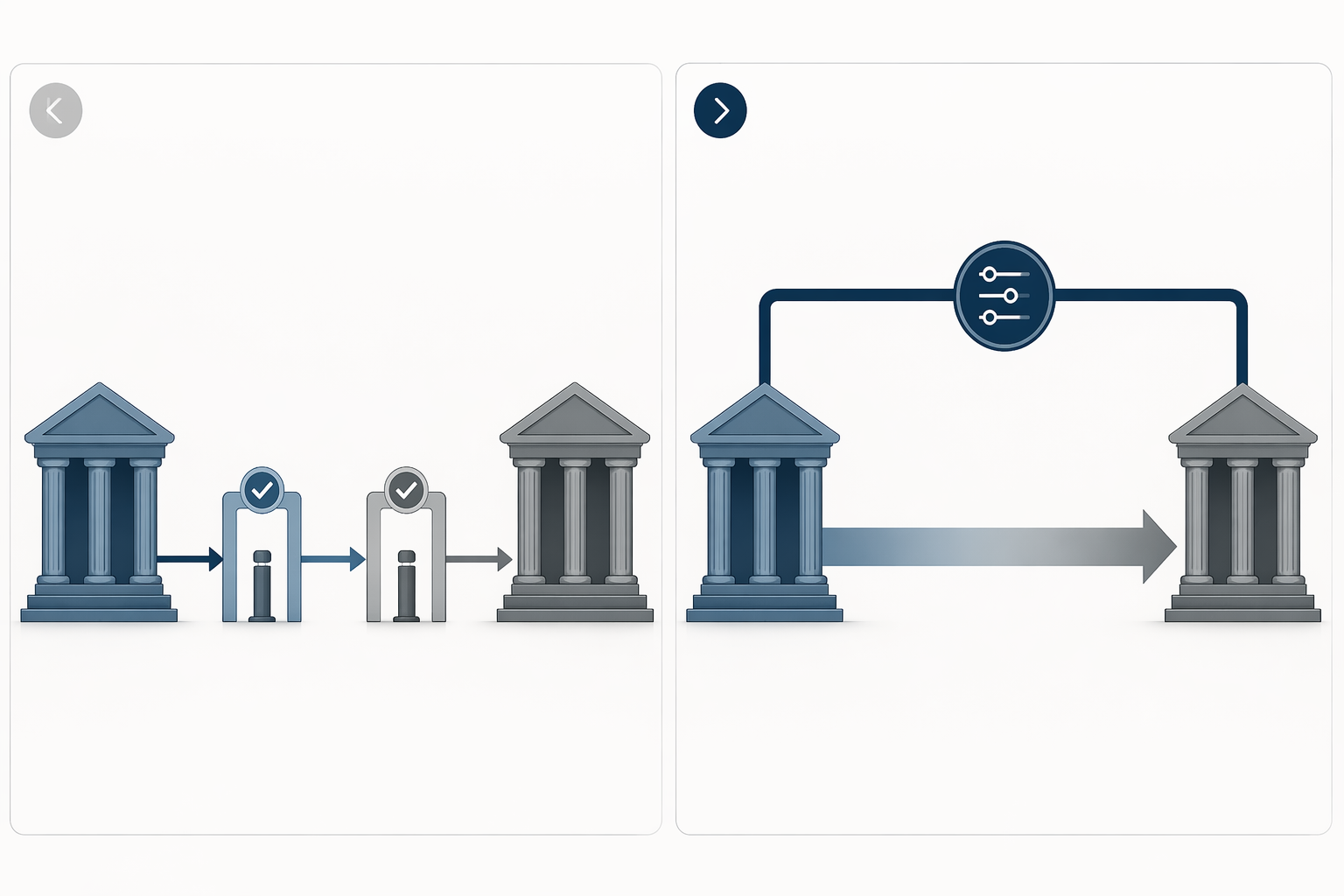
The practical compliance problem is the compression of approvals. Under a separated model, an SSA-side official and an IRS-side official can each ask whether a proposed exchange fits that agency’s statutory authority, privacy obligations, and program need. If one person controls both sides of the exchange, a structural check is weakened even if every signature block remains formally intact. A memorandum of understanding can still exist, but the independence behind it is harder to demonstrate.
That is why treating “data sharing” as a generic efficiency measure misses the legal issue. The relevant question is narrower: who approved which disclosure, under what statutory exception, for what program purpose, with what limits on reuse? If Trump Accounts implementation requires IRS-held return information, SSA identity or benefits data, or combined datasets, a reviewer would need to trace each movement through those questions rather than rely on the fact that a single senior official wanted a coordinated rollout.
A single leader can improve execution, but that is not the same as curing authority
The administration’s likely operational defense is not trivial. One accountable leader can reduce interagency delay, prevent duplicate intake processes, and move a new account program through federal machinery faster. For a program launched in early July 2026, speed and coordination may be especially attractive.[1]
But efficiency is not a substitute source of legal authority. It may explain why Treasury chose Bisignano for Trump Accounts expansion; it does not answer whether an IRS dataset may be used for a non-tax purpose, whether SSA records may be repurposed for account administration, or whether the official directing both agencies has been appointed to the IRS role in a constitutionally adequate way. Compliance staff are not usually asked to approve “coordination.” They are asked to approve a specific data use.
| Implementation question | Compliance issue |
|---|---|
| Can IRS-held information support Trump Accounts outreach, eligibility, or account setup? | A Section 6103 analysis would need to identify a disclosure authority and limits on reuse. |
| Can SSA records be matched with tax or account records? | The agencies would need documented purpose, access controls, and approval responsibility. |
| Can one official approve both sides of an interagency data flow? | The legal question is not only signature authority, but whether the approval remains meaningfully independent. |
| Can the IRS CEO direct agency functions without Senate confirmation? | That turns on Appointments Clause and statutory-authority questions that have been flagged but not resolved in court. |
The IRS CEO title raises a separate Appointments Clause question
Bisignano was confirmed as Social Security administrator. The IRS CEO position is different. Federal News Network reported in October 2025 that he had been named to the newly created position of IRS CEO while continuing to lead SSA.[6] Government Executive reported that the arrangement raised questions about the Senate confirmation process because the IRS role was created administratively and did not go through a separate confirmation.[7]
The Appointments Clause issue is not a label fight. If an official exercises significant authority over the IRS, the route by which that official obtained that authority matters. A title created inside the executive branch may be operationally useful, but a court would look at function: what powers the position actually carries, whether those powers belong to an officer of the United States, and whether Congress authorized the appointment mechanism being used.
The available record does not support saying a court has found the arrangement unlawful. It has not. The more careful conclusion is that experts and legal observers have identified a foreseeable constitutional challenge path. If the IRS CEO role is treated as a managerial post with limited delegated duties, the government would likely defend it differently than if the role directs core IRS operations, approves major data practices, or binds the agency in ways normally associated with a Senate-confirmed head.
That unresolved status matters for Trump Accounts implementation. An account rollout will produce decisions: forms, eligibility processes, agency instructions, data matches, vendor or trustee arrangements, and perhaps interagency agreements. If those decisions are traceable to an official whose IRS authority is contested, litigants would have a natural way to challenge not just the policy outcome but the legitimacy of the decision-maker.
The warning signs around data access were already present
The triple role lands in an environment where federal data-access boundaries were already under stress. Federal News Network reported in 2025 on Bisignano’s appointment to the new IRS CEO role against a backdrop of management changes at the tax agency.[6] Other reporting in the same period identified alarms around dual-agency access and taxpayer privacy.[4][5]
The research record also points to whistleblower reports, DOGE access demands, and fallout from an IRS-DHS data-sharing agreement that prompted resignations of top IRS officials. Those events are relevant not because they prove the Trump Accounts arrangement is unlawful, but because they show the legal terrain on which implementation will occur: officials are already contesting who may reach sensitive federal datasets, for what purpose, and with what approvals.
In that setting, a compliance lawyer reviewing a Trump Accounts data flow would not start from the question, “Is consolidation good or bad?” The first useful question would be whether the proposed use would look lawful if the agencies were still led by separate people. If the answer depends on Bisignano’s control of both sides, that is a warning sign rather than a cure.
Conflict concerns are narrower, but not irrelevant
Federal conflict-of-interest analysis should be kept in proportion. The materials available here do not establish a personal financial conflict by Bisignano. The more immediate conflict concern is institutional: one official may be responsible for advancing Trump Accounts while also overseeing agencies whose records or enforcement interests may constrain that rollout.
That kind of role conflict can still matter. If the implementation team wants more data, the IRS privacy office may need to say no. If SSA records appear useful for account setup, Social Security program lawyers may need to limit use. A leader tasked with expanding the program while also controlling the agencies holding the data creates pressure on the ordinary escalation path. The legal defect, if one emerges, would likely be found in a specific approval or disclosure rather than in the mere fact of wearing more than one hat.
The Anti-Weaponization Fund episode shows judicial friction, not a final answer
The National Committee to Preserve Social Security and Medicare has criticized Bisignano’s role in a settlement it described as creating a $1.8 billion “Anti-Weaponization Fund,” and reported that a federal judge froze the arrangement in late May 2026.[8] The group’s “slush fund” characterization is advocacy language and should be read as its criticism, not as a judicial finding.[8]
Even with that caution, the episode belongs in the legal-risk map. It shows that courts and outside challengers are already willing to scrutinize arrangements tied to concentrated administrative control and disputed uses of federal money. It does not decide the SSA-IRS-Trump Accounts issue. It does, however, make it harder to treat the current structure as a purely internal management choice insulated from judicial review.
The date boundary is important. The freeze order described by NCPSSM was reported as of late May 2026, and the status of that litigation or settlement may have evolved since then.[8] For present purposes, the safer point is limited: the fund dispute is a contested example of legal vulnerability around Bisignano-linked decisions, not proof that the Trump Accounts assignment itself is invalid.
What a challenge would probably target
A lawsuit would not need to ask a court to condemn consolidation in the abstract. The stronger challenge paths are more specific. A plaintiff could attack a particular data-sharing agreement, a disclosure of return information, an SSA-IRS matching process, an IRS directive issued by the CEO, or a Trump Accounts implementation decision allegedly made by an improperly appointed official.
- Section 6103: A challenge could argue that IRS return information was disclosed or reused without a valid statutory basis.
- Appointments Clause: A challenge could argue that the IRS CEO exercises significant authority without the appointment process required for that role.
- Administrative procedure: A challenge could focus on whether implementation decisions were adequately authorized, reasoned, and documented.
- Conflict and safeguards: A challenge could argue that cross-agency approvals lacked meaningful independence or ignored required privacy controls.
None of those theories is automatic. Standing, statutory review provisions, sovereign-immunity limits, and the factual record would shape any case. But the structure supplies identifiable targets. The legal exposure is not speculative in the sense of being imaginary; it is unresolved in the sense that no court has yet tested these facts against the governing rules.
The July 22 posture
As of July 22, 2026, the legality of Bisignano’s combined SSA, IRS, and Trump Accounts role has not been resolved by a court. The best-supported conclusion is narrower and more useful: the structure creates foreseeable legal vulnerabilities under taxpayer-privacy law, appointment rules, conflict safeguards, and cross-agency data-sharing controls.
The administration can argue that a single accountable leader improves execution. That argument may matter politically and operationally. It does not remove the need to show statutory authority for each disclosure, a valid basis for each IRS function performed by the CEO, and a documented reason why old separation-based controls can be compressed without losing the protections they were meant to provide.
The risk, then, is not that consolidation has already been declared illegal. It is that Trump Accounts implementation is beginning before the government has publicly resolved the legal questions created by putting the same official over SSA, the IRS, and the new account-expansion program.
References
- Treasury press release SB0563, U.S. Department of the Treasury.
- IRS chief Frank Bisignano will lead Trump accounts expansion, CNBC, July 15, 2026.
- Bisignano Adds Trump Account Expansion to SSA, IRS Leadership Roles, PlanAdviser.
- New IRS Leader’s Dual Agency Roles Raise Data Security Alarms, Bloomberg Tax, October 2025.
- New IRS CEO heads Social Security, CNBC, October 7, 2025.
- Social Security Administrator Frank Bisignano is named to the newly created position of IRS CEO, Federal News Network, October 2025.
- Bisignano to lead IRS in addition to SSA duties, raising questions about Senate confirmation process, Government Executive, October 2025.
- Social Security Commissioner Facilitated Creation of Trump Slush Fund, National Committee to Preserve Social Security and Medicare, 2026.
Comments
Join the discussion with an anonymous comment.