
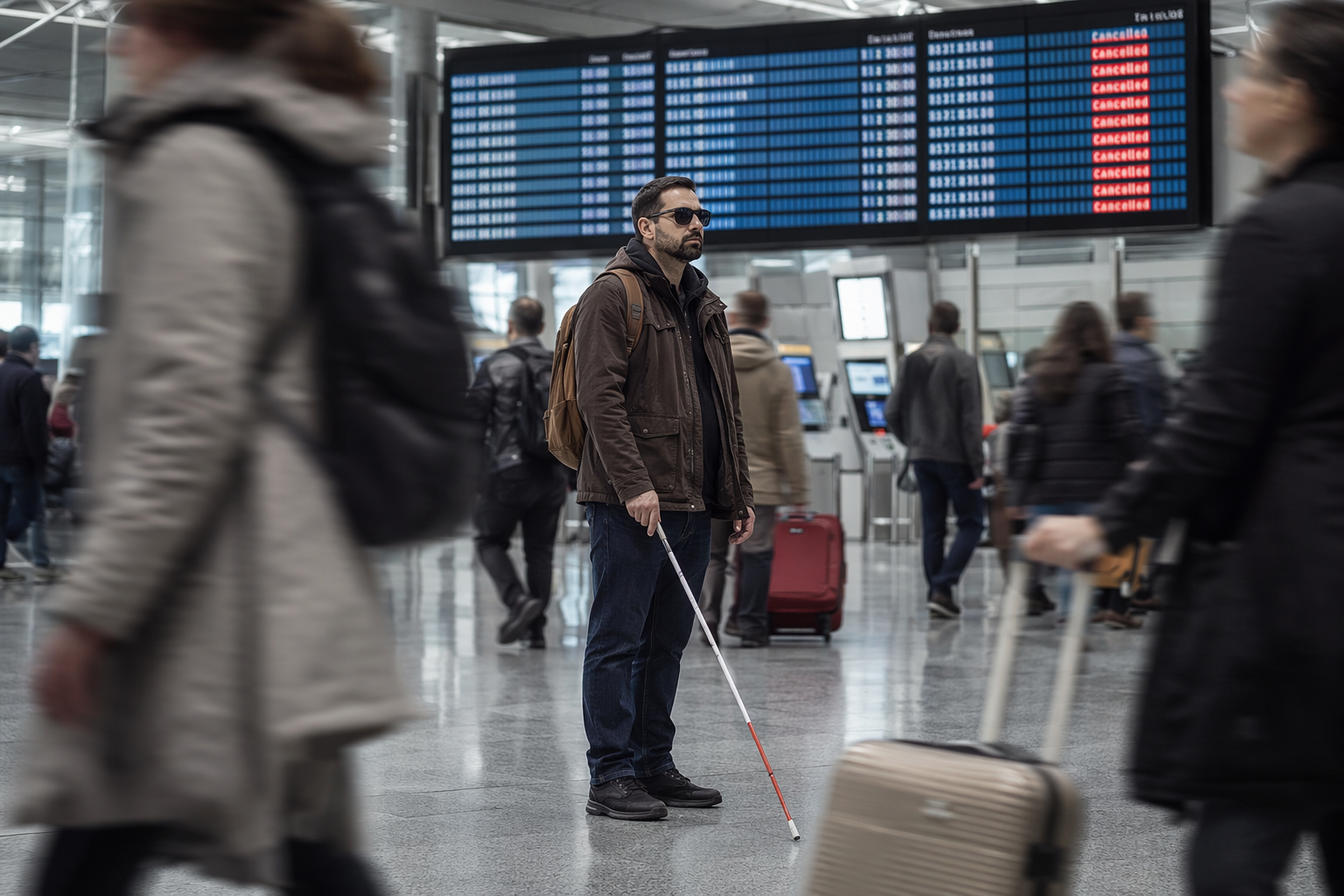
Anthony Maglione’s March 30, 2026 trip, as he described it to USA Today and CBS Philadelphia, failed at the handoff points that matter most after a cancellation. His American Airlines flight from Philadelphia was canceled. He said he did not hear a verbal announcement and learned of the cancellation through an app notification. The assistance he had arranged did not appear. After he was rebooked, he said he was again left without proper help in Charlotte and had to ask strangers to guide him through the airport process.[1][2]
People searching for blind traveler rights after a flight cancellation under the ADA usually arrive at the right concern through the wrong statute. In U.S. air travel, the operative federal law is the Air Carrier Access Act and its implementing regulations in 14 CFR Part 382. That distinction matters because the rules do not merely say that an airline should be considerate. They assign duties at specific handoff points: cancellation information, movement through the terminal, time left unattended, contractor performance, and access to a complaint-resolution official.
There is no public DOT finding, at least on the materials available here, that American violated the ACAA in Maglione’s case. The legal analysis therefore has to stay in its lane: the reported facts implicate several ACAA duties, and American’s public response does not appear to answer each of them. The point is not that a cancellation is unlawful. It is that a cancellation starts a regulated sequence in which a blind passenger may need information and assistance at the very moment the airline’s ordinary workflow has broken.
The First Failure Was Information
A canceled flight is not just a schedule change for a blind traveler who is waiting in a terminal. It can change the gate, the counter, the line, the city, the connection, the person responsible for assistance, and the passenger’s immediate ability to know what to do next. Maglione’s account begins with that problem: the cancellation notice reached him through an app, while the audible or direct communication he needed did not reach him.[1]
Section 382.53 requires carriers to make information available to passengers with a disability when that information is provided to other passengers, including information about flight delays, schedule changes, and other services. The regulation is not limited to a website or mobile alert. Its practical concern is whether the passenger can actually receive the information in an accessible form when the airline is communicating material travel information to others.[3]
The DOT’s Airline Passengers with Disabilities Bill of Rights states the same point in plainer public-facing language: passengers with disabilities have a right to receive information in an accessible format. The Bill of Rights is not a substitute for the regulation, but it confirms that accessible information is not a courtesy layered on top of air travel. It is part of the service the carrier is required to provide.[4]
That is why the app notification does not end the inquiry. An app may be useful; it may even be the way many passengers first learn of a disruption. But if the airline is making cancellation information available in the terminal and the blind passenger cannot access that information without sight or without an individualized communication, the regulation points to the carrier’s obligation, not the passenger’s improvisation.
A Canceled Itinerary Does Not Cancel Assistance
The next part of Maglione’s account is more serious because it turns an inaccessible notice into physical dependence inside the terminal. He said the assistance he had arranged did not materialize in Philadelphia after the cancellation. After rebooking, he said he was later abandoned again in Charlotte.[1][2]
Section 382.91 requires carriers to provide assistance to passengers with a disability in moving within the terminal, including between gates, from a gate to the terminal entrance, and to key locations when needed as part of air transportation. The rule is often discussed in wheelchair terms because many airport-assistance disputes involve mobility devices, but the duty is not confined to wheelchair users. A blind traveler who needs sighted guidance through a changed airport process is squarely within the logic of the rule.[3]
| Reported breakdown | ACAA provision implicated | Why it matters |
|---|---|---|
| Cancellation information allegedly did not reach Maglione in an accessible way | 14 CFR § 382.53 | Carriers must make key travel information available to passengers with disabilities when it is made available to others.[3] |
| Arranged assistance allegedly did not appear after the Philadelphia cancellation | 14 CFR § 382.91 | Terminal assistance must continue when the passenger needs help moving through the airport process.[3] |
| Maglione said he was left again after rebooking in Charlotte | 14 CFR § 382.103 | Carriers may not leave a passenger who has requested assistance unattended for more than 30 minutes in certain covered circumstances.[3] |
| American said it was reviewing the matter with a vendor | 14 CFR § 382.15 | A carrier remains responsible for contractor compliance with Part 382.[3] |
This is the part of the incident that resists being reduced to inconvenience. Once the airline knows a passenger needs assistance, the passenger’s ability to complete the trip can depend on a sequence of employees or contractors who do not see the whole itinerary. A cancellation interrupts that sequence. The regulation matters because it treats the sequence as the carrier’s responsibility anyway.
For ordinary cancellation rights — refunds, rebooking, and the broader U.S. framework for disrupted flights — the disability-rights analysis sits alongside the rules discussed in the site’s AA2653 cancellation legal rights coverage. Maglione’s case adds a separate question: what happens when the disrupted passenger cannot safely or equally navigate the airport without the assistance the airline is already required to provide?
Being Parked and Forgotten Is Its Own Regulatory Problem
Section 382.103 addresses one of the most ordinary-looking ways assistance fails: a passenger is placed somewhere and left. The rule prohibits a carrier from leaving a passenger who has requested assistance unattended for more than 30 minutes by airline personnel or contractors when the passenger is in a wheelchair or other device in which the passenger is not independently mobile, or in another covered situation involving requested assistance.[3]
The research materials do not provide a minute-by-minute timeline for Maglione’s time alone, and that limitation matters. Without a DOT investigation or a fuller record, it would be careless to declare that § 382.103 was conclusively violated. But the reported abandonment is exactly the kind of fact pattern the provision is designed to test: once a passenger asks for assistance, how long may the system leave him waiting, and who is actually tracking the clock?
The 30-minute rule is not a sentimental standard. It is an administrative control. It recognizes that a passenger who depends on assistance cannot be treated as if waiting indefinitely is a neutral condition. The harm is not only the eventual missed instruction or missed connection. It is the transfer of operational burden from the carrier to the disabled passenger, who is then left to locate strangers, explain the problem, and hope someone is willing and able to help.
The Vendor Explanation Does Not Move the Legal Duty
American’s response, as reported, included a $350 travel credit and a statement that the airline was reviewing the matter with its vendor.[1] Those are recognizable customer-service moves: acknowledge, compensate modestly, route the operational issue to a contractor review. They may be appropriate as far as they go. They do not, however, answer the ACAA question.
Section 382.15 makes carriers responsible for ensuring that contractors who provide services to passengers comply with Part 382. A carrier may use another company to perform assistance functions, but it may not use that arrangement to relocate the civil-rights obligation outside the carrier’s own compliance perimeter.[3]
That contractor-liability rule is easy to understate until a case like this. Airport assistance is often delivered through contracted labor. The passenger may not know which badge belongs to the airline and which belongs to a vendor. The regulation does not require the passenger to sort that out in the middle of a canceled itinerary. It keeps the carrier on the hook for the service it chose to deliver through another entity.
The Complaint System Exists, but Timeliness Is the Weak Point
Part 382 also gives disabled passengers a way to raise disputes in real time. Section 382.151 requires carriers to make a Complaints Resolution Official available to resolve disability-related complaints. The CRO is supposed to be trained and available, either in person or by phone, when disability conflicts arise in air transportation.[3]
That right matters most before the failure becomes irreversible. A CRO contacted while a blind passenger is stranded in a terminal can, at least in theory, identify the applicable rule, direct staff or contractors, and keep the issue from being processed later as a generic service complaint. A complaint filed after the trip may still matter, but it cannot guide a passenger through the airport at the moment he needs help.
DOT publishes disability-related complaint data, and the existence of that data is important because it shows that these disputes are not invisible to the federal regulator. But complaint reporting is not the same thing as immediate correction, and it is not the same thing as a public enforcement finding in an individual case.[5]
Training Is the Present-Tense Fight
Maglione’s trip took place in the same period when federal disability-access rules for air travel were already under strain. DOT’s 2024 Wheelchair Rule, published in December 2024, included mandatory hands-on training for personnel who physically assist passengers with disabilities, with a June 17, 2026 compliance deadline. A September 2025 enforcement-discretion notice, described in Able News coverage, said DOT would not enforce four provisions of the rule, including the training requirement, while Airlines for America litigation challenging DOT authority remained pending.[6]
That context should be handled precisely. The training rule was not erased. Enforcement discretion is not the same as repeal. The lawsuit had not produced, on the materials supplied here, a final ruling as of July 19, 2026. But enforcement discretion changes the practical force of a deadline. A requirement that exists on paper and is not being enforced sits in the same uneasy space as an assistance request that exists in a reservation but does not produce a person at the gate.
The Maglione facts do not prove that the enforcement-discretion notice caused his experience. The narrower and better-supported point is that his account landed in a regulatory moment when training, contractor performance, and DOT enforcement were all contested parts of the system. For a blind passenger, the difference between a trained handoff and an improvised one is not abstract. It can be the difference between receiving usable cancellation information and being left to recruit help from strangers.
The Enforcement Gap Is Older Than This Case
The weakness in ACAA enforcement is not a new criticism. In 1999, the National Council on Disability issued “Enforcing the Civil Rights of Air Travelers with Disabilities,” a report that examined DOT’s enforcement of the ACAA and identified structural problems in how disability complaints were handled. One of its stark findings was that complaints filed with airlines outnumbered complaints filed with DOT by a 99:1 ratio, a figure that described the complaint universe examined in that report rather than current complaint proportions.[7]
The age of that report cuts both ways. It should not be used as if it were fresh statistical proof of 2026 complaint behavior. But as a structural diagnosis, it remains relevant: if most disputes stay inside airline complaint systems, then civil-rights failures can be absorbed into apology letters, credits, and internal reviews unless DOT action gives the rules visible consequence.
That is the uncomfortable fit between Maglione’s account and American’s reported response. A travel credit may compensate for inconvenience in some ordinary sense. It does not explain how cancellation information failed to reach a blind passenger, why arranged assistance did not appear, who tracked him after rebooking, whether a CRO was offered, or what contractor controls failed. A vendor review may be necessary, but under § 382.15 it cannot be the place where the airline’s own responsibility disappears.[1][3]
What the ACAA Required at Each Handoff
Viewed through Part 382, the Philadelphia-to-Charlotte sequence is not one undifferentiated bad trip. It is a chain of regulated duties.
- When the flight was canceled, cancellation information needed to be communicated in a form Maglione could access, implicating § 382.53.[3]
- When the cancellation changed what he needed to do in the terminal, assistance moving through that process needed to continue, implicating § 382.91.[3]
- When he was waiting for help after requesting assistance, the airline needed a system that did not leave him unattended beyond the limits set by § 382.103.[3]
- When a vendor performed or failed to perform assistance, American remained responsible for Part 382 compliance under § 382.15.[3]
- When the disability-related problem arose, access to a CRO under § 382.151 was the mechanism meant to move the issue out of ordinary customer-service handling and into rights-based resolution.[3]
None of those duties depends on calling the incident an ADA case. In domestic air travel, the ACAA supplies the more specific framework. The ADA may shape the public’s vocabulary for disability access, but the ACAA is where the airline-cancellation question becomes administratively concrete.
Based on the reported facts, Maglione’s experience illustrates how specific ACAA protections can collapse in practice without an immediate finding, a courtroom, or a dramatic refusal of service. The collapse can look administrative: an announcement not received, a helper not dispatched, a rebooked passenger not tracked, a contractor review substituted for an explanation, a credit offered after the fact. The rules are specific enough to identify each weak point; the unresolved question is whether the enforcement system is strong enough to make those rules function in time.
References
- Blind travelers say airport assistance is failing them, USA Today, June 22, 2026.
- Blind traveler left behind during trip at Philadelphia airport, CBS Philadelphia.
- 14 CFR Part 382 - Nondiscrimination on the Basis of Disability in Air Travel, Electronic Code of Federal Regulations.
- Airline Passengers with Disabilities Bill of Rights, U.S. Department of Transportation.
- Reporting Disability-Related Complaint Data 2025, U.S. Department of Transportation.
- Airlines Challenge New Rules and USDOT's Enforcement Freeze Stall Accessibility Reforms, Able News, December 2025.
- Enforcing the Civil Rights of Air Travelers with Disabilities: Recommendations for the Department of Transportation and Congress, National Council on Disability.
Comments
Join the discussion with an anonymous comment.