
The phrase “Boeing aircraft orders legal contract disputes” sounds narrower than the file usually is. By 2025, Boeing reported a $682 billion total backlog, 600 commercial deliveries, and a record $567 billion commercial airplane backlog, while its commercial airplanes segment still posted a $7.079 billion full-year loss.[1] That mismatch matters because a strained order book does not produce one kind of lawsuit. It produces refund claims, delivery compensation demands, renegotiated purchase packages, defense-contract charges, criminal-resolution tracks, tort settlements, and adjacent labor fights that can look related operationally while turning on different legal instruments.
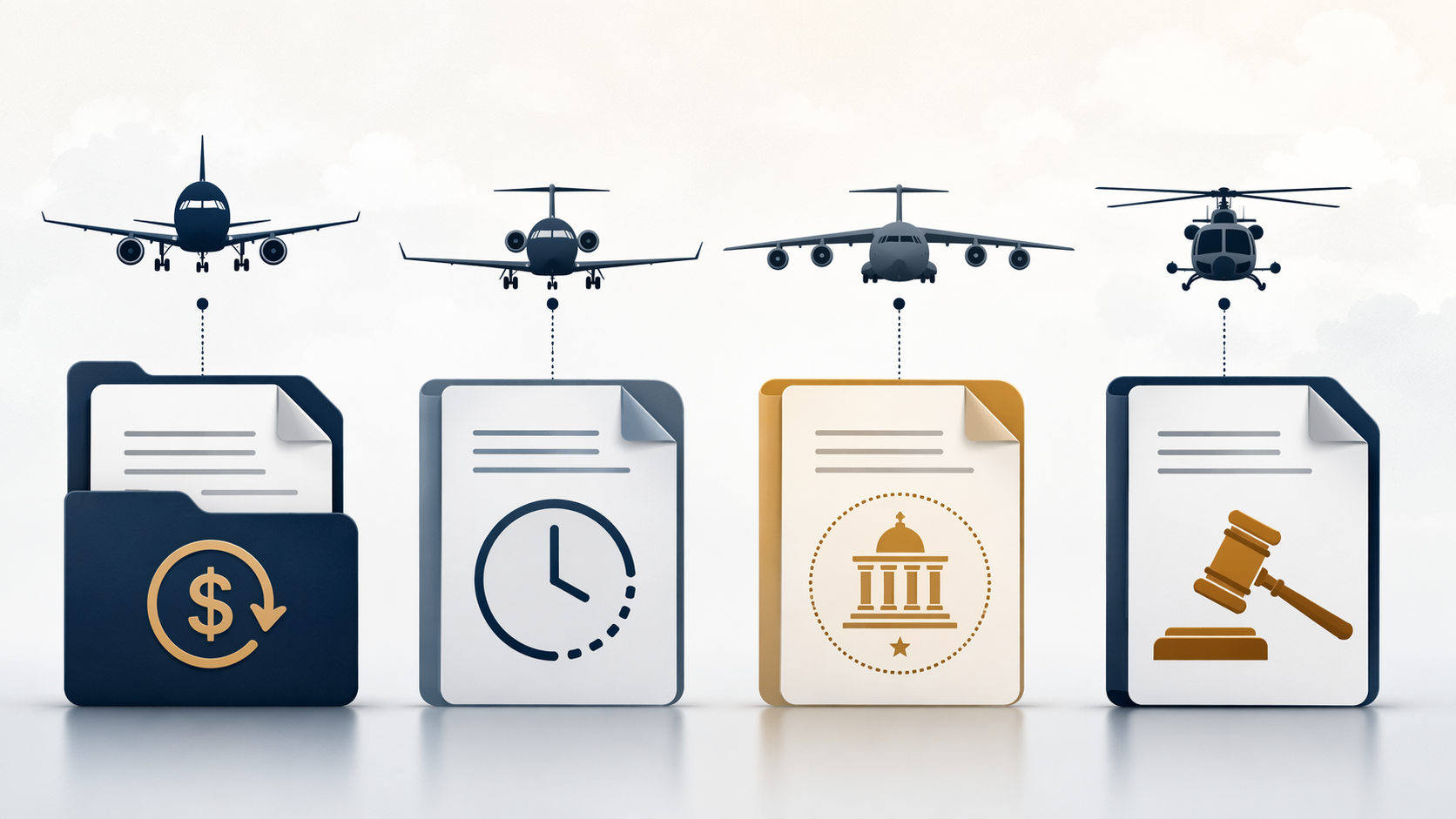
For counsel, the first useful move is classification. A grounded aircraft may explain why parties are angry; it does not answer who owes money, whether delay is excusable, whether a forum can hear the claim, or whether a payment is compensation, settlement currency, a contract charge, or tort damages.
| Category | Typical Claim | Legal Center of Gravity | Examples in the Record |
|---|---|---|---|
| Order cancellation and advance payment claims | Refund of pre-delivery payments after cancellation or alleged non-excusable delay | Purchase agreement text, cancellation rights, excusable-delay provisions, forum and pleading posture | ALAFCO; Timaero Ireland |
| Delivery delay compensation | Commercial compensation for grounded or late aircraft, often resolved outside a merits judgment | Excusable delay, force majeure framing, negotiated credits, amended orders, capacity consequences | Norwegian Air; Ryanair demands; Southwest compensation; United pilot leave |
| Government fixed-price contract losses | Program charges and disputes under defense contracting rules | Fixed-price development risk, CAS/FAR discipline, cost accounting, government-contract forum rules | Boeing Defense fixed-price program charges; Boeing v. United States |
| Crash-related tort and criminal-resolution exposure | Wrongful-death claims, settlements, verdicts, DOJ agreements, shareholder-related litigation | Tort causation, damages, criminal fraud resolutions, deferred prosecution agreements, settlement posture | 737 MAX civil settlements; Garg family verdict; DOJ DPA and plea developments |
The refund cases are contract disputes before they are aviation stories
The cleanest entry point into Boeing aircraft order litigation is the lessor or airline that paid money before delivery and then tried to unwind the deal. Those cases are tempting to describe as “MAX grounding lawsuits,” but that label hides the operative questions: what event triggered cancellation rights, whether the delay was excusable, what the purchase agreement said about refunds, and which court or arbitral forum could decide it.
ALAFCO’s April 2020 suit is the important example because it put a dollar amount and a contract theory on the problem. The Kuwaiti aircraft lessor sued Boeing in federal court in Chicago seeking $336 million after Boeing allegedly refused to return advance payments tied to canceled 737 MAX orders; reporting at the time described ALAFCO’s position as resting on “non-excusable delay.”[2][3] That phrase does substantial work. If the delay is excusable under the contract, a buyer’s remedy may be narrower or postponed. If it is non-excusable, the same delivery failure can become a refund claim.
The caution is just as important as the filing. The available research does not establish the ultimate disposition of ALAFCO’s $336 million claim. It should be treated as a filed, reported refund dispute with an unresolved-status caveat, not as a recovered amount or a merits ruling against Boeing.
Timaero Ireland belongs in the same bucket because it was also reported as a lessor suit seeking return of advance payments. The shared feature is not that both were lessors, nor even that both involved the 737 MAX. The shared feature is the remedy: money paid before delivery, claimed back after a cancellation theory matured or was alleged to have matured. That is a different legal posture from an airline seeking commercial compensation while keeping a relationship alive.
Delay compensation often ends in commercial restructuring, not a court answer
Delivery delay compensation is the broadest and easiest category to overstate. Airlines lost planned capacity, pilots and schedules were affected, and compensation demands became public. But a demand is not a judgment, and a compensation agreement is not necessarily an admission of contractual liability. In aircraft procurement, a settlement can be paid in cash, credits, delivery adjustments, revised pricing, or new orders.
Norwegian Air shows why this category deserves close handling. In May 2022, Norwegian announced an agreement to buy 50 Boeing 737 MAX 8 aircraft and said the arrangement resolved prior disputes with Boeing; Reuters reported that the package included 2 billion Norwegian crowns, about $212 million, in compensation.[4] Separately, DiCello Levitt’s case study states that Norwegian had sought more than $1 billion in damages from Boeing.[5] Those two figures should not be merged. One is a reported settlement-and-order package; the other describes the scale of damages sought.
That distinction is not pedantry. If new aircraft orders are part of a resolution, the legal and commercial bargain are fused. Boeing may preserve a customer relationship and backlog position; the airline may obtain aircraft, pricing, compensation, and timing terms that matter more than a public liability finding. For a lawyer benchmarking exposure, Norwegian is evidence that disputes can be resolved through a combined purchase-and-compensation structure. It is not evidence that every delay claim prices the same way.
Ryanair and Southwest illustrate the other side of the public record: compensation pressure without a clean litigation merits ruling. Leeham News reported in 2019 that compensation claims were beginning to ramp up, including Ryanair demands and a reported $125 million compensation agreement with Southwest.[6] The same reporting discussed Boeing’s apparent reliance on an “excusable delay” position, but that is secondary market reporting and should be treated as such. It is useful for understanding the negotiation environment; it is not a substitute for the actual contract language.
United’s pilot leave tied to MAX delays belongs here only as an operational consequence. It shows that a delivery or grounding problem can cascade into labor scheduling and staffing decisions, but it does not by itself identify a Boeing-payment obligation. The legal question remains where the loss sits: under the aircraft purchase agreement, under a labor arrangement, under insurance, under a negotiated commercial accommodation, or nowhere recoverable at all.
The category remains current because delay risk did not end with the initial ungrounding period. Simple Flying reported that Boeing warned customers of 737 delivery delays through 2026.[7] That fact supports continued relevance for contract review, not a prediction that customers will prevail on future claims. A 2026 delay notice still has to be matched against order terms, notice provisions, excusable-delay language, production assumptions, and any later amendment.
Excusable delay and force majeure are not magic labels
The doctrine work in these disputes is usually less cinematic than the business facts. An excusable-delay clause may protect a manufacturer from certain delivery consequences if the delay arises from specified events or conditions outside the required control. A force majeure clause may do similar work, depending on drafting and governing law. Neither clause answers the case until counsel identifies the covered event, the notice requirement, the causal chain, the duration of relief, and the remedy after prolonged delay.
That is why Boeing-specific materials and general force majeure commentary should not be blended too aggressively. General aviation finance discussions can help frame issues such as “hell-or-high-water” payment obligations or the treatment of extraordinary events, but they do not decide a Boeing purchase dispute unless the contract, forum, and governing law line up. The practical file review starts with the purchase agreement and amendments, not the aircraft model.
Defense fixed-price losses sit on a different legal surface
Government fixed-price contract losses are often mentioned in the same breath as Boeing’s commercial troubles because they hit the same company’s financial statements. Legally, they belong elsewhere. An airline order dispute usually asks what an aircraft purchase agreement allows after delay, cancellation, or grounding. A defense fixed-price development problem asks who bears cost growth under a government contract and whether the contractor’s accounting and performance obligations satisfy the defense-procurement framework.
The financial pressure is substantial. Legal Dive reported that Boeing Defense had a $2.4 billion quarterly loss and $4.9 billion in year-end charges on five major fixed-price development programs in 2025, using Boeing’s defense-contracting problems as an example of how weak contracting discipline can damage a business.[8] Those figures are not airline compensation claims. They are contract economics under government-program structures, where the contractor may carry cost overruns that cannot simply be passed through.
The doctrinal vocabulary changes accordingly. Counsel should expect CAS and FAR issues, cost-accounting disputes, claims procedure, and federal contracting forums rather than the purchase-agreement remedies that dominate the ALAFCO-style files. Boeing v. United States, described in 2025 commentary as a Federal Circuit dispute over CAS cost accounting, is useful for that reason: it points to the machinery of government contract law rather than passenger-airline capacity loss.[9]
This is the category most likely to be misclassified by a commercial-aircraft reader. A fixed-price development charge may look like another consequence of overcommitted aerospace production. In legal terms, however, the exposure is built into the bargain: a contractor agrees to deliver under pricing and accounting rules that allocate cost growth differently than a commercial purchase agreement does. That is why the same corporate earnings release can contain both a record commercial backlog and severe defense charges without creating a single litigation theory.
Crash-related liability overlaps factually, but not doctrinally
The 737 MAX crash-related matters are part of Boeing’s legal exposure landscape, but they are not aircraft order disputes in the ordinary purchase-agreement sense. They involve wrongful-death claims, settlements, criminal-resolution agreements, and shareholder-related proceedings. They may affect negotiation leverage and corporate risk assessment, yet the legal duties and remedies differ from advance payment refunds or delayed-delivery credits.
The DOJ track illustrates the separation. In 2021, Boeing agreed to pay more than $2.5 billion to resolve a criminal charge connected to the 737 MAX, through a deferred prosecution agreement reported by Courthouse News.[10] Later reporting described a 2024 fraud guilty plea involving a $487 million penalty and a 2025 agreement in principle, but those criminal-resolution developments should not be recast as contract remedies for airline buyers. They sit in a public-enforcement lane.
Civil tort exposure has its own posture. Reuters reported in November 2025 that a jury ordered Boeing to pay more than $28 million to the family of 737 MAX crash victim Shikha Garg, with total damages of $35.85 million after additions; the same report stated that more than 90% of the crash lawsuits had settled.[11] That first civil jury verdict matters because it supplies a public damages outcome after many confidential resolutions. It does not supply a measure for commercial order disputes.
For legal departments, the temptation is to use the crash litigation as a general proxy for Boeing risk. That shortcut is unsafe. Tort plaintiffs, airline customers, aircraft lessors, shareholders, and the Department of Justice are not enforcing the same promise. They may rely on overlapping facts about the MAX program, but their claims move through different elements, burdens, forums, and settlement incentives.
Adjacent operational disputes should stay adjacent
Not every Boeing-related case that touches aircraft operations belongs in the four core categories. The Boeing Company v. Southwest Airlines Pilots Association, decided by the Texas Supreme Court in 2025, involved Boeing and a pilots association in a labor-related dispute adjacent to Southwest’s operations.[12] It is relevant to the broader operational fallout around Boeing aircraft, but it should not be forced into an aircraft-order frame unless the pleaded claims and requested relief actually concern purchase rights, delivery remedies, or compensation under an order contract.
That boundarykeeping is useful in practice. A litigation tracker that tags every MAX-adjacent filing as an order dispute will overcount purchase-agreement exposure and underexplain what the cases are really doing. Labor claims, shareholder derivative suits, government enforcement, crash-tort matters, and procurement disputes can all be Boeing legal exposure without being Boeing aircraft order contract disputes.
What to verify before drawing a recovery conclusion
The most common analytical error is to move from operational disruption to expected recovery. The record supports something narrower: Boeing customers and counterparties asserted substantial claims, some disputes settled through compensation and order packages, some refund suits were filed, defense programs produced large fixed-price charges, and crash-related litigation produced settlements and at least one public civil verdict. It does not support a single recovery formula.
- Contract text: cancellation rights, excusable-delay provisions, force majeure wording, notice rules, refund mechanics, limitation clauses, and amendment history.
- Forum and posture: filed complaint, arbitration, settlement announcement, regulatory agreement, criminal plea, jury verdict, appeal, or unresolved docket.
- Remedy type: advance payment refund, cash compensation, credits, revised delivery schedule, new aircraft order, program charge, tort damages, or criminal penalty.
- Source quality: primary filing, company release, court decision, Reuters-style report, secondary market intelligence, law-firm case study, or paywalled snippet.
- Claimant identity: airline, lessor, government customer, crash family, shareholder, union, or regulator.
Those checks change the conclusion quickly. ALAFCO’s $336 million figure is a claimed refund amount in a reported federal suit, not a confirmed recovery. Norwegian’s 2 billion NOK compensation figure is part of a package that also included 50 new aircraft, not a standalone damages award. Southwest’s reported $125 million compensation agreement is a reported commercial resolution, not a precedent on excusable delay. Boeing Defense’s $4.9 billion in charges is a government fixed-price contracting problem, not an airline order claim. The Garg verdict is a tort damages result, not an aircraft purchase remedy.
That is the practical map. Boeing-related exposure after 2019 is not one litigation wave. It is several legal surfaces created by the same stressed aerospace program environment: commercial purchase agreements, delivery accommodations, government fixed-price contracts, and crash-related tort and enforcement proceedings. The safest judgment starts with contract text and forum, then asks what the cited source actually proves.
References
- Boeing Reports Fourth Quarter Results, Boeing, Jan. 2026.
- ALAFCO Sues Boeing Over 737 MAX Order Cancellation, Simple Flying.
- Boeing is sued for $336 million over canceled 737 MAX order, Fox Business.
- Norwegian Air orders 50 Boeing MAX aircraft, resolving dispute, Reuters, May 30, 2022.
- Norwegian Air v. Boeing — DiCello Levitt case study, DiCello Levitt.
- Pontifications: Compensation claims against Boeing beginning to ramp-up, Leeham News, May 27, 2019.
- Boeing Warns Customers Of 737 Delays Through 2026, Simple Flying.
- Boeing defense mess shows how weak contracting can wreck a business, Legal Dive.
- Boeing v. U.S. — Contract Dispute Over Cost Accounting Resurrected, Whitcomb Law PC.
- Boeing Agrees to Pay $2.5B to Resolve Charges Over 737 Max, Courthouse News.
- Boeing ordered to pay more than $28 million to 737 MAX crash victim's family, Reuters, Nov. 13, 2025.
- The Boeing Company v. Southwest Airlines Pilots Association, Justia, 2025.
Comments
Join the discussion with an anonymous comment.