
The mortgage-liability claim against JPMorgan now pending in the Southern District of New York is not, at least yet, a climate case in the way that phrase is usually used. It is a contract-capacity case wearing the facts of a climate-loss case: a borrower says he should not be held to a $3.85 million mortgage because he was in a manic psychotic episode when he signed the loan papers for a Cape Cod property already exposed to severe coastal erosion.
The case is Bonomi v. JPMorgan Chase Bank, N.A., assigned to Judge Gregory H. Woods in SDNY as No. 1:25-cv-07664. The docket is still at an early stage. JPMorgan has sought to move against the complaint before discovery proceeds, and discovery has been stayed pending resolution of that effort.[1][2] That posture matters. The strongest version of the borrower’s story and the strongest version of the bank’s defense are still mostly pleadings, press accounts, docket entries, and quoted positions—not tested deposition testimony, loan-file evidence, underwriting notes, or judicial findings.
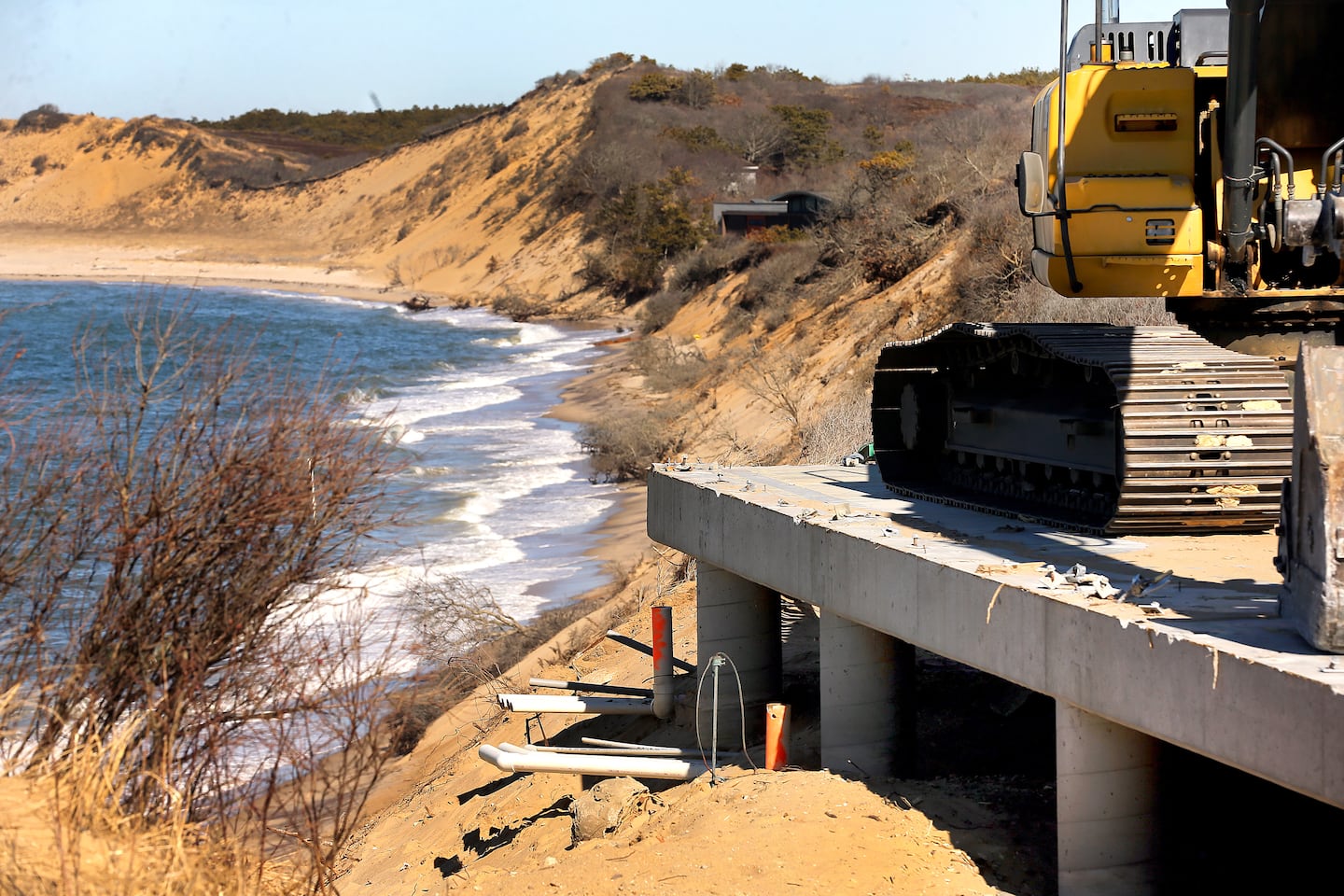
The factual spine is stark enough without embellishment. Paul Bonomi bought the Blasch House in Wellfleet, Cape Cod, for $5.5 million in November 2021. The property sat on a coastal bank reported to be eroding at up to seven feet per year. It was demolished in February 2025 after the edge moved too close. The land’s assessed value fell from $4.38 million in 2021 to $385,000 in January 2025, a 91% drop.[3] Bonomi now seeks to void the mortgage and claims the loan, damages, and fees exceed $3.85 million plus more than $1.4 million.[4]
The claim depends on incapacity, not regret
New York law does not let a borrower unwind a mortgage simply because the collateral later became worthless, the bargain was ruinous, or the lender was better positioned to understand risk. The live doctrinal question is narrower: whether Bonomi can fit his allegations into the mental-incapacity rule associated with Ortelere v. Teachers’ Retirement Board.
Ortelere rejected a purely old-fashioned incapacity standard that turned only on whether a person could understand the nature and consequences of a transaction. The New York Court of Appeals recognized a broader rule for a person “laboring under a mental defect” that prevented reasonable action in relation to the transaction, where the other party knew or had reason to know of the condition.[5] The second half is not decorative. It is what keeps the doctrine from becoming a general escape hatch for hard bargains made during difficult periods.
Bonomi alleges that he was experiencing bipolar I manic psychosis when he bought the property and obtained the mortgage. JPMorgan’s May 2026 answer denies the allegation and, as reported, leaves Bonomi to his proofs.[6] That is the normal litigation posture, but it is also a reminder of what has to be shown. A diagnosis, even if established, is not automatically enough. The question becomes what his condition did to his ability to act reasonably in this particular transaction, and what JPMorgan knew or should have known before lending.
Fordham Law professor Ethan Leib put the obstacle plainly in comments to the ABA Journal: Bonomi faces a “difficult burden of proof,” especially because he made roughly $21,000 monthly payments for nearly three years before stopping.[7] That payment history is not a complete defense by itself. It does, however, make the incapacity theory harder to present as a single moment of irrationality followed by immediate collapse. Continued performance can look like ratification, rational calculation, or at minimum evidence that the borrower was capable of managing the consequences for a substantial period.
Why the three-year payment history cuts so sharply
The $21,000 monthly-payment fact is doing more work than a colorful number usually should. It bears on several questions at once: whether Bonomi understood the loan after closing, whether he accepted its benefits and burdens, whether the bank had reason after origination to treat him as incapable, and whether the claimed defect was tied to the mortgage decision rather than to the later economic disaster of owning a rapidly eroding property.
| Issue | Why the payment history matters |
|---|---|
| Capacity at signing | Sustained performance does not prove capacity at closing, but it gives JPMorgan a concrete fact to argue that the transaction was understood and managed. |
| Ratification or affirmation | A borrower who keeps paying for years may face arguments that he accepted the loan after any alleged episode ended. |
| Lender notice | Regular payments can weaken the claim that the lender was seeing obvious signs of incapacity after origination. |
| Causation | The longer the loan performed, the more JPMorgan can frame the loss as erosion risk materializing rather than incapacity causing the mortgage obligation. |
The borrower’s best response is likely to separate origination from performance. A person can be impaired when entering a transaction and later make payments for reasons that do not amount to a meaningful affirmation: fear of default, hope of rescue, advice from others, liquidity, or simple delay. But those explanations need evidence. They cannot just be inferred from the fact that the property eventually failed.
That is where discovery, if reached, would matter. The most probative material would not be scenic photographs or generalized climate reports. It would be loan-application communications, underwriting notes, appraisal materials, private-banking communications, any unusual borrower statements, and any internal discussion of whether the transaction made sense given the borrower’s condition, finances, and the property’s physical risk.
The bank’s duty to inquire is the harder part of the case to dismiss as theater
JPMorgan does not become a mental-health monitor merely by making a large mortgage. Lenders are not ordinarily required to diagnose borrowers, rescue them from imprudent purchases, or refuse loans whenever collateral carries risk. A rule like that would be unworkable and, in many cases, paternalistic.
But Bonomi does not need to prove that banks have a general duty to investigate every borrower’s mental state. He needs facts that would bring this loan within a more specific notice-and-inquiry framework. A 2019 New York Second Department authority, Marks v. Real Estate Mortgage Network, is described in a New York property-law bulletin as holding that a mortgagee has a “duty to inquire where it is aware of facts that would lead a reasonable, prudent lender to make inquiries.”[8] That formulation is more dangerous for JPMorgan than a pure incapacity claim because it shifts attention from what Bonomi privately experienced to what the lender allegedly saw.
The pleadings will have to connect that rule to concrete facts. What did JPMorgan know about Bonomi’s condition before closing? What did it know about the property’s erosion profile? Did anything about the structure, valuation, appraisal, borrower communications, or transaction pacing create a duty to ask more questions? And if more questions were required, what would reasonable inquiry have revealed before the mortgage was made?
Those questions are not answered by saying the house was plainly at risk. A lender may knowingly finance risky collateral. Nor are they answered by saying the borrower later alleged mania. The legal bridge has to run through notice: facts available to JPMorgan at the relevant time that would have led a reasonable lender to doubt capacity, transaction reasonableness, collateral adequacy, or some combination of those points.
Climate risk matters only if it becomes lender knowledge
The erosion facts are impossible to ignore, but they do not automatically create JPMorgan liability. The property’s physical decline matters legally only to the extent it bears on underwriting, valuation, borrower capacity, notice, or incentives after default. Otherwise, it risks becoming background tragedy rather than an element of a claim.
That distinction is especially important because climate-exposed collateral is not new to mortgage markets. Yale Climate Connections reported in 2020 that smaller banks had been selling mortgages exposed to sea-level-rise risk to Fannie Mae and Freddie Mac, describing a market structure in which risk can be moved away from originators.[9] The Bonomi case is different in scale and posture: a specific high-value mortgage, a specific demolished property, and a borrower invoking mental incapacity rather than a regulator or investor challenging portfolio risk.
Harvard’s Environmental & Energy Law Program has also noted the unresolved allocation problem when coastal structures are abandoned to rising seas, observing that there is “no uniform answer as to who bears the liability to remove it or pay damages.”[10] That observation helps explain why a lender might care about timing, foreclosure, possession, and cleanup responsibility. It does not prove that JPMorgan delayed foreclosure for an improper reason in this case.
Bonomi alleges that JPMorgan delayed foreclosure to avoid assuming ownership of an environmental liability. JPMorgan, through spokesperson Justin Page, has attributed the delay to Regulation X’s 120-day foreclosure moratorium.[7] On the current public record, that is a pleaded dispute, not a finding. The allegation is serious because it suggests the bank wanted the benefits of the debt position without the burdens of owning the deteriorating collateral. But the bank’s regulatory explanation is facially ordinary, and timing evidence will matter more than rhetoric.

What discovery would actually test
The temptation with a case like this is to argue from the ending backward: the house was demolished, the assessment collapsed, and therefore no rational transaction could have occurred. That is not how the proof burden is likely to work. The court will need to know what was knowable and known at the time of lending, and then what JPMorgan did with that information.
- Capacity evidence: medical records, contemporaneous communications, witnesses, and expert testimony tying any manic psychosis to the mortgage decision.
- Notice evidence: emails, call notes, loan-officer observations, private-banking records, and any borrower statements that allegedly signaled impairment.
- Collateral evidence: appraisals, erosion reports, insurance materials, municipal records, and any underwriting discussion of remaining useful life or marketability.
- Foreclosure evidence: default timeline, servicing notes, Regulation X compliance records, internal discussion of environmental exposure, and communications about whether taking title would create costs.
Each category points in both directions. A clean underwriting file and ordinary borrower communications would help JPMorgan. A file showing internal concern about capacity, urgency, physical instability, or post-default environmental exposure would make the bank’s dismissal posture more difficult. The case is unusual because the same fact—the property’s obvious physical vulnerability—can be framed either as a known risk voluntarily assumed by a sophisticated borrower or as part of the reason a prudent lender should have paused.
Novel does not mean likely to win
Bonomi’s own lawyer, Thomas Moore, has said he does not know of any cases in which a similar argument has been used to void a mortgage.[7] That is useful candor. Novelty can make a complaint interesting, but it does not lower the proof burden. If anything, a court may be careful about writing a rule that invites borrowers to convert catastrophic collateral losses into capacity litigation.
At the same time, novelty is not a defense. Ortelere already asks whether a party could act reasonably and whether the counterparty knew or had reason to know of the defect. Marks-style inquiry language, if applicable, gives the borrower a way to argue that a mortgagee cannot ignore red flags simply because the borrower signed standard documents. The case will likely turn less on whether the legal theory sounds unusual and more on whether the complaint pleads enough facts to justify testing JPMorgan’s knowledge.
That is why an easy public narrative for either side is premature. Bonomi faces a substantial proof problem because three years of large payments look like sustained, deliberate performance. JPMorgan, however, may not get a clean narrative win if the pleadings plausibly raise lender notice, duty-to-inquire, collateral-valuation, or foreclosure-timing issues. The court has not yet said that mental incapacity doctrine reaches this mortgage. It also has not said that it cannot.
For now, the practical significance is narrower and more interesting than a headline about a mansion falling into the ocean. Bonomi v. JPMorgan tests whether an old New York incapacity framework can do remedial work in a transaction where mental-health evidence, lender risk management, and climate-doomed collateral meet in the same loan file. Until the record is developed, the most defensible answer is procedural: confidence for either side is ahead of the evidence.
References
- PacerMonitor docket for 1:25-cv-07664, PacerMonitor.
- Bonomi v. JPMorgan Chase Bank, N.A., CourtListener.
- Cape Cod homeowner sues, says bank should not have given him mortgage for $5.5m mansion at risk of collapse, Boston Globe, July 16, 2026.
- Bonomi Sues JPMorgan Chase for Giving Him a Loan to Buy Doomed House, Provincetown Independent, February 18, 2026.
- Ortelere v. Teachers' Retirement Board, 250 N.E. 2d 460 (NY 1969), Open Casebook.
- NY Attorney Sues Bank Over “Manic” Cape Cod Home Purchase, The Real Deal, July 17, 2026.
- Lawyer says he was “manic” when he bought Cape Cod mansion in danger of falling into ocean, ABA Journal, July 17, 2026.
- NY Property Law: Mental Capacity Rules, Home Abstract Corp.
- Mortgage lenders face increasing risks from sea-level rise, Yale Climate Connections, 2020.
- Abandoning structures to rising sea levels, what are the legal issues and solutions?, Harvard Environmental & Energy Law Program.
Comments
Join the discussion with an anonymous comment.