
Trump's FCC cannot legally revoke broadcast licenses
This article examines the statutory and constitutional barriers that prevent the FCC from revoking broadcast licenses based on content or political viewpoint, drawing on the Communications Act, FCC guidance, and settled First Amendment law. It provides legal professionals with a source-cited analysis of why content-based license revocation remains legally untenable despite political pressure.
- Hallucination rate
- Not measured / undisclosed
The first legal problem with threats to revoke “ABC’s license” or “NBC’s license” is that there is no such broadcast license to revoke. The FCC licenses individual local broadcast stations, not television networks as networks, and those station licenses ordinarily run for eight-year terms.[1] That distinction is not a technicality. It determines the licensee, the administrative record, the statutory standard, the forum for objections, and the kind of order an agency would have to defend in court.
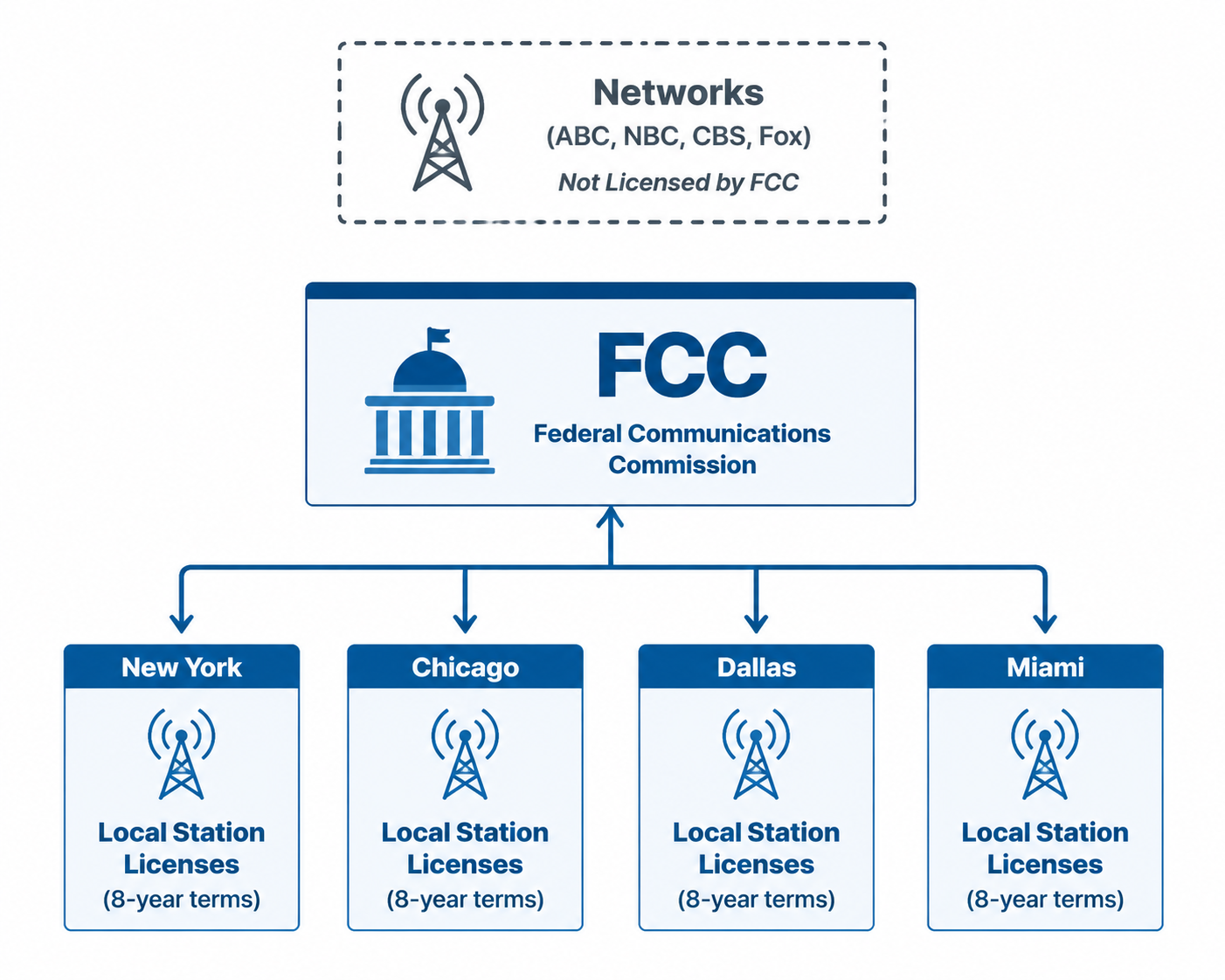
That is the necessary starting point for legal analysis of Trump-era broadcast-license threats. A president may denounce a network. An FCC chair may criticize a broadcast owner. But the operative legal question is narrower: can the Commission take a local station’s license away because federal officials dislike the station’s, network’s, or affiliate’s programming? Under current law, the answer is no.
The FCC’s own public guidance states the constraint plainly: Section 326 of the Communications Act bars the Commission from censoring broadcast material, and the agency says it cannot “prevent the broadcast of any particular point of view.”[2] That statutory command does not disappear because a complaint is politically popular, because programming is offensive, or because a regulator describes a license as a public privilege rather than private property.
The immediate 2026 setting makes the distinction more than academic. NBC News reported on April 28, 2026, that the FCC planned to direct eight Disney-owned ABC stations to file early license renewal applications, an unusual use of the renewal process against stations associated with a network that had drawn presidential criticism.[3] Around the same period, FCC Chair Brendan Carr publicly emphasized that broadcast licenses are “not a property right,” a statement that is true in the limited sense that licensees do not own spectrum as private property, but incomplete if treated as a shortcut around the Communications Act, the First Amendment, or administrative procedure.[4]
What the FCC actually licenses
Broadcast licensing is local. A station license belongs to a station licensee serving a particular community, not to a national network brand in the abstract. ABC, CBS, NBC, and Fox may supply programming to affiliates or own particular stations through corporate parents, but the FCC licensing hook is the station, not the network feed. A legally operative revocation threat therefore has to identify a licensee and a station license, not merely a disliked national program or a network name.
That point matters procedurally. If the Commission wants to act against a license, it must build a record tied to that licensee’s conduct and to a statutory or rule violation. A speech grievance against a network segment cannot simply be converted into a revocation order against any affiliated local station. The agency would need to explain why the local licensee committed a legally cognizable violation, why the violation satisfies the revocation standard, and why the sanction does not amount to censorship or viewpoint discrimination.
This is where many public accounts become misleading. Saying “the FCC can revoke broadcast licenses” is formally true. Saying the FCC can revoke a broadcast license because the president dislikes coverage is a different proposition. The first describes an agency power. The second describes a use of that power that collides with the statute, FCC doctrine, and constitutional law.
The Communications Act is the first barrier, not an afterthought
Section 326 is the provision that should appear before the rhetoric about presidential leverage. It says nothing in the Communications Act shall be understood to give the FCC censorship power over radio communications, and it bars the agency from adopting regulations or conditions that interfere with free speech by means of radio communication.[2] In the broadcast context, that language does not eliminate all FCC content rules; the agency still administers limited doctrines such as indecency rules and sponsorship identification. But it does foreclose using license authority as a general instrument of editorial control.
Section 312 supplies the revocation machinery. As summarized in James B. Speta’s Yale Journal on Regulation analysis, revocation requires a legally sufficient basis such as willful or repeated failure to comply with the Act, FCC rules, or license terms.[5] That is a violation standard, not an all-purpose public-interest displeasure standard. A regulator still must identify the rule, show the violation, satisfy the statutory threshold, and choose a sanction that can survive judicial review.
The renewal process is also narrower than some political language suggests. Brookings notes that Congress changed the renewal landscape in 1996 by eliminating comparative renewal hearings, which previously allowed challengers to argue that they would operate a station better than the incumbent licensee.[1] The current renewal question is not whether a different broadcaster might be more congenial to the administration. It is whether the incumbent licensee served the public interest, committed serious violations, or engaged in a pattern of abuse under the governing statutory framework.
| Question | Legal significance |
|---|---|
| Is the target a network or a station licensee? | The FCC licenses local stations, not networks as networks. |
| What statutory or rule violation is alleged? | Revocation under Section 312 requires more than disapproval of content. |
| Does the action interfere with editorial judgment? | Section 326 bars FCC censorship and conditions that abridge broadcast speech. |
| Is the government targeting a viewpoint? | Viewpoint-based punishment triggers the most serious First Amendment problem. |
Carr’s “not a property right” point does not defeat any of this. Broadcast licenses are conditional government authorizations. They can expire, be renewed, be assigned with approval, or be revoked for legally valid reasons. But the absence of a property right does not mean the absence of constitutional rights. A public employee, government contractor, permit holder, or regulated entity may lack an unconditional entitlement, yet the government still may not deny or threaten the benefit for a forbidden speech reason.
That is why the statutory record would be so difficult to write. An order saying that a local station lost its license because a network interview, debate edit, late-night segment, or war-coverage judgment displeased federal officials would not become lawful by substituting “public interest” for “viewpoint.” Courts look at substance, sequence, context, and stated reasons. If the administrative record shows retaliation for editorial viewpoint, the Commission’s licensing vocabulary will not save the order.
The First Amendment problem is viewpoint discrimination
The constitutional barrier is not merely that “the press is protected.” That statement is correct, but too general for the problem. The sharper rule is that government may not punish speech because it disagrees with the speaker’s viewpoint. Speta anchors the broadcast-license question in the settled First Amendment principle reflected in Rosenberger v. Rector: viewpoint discrimination is an especially forbidden form of government action.[5]
Broadcast regulation has always occupied a somewhat distinct First Amendment space because licensed stations use scarce spectrum. But that distinction has never given the FCC a roving power to punish disfavored political coverage. Scarcity doctrine may support licensing and certain structural obligations. It does not authorize retaliatory revocation because a station, network, host, or journalist aired an account the government dislikes.
NRA v. Vullo adds a more current and practical comparison. In 2024, the Supreme Court held that government officials may not use threats of adverse regulatory action to coerce private parties into suppressing disfavored speech.[5] That framework matters because modern pressure rarely arrives as a clean written order saying “suppress this viewpoint.” It often appears as public threats, pending approvals, informal warnings, and signals about regulatory pain.
That is where explicit revocation talk becomes legally relevant even before a license is actually revoked. CBS News reported in March 2026 that Carr threatened news networks’ broadcast licenses in connection with coverage of the Iran war.[6] A court reviewing later agency action would not have to pretend those statements never occurred. They could help show whether a nominal licensing action was, in context, an effort to coerce or punish editorial choices.
The point is not that every public criticism by an FCC chair is unconstitutional. Agency heads may speak, criticize, and explain regulatory priorities. The problem begins when official speech is paired with regulatory authority in a way that threatens punishment for disfavored expression. In that setting, the government’s own words can become part of the evidence of coercion.
News distortion is a narrow doctrine, not a revocation shortcut
The doctrine most likely to be invoked in this area is the FCC’s news distortion policy. It is also the doctrine most likely to be overstated. The FCC’s public speech guidance describes news distortion as involving intentional falsification or staging by a broadcaster in bona fide news programming, and the agency distinguishes that narrow category from ordinary disputes over coverage, selection, emphasis, or editorial judgment.[2]
Speta emphasizes two limits that are often lost in political discussion. First, the doctrine concerns bona fide news programming, not entertainment, satire, late-night comedy, or generalized political commentary. Second, it requires evidence of intentional distortion by the licensee or its management, not merely a viewer’s belief that coverage was biased, unfair, incomplete, or hostile.[5]
The historical record is equally important: Speta states that the news distortion doctrine has never produced a license revocation.[5] That does not mean the doctrine is imaginary. It means it is a narrow enforcement category with a demanding evidentiary threshold, not a ready-made tool for punishing national media criticism.
A hypothetical illustrates the boundary without pretending to describe a real case. If station managers knowingly staged a false news event and presented it as genuine reporting, the FCC would at least have a doctrine to examine. If a president believes a network anchor was unfair, a debate edit was unflattering, or a late-night host was hostile, that is not the same legal category. The first allegation points toward intentional falsification in bona fide news. The second points toward protected editorial judgment or commentary.
Prior FCC chairs understood the line
The present posture is also notable because prior FCC leadership from both parties publicly recognized the same limit. Brookings recounts that Republican Chair Ajit Pai rejected Trump’s 2017 suggestion that NBC licenses could be challenged over news coverage, saying the FCC lacks authority to revoke a license based on content criticism.[1] Democratic Chair Jessica Rosenworcel took a similar position in 2024 when Trump again threatened broadcast licenses.[1]
Those statements do not bind the current Commission as precedent in the way an adjudicatory order would. Their value is more practical: they show how recent chairs responsible for the same statute described the agency’s limits when faced with politically charged demands. Carr’s 2026 posture is therefore not ordinary housekeeping under the Communications Act. It is a departure from a recent bipartisan understanding of how little room the FCC has to punish broadcast viewpoints.
Civil-liberties organizations have treated the early ABC renewal review and related threats as First Amendment concerns, with groups including FIRE, the Knight First Amendment Institute, PEN America, and Reporters Without Borders criticizing the move.[7] Their objections are consistent with the legal analysis, but the stronger point for agency review is not institutional outrage. It is that a content-retaliation order would have to pass through statutory text, a license-specific record, FCC doctrine, the Administrative Procedure Act, and First Amendment review.
What could still matter procedurally
Saying content-based revocation is legally untenable is not the same as saying regulatory pressure has no consequences. A station owner ordered into early renewal preparation must respond. Lawyers must preserve objections. Compliance staff must gather records. Transactions may slow. Corporate officers may reassess risk. The law may make the government’s ultimate merits position weak while still allowing the process itself to impose cost.
That institutional risk is especially relevant when license renewals, ownership limits, merger approvals, and political statements move in the same period. As of July 18, 2026, publication should still check three moving pieces before treating the landscape as fixed: the pending Supreme Court case on for-cause removal protections for independent agency commissioners, the status of the Nexstar-Tegna transaction, and the FCC’s announced August 6, 2026 ownership-cap vote. Those developments do not make viewpoint-based license revocation lawful by themselves, but they may affect how much practical independence commissioners and regulated companies have when pressure is applied.
The independent-agency issue is particularly important. If the Supreme Court narrows or eliminates for-cause removal protections for commissioners, presidential influence over agencies such as the FCC could increase. That would change the institutional setting, not the core First Amendment rule. A more controllable Commission still could not lawfully revoke a license because it dislikes a broadcaster’s viewpoint, but the path from presidential demand to agency action might become shorter.
The administrative record would then carry even more weight. Courts reviewing an FCC order would examine the stated basis, the evidence, statutory authority, departures from prior practice, and whether the decision was arbitrary, capricious, contrary to law, or unconstitutional. Public threats, timing, and inconsistency with ordinary enforcement priorities could all matter. A licensee defending against retaliatory action would not be limited to saying “the First Amendment exists”; it would have a statutory and procedural path to attack the order.
Present-law judgment
Under current law, the FCC cannot legally revoke a broadcast license because the president or the chair dislikes programming. The agency does not license networks as such. Section 326 bars FCC censorship. Section 312 requires a legally cognizable violation, not viewpoint displeasure. The news distortion doctrine is narrow and has never produced a revocation. Viewpoint discrimination is constitutionally forbidden, and NRA v. Vullo makes regulatory threats aimed at private suppression of disfavored speech especially suspect.
A lawful revocation case would have to look very different from a political grievance dressed in licensing terms. It would need a station-specific record, a real statutory or rule violation, evidence satisfying the relevant standard, and an explanation that does not depend on punishing disfavored editorial judgment. That is a demanding path by design. This analysis is for general legal information and is not legal advice.
References
- Donald Trump has threatened to shut down broadcasters, but can he?, Brookings
- The FCC and Speech, Federal Communications Commission
- FCC to direct Disney-owned TV stations to file early license renewals, source says, NBC News, April 28, 2026
- FCC Chair Brendan Carr says broadcast licenses are not a property right, CBS News
- The FCC Lacks Authority to Punish Broadcasters for Their Viewpoints, Yale Journal on Regulation
- FCC chair threatens news networks' broadcast licenses over Iran war coverage, CBS News, March 2026
- First Amendment advocates blast FCC's early review of ABC broadcast licenses, NBC News
Chronological incident history
No sanction cases have named this tool in the tracked record set to date. This does not imply the tool is safe — see Risk Digest for ongoing monitoring.
← Compare peer toolsReport a correction or tip
Spotted an outdated figure, a misstated fact, or a ruling this tool profile should reflect? Public comments are disabled for this content given the professional cost of a misreported case outcome, penalty amount, or rule text — use the structured correction channel instead.
Report a correction or tip for this record →