
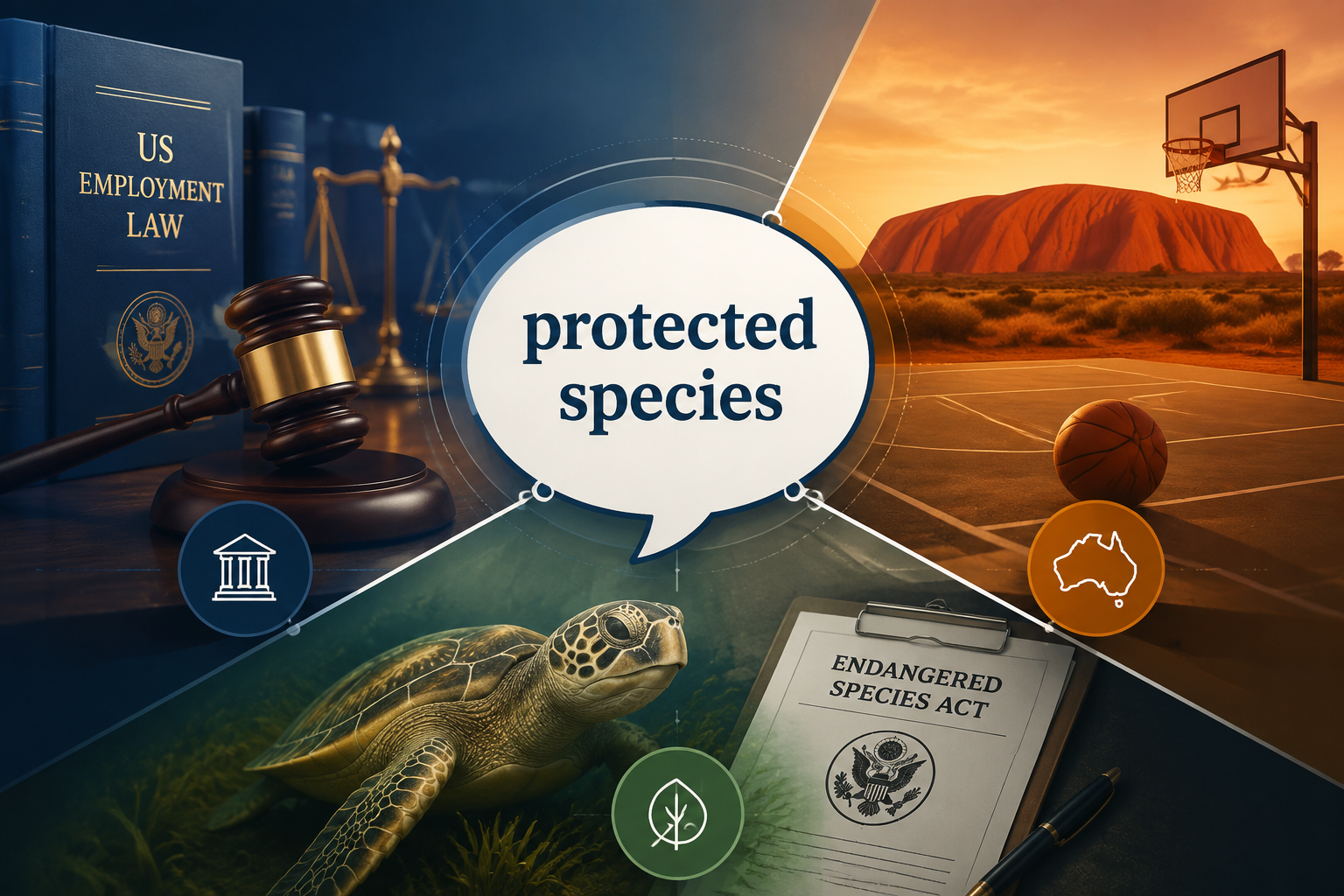
“Protected species” is an unusually slippery phrase for a workplace-law problem. In one setting, it is a federal environmental-law concept. In another, it is Australian sports shorthand for a player who is thought to receive unusually favorable treatment from officials. In the setting that matters for Sandy Brondello’s suspension, it was a coach’s public comment about Angel Reese during a WNBA controversy, followed by a one-game suspension issued within roughly a day of the incident becoming public.[1][2]
That is why the legal implications of the Sandy Brondello suspension cannot be answered by asking only what Brondello says she meant. Intent matters to reputation, discipline, and mitigation. It is not the same thing as the liability test under U.S. employment discrimination law.
The phrase has a real legal home, but not the one that decides this dispute
Start with the cleanest meaning first. Under the Endangered Species Act, an “endangered species” is a species in danger of extinction throughout all or a significant portion of its range.[3] The statute has its own enforcement architecture, including civil penalties up to $25,000 and criminal penalties up to $50,000 and imprisonment tied to conduct involving listed species.[3]
That statutory background matters only as contrast. It explains why “protected species” can sound formal, legal, and loaded in American English. It does not mean Brondello invoked environmental law, and it does not supply the cause of action for a player or league employee. The employment-law question is not whether Reese was literally compared to an ESA-listed animal. It is whether the comment, heard in its workplace setting and directed at a Black player, could be treated as race-based harassment severe enough to affect the conditions of employment.
The Australian sports usage is relevant, but it is not a legal shield
Brondello’s explanation should not be caricatured. In her July 19 apology, she said she intended the phrase in the Australian sports sense: a player treated by referees as receiving special protection.[4] That usage exists, and it is not inherently a racial epithet in that sporting dialect.
But the phrase did not remain in that dialect. It landed in a U.S. professional basketball workplace, in a dispute involving a Black player, after a public comment by a coach. Reese characterized the remark as carrying racial implications, and the Martin Luther King, Jr. Center also responded publicly to the incident.[5][6] The WNBA then imposed a one-game suspension.[1][2]
For lawyers, that sequence is more important than any abstract debate over dictionary meaning. A phrase can have a benign origin and still create workplace risk once it is received in a context where race, hierarchy, public audience, and professional consequences are all present. U.S. harassment law does not give employers a safe harbor whenever a speaker can identify a non-racial meaning used somewhere else.
The Title VII question is severity, context, and who said it
A hostile work environment claim under Title VII generally turns on whether the challenged conduct was sufficiently severe or pervasive to alter the conditions of employment. Courts do not require the plaintiff to prove that the speaker privately intended racial harm. The legal focus is on the effect of the conduct in context: what was said, who said it, where it was said, how it was received, and whether a reasonable recipient could experience it as affecting the workplace.
That is where Woods v. Cantrell matters. In 2022, the U.S. Court of Appeals for the 5th Circuit held that a single use of a racial epithet by a supervisor, in front of subordinates, could state a hostile work environment claim.[7] Employment-law commentary on Woods has treated the decision as a warning that a single incident is not automatically too isolated to matter when the term is severe and the speaker has workplace authority.[7][8]
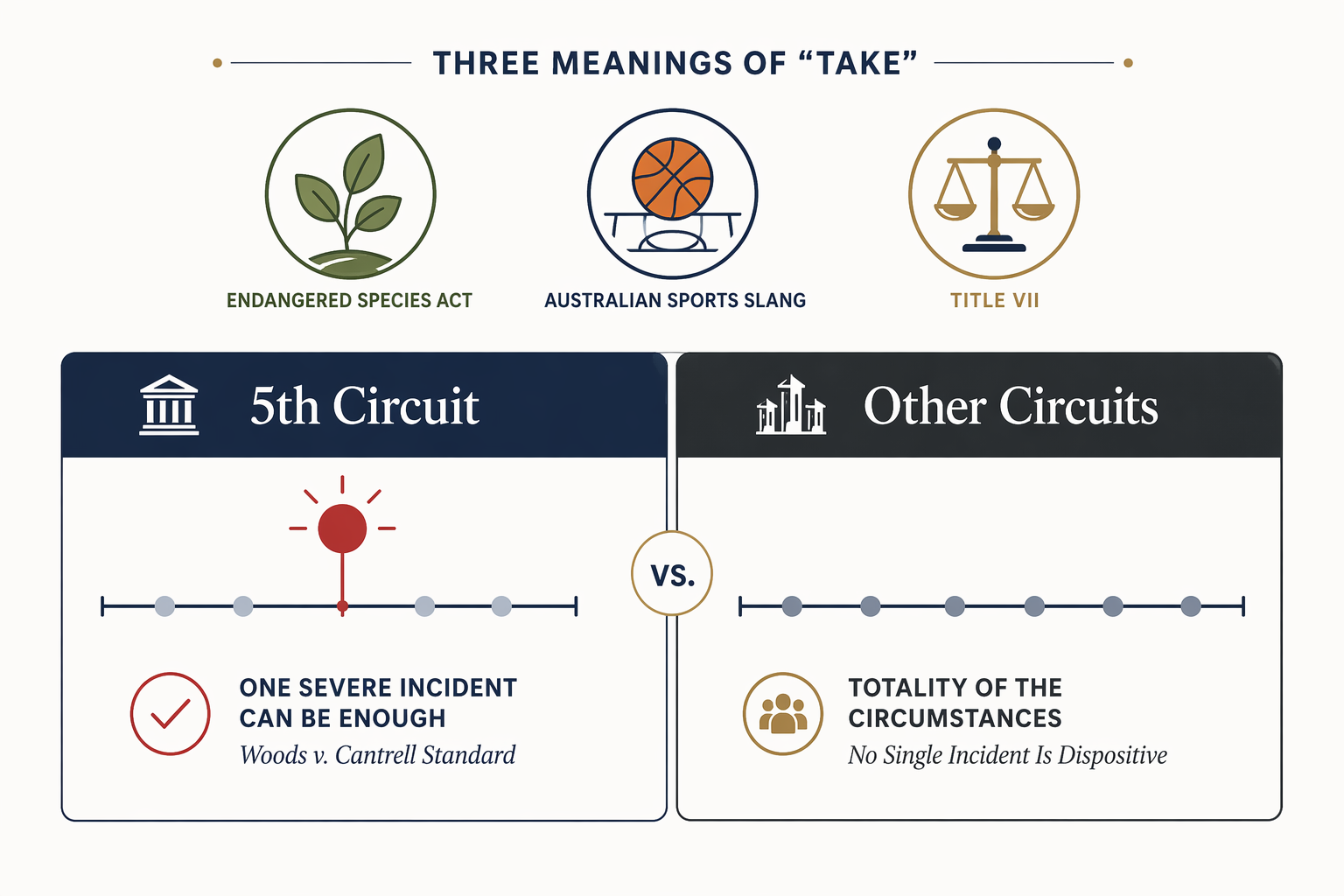
That does not make Woods a national rule for every Brondello-style fact pattern. It is 5th Circuit law. Other circuits still apply the severe-or-pervasive framework through their own precedent and may weigh a single disputed phrase differently. The same comment can therefore create different litigation risk depending on forum, workplace structure, and the evidence developed beyond public reporting.
| Framework | What it asks | What it does not decide |
|---|---|---|
| Endangered Species Act | Whether a species is protected under federal environmental law and what penalties attach to covered conduct | Whether Brondello's comment created workplace harassment liability |
| Australian sports slang | Whether the speaker had a non-racial sports meaning available in her own linguistic context | Whether a U.S. workplace recipient reasonably experienced the comment as race-based |
| Title VII hostile work environment | Whether the comment was severe or pervasive enough, in context, to alter employment conditions | Whether the speaker's later explanation alone defeats a claim |
Why a coach’s role changes the risk analysis
The harder version of the question is not whether a random fan’s comment could be offensive. It is whether a coach’s comment, made in the environment of a professional league, can be treated as workplace conduct. A coach is not merely another speaker in the arena. Coaches carry institutional authority, shape league workplace culture, and, depending on the relationship at issue, may influence evaluation, discipline, opportunity, or professional reputation. Even where the exact contractual chain is more complicated than a conventional office hierarchy, the authority signal is obvious enough that employment lawyers should not treat the comment as detached commentary.
That is also why the public setting matters. A severe statement made before others can intensify the workplace effect. Woods emphasized a supervisor’s use of a racial epithet before subordinates; the Brondello incident is not identical, but it raises the same kind of question about authority, audience, and humiliation.[7] The legal analysis would still need a developed record: exact words, tone, surrounding comments, who heard them, the relationship between the teams and league, any prior conduct, and the employment status of the parties.
Prompt discipline is risk management, not a merits ruling
The WNBA’s one-game suspension is legally relevant because it shows the league recognized the comment as serious enough to warrant prompt remedial action. Public reports described the suspension as coming within 24 hours, which matters for an employer or league trying to reduce ongoing harm and demonstrate responsiveness.[1][2]
It does not prove Title VII liability. It also does not disprove it. Employers often discipline quickly to contain risk, preserve trust, and prevent recurrence. A later court would not simply adopt the league’s disciplinary conclusion. It would ask whether the legal elements are met under the governing jurisdiction’s standard.
The public procedural record is thin. The WNBA and WNBPA announced a 2026 collective bargaining agreement described as a seven-year deal running through 2032, but that agreement concerns players.[9] Public commentary on WNBA arbitration issues has also underscored that league employment disputes can turn on the specific arbitration provision, contract language, and role involved.[10] There is no public coach contract or league-wide coach disciplinary bylaw in the available record that resolves what process Brondello had, or did not have, for challenging the suspension.
Intent still matters, just not in the way speakers usually want it to
Brondello’s Australian-slang explanation would be important evidence in any fair account of the incident. It could affect discipline, public judgment, credibility, and perhaps whether a factfinder views the comment as intentionally discriminatory. It may also matter to a league deciding whether education, apology, suspension, or some other response best fits the event.
But hostile work environment law is not limited to intentional slurs. A workplace can become hostile through conduct that a speaker later describes as misunderstood. The reason is practical: the injury Title VII addresses is not the speaker’s unexpressed mental definition of a phrase. It is the effect of workplace conduct on the employee’s conditions of work, assessed through the lens of reasonableness and context.
This is the point multinational employers and sports organizations often miss. Cultural translation can explain how a comment happened. It does not control how the comment functions after it enters a different workplace culture. If a term is foreseeably racialized in the receiving environment, the employer’s legal problem begins before anyone finishes debating the speaker’s home-country idiom.
What a claim would still have to prove
A viable claim would need more than public discomfort with the phrase. The claimant would have to connect the comment to race-based workplace harassment and satisfy the governing standard for severity or pervasiveness. In a Woods-style 5th Circuit analysis, the argument would be that a single severe racialized comment by a supervisor or supervisor-like figure, made in front of others, can be enough.[7][8]
Outside that framework, the analysis may be less forgiving to a single-incident claim. Courts would still examine the total circumstances: whether the phrase was understood as racial, the speaker’s workplace role, whether the statement was public, whether it was accompanied by other conduct, whether the employer responded effectively, and whether the working environment changed in a legally meaningful way.
The public record as of July 20, 2026 does not supply a litigated finding, a complete disciplinary file, Brondello’s contract, or an internal WNBA policy that answers those questions. It supplies a reported comment, Reese’s stated reaction, a public apology invoking Australian sports usage, outside criticism, and a prompt one-game suspension.[1][4][5][6]
The narrow legal takeaway
The legal layers behind Sandy Brondello’s “protected species” remark are not equally decisive. The ESA gives the phrase a formal legal echo, but not the governing claim. Australian sports slang gives Brondello a plausible explanation for how the phrase was chosen, but not a complete defense to workplace harm. Title VII supplies the real liability question.
Under the 5th Circuit’s Woods v. Cantrell approach, a single severe racialized comment by a supervisor or supervisor-like figure can support a hostile work environment claim. In other circuits, courts would still work through severity, pervasiveness, speaker role, audience, remedial action, and total circumstances. Cross-cultural intent may explain the origin of the words. It does not decide how U.S. workplace law evaluates their impact.
References
- Tempo coach Brondello suspended 1 game after inappropriate comment, AP News
- Tempo coach Sandy Brondello suspended over protected species comment about Angel Reese, The Guardian
- Endangered Species Act (ESA) | Wex | US Law, Cornell LII
- Sandy Brondello shares Angel Reese apology for species comment, USA Today
- Angel Reese Calls Out Sandy Brondello Over Protected Species Remark, SI/Fastbreak
- Angel Reese Responds to Sandy Brondello Protected Species Apology, SI/Fastbreak
- Single Use of Racial Slur Can Create Hostile Work Environment, SHRM
- Avoiding Single Event Hostile Work Environment Claims, Jackson Walker
- WNBA And WNBPA Reach Tentative Deal on Historic Collective Bargaining Agreement, WNBA.com
- Hamby pregnancy suit survives, exposes limits of WNBA arbitration provision, Constangy
Comments
Join the discussion with an anonymous comment.