
Burnham’s devolution and public ownership agenda sounds, in political shorthand, like one program. Legally it is not. The relevant framework is a stack of different powers: deeper devolution through statutory authorities, public control through franchising, public ownership through acquisition or sector legislation, insourcing through procurement law, and temporary administration through utility rescue regimes. Treating those as interchangeable is the fastest way to overstate what the law already permits.
For U.S. readers, the first translation point is constitutional. A mayoral combined authority in England is not a state government with residual sovereignty. It is a statutory body, with powers Parliament gives it, limits Parliament keeps, and funding terms still shaped heavily by the Treasury. Royal Assent means an Act has become law, but it does not by itself create local fiscal capacity. That distinction matters for any serious account of Burnham’s devolution and public ownership agenda.

The Legal Stack Is Real, but Uneven
The 2026 starting point is the English Devolution and Community Empowerment Act 2026. It received Royal Assent on 29 April 2026 and creates a tiered system of Foundation, Mayoral, and Established Mayoral Strategic Authorities. It also extends the Localism Act 2011 general power of competence to Strategic Authorities and mayors, and imposes a duty to consider health inequalities under section 45.[1][2]
That is a meaningful constitutional container. It gives a Burnham government a stronger statutory architecture for place-based government than earlier English devolution settlements did. But it is still a container. The authority must then find the sector-specific instrument: a bus franchising scheme, a procurement decision, a rail role, a housing power, or a utility intervention route.
| Policy label | Legal mechanism | What it can do now | Main constraint |
|---|---|---|---|
| Deeper devolution | English Devolution and Community Empowerment Act 2026 | Creates and empowers Strategic Authorities, including mayoral forms | Fiscal autonomy remains limited |
| Bus public control | Bus Services Act 2017 franchising model | Lets a mayoral authority control routes, fares, standards, and contracting structure | Requires lawful process and procurement capacity |
| Rail involvement | Railways Bill framework | Gives Mayoral Strategic Authorities statutory roles in rail services | Sector implementation and central government settlement |
| Insourcing | Procurement Act 2023 and PPN 024 | Requires public interest scrutiny for larger service contracts | Untested application and non-discrimination duties |
| Utility public control | Special administration regimes and possible future sector measures | Can move a failing utility into temporary statutory control | Compensation, creditor litigation, and permanence |
The practical question, then, is not whether Parliament has moved in Burnham’s direction at all. It has. The harder question is which pledge already has a decision-maker, a statutory route, a reviewable process, and a plausible funding source.
Bus Franchising Is the Worked Example
Greater Manchester’s bus franchising experience is the clearest legal precedent for Burnham’s preferred phrase: public control, not necessarily public ownership. Under the Bus Services Act 2017, a mayoral combined authority can replace a deregulated commercial bus market with a franchised system in which the public authority specifies the network and private operators bid to run services.
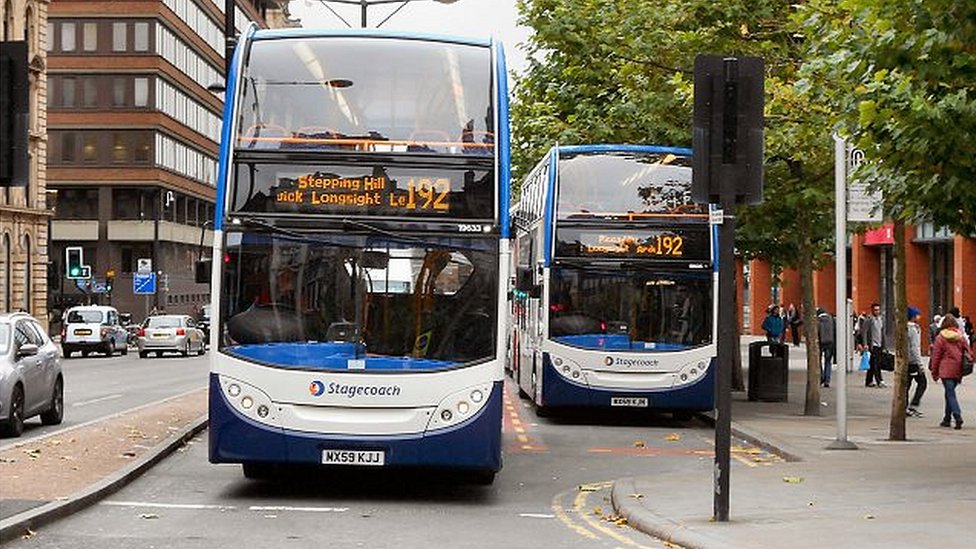
The litigation matters because it converted a campaign argument into an administrative-law test. Stagecoach and Rotala challenged the Greater Manchester Combined Authority’s decision to proceed with franchising. In March 2022, Mr Justice Julian Knowles dismissed all claims and held that GMCA had acted “lawfully and rationally.”[3]
That does not mean every franchising scheme will survive challenge. It means this model can survive a serious operator challenge where the statutory process is followed, the authority’s analysis is rational, and the decision-maker stays within the scheme Parliament created. A later Rotala appeal concerning Covid assessment audit grounds was also dismissed in June 2022.[4]
The policy record behind the move was also concrete. Burnham’s case for franchising included the fall in Greater Manchester bus journeys from 400 million to 200 million per year over 36 years of deregulation, and the contrast between fares of up to £4 in Greater Manchester and £1.65 in London.[5]
Those figures do not prove that franchising caused improvement; they explain why a public authority could rationally decide that the deregulated structure had failed its transport objectives. For judicial review purposes, that distinction is not academic. Courts are not asked whether franchising is ideologically preferable. They are asked whether the authority had power, used the right process, considered relevant material, avoided legal error, and reached a rational decision.
What the Bus Case Teaches for Other Sectors
The bus model is tempting because it separates control from ownership. The public authority does not need to buy every asset or employ every driver to set service standards, route priorities, ticketing rules, and accountability structures. It can use a statutory market-design power instead.
But the lesson cannot simply be exported by analogy. Buses had a specific franchising statute. Water and energy do not become franchisable merely because the public law logic is attractive. Any extension of that model needs either an existing sector power, a procurement route, a rescue regime, or new legislation.
The 2026 Act Supplies Devolution Capacity, Not a Blank Check
The English Devolution and Community Empowerment Act 2026 is still significant. By creating Strategic Authorities and giving statutory recognition to different tiers, it reduces the improvisational quality of English devolution. The extended general power of competence also matters because it widens the legal field in which authorities can act unless another rule restricts them.[1][2]
The section 45 health inequalities duty is easy to overlook, but it may prove important in transport, housing, environmental, and service-location decisions. It gives public authorities another required lens when making choices that affect access to work, care, clean environments, or essential services.[1]
Still, a general power of competence is not a sector-specific nationalization power. It cannot override procurement law, compensation obligations, company law, regulated asset structures, or central government spending controls. In U.S. terms, it is closer to a broad municipal capacity provision than to state sovereignty.
Rail Has Its Own Statutory Track
Rail sits between the bus example and full national infrastructure reform. The Railways Bill materials describe statutory roles for Mayoral Strategic Authorities in rail services.[6] That matters because rail integration cannot be accomplished by mayoral enthusiasm alone. Timetabling, infrastructure, national service planning, and funding settlements require a specific statutory settlement.
For Burnham’s agenda, the rail point is not that a mayor can simply take over the railway. It is that Parliament is creating a formal place for mayoral authorities inside the rail governance structure. That is a different kind of public control from bus franchising: less local unilateralism, more statutory participation in a national system.
Insourcing Runs Through Procurement Law
The Procurement Act 2023 and the June 2026 procurement policy note known as PPN 024 give Burnham a more immediate route for parts of the public ownership agenda that are really about service delivery. PPN 024 introduces a mandatory public interest test for service contracts over £1 million, and the Procurement Act permits social value weighting under section 90.[5][7]
That is not nationalization. It is a disciplined choice point. Before outsourcing or re-outsourcing a substantial service, a contracting authority must confront whether public provision better serves the public interest. In legal practice, that may be more consequential than a broad ownership slogan because it attaches to procurement decisions that authorities actually make.
The language around “British-based” suppliers also needs care. The point is not a free-standing power to discriminate in favor of domestic firms. The available commentary treats that wording as a way to remain conscious of the UK’s obligations under the WTO Government Procurement Agreement and the EU-UK Trade and Cooperation Agreement, both of which constrain nationality-based discrimination in covered procurements.[5][7]
PPN 024 is new enough that its litigation profile is still unclear. The legal risk is likely to sit in the quality of the authority’s public interest analysis, the treatment of incumbent contractors, equal treatment of bidders, and the boundary between permissible social value criteria and impermissible discrimination.
Water and Energy Are Not Buses
Water and energy are where the public-control language becomes most legally sensitive. A mayoral authority can point to the bus experience as a governance model: public specification, accountable planning, private or mixed delivery, and enforceable standards. But regulated utilities come with different statutes, financing structures, creditor rights, and national regulatory institutions.
The existing route that most closely resembles public control in a failing utility is special administration. The Thames Water situation shows why that route is powerful but contested. Sky News reported that creditors controlling about £17 billion of Thames Water’s £21 billion debt had engaged Pallas Partners to prepare a legal challenge if the company were forced into a public corporation.[8]
That report should be handled cautiously. It is not the same as a filed claim, a pleaded ground, or a judicial ruling. But it identifies the predictable fault line: if government moves from emergency stabilization toward public corporation control, creditors will scrutinize the statutory basis, valuation, compensation, procedure, and purpose.
Special administration is therefore not a general public ownership machine. It is an emergency statutory regime for continuity and rescue. It can put a failing utility under extraordinary control, but permanent ownership change still raises compensation and financing questions that franchising largely avoids.
The Fiscal Gap Is the Hardest Legal Fact
The unresolved issue is fiscal devolution. The UCL Constitution Unit has noted that the Treasury’s devolution roadmap pre-dated Burnham, and commentary on his plans has emphasized that the Barnett formula has been ruled out while genuine tax-raising autonomy remains unresolved.[9][10]
That matters because legal power and balance-sheet capacity are different things. A statutory authority may have competence to act, a procurement rule may make insourcing easier, and a sector statute may authorize intervention. None of that answers how compensation, operating subsidy, debt assumption, or capital investment will be funded.
Bond-for-shares nationalization is the clearest example. If compensation is legally required or politically unavoidable, the structure of the consideration does not eliminate the fiscal question. It changes the instrument through which the state pays. The constraint then becomes debt treatment, market credibility, fiscal rules, and Treasury tolerance.
This is where some public ownership arguments become least precise. They identify a failed privatized structure and assume that public acquisition is the next legally available step. Sometimes it may be. But in capital-intensive regulated sectors, the missing document is often not a manifesto page; it is a funded acquisition and compensation plan.
What Is Actionable as of Q3 2026
As of Q3 2026, the agenda separates into three legal categories.
- Law now permits: Strategic Authorities under the 2026 Act, mayoral general competence within statutory limits, bus franchising where the 2017 Act process is followed, and public interest scrutiny of large service contracts under the Procurement Act 2023 and PPN 024.
- Law may permit after process: further transport integration, rail participation through the Railways Bill framework, insourcing decisions supported by a defensible public interest assessment, and temporary utility control through special administration where statutory thresholds are met.
- Law would still need money or new legislation: permanent utility nationalization, large-scale bond-for-shares acquisition, extensive local tax autonomy, and any sector-wide public ownership model not already grounded in an enacted statutory route.
The strongest part of Burnham’s legal architecture is transport control. The bus franchising pathway has been enacted, used, and tested in court. The next strongest is procurement-based insourcing, although PPN 024 is too new to have a settled body of practice or case law. Devolution capacity is real but Treasury-shaped. Utility intervention is available in emergency form, but permanent ownership is where compensation and creditor rights move to the center.
The deliverability judgment is therefore mixed, not because the agenda lacks law, but because different parts of it sit at different points in the statutory system. Legal authority is no longer the main missing piece for devolution structures, buses, procurement choices, and emergency intervention in failing utilities. Fiscal devolution, compensation costs, untested PPN 024 application, possible Thames Water litigation, and post-transition Treasury constraints remain the places where the program may narrow.
References
- English Devolution and Community Empowerment Act 2026: A Comment, Thomas Poole and Elena de Nictolis, UK Constitutional Law Association, 19 May 2026, link
- English Devolution and Community Empowerment Act 2026, legislation.gov.uk, link
- Bus firms lose legal bid to block Greater Manchester public control plan, BBC News, link
- Rotala loses appeal over Greater Manchester bus franchising, Local Government Chronicle, 7 June 2022, link
- Public ownership: procurement, franchising and nationalisation, Travers Smith, link
- Railways Bill factsheet, GOV.UK, link
- Procurement Act 2023 and public interest test commentary, Browne Jacobson, link
- Thames Water lenders plot legal fight against nationalisation, Sky News, link
- Devolution under a Burnham government, UCL Constitution Unit, 29 May 2026, link
- This is what Andy Burnham’s devolution plans need to consider, The Conversation, link
Comments
Join the discussion with an anonymous comment.