
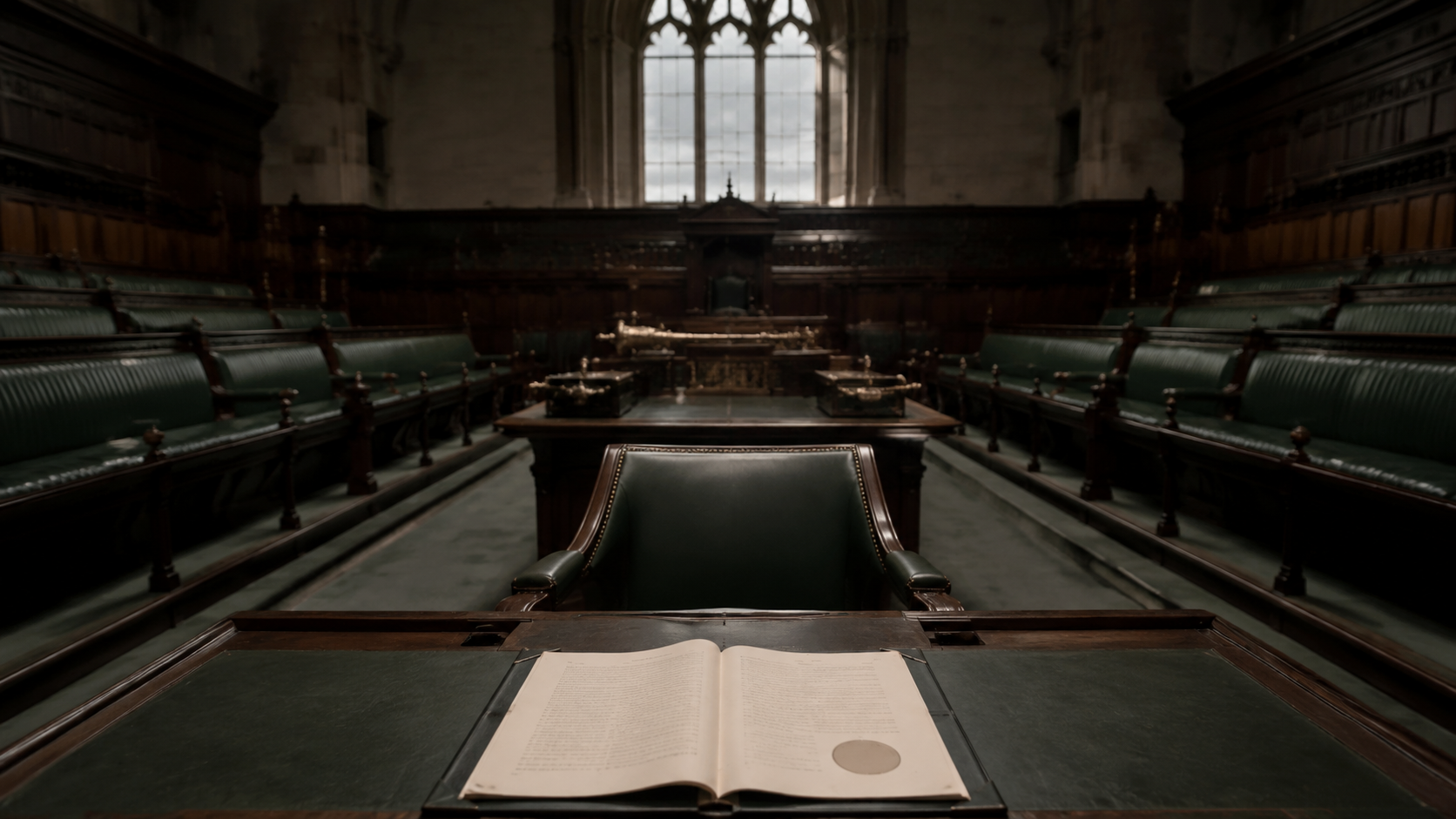
The C-130 theft case begins most usefully not with the aircraft over the Channel, but with a question in the House of Commons after it was already gone. On June 12, 1969, Eldon Griffiths rose during a Commons exchange about the unauthorized flight from RAF Mildenhall and made the point that turns a bizarre security breach into a legal pattern: “We had a similar occurrence in 1958 at Alconbury.” The ministerial answer that followed was calm, procedural, and revealing. The United States had reinforced its instructions; conventional transport aircraft did not operate under the two-man rule applied to nuclear-armed aircraft; and the British government did not present itself as having a direct lever over the American inquiry or the American base-security system.[1]
That is the point at which the story stops being an aviation anecdote. The legal question was not simply how one man reached an aircraft. It was who, after such an act, could demand documents, compel reforms, and prosecute a surviving offender when the servicemember belonged to a visiting force, the aircraft belonged to that force, and the airfield sat on British soil.
The Recurrence Griffiths Noticed
The earlier incident had occurred on June 13, 1958. Airman Vernon Morgan, described in the Aviation Safety Network record as an aircraft mechanic, stole a North American B-45 Tornado from RAF Alconbury and crashed shortly after takeoff; the record states that the crash occurred within three minutes and that Morgan died.[2] The later incident occurred on May 23, 1969, when Sergeant Paul Meyer took a Lockheed C-130 Hercules from RAF Mildenhall. Secondary accounts describe a 105-minute flight, an impersonation of an officer, and an RAF Canberra intercept before the aircraft crashed into the English Channel; Meyer also died.[3]
Those facts are enough for the legal problem. The details that usually make the 1969 episode memorable—the night flight, the intercept, the romance or desperation sometimes attached to Meyer in later retellings—do not decide jurisdiction. What matters is that both men were members of the United States Air Force, both aircraft were American military property operating from bases in England, and both deaths prevented a prosecution that might have forced the treaty framework into court.
Griffiths’s intervention in 1969 therefore did more than complain about lax security. By invoking Alconbury, he asked why a vulnerability known after a fatal theft in 1958 still appeared capable of recurrence in 1969. The minister, John Morris, did not answer by pointing to a British power to inspect, discipline, or compel. He answered by referring to United States instructions and internal American measures.[1]
From Security Question to Accountability Question
The June 1969 Commons exchange began as a question about aircraft security. That was inevitable: a military transport had been taken from a United States base in England without authority. But the answer exposed a second issue. Morris explained that the two-man rule applied to nuclear-armed aircraft, not to conventional transports such as the C-130. He also indicated that the United States had “already issued instructions reinforcing existing orders.”[1]
As a practical answer, that may have reassured some listeners. As a legal answer, it is thinner. Reinforced instructions are not the same thing as host-state control. They do not show that British authorities could require the United States Air Force to change its procedures, disclose its findings, or submit the matter to a British forum. They show that the United States, after embarrassment and loss of life, chose to tighten its own internal discipline.
The distinction became plainer in the follow-up exchange on July 8, 1969. Griffiths pressed on whether the government would obtain the transcript of the United States inquiry. Morris declined to seek it. The refusal matters less as a personal ministerial choice than as a jurisdictional symptom: Parliament could ask, but the British executive was not asserting a procedural right to acquire the American board-of-inquiry record.[4]
This is where the host-state problem appears most clearly. The United Kingdom had territorial sovereignty. Parliament had political standing to demand explanations from ministers. Yet the operational facts were inside an allied military system designed to preserve United States command discipline. A British MP could identify recurrence, ask for documents, and press for accountability; the answer still passed through American discretion.
The Treaty Framework Did Not Leave a Simple Empty Space
The gap was not created by the absence of law. It arose inside a legal framework dense enough to allocate jurisdiction in ordinary cases, but not clean enough to settle this one without litigation. The NATO Status of Forces Agreement, signed in 1951, gives the sending state the right to exercise criminal and disciplinary jurisdiction over persons subject to its military law. It also recognizes the receiving state’s jurisdiction over offenses committed within its territory and punishable by its law.[5]
Article VII is built around exclusive and concurrent jurisdiction. Where only the sending state’s military law is offended, the sending state has the jurisdictional claim. Where only the host state’s law is offended, the host state does. The harder cases are concurrent. In those, the SOFA gives the sending state primary jurisdiction over offenses solely against its property or security, or solely against another member of the force or a dependent, and over acts or omissions done in the performance of official duty. The receiving state has primary jurisdiction in other concurrent cases.[5]
A stolen American military aircraft in England sits awkwardly inside that language. One characterization points toward the United States: the aircraft was United States property, the alleged offender was a United States servicemember, and the obvious military offenses would have belonged to American military law. Another characterization points toward the United Kingdom: the taking and unauthorized operation occurred on British territory, created risks within British-controlled airspace and surrounding communities, and could be framed as conduct punishable under domestic law. The treaty text gives tools for argument; it does not, by itself, tell us which court would have prevailed in a contested prosecution.
The Visiting Forces Act 1952 was the United Kingdom’s domestic machinery for this arrangement. Section 3 addresses how United Kingdom courts deal with offenses connected to visiting forces and implements the SOFA structure in domestic law.[6] It did not give an MP a direct right to the transcript of a United States Air Force inquiry. Nor did it create an obvious parliamentary mechanism for compelling American base-security reforms after an aircraft theft.
| Issue | What the Materials Show | What Remained Untested |
|---|---|---|
| Base security | The United States reinforced existing orders after the 1969 C-130 theft. | Whether the UK could compel different procedures rather than rely on US voluntary action. |
| Inquiry access | Griffiths pressed for the US inquiry transcript; Morris declined to seek it. | Whether any legal or diplomatic route could have forced disclosure to Parliament. |
| Criminal jurisdiction | NATO SOFA and the Visiting Forces Act recognized overlapping US and UK interests. | Which forum would have had primary jurisdiction over a surviving aircraft thief. |
Why a Surviving Defendant Would Have Mattered
The deaths of Morgan and Meyer are not just tragic endpoints. They are the reason the jurisdictional question stayed theoretical. Had Meyer survived, the United States would have had obvious military-law charges available. Article 121 of the Uniform Code of Military Justice covers larceny and wrongful appropriation, and Article 85 covers desertion.[7][8] Depending on the provable facts and the charging theory, the unauthorized taking of a military aircraft and departure from duty could have been treated within that system.
That does not end the analysis. A United States charge sheet would not automatically answer whether the United Kingdom could also claim jurisdiction, or whether it would have primary jurisdiction over some domestic offense arising from the same conduct. Under Article VII, the difficult question would have been whether the conduct was best understood as an offense solely against United States property and military discipline, or as conduct also giving the host state a primary claim because it violated British law in a way not reducible to American property loss.[5]
No prosecution forced that question. No court had to decide whether stealing a United States aircraft from an English base was, for SOFA purposes, primarily a sending-state matter, a host-state matter, or a set of offenses capable of being divided by charge. No reported case in the materials supplied resolves the point for aircraft theft by a servicemember. The strongest conclusion is therefore narrower than a precedent claim: the incidents revealed a lacuna, not a litigated rule.
What Changed Between 1958 and 1969
The change visible in the available parliamentary record is not that the United Kingdom acquired a stronger legal instrument. It is that, by 1969, the Commons had a precedent to remember. Griffiths’s reference to Alconbury converted the Mildenhall theft from a singular failure into a recurrence. That gave the question a sharper institutional edge: if the first death had produced assurances, why should the second death be met with another assurance?
Morris’s answers did not deny the seriousness of the event. They did something more legally important: they stayed within the limits of what the British government appeared prepared to demand from an ally. The United States could issue instructions. The United States could conduct an inquiry. The United Kingdom could ask questions in Parliament. But when Griffiths pressed for the inquiry transcript, the government did not transform parliamentary concern into a demand for compulsory production.[4]
That posture is understandable within alliance practice. Visiting-force arrangements depend on discipline being maintained by the sending state and on the host state avoiding routine interference in allied command. But the very feature that makes the system workable in ordinary discipline cases makes it fragile after an incident that attracts public danger and parliamentary scrutiny. The host state bears the political consequences on its territory without necessarily controlling the evidence or the remedy.
The Modern Context Does Not Close the Historical Gap
The issue is not merely antiquarian. The House of Commons Library’s current briefing on United States forces in the United Kingdom places the continuing American presence at approximately 11,000 personnel as of 2026.[9] That figure does not imply that the same kind of aircraft theft is likely, and it says nothing by itself about modern base-security effectiveness. It does show that the legal architecture governing a large visiting force remains a live institutional subject, not a closed Cold War curiosity.
It would be too easy to treat the Morgan and Meyer cases as colorful exceptions and leave the legal framework untouched. It would also be too strong to say that they established a rule of jurisdiction. They did not. Both alleged offenders died. The 1969 United States accident report is not available in the supplied materials, and the public narrative of Meyer’s flight depends in part on secondary accounts rather than an accessible official report. The legal analysis therefore has to remain disciplined: the primary materials support a structural concern, not a solved doctrine.
That leaves the two thefts as a recurring jurisdictional lacuna rather than a pair of precedents. Parliament recognized the problem. The United Kingdom lacked a clear procedural lever to force American cooperation on inquiry access or reform. The jurisdictional question remains unresolved precisely because the only defendants who could have tested it never reached a courtroom.
References
- United States Aircraft (Unauthorised Flight), Hansard, June 12, 1969.
- ASN Wikibase Occurrence #153514, Aviation Safety Network.
- 1969 theft of C-130, Wikipedia.
- United States Aircraft (Unauthorised Flight), Hansard, July 8, 1969.
- Agreement between the Parties to the North Atlantic Treaty regarding the Status of their Forces, NATO, June 19, 1951.
- Visiting Forces Act 1952, legislation.gov.uk.
- 10 U.S. Code § 921 - Art. 121. Larceny and wrongful appropriation, Legal Information Institute.
- 10 U.S. Code § 885 - Art. 85. Desertion, Legal Information Institute.
- US military forces in the UK, House of Commons Library.
Comments
Join the discussion with an anonymous comment.