
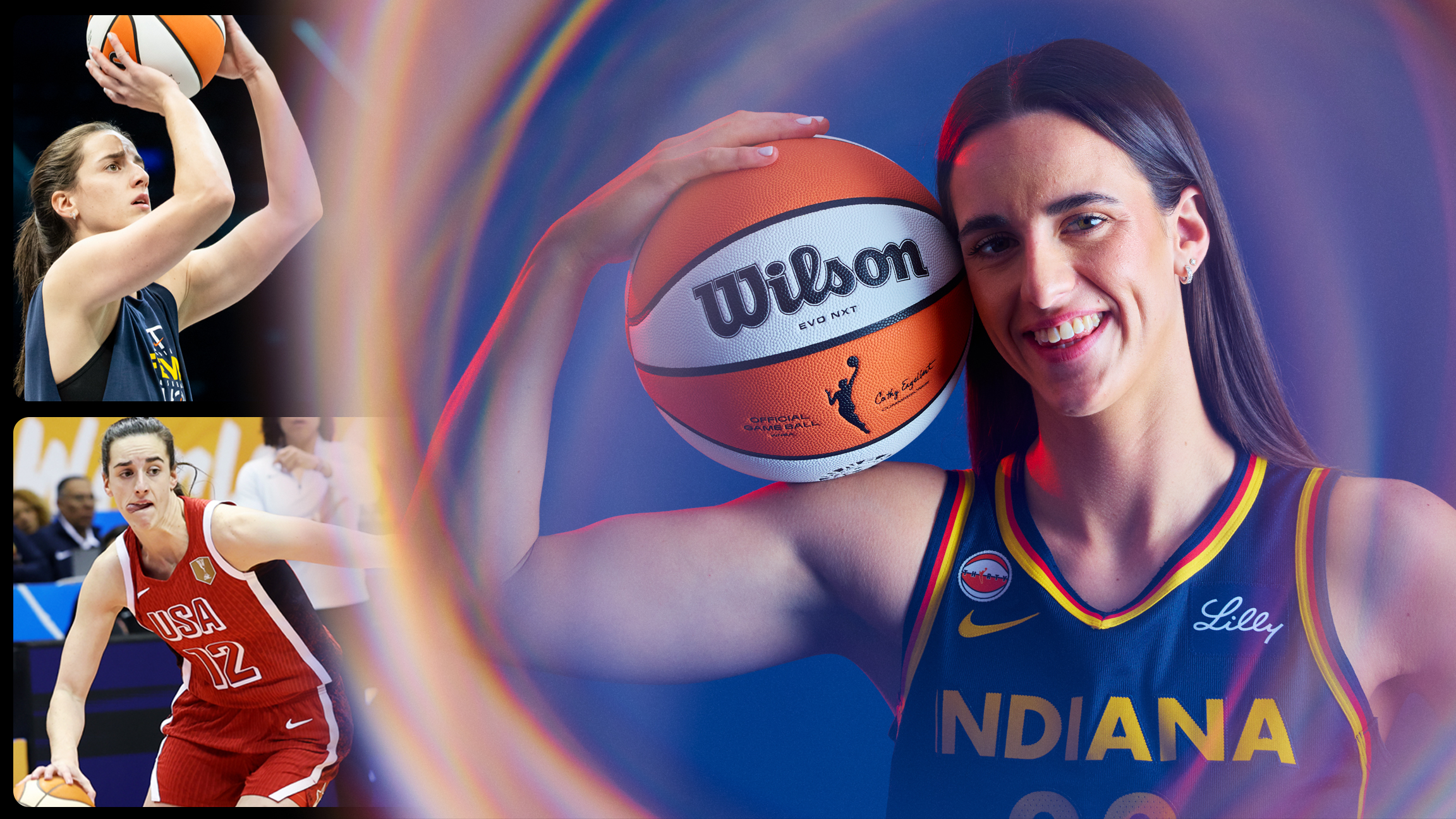
Caitlin Clark’s suspension risk is no longer a remote rules question. As of July 20, 2026, her technical-foul count sits in a reported 5-to-6 range, depending on the final status of a disputed June technical that was first reported one way and then corrected in later coverage.[1] That range matters because the current WNBA system triggers a one-game suspension at eight technical fouls, with each additional technical after that carrying another suspension risk.[2]
The public argument has mostly stayed at the level of individual calls: whether Clark clapped at an official, whether a particular reaction crossed the line, whether she receives different treatment because she is the league’s most visible player. Those questions are not irrelevant. But the legal issue is narrower and more consequential: once the whistle is blown, who has authority to decide whether the technical remains in the count?
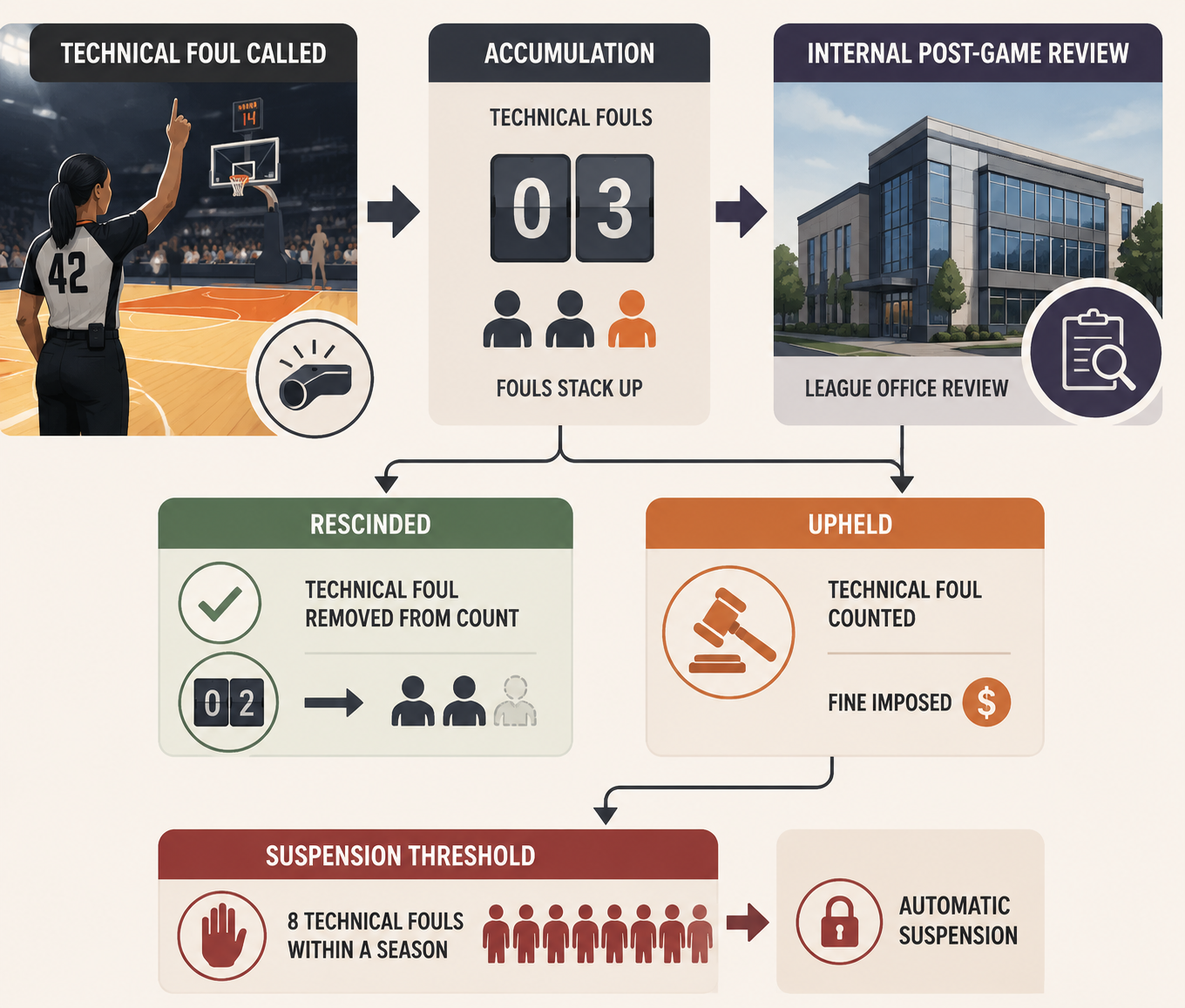
Under the WNBA’s disciplinary framework, the answer is not an independent arbitrator, at least not for ordinary in-game technical-foul accumulation. The system runs through league authority: referees call technicals in real time, the count accumulates, fines attach on a tiered schedule, and the league office may review and rescind or uphold a technical after the game. That internal review power can change the practical result. It can also leave outsiders unable to see why one technical survives and another disappears.
The Suspension Rule Is Simple; The Count Is Not
A technical-foul suspension system looks mechanical from a distance. A player accumulates technicals. The league counts them. At a threshold, suspension follows. In 2026, the threshold is eight technical fouls.[2] Clark’s reported 5-to-6 count places her close enough that a single rescission is no longer a bookkeeping detail. It changes how much room she has for the rest of the season.
That uncertainty matters legally because it shows how the rule actually operates. If Clark has five technicals, she can receive two more before the next one reaches the suspension line. If she has six, the cushion is thinner. The difference turns on an internal post-game process that can remove a technical from the record, not on a public hearing or a formal adversarial appeal.
| Stage | What Happens | Why It Matters For Clark |
|---|---|---|
| In-game call | An official assesses a technical foul during play. | The call immediately enters the working count unless later changed. |
| Accumulation | Technicals are tracked across the season. | Clark’s reported count is 5–6 as of July 20, 2026. |
| Fine | A tiered fine applies depending on how many technicals the player has accumulated. | Her current range falls within the middle fine tier. |
| League review | The league office can uphold or rescind the technical after the game. | A rescission changes both the public count and the suspension runway. |
| Suspension threshold | The eighth technical triggers a one-game suspension. | The disputed June technical determines how close Clark is to that line. |
The legal structure is spare. The key act is not a courtroom-style appeal. It is league review. For a player approaching a suspension line, that distinction does much of the work.
What Review Can Fix, And What It Does Not Expose
Post-game review is not cosmetic. It can determine whether a player is punished for conduct that, after a calmer look, the league decides should not count. Diana Taurasi’s prior experience is the useful calibration point: a seventh technical was rescinded on league review, changing the consequence that would otherwise have followed from the accumulation system.[3]
That example cuts both ways. It shows the league has a mechanism to correct calls after the game. It also shows that the mechanism is centralized. The public can usually see the result, but not necessarily the reasoning, the standard applied, the internal reviewer, or whether comparable technicals were treated consistently.
Clark’s disputed June technical made that opacity visible. Coverage initially indicated that the technical had been rescinded, then later reporting corrected the status and placed her count in the 5-to-6 range depending on that appeal’s treatment.[1] The legal significance is not that a media correction proves unfairness. It does not. The significance is that a disciplinary event with suspension implications could not be reliably understood from outside the league process while the player’s seasonal count was becoming materially important.
A labor lawyer would not automatically expect every in-game call to produce a full evidentiary hearing. Sports leagues need speed, uniformity, and authority over game conduct. But when an accumulation system converts subjective in-game reactions into escalating fines and suspension, review becomes more than a courtesy. It is the only procedural valve in the system.
That is where the CBA framework matters. A collectively bargained disciplinary system receives substantial legal respect precisely because it is part of the parties’ labor arrangement. Courts reviewing sports discipline often ask whether the decision draws its essence from the agreement, a deferential posture familiar from high-profile league discipline litigation.[4] If the WNBA’s governing documents authorize league control over technical-foul discipline, the league has broad room to administer that system.
But contractual authority does not answer every process question. It answers a narrower one: whether the league has a bargained-for basis to act. It does not make the process transparent. It does not make internal explanations public. It does not give a player the kind of independent review that employees in other disciplinary settings might expect when accumulated infractions put work time and compensation at stake.
The Fine Schedule Looks Harsher Until Salaries Enter The Frame
The 2026 CBA made the nominal technical-foul fines larger. The reported fine schedule is $500 for technicals one through three, $1,000 for technicals four through seven, and $1,500 for the eighth and later technicals. The prior schedule was $200, $400, and $800.[2] On its face, that is a meaningful increase.
In labor terms, however, nominal dollars are the wrong stopping point. The same 2026 framework raised the team salary cap to $7 million from $1.5 million and the minimum salary to $270,000 from $66,000.[5] Against that floor, a $1,000 mid-tier technical is roughly 0.37 percent of a minimum salary. Under the prior $66,000 minimum, a $400 mid-tier fine was roughly 0.61 percent.[5]

That comparison is not a defense of every fine. It is a proportionality point. The economic bite of each technical appears smaller relative to the new salary structure, even though the league raised the dollar amounts. If Clark is paid above the minimum, the relative burden is lower still; her exact 2026 salary is not confirmed in the available materials, so the minimum salary is the conservative baseline.
This is why the suspension count is more important than the fine schedule in Clark’s case. A $1,000 fine can be material, especially for players outside the league’s highest compensation tier. But for a high-profile player nearing eight technicals, the legal pressure point is no longer primarily the money. It is the conversion of disputed conduct calls into lost game availability.
Comparable Cases Show The Trigger Is Real
Natasha Cloud’s 2024 suspension is the cleanest reminder that accumulation systems are not theoretical. Under the prior rule, she was suspended after reaching seven technical fouls.[6] That old threshold differs from the current eight-technical line, but the lesson carries over: once the count reaches the trigger, the penalty can move from financial to competitive.
Clark had already lived near this line before the 2026 season. In 2024, she finished with six technicals, one short of the then-existing seven-technical suspension threshold.[7] The 2026 version is not a new public fascination invented from nothing. It is the continuation of a recurring accumulation problem, now under a revised CBA and a higher suspension trigger.
Taurasi’s rescission and Cloud’s suspension do not prove inconsistency by themselves. They prove that two parts of the machinery matter: the line can be enforced, and review can keep a player from crossing it. That is enough to make Clark’s disputed technical legally relevant even before she reaches eight.
Due Process Is The Harder Question
The phrase “due process” can do too much work in sports discipline debates. It can mean constitutional due process, contractual process, workplace fairness, public transparency, or simply the fan’s belief that an official got the call wrong. Those are different claims.
The stronger legal critique of the WNBA technical-foul system is not that every player is entitled to litigate every technical. It is that the system creates accumulated employment consequences through fast, subjective game decisions, then places the meaningful corrective authority inside the league office. That may be contractually permissible. It is still procedurally thin.
A broader due-process critique of U.S. professional sports discipline has already been made outside the WNBA context. The University of Texas at Austin Human Rights Clinic issued a 98-page report finding that U.S. pro sports disciplinary systems “do not guarantee due process” under international human-rights-law standards, according to coverage by the Austin Chronicle.[8] That report is not the governing law for Clark’s technical-foul count. It is useful because it identifies the same pressure point: league-administered discipline often gives management-side institutions the final practical word.
The CBA answer is predictable: the union and league bargained for the disciplinary system, and the Commissioner’s office has authority to maintain order and enforce conduct rules. That answer carries real legal weight. Collective bargaining is not a footnote; it is the source of the system’s legitimacy.
Still, “the players agreed to it” is not the end of the analysis for anyone trying to evaluate fairness rather than enforceability. A negotiated process can be binding while remaining opaque. A league can have authority while still failing to explain how similarly situated technicals are reviewed. A player can be subject to a valid rule and still have reason to object when that rule depends on discretionary calls that accumulate quietly until the suspension line is close.
What Clark’s Case Actually Shows
Clark’s 2026 technical-foul situation does not prove that the WNBA is targeting her. It also does not prove that the league is protecting her by rescinding calls or managing her count. The available record supports a more limited conclusion: she is close enough to the eight-technical suspension threshold that every post-game review now has disciplinary significance beyond the box score.
The WNBA’s CBA-based framework gives the league broad contractual authority to administer technical-foul discipline. Technicals accumulate. Fines escalate. The eighth technical triggers suspension. The league can review and rescind a technical after the game. But the available materials do not show an independent arbitral process for ordinary in-game technical accumulation.
The fine structure has become less severe relative to the new salary floor, which makes the procedural stakes stand out more clearly. The money is not meaningless, but the sharper question is who controls the count that can take a player off the floor. In Clark’s case, that control sits largely with the league’s internal process.
That arrangement is likely strong as a matter of contractual authority. It is less satisfying as a matter of transparent discipline. Clark’s current count exposes the tradeoff built into the system: efficient league control over game conduct, bought at the cost of public visibility into the review decisions that decide whether a technical remains merely a moment of frustration or becomes one step toward suspension.
References
- Caitlin Clark 2026 technical foul count and appeal status reporting, The Athletic, Yahoo Sports, Bleacher Report.
- WNBA Slightly Raises Technical, Flagrant Foul Fines for 2026 Season, Yahoo Sports / Front Office Sports.
- Diana Taurasi seventh technical foul rescission reporting, WNBA technical foul coverage.
- WNBA labor and antitrust litigation framework analysis, Sportico, October 2025.
- WNBA CBA explainer, Her Hoop Stats.
- Natasha Cloud suspended after seventh technical foul, WNBA.com, 2024.
- Caitlin Clark finished 2024 season with six technical fouls, Sports Illustrated / Indiana Fever coverage.
- UT-Austin Human Rights Clinic report coverage on due process in U.S. pro sports discipline, Austin Chronicle.
Comments
Join the discussion with an anonymous comment.