
The first legal question in California earthquake preparedness is not whether earthquakes are foreseeable. It is which layer applies to the property in front of you. A pre-1978 Los Angeles soft-story apartment building, a San Francisco Tier IV building with a missed deadline, a hospital subject to HCAI seismic standards, a commercial building transfer requiring Form 315-1, and a remodel that crosses a building-code cost threshold do not sit in the same compliance box.
California's earthquake preparedness legal requirements are best read as a routing problem. The exposure usually begins when a memo treats them as one statewide retrofit mandate instead of separating local ordinances, transaction disclosures, project-triggered code duties, and special-use rules.

Start With the Applicability Layer
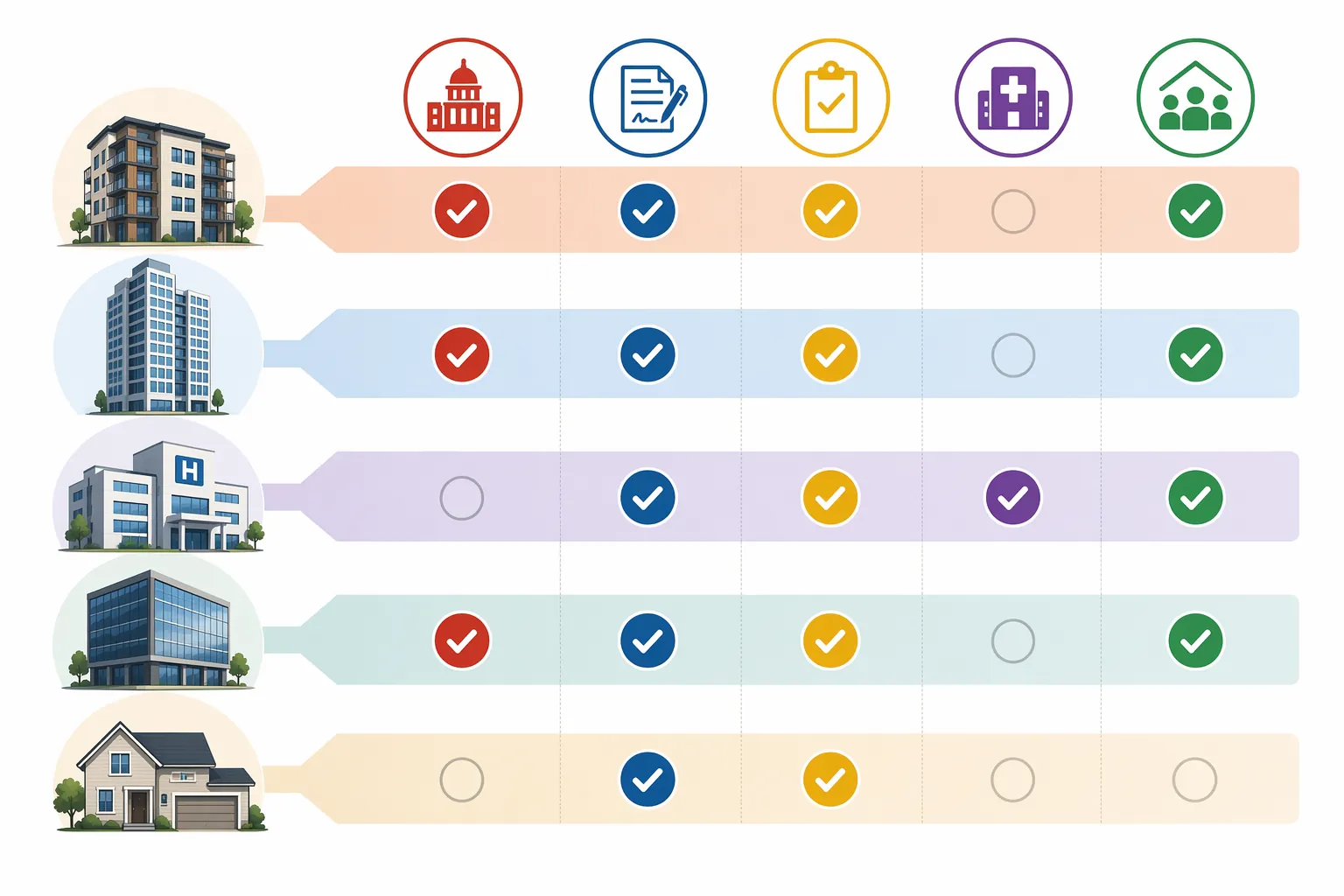
For diligence, disclosure schedules, portfolio reviews, and landlord-side compliance, the useful first pass is not a construction diagnosis. It is a legal classification exercise: building type, construction date, unit count, jurisdiction, use, transaction posture, and whether an order to comply has already issued.
| Property or role | Primary earthquake-related layer to check | What usually decides applicability |
|---|---|---|
| Wood-frame multifamily soft-story building | City or county retrofit ordinance | Jurisdiction, construction date, number of stories or units, and any order to comply |
| Commercial building sale or transfer | Commercial earthquake disclosure | Pre-1975 status or structural category such as tilt-up, non-ductile concrete, soft-story, URM, or steel-frame |
| Residential sale | TDS, NHD, and possibly Residential Earthquake Hazards Report | Known defects, mapped hazard zones, and whether the home is pre-1960 |
| Major remodel or alteration | Building-code seismic upgrade trigger | Project scope and whether remodel cost crosses the applicable threshold |
| General acute care hospital | HCAI seismic performance requirements | SPC and NPC status, reporting, public notice, and the 2030 deadline |
| Landlord of covered housing | Local retrofit duties, habitability, tenant notice, and possible cost pass-through | Local ordinance status, lease context, and known seismic vulnerability |
| Employer or workplace operator | Cal/OSHA hazard obligations | Whether an earthquake-related condition is a recognized workplace hazard |
This table does not answer whether a particular building complies. It tells the reviewer which official record to pull next. That distinction matters because several of the most important California earthquake obligations are not statewide, and several statewide rules are disclosure rules rather than retrofit commands.
Soft-Story Retrofit Duties Are Local, Deadline-Driven, and Easy to Misfile
Soft-story ordinances are where the patchwork becomes most visible. The shorthand “California requires soft-story retrofits” is wrong as a legal conclusion. The better sentence is narrower: certain California cities require specified classes of older, usually wood-frame multifamily buildings to evaluate or retrofit under local ordinances, often on a schedule tied to building tiers or individual orders to comply.
San Francisco’s program, adopted in April 2013, covers wood-frame buildings permitted before 1978 with three or more stories and five or more units. The Tier IV completion deadline was extended to September 15, 2021, which means any still-unresolved Tier IV property should be treated as a deadline problem, not merely a future planning item.[1]
Oakland’s Ordinance 13516, adopted in 2019, covers pre-1991 buildings with five or more units. Tier 1 and Tier 2 deadlines had passed as of February 2024, and the Tier 3 deadline was February 21, 2025. Unless local law has changed for a specific property class, that date is now also in the past.[1]
Los Angeles is different in the way lawyers most often experience it: by order date. Ordinance 183893 covers pre-1978 wood-frame buildings with four or more units, affecting roughly 13,500 structures. Compliance runs seven years from the individual Order to Comply date, with orders issued in priority phases beginning in May 2016.[1]
That order-based structure changes diligence. A property cannot be cleared by saying only that the ordinance exists or that the city has a seven-year period. The file needs the actual order, the date of service, the building’s phase if relevant, and the current permit or construction status.
Berkeley’s January 2014 ordinance covered pre-1978 buildings with five or more units, a class described as more than 300 structures. Permit applications were required by December 31, 2016, with construction required within two years of submittal.[1] Long Beach has a Building Resiliency Program covering soft-story residential buildings constructed before 1980, though the available source here is a commercial seismic provider rather than the municipal ordinance text.[2]
The pattern is more important than a city-by-city recital. The same building can move from “not covered” to “past deadline” when one variable changes: unit count, permit date, city boundary, or order status. A five-unit Oakland building built before 1991 and a four-unit Los Angeles building built before 1978 do not point the reviewer to the same legal schedule, even though both may be described casually as soft-story multifamily.
Non-Ductile Concrete and County-Level Movement
The same classification problem appears outside soft-story wood-frame apartments. Los Angeles non-ductile concrete buildings face a 25-year compliance window under the ordinance information summarized by WJE’s database.[1] Los Angeles County voted in 2023 to require all non-ductile high-rises to be retrofitted within 10 years, according to a commercial construction source; that is useful routing information, but counsel should verify the operative county materials before treating it as the final legal text.[3]
Disclosure Rules Travel Across Transactions Even When Retrofit Duties Do Not
A sale can carry earthquake-related legal work even when no city retrofit ordinance applies. The disclosure layer is often broader than the retrofit layer because it asks what the seller knows, what the property maps show, and whether the property falls into a statutory reporting category.
For residential transactions, California Civil Code section 1102’s Transfer Disclosure Statement requires sellers to disclose known material defects, including earthquake damage, foundation problems, and structural modifications.[4] That is not an engineering warranty. It is a disclosure duty tied to known conditions.
Natural Hazard Disclosure reports add another route into earthquake information. For residential transactions, NHD reports must identify whether the property is in an Earthquake Fault Zone under the Alquist-Priolo Act or in a Seismic Hazard Zone, including liquefaction and landslide areas.[4] This layer is map-based; it does not depend on whether the building has already been damaged.
Older residential property has a separate form requirement. Sellers of pre-1960 residential property must deliver the Residential Earthquake Hazards Report, Form 315, and the Homeowner’s Guide to Earthquake Safety booklet.[4] In a closing file, that requirement should not be collapsed into the TDS or NHD just because all three documents mention seismic risk.
Commercial property has its own disclosure path. Sellers of pre-1975 commercial buildings, and sellers of buildings in categories such as tilt-up, non-ductile concrete, soft-story, unreinforced masonry, or steel-frame, must deliver the Commercial Property Earthquake Disclosure Report, Form 315-1, and the Commercial Property Owner’s Guide.[4]
| Transaction item | Applies to | What it does not necessarily do |
|---|---|---|
| TDS under Civil Code section 1102 | Residential sales covered by the statute | Does not convert every unknown seismic issue into a known disclosed defect |
| NHD report | Residential transactions with mapped natural hazard disclosures | Does not determine whether the structure itself complies with a retrofit ordinance |
| Form 315 | Pre-1960 residential sellers | Does not require the seller to complete a retrofit before sale |
| Form 315-1 | Covered commercial sellers, including specified older or vulnerable structural categories | Does not replace review of local retrofit ordinances or orders to comply |
The caveat is important enough to keep in the file: state law, as summarized in the available source, does not require sellers to hire inspectors, remove siding or drywall, or complete retrofits before sale. The liability concern is different. A seller who fails to disclose known seismic deficiencies can face post-sale exposure.[4]
For an acquisition team, that means “no retrofit required before closing” is not the same as “no earthquake-related closing issue.” The diligence question becomes whether the correct forms were delivered, whether local orders exist, whether known defects were disclosed, and whether the purchase agreement allocates the risk of further investigation.
Remodels Can Trigger Seismic Work Without a Sale or Local Soft-Story Order
A property that is clean on transaction disclosures and outside a named local retrofit class can still encounter seismic obligations through the building permit process. Under the building-code trigger described in the available remodeling source, seismic upgrade requirements may activate when remodel cost exceeds 50% to 75% of assessed replacement value, with added project costs estimated at $10,000 to more than $50,000.[5]
Those numbers should be handled carefully. They are not a statewide price schedule and not a legal conclusion for every permit counter. They show why counsel reviewing a renovation budget should ask whether the scope has crossed a seismic-trigger threshold and which building department will calculate it.
This is also where a generic “preparedness” label becomes unhelpful. The operative facts are permit valuation, assessed replacement value, alteration scope, structural work, and local plan-check interpretation. The person signing a diligence memo needs those facts, not a general statement that California encourages resilience.
Hospitals Are the Exception Where Statewide Seismic Standards Dominate
Hospitals belong in a different column. General acute care hospital buildings must achieve SPC-4D or higher, meaning full post-earthquake operational capability, and NPC-5 for non-structural systems by January 1, 2030, according to HCAI’s seismic compliance framework.[6]
The scale explains why hospital seismic compliance is not just a facilities issue. A 2019 RAND study for the California Hospital Association estimated statewide compliance costs at $34 billion to $143 billion, and CalMatters reported in January 2023 that roughly 62% of California hospitals had at least one non-compliant building while 40% of hospitals were in “severe financial distress.”[7]
The deadline has also become a public-notice issue. AB 1882, effective in 2023, requires public notification of hospital seismic compliance status through signage QR codes and annual status reporting to HCAI.[7] Governor Gavin Newsom vetoed SB 1432 in 2024, a bill that would have extended the 2030 deadline to 2035.[7]
For real-estate and corporate counsel, the hospital point is not that every property should be analyzed like a hospital. It is the opposite: hospitals show what a true statewide, use-specific seismic regime looks like. Most other California properties require local and transactional routing before anyone can say what is mandatory.
Landlords, Tenants, and Employers Add Liability Layers
A landlord’s file can include more than the city ordinance deadline. Commercial seismic sources frame the implied warranty of habitability as including seismic safety, with code violations potentially pleaded as a breach.[8] That proposition should be verified against controlling case law and the specific lease or tenancy context, but it is a practical warning against treating retrofit compliance as only an administrative matter.
Cost allocation can also be ordinance-specific. Los Angeles allows landlords to split retrofit costs with tenants through rent increases of up to $38 per month for the tenant’s share, according to the available commercial source.[8] That figure is not portable to another city and should not be used without checking the current Los Angeles rent and housing materials.
Liability history is often cited in this area, but the source quality matters. Commercial seismic materials point to a 2010 Paso Robles appeals ruling holding property owners liable for earthquake deaths even though the city’s retrofit deadline had not yet passed, and to multi-million-dollar settlements after Northridge Meadows in 1994 and Loma Prieta in 1989.[8] Those references are useful issue-spotters; they should be checked against court records before being relied on in a legal opinion.
Employers have a separate workplace-safety route. CRMP describes Cal/OSHA Title 8’s general duty clause as potentially reaching seismic hazards that could cause injury during an earthquake when they constitute a recognized hazard.[9] That is a narrower proposition than saying every employer has a retrofit duty. The relevant question is whether a known workplace condition creates a recognized hazard under the facts.
Statewide Inventory Efforts Do Not Replace Local Verification
AB 2681 expanded statewide inventory and notification frameworks, increasing the likelihood of additional local mandates, according to CRMP.[9] That development is worth watching for portfolio owners because it can make previously quiet building classes visible to regulators and local governments.
It still does not create a single California earthquake retrofit rule for all buildings. Inventory, notice, disclosure, retrofit command, tenant pass-through, and hospital operational standard are different legal events. A compliance chart that treats them as interchangeable will mislead the person who has to decide whether a closing condition, reserve, covenant, or notice is required.
A Disciplined Verification Protocol
The safest legal approach is to narrow the property before expanding the research. Confirm the building type, construction date, unit count, jurisdiction, transaction status, existing orders to comply, remodel scope, and official deadline source. Then separate the answer into retrofit duty, disclosure duty, project-triggered code duty, and special-use or ownership duty.
- Pull the municipal ordinance or agency material before relying on a contractor or consulting-firm summary.
- For soft-story buildings, identify the covered class and the actual deadline mechanism, especially whether it is tier-based or tied to an individual order to comply.
- For sales, separate TDS, NHD, Form 315, and Form 315-1 instead of treating “earthquake disclosure” as one document.
- For remodels, ask whether the permit valuation or alteration scope crosses a seismic upgrade threshold.
- For hospitals, landlords, and employers, check the special statutory, tenant, habitability, notice, and workplace-safety layers before closing the file.
This article is a legal reference resource, not legal advice. Its practical point is limited but important: earthquake preparedness legal requirements in California become manageable only after the property is put in the right legal category. The exposure comes from skipping that classification step.
References
- Seismic Ordinances, WJE SeismicOrdinances.com
- Long Beach Soft Story Retrofit, Saunders Seismic
- Los Angeles County Non-Ductile Concrete Retrofit, SKS Construction, 2023
- Earthquake Hazards Disclosure, firsttuesday Journal
- California Seismic Retrofit Requirements, Custom Home
- Hospital Seismic Safety, California Department of Health Care Access and Information
- California hospitals face 2030 seismic deadline, CalMatters, January 2023
- Landlord Liability and Seismic Retrofit Requirements, Optimum Seismic
- Earthquake Preparedness and Mitigation for Businesses, California Residential Mitigation Program
Comments
Join the discussion with an anonymous comment.