
The cleanest way into MAGA Inc.’s campaign-finance implications is not through the size of the checks. It is through the $20 million that Save America, Donald Trump’s leadership PAC, sent to Make America Great Again Inc. in 2022 after Trump had become a federal candidate. Campaign Legal Center’s pending FEC complaint treats that transfer as a soft-money problem: a federal candidate, through a committee he controlled, allegedly moved funds raised outside the contribution limits and source restrictions that would apply to his authorized campaign into a super PAC supporting him.[1]
That is a more precise question than whether MAGA Inc. is “dark money” or whether Trump has unusually wealthy allies. Save America is a leadership PAC. MAGA Inc. is a super PAC. Securing American Greatness is a 501(c)(4) social-welfare organization. Other fundraising vehicles, including the reported White House ballroom fund, sit outside ordinary FEC committee reporting altogether. Each container carries a different disclosure rule, source restriction, candidate-control rule, and enforcement hook. The legal character of the money changes, or appears to change, when it crosses from one container to another.
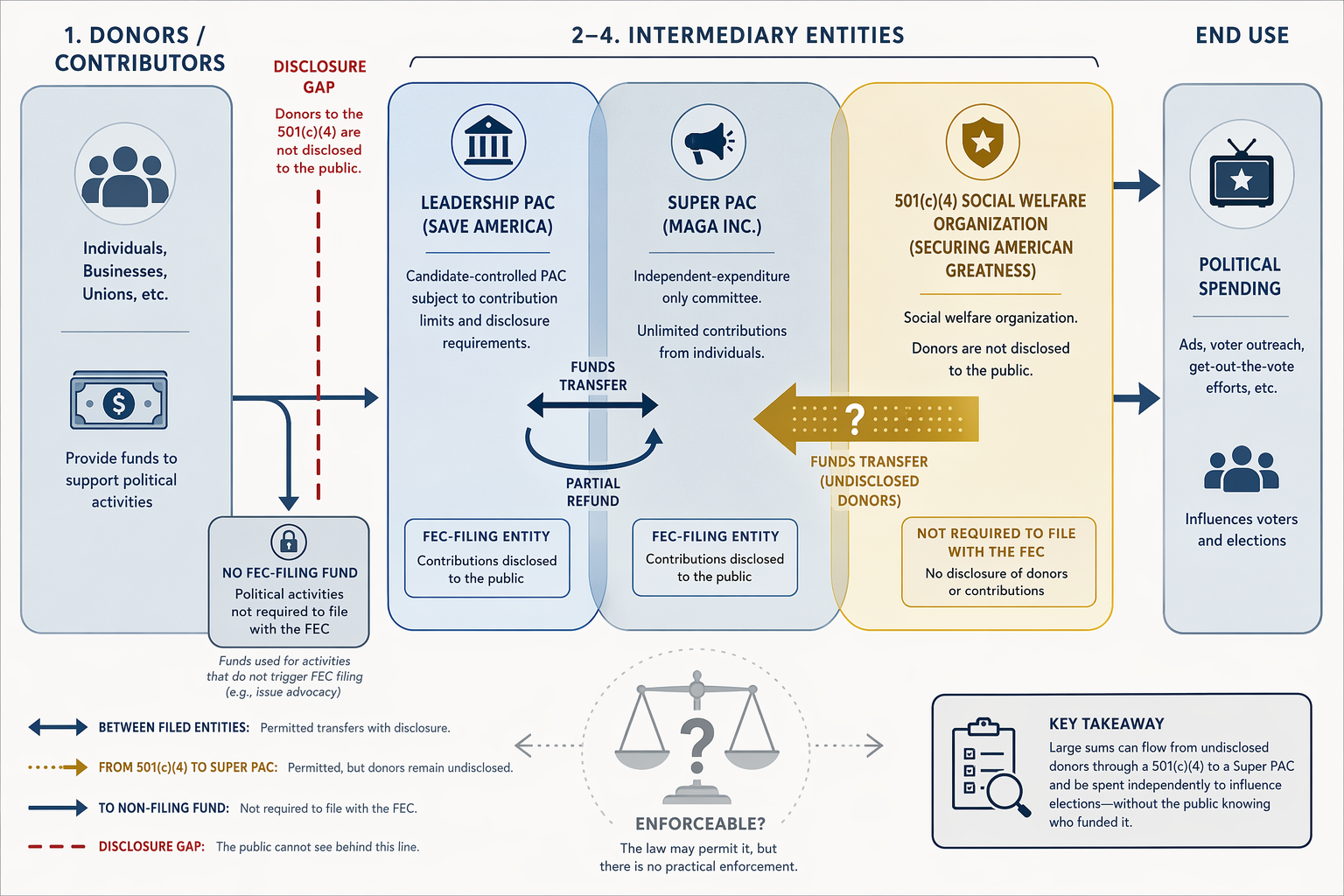
For a compliance officer, the map matters more than the branding. A report may show a transfer. It may show a refund. It may show a contribution from an LLC. It may show a super PAC receipt from a nonprofit. What it will not necessarily show is the original donor, the practical controller, the understanding attached to the money, or whether a statutory restriction should have followed the funds across the boundary.
The Save America Transfer Tests the Soft-Money Wall
The Save America-to-MAGA Inc. transfer is load-bearing because it puts the candidate-status issue in the foreground. Leadership PACs may raise and spend money for political purposes, but they are not authorized candidate committees. Super PACs may accept unlimited contributions and make independent expenditures, but they may not coordinate with candidates. Federal candidates and officeholders, meanwhile, face soft-money restrictions: they generally may not solicit, receive, direct, transfer, or spend funds in connection with a federal election unless those funds comply with federal limits, prohibitions, and reporting requirements.
CLC’s complaint alleges that Trump was already a federal candidate when Save America transferred $20 million to MAGA Inc., and that the transfer therefore violated the soft-money ban.[1] The theory is not that a super PAC may never receive large checks. The theory is that money under a candidate’s control cannot be routed through a leadership PAC into a supportive super PAC if the funds do not satisfy the federal restrictions that would apply to candidate-linked money.
That distinction is easy to lose in ordinary political coverage. A super PAC’s ability to accept unlimited contributions does not answer the candidate-control question. Nor does the leadership PAC label end the inquiry if the facts show that a federal candidate used it to move money in connection with his own election. The relevant legal question is not whether MAGA Inc. had a different committee ID. It is whether the restriction attached to Trump and Save America should have followed the funds into the super PAC.
| Vehicle | Reported Role | Compliance Seam |
|---|---|---|
| Save America | Leadership PAC associated with Trump | Candidate-control and soft-money restrictions when funds are moved after candidacy |
| MAGA Inc. | Super PAC supporting Trump | Unlimited receipts, independence requirement, and disclosure limited to reported payors |
| Securing American Greatness | 501(c)(4) social-welfare organization | Donors behind the nonprofit may remain undisclosed when the nonprofit transfers funds |
| White House ballroom fund | Reported non-FEC-filing fundraising vehicle | No ordinary FEC contribution report for donors to inspect |
The later refund makes the issue less tidy, not less important. Save America requested and received more than $12 million back from MAGA Inc. in 2023, according to accounts citing FEC filings.[2] A refund can reduce the amount retained by the super PAC and may narrow the practical effect of the original transfer. But it does not automatically answer whether the original movement of funds violated the soft-money restriction at the moment it occurred.
Refunds are familiar in campaign finance compliance. Committees use them to cure excessive, prohibited, or otherwise problematic receipts. But the Save America loop is not a simple excessive-contribution refund from a donor to a committee. It is a transfer from a candidate-linked leadership PAC to a super PAC, followed by money moving back after the soft-money theory was already in view. The refund may matter to remedy, intent, amount, and continuing violation analysis. It does not erase the need to decide which rule governed the original transfer.
That is precisely the sort of question the FEC would normally be asked to test: Was Trump a candidate for purposes of the soft-money ban? Did Save America function as a candidate-controlled source of funds? Were the funds used in connection with a federal election? Did the subsequent refund cure, mitigate, or leave untouched the alleged violation? The public reports show enough to frame the legal theory. They do not decide it.
The 501(c)(4) Pipeline Shows Where Disclosure Stops
The Securing American Greatness-to-MAGA Inc. transfers raise a different problem. The issue is not candidate soft money in the first instance. It is donor opacity. A 501(c)(4) can receive funds from donors whose identities are not publicly disclosed in the same way super PAC donors are. When that nonprofit transfers money to a super PAC, the super PAC can report the nonprofit as the source. The public still does not see who supplied the nonprofit’s funds.
Brennan Center analysis described Securing American Greatness as a dark-money source for MAGA Inc., and CNN, citing New York Times reporting, placed the scale of the pipeline in the range of $13.8 million to $21 million.[3][4] The exact figure depends on the reporting window and characterization of the transfers, but the compliance point does not depend on choosing the larger number. The disclosure system reveals the entity-level transfer while leaving the underlying donors untraceable to the public.
This is why “dark money” is too blunt a label. The hidden donor is not necessarily hidden at every point in the chain. MAGA Inc. reports a receipt. The reported source is Securing American Greatness. The opacity begins one level earlier, where the nonprofit’s donors do not appear on the super PAC’s FEC report. The harder enforcement question is whether any earmarking, agency relationship, conduit arrangement, or coordination theory would permit regulators to look through the nonprofit and identify the original donor as the legally relevant source.
Without that look-through theory, the formal record can be both accurate and incomplete. A super PAC can disclose the payor named on the check while the public remains unable to assess whether the original money came from a prohibited source, a donor seeking a particular governmental outcome, or a cluster of donors whose collective role would matter politically. Disclosure law then regulates the visible transaction, not necessarily the economic source of the funds.
LLCs and Subsidiaries Create Sharper Source Problems
The LLC complaints sharpen the same disclosure issue. Campaign Legal Center filed a complaint involving ML Organization LLC, alleging that an apparent shell company was used to funnel undisclosed money to MAGA Inc. through $1.2 million in contributions.[5] Building Our Future Today LLC has also been flagged in this context.[5] The legal theory here is not merely that an LLC gave money. It is that the named contributor may not be the true source.
Federal campaign finance law has conduit and straw-donor rules because disclosure would be meaningless if a donor could simply place another legal person between itself and the committee. But enforcement turns on facts that are rarely visible from the face of an FEC report: who capitalized the LLC, whether it had real business activity, who directed the contribution, and whether the funds were provided for the purpose of making the political payment. A shell-company allegation is therefore a demand for investigation, not a conclusion that can be drawn from the committee report alone.
The federal-contractor issue is narrower and more technical, but it belongs on the same map. Public Citizen identified a $1 million donation to MAGA Inc. by GEO Reentry Services LLC while its parent, GEO Group, held more than $1.4 billion in federal ICE contracts.[6] Federal contractors are barred from making federal political contributions, but corporate-family structures can make the source-ban question harder: Is the contributing subsidiary itself the contractor? Is it sufficiently separate? Is the parent’s contractor status legally attributable to the entity that wrote the check?
Those questions have not produced a clean enforcement line. Available accounts note that FEC precedent on the subsidiary issue has deadlocked.[6] That matters because a deadlock is not an exonerating rule. It is an unresolved enforcement posture. For compliance planning, the difference is substantial: a contribution can remain publicly reportable, politically consequential, and legally contestable even when the agency has not supplied a durable answer.
Large Donors, Appointments, and Pardons Raise a Different Legal Risk
The donor-outcome patterns sit adjacent to FECA, not inside the same doctrinal box. CNN’s June 2026 analysis, citing New York Times reporting, identified several donors who gave $1 million or more to MAGA Inc. and later received senior administration posts: Benjamin Landa gave $5 million and was named ambassador to Hungary; Warren Stephens gave $2 million and was named ambassador to the United Kingdom; Kelly Loeffler gave $5 million and became SBA administrator; and Jared Isaacman gave $2 million and was named NASA administrator.[4]
Those facts raise the familiar appearance problem that campaign finance law has never handled comfortably. Large lawful contributions followed by appointments can look transactional without proving a criminal exchange. Bribery law under 18 U.S.C. § 201 requires more than temporal proximity and donor status; it requires a provable quid pro quo. The materials identify no court finding that such an exchange occurred in these cases.[4]
The pardon-linked donations are more unsettling because clemency is an individualized sovereign act. CNN and other accounts described Paul Walczak receiving a pardon after his mother made a $1 million donation to MAGA Inc.; they also described a pardon granted within weeks of a $3.5 million donation by Isabela Herrera’s father.[4][2] Again, the legal point has to be kept narrow. The timing and amounts create an appearance-of-corruption concern. They do not, without more, establish that a pardon was bought.
This is where the committee architecture matters beyond ordinary disclosure. If a donor gives directly to a disclosed super PAC, the public can at least match donor, amount, date, and later governmental benefit. If the donor gives through a nonprofit, shell entity, or fund outside FEC reporting, the public record may lose one or more of those coordinates. A bribery theory still needs evidence of an agreement. But the absence of transparent source information can make even preliminary corruption screening harder.
The Ballroom Fund Sits Outside the Usual FEC Frame
The reported White House ballroom fund moves the discussion away from FEC committee transfers and into a more basic filing problem. CNN, citing New York Times reporting, described a ballroom project projected to cost $400 million and overseen by Meredith O’Rourke, Trump’s former campaign finance director.[4] The reported fund does not carry the ordinary FEC filing obligations that attach to political committees.
That does not make every donation to such a fund a campaign contribution. It does mean the usual campaign-finance report is the wrong place to look for the donor list. If the same fundraising professionals, donor networks, and officeholder relationships operate across a super PAC, a nonprofit, an inaugural or transition-adjacent vehicle, and a no-FEC-filing project, the compliance concern becomes architectural. The legal system regulates each vehicle according to its own category, while donors and fundraisers may experience the network as one relationship channel.
That difference matters for investigators. FEC reports can help reconstruct MAGA Inc. receipts and disbursements. They can show a disclosed transfer from a nonprofit or an LLC. They cannot, by themselves, show a complete donor relationship across non-FEC vehicles. If the alleged corruption risk depends on the full sequence of donor access, political spending, official benefit, and noncampaign payment, the public reporting system supplies only fragments.
Scale Increases the Stakes, but It Does Not Decide the Law
MAGA Inc.’s scale explains why these questions matter now. FEC committee data for Make America Great Again Inc., committee C00892471, listed approximately $397.7 million in total receipts, while its summary page showed $0 in individual contributions because of how the committee is categorized in the FEC system.[7] USA Today reported on July 21, 2026, that MAGA Inc. had about $400 million available as Republicans looked toward the midterms.[8] A $400.6 million cash-on-hand figure from FEC summary data as of June 30, 2026, may be subject to minor later adjustments because FEC totals can lag by up to 48 hours.[7]
Those numbers do not prove any violation. They do make the routing questions less academic. A $20 million leadership PAC transfer, a multimillion-dollar nonprofit pipeline, a seven-figure LLC contribution, and a seven-figure subsidiary contribution each test a different boundary. In a small committee, these might be isolated compliance disputes. In a network of this size, the disputes become a working model for how federal campaign finance law can be navigated by form.
What Would Have to Be Proven
The useful compliance map separates the theories instead of collapsing them into a general allegation that the network is improper.
- For the Save America transfer, the central issue is whether candidate-linked soft-money restrictions followed the funds from the leadership PAC into MAGA Inc.
- For the refund loop, the issue is whether returning more than $12 million mitigated, cured, or failed to affect the legal consequences of the original transfer.
- For Securing American Greatness, the issue is whether disclosure law stops at the nonprofit payor or can reach the underlying donors through earmarking, agency, or conduit evidence.
- For the LLC complaints, the issue is whether the named LLCs were the true sources of the money or merely intermediaries for undisclosed donors.
- For the GEO-related contribution, the issue is whether the federal-contractor ban reaches the contributing subsidiary within the corporate structure.
- For appointments and pardons, the issue is not FECA disclosure alone but whether evidence exists of an exchange sufficient for bribery or another corruption theory.
Each theory requires a different factual record. The same public filing cannot answer all of them. A receipt line may establish that money moved. It usually will not establish control, purpose, agreement, donor identity behind an intermediary, or attribution within a corporate family. That is why formal neatness in the reports should not be mistaken for legal resolution.
The Enforcement Problem Is No Longer Secondary
Ordinarily, the answer to an unresolved campaign-finance theory is investigation, probable-cause analysis, conciliation, litigation, dismissal, or deadlock. In mid-2026, even that ordinary path is impaired. Brennan Center analysis reported that after Trump fired Democratic Commissioner Ellen Weintraub and a Republican appointee resigned, the FEC lacked the four-commissioner quorum required to enforce campaign finance law.[9]
That quorum loss changes the practical meaning of every pending theory. The Save America soft-money complaint can be framed. The Securing American Greatness disclosure seam can be described. The LLC and contractor-ban complaints can be tested against known legal doctrines. The donor-appointment and donor-pardon patterns can be separated from adjudicated bribery. But the federal agency built to resolve civil FECA enforcement questions cannot presently act with the required votes.
The result is not a verdict that every transfer is unlawful. Some facts may have lawful explanations. Some refund activity may reduce exposure. Some donor-outcome sequences may remain disturbing but legally unprovable. The more severe conclusion is institutional: the Trump fundraising network exposes several campaign-finance seams at once while the enforcement mechanism needed to test those seams is disabled.
The law’s boundaries are visible enough to name. The public record is complete enough to trace parts of the architecture. The missing pieces are also visible: original donors behind nonprofits, beneficial sources behind LLCs, attribution across corporate subsidiaries, control over candidate-linked funds, and evidence of any exchange for official action. Those are not questions that outrage or formal compliance labels can answer. They are questions for subpoenas, votes, findings, and enforceable decisions. For now, the map exists without a functioning referee.
References
- Complaint against Trump/Save America for soft-money violation, Campaign Legal Center
- Make America Great Again Inc., Wikipedia
- Unprecedented Big Money Surge for Super PAC Tied to Trump, Brennan Center
- Who is cutting $1 million-plus checks to MAGA Inc. and what do they want?, CNN, June 2026
- Complaint against ML Organization LLC, Campaign Legal Center
- Trump's MAGA Inc. SuperPAC Donor List is Littered with Corporate and Billionaire Influence Buyers, Public Citizen
- Make America Great Again Inc. committee data, Federal Election Commission
- MAGA Inc. has $400 million. Can it help Republicans?, USA Today, July 21, 2026
- As of Thursday, the FEC Can't Enforce Campaign Finance Laws, Brennan Center
Comments
Join the discussion with an anonymous comment.