
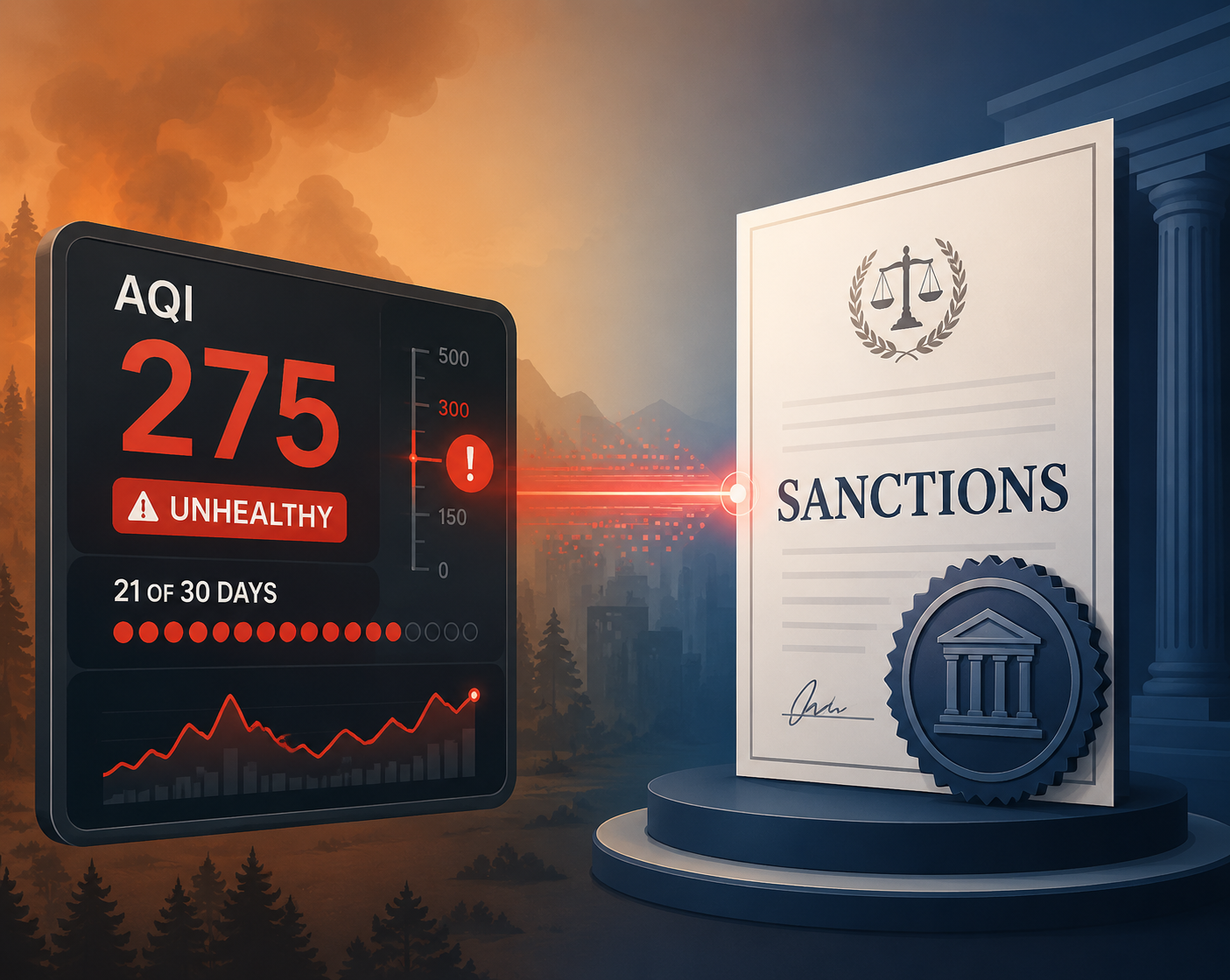
The legally important feature of Senator Bernie Moreno’s Canada wildfire sanctions bill is not simply that it points sanctions language at Canada. It is that the CANADA FIRE Act, as summarized before its scheduled introduction, would make a measurable air-quality pattern start a mandatory sanctions clock. If an official U.S. EPA monitor within 200 miles of the Canadian border records an AQI above 200 for 21 days within a 30-consecutive-day period, the President would have 30 days to impose specified sanctions against Canada-related targets.[1]
That is the clause practitioners should read first. It is concrete enough to become a monitoring obligation, strange enough to create interpretive problems, and different enough from familiar sanctions pathways that business teams hearing “Canada sanctions” will need careful translation. As of July 19, 2026, the bill is scheduled for introduction on July 20 and has no assigned bill number. The public record available for analysis consists of Senator Bernie Moreno’s press release, a linked bill PDF that was announced ahead of formal introduction, and contemporaneous reporting; the full PDF text was not independently crawled for this article.[1][2]
The trigger turns air monitoring into sanctions administration
The bill’s operative trigger has four parts: an AQI reading above 200; a 21-of-30-days duration requirement; an EPA monitor located within 200 miles of the Canadian border; and a 30-day presidential obligation after the finding. Each element matters because each one could become a point of compliance disagreement if the bill advances.
| Trigger Element | Why Counsel Would Care |
|---|---|
| AQI above 200 | The threshold uses an environmental measurement rather than a finding that a Canadian person or agency engaged in sanctionable conduct. |
| 21 days in a 30-consecutive-day period | The calendar is administrable and potentially automatable, but it raises questions about which daily readings count and who makes the official calculation. |
| EPA monitor within 200 miles of the Canadian border | The trigger is tied to U.S. monitor geography, not to proof that a specific Canadian fire, ministry, province, or official caused a specific U.S. impact. |
| Presidential sanctions within 30 days | The summarized language is mandatory in structure, leaving less room than ordinary discretionary sanctions programs appear to provide. |
The air-quality context explains why the proposal exists. Yale Climate Connections reported that the July 2026 smoke event pushed AQI readings above 900 in Duluth, Minnesota; above 500 in Chicago and Detroit; and into Hazardous levels across Minnesota, Wisconsin, Michigan, Illinois, and Ohio, with Very Unhealthy air in New York, Pennsylvania, and Indiana.[3] Yale also reported that a 2025 Nature study associated the 2023 Canadian wildfire season with approximately 33,000 premature deaths in the United States.[3]
Those figures make the legislative impulse easier to understand, but they should not be confused with the bill’s legal trigger. The bill, as summarized, keys off EPA monitor readings within a defined border zone. Some of the most dramatic smoke measurements in public discussion came from lower-cost PurpleAir sensors, including an extreme Sea Gull Lake, Minnesota reading reported by Yale; those are not the same thing as official EPA 24-hour readings and should not be treated as if they automatically satisfy the statutory test.[3]
The economic sanctions package is grouped around public money
After the AQI trigger is met, the CANADA FIRE Act would require the President to impose a package of sanctions that focuses on government-linked economic support: prohibitions on new U.S. government contracts with Canadian entities, restrictions on Export-Import Bank financing for Canadian projects, and instructions for U.S. directors at international financial institutions to vote against loans to Canada.[1][4]
For sanctions and procurement counsel, the first question would not be whether every Canada-related transaction is prohibited. The summarized provisions are narrower than that. They point toward new U.S. government contracts, Ex-Im financing, and multilateral lending votes. That still leaves substantial diligence work: identifying what counts as a “Canadian entity,” determining whether renewals or modifications are treated as new contracts, reviewing projects with Canadian sponsors or beneficiaries, and tracking whether a financing application sits inside or outside the covered period.
The international-financial-institution provision would operate differently from a direct private-sector prohibition. A U.S. company is not itself voting at the World Bank or another multilateral lender. But a project finance lawyer representing a Canadian borrower, a U.S. contractor on a Canadian public project, or a sponsor with Canadian government participation would still need to know whether U.S. opposition at the lender level changes closing assumptions, board timing, or conditionality.
The procurement language would likely generate the most immediate internal questions because it is closest to ordinary vendor onboarding. If enacted in the summarized form, companies selling to U.S. agencies would need a way to answer whether a counterparty is Canadian, whether a contract is new, and whether the sanctions period has begun. Those are not atmospheric political questions. They are representations, certifications, and deal-timing questions.
Why this is unlike the sanctions pathways lawyers usually see
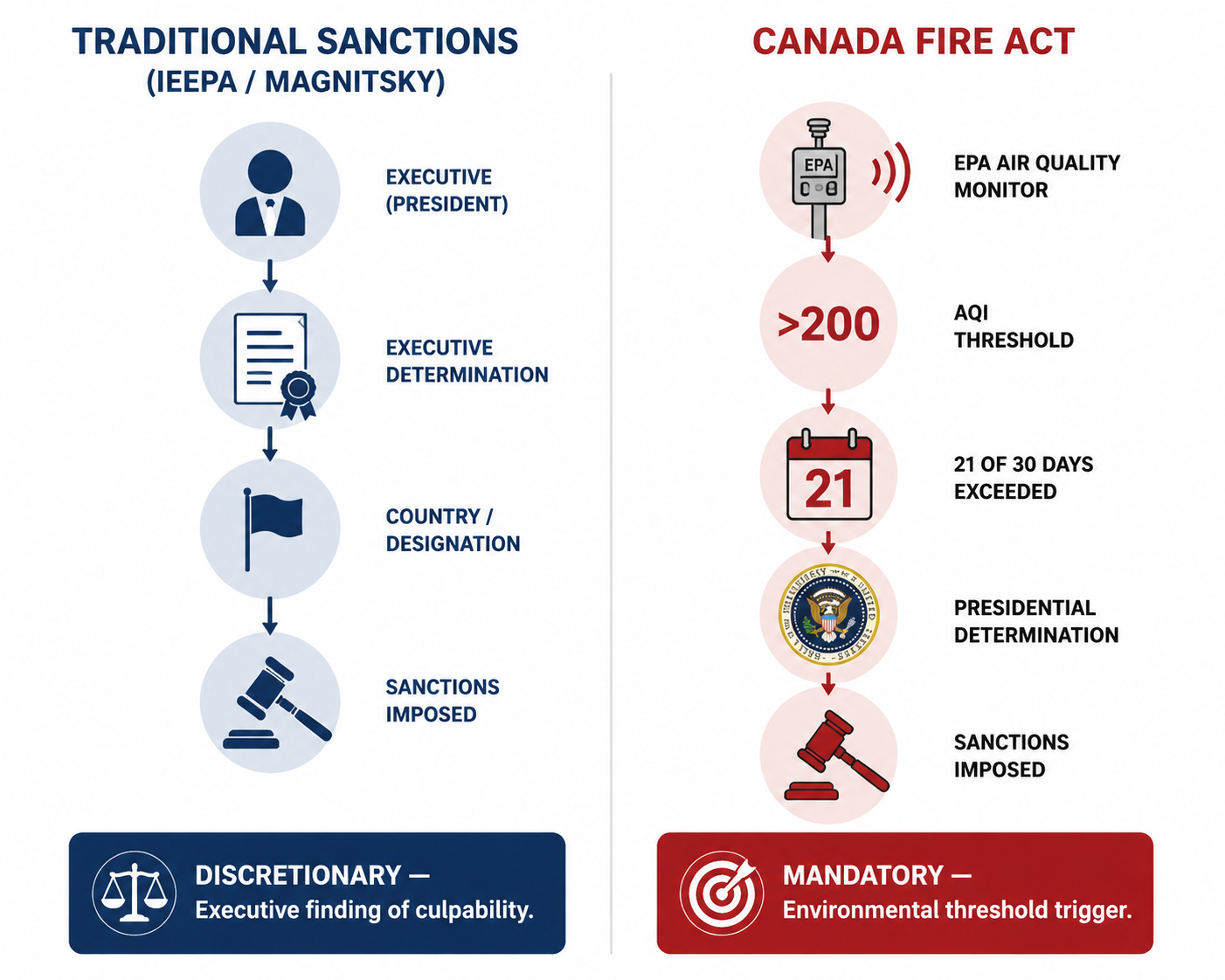
Most sanctions lawyers are accustomed to frameworks in which the executive branch makes a judgment about threat, status, conduct, or culpability before restrictions attach. IEEPA-based programs commonly rest on a national emergency and executive implementation. Magnitsky-style sanctions depend on designation decisions tied to specified conduct. Country or sector programs may be broad, but they still generally move through executive findings, implementing orders, agency rules, or designation processes.
The CANADA FIRE Act, as publicly summarized, uses a different legal architecture. The AQI threshold does work that sanctions statutes usually assign to executive discretion or conduct-based analysis. The President would not first need to determine, at least in the summarized trigger, that a named Canadian official caused a particular fire, that a Canadian agency acted with a specified intent, or that a Canadian entity engaged in sanctionable conduct. The environmental condition itself would start the sanctions obligation.[1]
That distinction is easy to lose in political coverage. The novelty is not that Congress is angry about smoke crossing a border. Congress often expresses anger in foreign-policy statutes. The unusual move is converting a set of U.S. air-monitor readings into mandatory sanctions machinery. If enacted, sanctions teams would need to follow environmental data with the same seriousness they ordinarily reserve for Federal Register notices, OFAC designations, executive orders, and agency guidance.
This article does not reach a settled conclusion about whether such a structure would survive analysis under IEEPA, USMCA, WTO rules, or diplomatic law. The research record surfaced no specific legal scholarship on this bill under those frameworks. The more defensible point is narrower: the bill appears to shift the front-end trigger from discretionary attribution to measurable environmental conditions, and that shift would change what lawyers monitor before any sanction becomes operational.
Automatic visa revocation creates a separate screening problem
The visa provision should not be folded into the economic sanctions package. Reporting describes it as requiring visa revocation for current and former Canadian Cabinet members and senior officials responsible for forestry, land management, and emergency response.[5][6] That is a role-based immigration consequence, and it would ask a different set of questions from contract or financing restrictions.
Immigration counsel would need to identify covered offices, not merely covered conduct. The inclusion of former officials matters. A person who no longer sits in Cabinet, no longer manages forestry policy, or has moved into the private sector could still require screening if the statutory text reaches prior service. Government-relations counsel would also need to understand whether an official traveling for negotiations, conferences, emergency coordination, or private employment falls inside the role categories.
Automatic revocation would also feel different from case-by-case inadmissibility analysis or designation practice. In the ordinary sanctions-adjacent immigration setting, counsel often looks for a named designation, a particular factual allegation, or an individualized government decision. Here, as reported, the covered person’s governmental role would do much of the work. That would make organizational charts, historical office titles, and ministerial portfolios legally relevant documents.
The diplomatic clause is vivid, but more bounded
The persona non grata language is the provision most likely to dominate headlines. Reporting describes it as a sense-of-Congress provision stating that the Canadian ambassador and consuls general in up to four U.S. cities should be declared persona non grata until AQI remains below 100 for 90 consecutive days.[4][5]
For legal operations, the important distinction is that a sense-of-Congress provision is not the same as an immediately enforceable sanctions prohibition. It can send a diplomatic signal, create pressure on the executive branch, and supply language for future oversight. But it does not do the same work as a mandatory contracting restriction or automatic visa-revocation rule.
The 90-day AQI-below-100 condition is still notable. It uses air-quality readings not only to start penalties but also to define when diplomatic pressure should end. That reinforces the bill’s broader design choice: environmental measurements become legal markers for foreign-policy consequences.
The compensation study is a trade-law watch item, not a present payment system
The CANADA FIRE Act also would direct a study of a victims’ compensation mechanism financed through possible additional tariffs on Canadian goods.[4][6] That should be tracked, but it should not be described as an existing compensation fund or an already-imposed tariff program.
For trade counsel, the study matters because it indicates where later legislative or administrative work could go. A tariff-financed fund would raise different issues from procurement exclusions or visa revocations: tariff classification, country of origin, importer liability, refund mechanics, and possible interaction with existing trade obligations. None of those downstream questions can be answered from the summarized study language alone.
What lawyers would need to monitor if the bill advances
The bill’s path remains uncertain. It was announced ahead of formal introduction, in a period of broader U.S.-Canada trade tension and international reaction to the proposal.[2][7] Until introduced text is available with a bill number, committee referral, and any later amendments, counsel should resist treating press-release summaries as operative law.
- Legislative text: whether the introduced bill matches the press-release summary, especially on definitions of “Canadian entity,” “senior official,” “responsible for,” and the AQI determination process.
- Trigger administration: which EPA readings count, how the 21-of-30-days period is calculated, and whether the President’s finding is public, reviewable, or tied to a specific agency record.
- Contract scope: whether the prohibition reaches only new prime contracts or also renewals, options, subcontracting, novations, grants, and cooperative agreements.
- Financing exposure: whether Canadian projects with U.S., third-country, provincial, municipal, or private sponsors are treated differently under Ex-Im or international-financial-institution provisions.
- Immigration coverage: how current and former Canadian officials are identified, and whether revocation language leaves room for waivers, exceptions, or case-by-case review.
The practical burden would fall across several desks at once. Sanctions counsel would track the AQI trigger and presidential action. Procurement lawyers would test new contract exposure. Project-finance lawyers would watch Ex-Im and multilateral lending channels. Immigration lawyers would screen official roles and former service. Government-relations counsel would need to explain why a sense-of-Congress diplomatic clause is not the same thing as an enforceable prohibition, even if it carries real political weight.
If enacted in the form summarized by the press release and reporting, the CANADA FIRE Act would require cross-border lawyers to treat environmental data, official Canadian government roles, financing exposure, and diplomatic signals as sanctions-relevant inputs. That is the bill’s real departure from the ordinary playbook: not a new country label on familiar restrictions, but a sanctions mechanism whose first legal question may be what an EPA monitor recorded near the border.
References
- CANADA FIRE Act press release, Moreno Senate, https://moreno.senate.gov
- Reporting on the CANADA FIRE Act legislative path, The Hill, https://thehill.com
- Yale Climate Connections reporting on July 2026 wildfire smoke AQI and health impacts, Yale Climate Connections, https://yaleclimateconnections.org
- Provision-by-provision reporting on the CANADA FIRE Act, KLTV, https://www.kltv.com
- Detailed reporting on CANADA FIRE Act provisions and official scope, Cleveland.com, https://www.cleveland.com
- Local reporting on CANADA FIRE Act bill specifics, The Dispatch, https://www.dispatch.com
- International reaction and U.S.-Canada political context, The Guardian, https://www.theguardian.com
Comments
Join the discussion with an anonymous comment.