
The Canadian woman arrested on assault charges after a Point Pleasant Beach confrontation is not only facing a municipal-court problem. Kaitlyn Tracey, a Canadian citizen, was arrested on July 13, 2026, charged in New Jersey with simple assault under N.J.S.A. 2C:12-1(a)(1) and endangering the welfare of a child under N.J.S.A. 2C:24-4, then transferred to ICE custody at Delaney Hall in Newark on an immigration detainer, with a reported next court date of August 4, 2026.[1][2][3]
That sequence is the problem. A disorderly persons assault charge may look, to a criminal calendar, like a small case: low penalty exposure, quick plea pressure, and a factual record still developing. For a non-citizen, the same file can become a custody file, a removal file, and a plea-advice problem before anyone has tested the beach-town facts in court.

Media accounts describe the incident as involving a teen wearing Trump-related clothing, and Tracey’s husband reportedly disputed the public version, claiming provocation by the teens and saying initial officers treated the event as minor.[1][2][3] Those points may matter to investigation, credibility, and negotiation. They do not change the first professional task. Counsel has to work from the charges filed, the client’s immigration status, and the immigration consequences that could attach to any plea.
Three Tracks, Not One Story
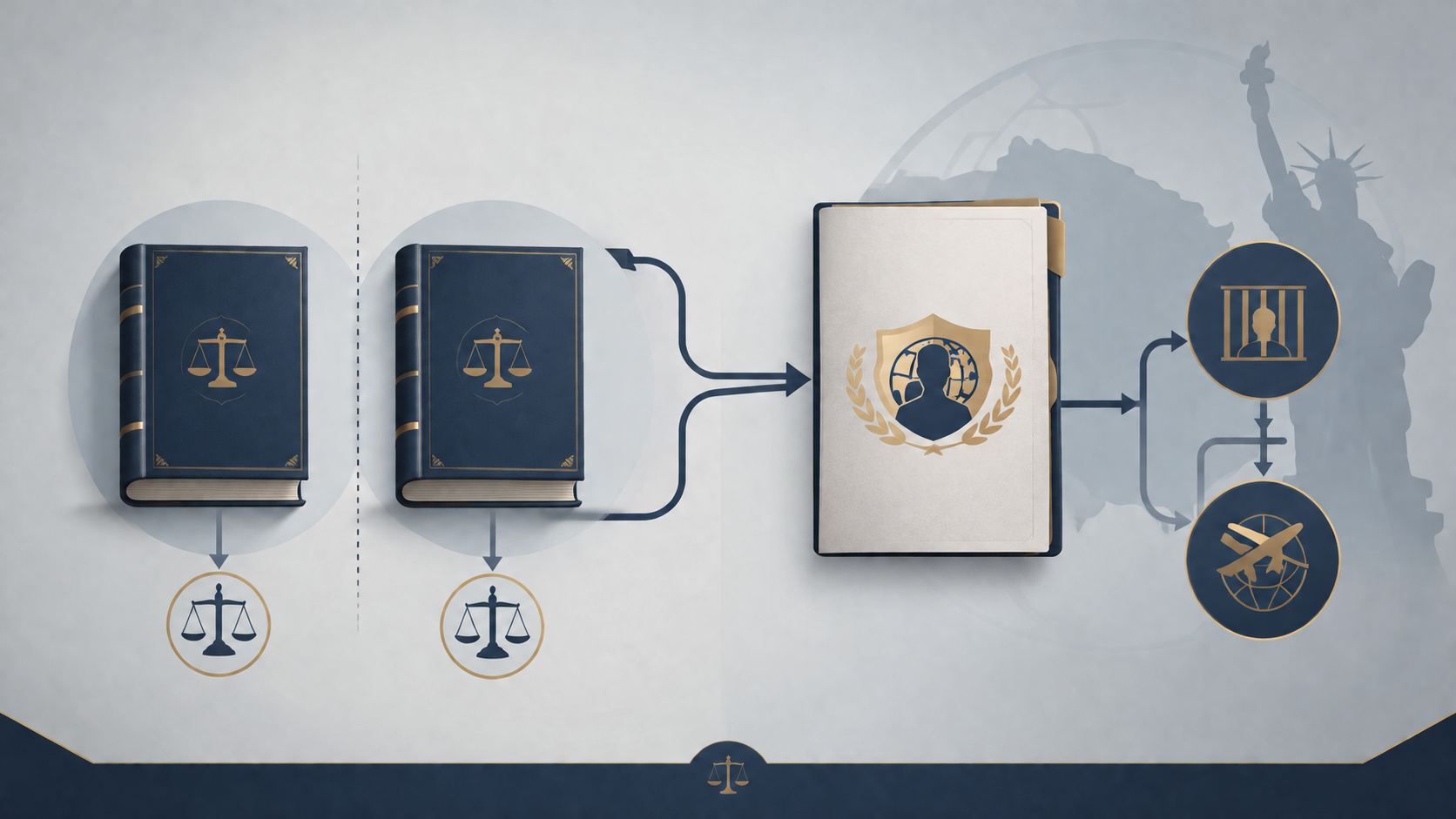
Coverage of the case tends to compress the sequence into one narrative: confrontation, arrest, ICE, deportation risk. A lawyer cannot leave it compressed. The file separates into at least three tracks.
- The criminal track: simple assault and endangering the welfare of a child, each with its own statutory elements and plea consequences.
- The civil immigration track: a reported visa overstay, independent of whether either charge results in conviction.
- The criminal-immigration track: whether a conviction, or a particular plea formulation, creates removability, inadmissibility, detention exposure, or later discretionary damage.
Tracey reportedly entered the United States in April 2024 and had a visa that expired on September 6, 2024, leaving more than 22 months of unlawful presence by July 2026.[1][3] That matters because unlawful presence or remaining beyond authorized status can support removal independently under INA § 237(a)(1). If the government has a clean civil overstay theory, the criminal case is not the only path to removal.
But the overstay does not make the criminal analysis optional. A client with an independent removability problem still needs accurate advice about whether a plea worsens detention posture, forecloses relief, supplies an additional charge of removability, or changes how immigration authorities and judges view discretion. The overstay may explain why ICE can act; it does not answer what a criminal-defense lawyer must say before resolving the New Jersey charges.
Why the Simple Assault Label Is Too Thin
New Jersey simple assault under N.J.S.A. 2C:12-1(a)(1) is commonly described as purposely, knowingly, or recklessly causing bodily injury to another. It is treated as a disorderly persons offense punishable by up to six months in jail and a $1,000 fine.[4] That penalty ceiling is one reason the charge can be mishandled in a non-citizen plea setting. The municipal-court frame invites the wrong question: how quickly can this be reduced, paid, or closed?
The immigration question is different. It asks what offense the record of conviction will establish, what mental state and conduct the statute requires, and whether the conviction falls within a removal category such as a crime involving moral turpitude. A simple assault statute that reaches reckless conduct is not safely treated as categorically turpitudinous merely because the word “assault” appears in the charge.
That caution cuts both ways. Defense counsel should not promise that simple assault is harmless. Nor should counsel announce that every simple assault conviction is a CIMT. The better analysis starts with the elements and the realistic minimum conduct covered by the statute. If the statute can be violated by conduct that does not involve the kind of depraved or morally reprehensible intent usually associated with CIMTs, the government’s categorical argument may be weaker.
For plea purposes, the dangerous document is often not the complaint alone but the final record: amended charge, factual basis, plea colloquy, judgment, and any incorporated admissions. A plea that casually adds intentional targeting, vulnerable-victim facts, or child-related injury facts may create a record far worse than the starting assault label suggested.
The Child-Endangerment Count Changes the File
The second charge is not background color. Tracey was also charged with endangering the welfare of a child under N.J.S.A. 2C:24-4.[1][2][3] That count changes the risk profile because child-welfare offenses are not evaluated with the same comfort level as a low-level assault charge.
The research materials identify N.J.S.A. 2C:24-4 as criminalizing conduct that creates a substantial risk of physical or mental injury to a minor, with knowing or purposeful conduct directed at a child’s welfare. On that description, the charge sits much closer to established CIMT concerns than ordinary simple assault. Child endangerment allegations can introduce intent, vulnerability, and harm-to-minor elements that immigration adjudicators often treat seriously.
No directly controlling ruling on this exact Tracey charge combination is identified in the available materials. That limitation matters. The responsible advice is not that the case will certainly be treated as a CIMT case. It is that the simple assault count and the child-endangerment count must be assessed separately, and then assessed together, because the second count may supply the very features the first count lacks.
| Charge | Why It Matters for Immigration Advice |
|---|---|
| N.J.S.A. 2C:12-1(a)(1) simple assault | The disorderly persons label and six-month ceiling do not decide the CIMT question; the mental state and record of conviction do. |
| N.J.S.A. 2C:24-4 endangering welfare of a child | The child-welfare and intent-based features can materially increase CIMT risk and discretionary damage. |
| Reported visa overstay | It can support removal independently, but it does not eliminate counsel’s duty to analyze the criminal plea. |
The combined analysis is where a routine plea can go wrong. A lawyer who sees only “simple assault, disorderly persons” may aim for a fast municipal disposition. A lawyer who sees the child-endangerment count as merely duplicative may miss the immigration significance of preserving, dismissing, amending, or avoiding admissions tied to the child-welfare allegation.
Padilla Advice Has to Be Charge-Specific
Padilla v. Kentucky requires criminal defense counsel to advise a non-citizen client about immigration consequences before a guilty plea. In a case like this, a generic warning that “there may be immigration consequences” is thin advice. The client needs to know what is clear, what is uncertain, and which plea choices may make the immigration case materially worse.
For the simple assault count, counsel should identify the statute, the mental states it covers, the penalty exposure, and why the offense should not be reflexively conceded as a CIMT. If immigration counsel is involved, the criminal lawyer should get that analysis before plea language is placed on the record, not afterward when the client is already detained.
For the child-endangerment count, the advice should be more urgent. Counsel should explain that a plea to an offense involving knowing or purposeful risk to a minor may carry a substantially higher moral-turpitude risk than a stand-alone simple assault disposition. If the prosecution offers a package plea, the immigration consequence of the package may be worse than the apparent criminal concession.
For the overstay, counsel should be direct but careful. The client may already be removable even if the criminal case is dismissed. That does not mean the plea is irrelevant. It means the plea may decide whether the client faces one removal theory or several, whether bond is contested more aggressively, whether relief becomes harder, and whether the immigration record contains damaging admissions that were not necessary to resolve the criminal case.
The practical sequence is simple enough to state, though not always easy to execute on a busy docket: identify the immigration status first; parse each charge by elements; map the record-of-conviction risk; consult immigration counsel where the consequence is uncertain or severe; and give the client advice that distinguishes likely, possible, and unknown consequences.
What Should Not Go Into the Plea Record
A non-citizen plea record should not collect unnecessary facts. If a lesser or amended disposition is available, counsel should pay close attention to whether the factual basis admits intentional harm, child-directed conduct, injury to a minor, or facts that make the case sound more morally aggravated than the statutory minimum requires. Criminal lawyers sometimes treat factual bases as housekeeping. Immigration lawyers often read them as evidence.
That does not mean counsel should distort facts or evade the court’s requirements. It means the plea should be no broader than necessary. Where the immigration consequence turns on a narrow distinction, unnecessary admissions can do the government’s work.
Detention Can Follow Even When the Criminal Theory Is Debatable
Tracey was reported to be in ICE custody at Delaney Hall in Newark after the Point Pleasant Beach arrest.[1][2][3] The ACLU of New Jersey has separately criticized conditions and immigration detention practices at Delaney Hall, a useful reminder that the custody setting is not abstract for the client waiting on the criminal case.[6]
Mandatory detention under INA § 236(c) applies to non-citizens inadmissible or deportable by reason of certain criminal offenses. If the predicate offense is uncertain, counsel should not assume mandatory detention is automatic. But that is not the end of custody exposure. ICE also has discretionary arrest and detention authority under INA § 236(a), and an overstay allegation can give the agency a civil immigration basis to proceed while the criminal case is pending.
A DHS spokesperson reportedly said Tracey was part of “nearly 70% of ICE arrests” involving immigrants charged with or convicted of a crime.[1] That formulation is worth reading precisely. “Charged with” is not “convicted of.” It describes enforcement selection, not criminal adjudication, and it does not resolve whether the New Jersey charges ultimately qualify as removable offenses.
The broader enforcement environment makes early plea advice more urgent. Brookings reported in January 2026 that ICE had deported roughly 540,000 people since January 2025, grown from about 10,000 to more than 22,000 personnel, shortened academy training from 22 weeks to 47 days, eliminated Spanish language training, and recruited 12,000 new agents with $50,000 signing bonuses amid allegations of lowered hiring standards.[5] Those figures are directional, not a current count as of July 2026. They still help explain why a low-level local charge can move quickly into federal custody.
The Contested Facts Do Not Pause the Immigration Clock
The public facts remain contested. Media accounts describe competing claims about provocation, the behavior of the teens, and how seriously the incident was first viewed by responding officers.[1][2][3] Those disputes belong in investigation and defense strategy. They may support dismissal, downgrade, diversion, or a more favorable factual record.
They do not suspend Padilla obligations. A lawyer advising a non-citizen client cannot wait for the cleanest version of the facts if the plea offer arrives first. The advice must be tied to the charges as filed, the likely alternatives, the immigration status the lawyer can reasonably determine, and the record the plea would create.
That is the uncomfortable procedural hinge in this case. The criminal allegation may be litigated as a brief public confrontation. The immigration system may treat the same file as a basis for detention and removal processing. Once that happens, the misdemeanor instinct is no longer adequate.
The Plea Question Counsel Has to Answer
Before any plea, counsel should be able to answer five questions in plain language for the client.
- Is the client independently removable because of status, including a visa overstay?
- Does the simple assault charge, by its elements and likely plea record, create a CIMT risk?
- Does the child-endangerment charge create a stronger CIMT risk or other immigration damage?
- Would the proposed plea create one removal theory, multiple removal theories, or new barriers to relief?
- Can the case be resolved with a charge, factual basis, or disposition that reduces immigration harm without misleading the criminal court?
Those questions are not a guarantee of safety. They are the minimum structure for competent advice. In Tracey’s posture, the defense lawyer’s task is not to decide whether the public should sympathize with her, the teens, or anyone else on the boardwalk. It is to prevent a plea to a case that looks minor inside the criminal docket from becoming an avoidable immigration admission.
Charge-by-charge precision comes first. The combined immigration effect comes second. Clear Padilla advice must come before the plea.
References
- NYPost — Tracey arrest/ICE detention, NYPost, July 15, 2026
- Fox News — Police account, Fox News, July 2026
- Halifax CityNews — Canadian angle, Halifax CityNews, July 16, 2026
- NJ Simple Assault statute & penalties, Rosenberg Perry Criminal Defense
- ICE expansion has outpaced accountability, Brookings Institution, January 2026
- Cruelty at Delaney Hall is yet more proof of the Trump administration’s horrific immigration agenda, ACLU of New Jersey
Comments
Join the discussion with an anonymous comment.