
The first useful question in candidate withdrawal is not why the candidate wants out. It is what date the campaign is standing on. In most federal and state races, no federal statute supplies a general withdrawal rule. The operative answer comes from state election codes, state election-board guidance, party rules, and the point already reached in the ballot calendar.
That is why the legal implications become concrete so quickly. A withdrawal request may be legally simple before filing closes, formally available for only a few days after filing, unavailable once ballots are transmitted to military and overseas voters, or still possible as a public act while no longer changing the ballot. Counsel who treats “withdrawal” as one event will miss the separate questions that actually control: whether the filing can be undone, whether the name can be removed, whether the party may replace the nominee, whether votes still count, and whether election officials must publish notices rather than alter ballots.

The Withdrawal Calendar Matters More Than the Announcement
A candidate can always announce an intention to stop campaigning. That announcement does not necessarily remove the candidate from the ballot, free a party to substitute another nominee, or prevent votes for that candidate from being counted. Election law generally works through filed forms, statutory deadlines, certification events, ballot-preparation schedules, and party-vacancy procedures.
Texas shows the point in unusually compressed form. Its Election Code requires a withdrawal request to be written and signed, and the general deadline for withdrawal is 5 p.m. on the fifth day after the filing deadline, subject to statutory exceptions.[1] Washington uses a similarly unforgiving filing-week structure: under state guidance applying RCW 29A.24.131, a candidate must withdraw by the Monday following the filing deadline; after that point, the filing fee is forfeited and the candidate cannot withdraw.[2]
Those rules do not ask whether the political reason for withdrawal is compelling. They ask whether the candidate has reached the statutory point at which the filing becomes fixed for ballot purposes.
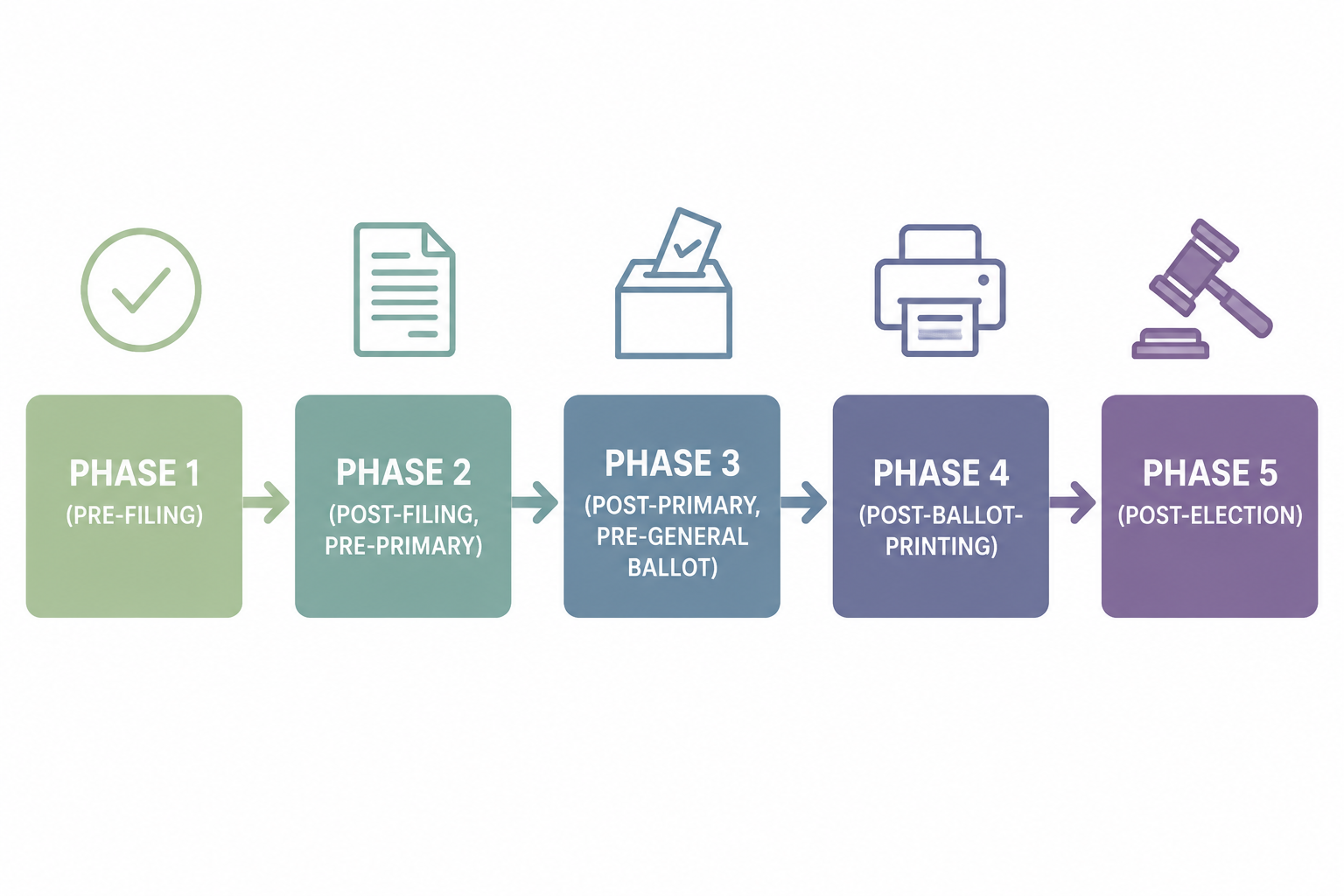
A Timing Workflow for Withdrawal Analysis
The cleanest way to analyze a withdrawal problem is to place it in the election calendar before looking for remedies. The phases below are not a national rule. They are a working sequence for identifying which state-law questions have become urgent.
| Timing phase | Main legal question | Typical consequence to verify |
|---|---|---|
| Before filing | Has candidacy legally attached? | The candidate may simply not file, or may avoid triggering ballot-access, fee, and party-vacancy consequences. |
| After filing but before the primary | Does the state allow withdrawal after filing, and by what deadline? | A formal withdrawal request may remove the name only if filed within a short statutory window. |
| After primary but before general-election ballot deadlines | Is the nominee allowed to resign, and can the party fill a vacancy? | Party replacement may depend on central committee action, certification timing, and ballot-transmission deadlines. |
| After ballot printing or military/overseas transmission | Can the ballot still be changed? | The name may remain, votes may still be counted, and election officials may use notices rather than reprinted ballots. |
| After Election Day | What happens if a withdrawn or non-campaigning candidate wins? | The issue usually shifts from withdrawal to vacancy, succession, refusal to qualify, or office-specific law. |
The workflow is useful because the same word, “withdrawal,” describes different legal acts at different moments. Before filing, it may mean no candidacy ever becomes official. After filing, it means a statutory request. After nomination, it may mean resignation from nominee status and a party-vacancy process. After ballots are locked, it may mean only that voters and officials receive notice that the candidate is no longer seeking the office.
Before Filing: The Easiest Withdrawal Is Non-Filing
Before a declaration, petition, fee, or other candidacy document is filed, the legal problem is usually avoidable. A prospective candidate can decline to file. The party may recruit someone else. Election officials have no ballot to alter. Campaign finance, endorsement, and communications consequences may remain, but ballot withdrawal has not yet become the administrator’s problem.
The danger in this phase is informal commitment. A campaign may have announced, raised money, and secured party support before counsel has reviewed withdrawal windows. That creates political pressure but not a substitute for statutory compliance. Once filing occurs, the campaign is no longer managing only public expectations; it is working inside an election calendar.
After Filing but Before the Primary: Short Windows Can Close Almost Immediately
The post-filing, pre-primary phase is where many campaigns first discover that withdrawal is not an open-ended right. Texas and Washington are useful not because they are representative of every state, but because they show how quickly a filed candidacy can become difficult to undo.
In Texas, the general withdrawal deadline is tied to the filing deadline rather than to the primary date: 5 p.m. on the fifth day after the filing deadline.[1] In Washington, the deadline is the Monday following the filing deadline.[2] Both rules force counsel to treat the filing week itself as a decision period. Waiting to see whether fundraising improves, whether another candidate clears the field, or whether an endorsement materializes may consume the legally relevant window.
South Dakota’s 2026 guidance illustrates the value of date-specific administrative calendars. For the 2026 cycle, the Secretary of State lists April 2, 2026, as the primary-election candidate withdrawal deadline and August 4, 2026, as the general-election candidate withdrawal deadline. The same guidance states that withdrawal forms must be received before the relevant party central committee meets to appoint a replacement.[3] That last requirement is the sort of operational detail that can decide whether a party’s substitution plan is legally usable.
The lesson is not that every state uses a filing-week deadline. It is that the deadline may be located somewhere other than the political team expects. Some calendars run from filing, some from certification, some from ballot transmission, and some from a fixed number of days before the election. The only safe assumption is that the controlling clock is jurisdiction-specific.
After the Primary: Withdrawal Becomes a Nominee and Replacement Problem
After a candidate wins a primary, withdrawal analysis changes. The party may no longer be dealing merely with a filed candidate. It may be dealing with a nominee, a ballot line, and a statutory vacancy mechanism. The relevant question becomes whether state law permits the nominee to resign in time for a replacement to be named and certified.
North Carolina’s rule makes the ballot-transmission cutoff central. State guidance on N.C.G.S. §163-114 says a person who wins a primary cannot resign as a general-election nominee after the first day that military and overseas ballots are transmitted.[4] That rule closes the resignation window before a campaign might think the general-election ballot is practically final. For counsel, the overseas-ballot date is not a mailing detail; it is a nominee-withdrawal deadline.
West Virginia uses a longer pre-election cutoff. Under West Virginia Code §3-5-11, a candidate may withdraw by filing a signed and notarized certificate no later than 84 days before the election. The same provision addresses vacancy-filling by party committee within 35 days and requires posted precinct notices when withdrawal occurs too late for the candidate’s name to be removed from the ballot.[5]
These rules place party committees in a procedural lane. A central committee may have to meet before a specified date. A replacement may have to be selected before ballots are prepared. A withdrawal form may need to be received before the committee acts. If those events happen in the wrong order, a politically settled replacement can still fail as a ballot-access matter.
After Ballots Are Locked: The Name May Stay Even If the Campaign Is Over
The hardest withdrawal disputes usually arise after ordinary withdrawal deadlines have passed. At that point, the question often stops being whether the candidate can withdraw in a meaningful political sense. The candidate can stop campaigning, endorse someone else, or ask voters not to vote for them. The legal question is whether election officials may still alter the ballot.
West Virginia supplies one statutory model for late withdrawal consequences. If withdrawal occurs after the deadline for removing the name, the statute requires the candidate’s name to remain on the ballot and requires commissioners of election to post notices at polling places advising voters that the candidate has withdrawn.[5] That structure does not pretend the ballot is current in the ordinary sense. It manages the conflict between a late withdrawal and an election already in motion.
North Carolina’s military and overseas ballot cutoff points to the same administrative reality. Once ballots are transmitted, changing candidate status can implicate federal and state timing obligations, local printing schedules, voter instructions, and uniform treatment of already-issued ballots.[4] The law may prefer a fixed ballot plus notice over a last-minute reprint that creates new risks.
Late ballot changes also create mechanical consequences. Reprinting may be impossible or expensive. Stickers or overlays may interfere with tabulation equipment. Different counties may be at different stages of printing, mailing, or proofing. Those facts do not override a statute, but they explain why statutes often draw hard lines before Election Day rather than inviting case-by-case adjustment after ballots have moved.
Votes for a Withdrawn Candidate Are Not Automatically Null
A late withdrawal does not by itself erase voter choices. Where a candidate’s name remains on the ballot, votes cast for that candidate are typically treated as valid votes unless a controlling statute provides otherwise. A candidate’s announcement cannot retroactively make those votes disappear.
This is the practical reason withdrawal can turn into a vacancy or succession problem after Election Day. If the withdrawn candidate receives enough votes to win, the next question is usually not whether the candidate’s withdrawal announcement was sincere. It is what office-specific law says about qualification, refusal, vacancy, succession, or replacement. Those rules vary by office and jurisdiction, and they should be analyzed separately from ballot withdrawal.
Counsel should resist the casual phrase “withdrawn from the ballot” unless the election authority has actually removed the name. A candidate may be withdrawn from active campaigning, withdrawn as a party’s preferred nominee, or withdrawn by public statement while still appearing on ballots and still receiving countable votes. Those are different legal positions.
Wisconsin’s 2025 Reform Changed Planning Assumptions
Wisconsin is important because its prior rule was unusually restrictive. Reporting on the 2025 reform describes the prior 1977-era statute as recognizing death as the only basis for removal from the ballot after filing. The new law, enacted in November 2025, permits a candidate to withdraw if the request is filed at least seven business days before Wisconsin Elections Commission certification, adds processing fees, and creates a felony penalty for impersonation fraud.[6]
The reform followed the 2024 dispute involving Robert F. Kennedy Jr.’s unsuccessful effort to withdraw from Wisconsin’s presidential ballot, but the lasting point is not the campaign anecdote. A rule that previously gave counsel almost no ordinary withdrawal path now contains a certification-linked window. That changes how campaigns in Wisconsin should calendar risk before filing, before certification, and before public withdrawal decisions.
It also shows why old withdrawal charts are dangerous. A state’s inherited rule may sit undisturbed for decades and then change because one cycle exposed an administrative problem. For 2026 planning, a campaign should verify current statutory text and current election-commission guidance rather than rely on a memorandum from the last presidential cycle.
Party Replacement Rules Do Not Override Ballot Deadlines
A party may have an internal answer for who should replace a candidate. That does not mean the replacement can appear on the ballot. The party process and the state ballot process have to fit together.
South Dakota’s 2026 guidance makes that dependency explicit by requiring withdrawal forms to be received before the party central committee meets to appoint a replacement.[3] West Virginia’s statute likewise ties withdrawal and vacancy-filling to a party committee process and a 35-day period.[5] Those provisions matter because a committee meeting held too late, or held before the required withdrawal is received, may not solve the ballot problem.
The presidential context is a boundary case, not the model for ordinary state-law analysis. Public materials from Protect Democracy and the National Task Force on Election Crises state that no constitutional or federal statutory provision directly governs presidential candidate withdrawal, and that the Democratic and Republican parties have different replacement procedures in their own rules.[7][8] Those national-party procedures may decide who the party recognizes, but state ballot access, elector slates, certification deadlines, and ballot-printing realities still have to be addressed state by state.
Where Litigation Fits After Bost
Candidate withdrawal disputes are natural litigation candidates because the losing side is often out of time. A party may seek ballot substitution. An election official may refuse to reprint. A candidate may challenge a deadline that keeps their name on the ballot. Voters, opponents, and parties may all claim injury from a late change or from the refusal to make one.
Bost v. Illinois State Board of Elections matters here, but only within its lane. In January 2026, the Supreme Court held 7-2 that federal candidates had Article III standing to challenge state time, place, and manner regulations affecting their elections.[9] That standing holding may make federal court more available for candidate challenges to state election rules, including challenges related to withdrawal deadlines, ballot-counting rules, or replacement procedures.
It does not decide whether a particular withdrawal deadline is valid, whether an election official must reprint ballots, whether a replacement nominee must be accepted, or whether votes for a withdrawn candidate must be disregarded. Those are merits questions. They will still turn on the governing statute, the constitutional claim asserted, the timing of the suit, the requested relief, and the election-administration record.
For campaign counsel, the litigation implication is practical. A campaign may have a clearer path to courthouse standing than it had before Bost, but standing is not a remedy. A late-filed complaint that asks a court to reorder printed ballots or disrupt military and overseas voting will still face timing, reliance, and administrability objections.
What Counsel Should Calendar Before 2026 Deadlines Arrive
A useful withdrawal file is not a memo that says a candidate may or may not withdraw. It is a jurisdiction-specific calendar that separates at least five dates: filing deadline, withdrawal deadline, certification date, military and overseas ballot transmission date, and ballot-printing or mailing date. In party races, it should also include the deadline and procedure for naming a replacement nominee.
- Confirm the official recipient of the withdrawal form, including whether it must be filed with a secretary of state, county authority, party officer, or election board.
- Verify signature, notarization, delivery, and receipt requirements; a public announcement should not be treated as filing.
- Identify whether the deadline runs from filing, primary date, general election date, certification, or ballot transmission.
- Map the party replacement process against the state ballot deadline rather than assuming internal party action is enough.
- Determine the late-withdrawal consequence: name removed, name remains, precinct notices posted, votes counted, or office-vacancy rules triggered.
- Recheck current law before relying on prior-cycle charts, especially in states that recently amended withdrawal or certification rules.
The planning discipline is unglamorous, but it is what prevents a voluntary campaign decision from becoming an emergency ballot case. Once the statutory window closes, the question often changes from “Can the candidate withdraw?” to “What legally unavoidable consequences follow from a withdrawal that came too late?”
References
- Texas Election Code Chapter 145 — Withdrawal, Death and Ineligibility of Candidate, Texas Legislature, https://statutes.capitol.texas.gov
- Withdrawal of Candidacy, Washington Secretary of State, https://www.sos.wa.gov
- 2026 Candidate Withdrawal Information, South Dakota Secretary of State, https://sdsos.gov
- Withdrawal of Candidacy, North Carolina State Board of Elections, https://www.ncsbe.gov
- West Virginia Code §3-5-11, West Virginia Legislature, https://code.wvlegislature.gov
- Wisconsin candidates have path off the ballot besides death under new law, Votebeat, Nov. 3, 2025, https://www.votebeat.org
- What happens if a presidential candidate dies or steps down?, Protect Democracy / National Task Force on Election Crises, https://protectdemocracy.org
- Candidate Succession Before Election Day, National Task Force on Election Crises, https://www.electiontaskforce.org
- Court holds that all candidates can challenge rules governing vote counting, SCOTUSblog, Jan. 15, 2026, https://www.scotusblog.com
Comments
Join the discussion with an anonymous comment.