
The Capital One 360 settlement payment date did not slip because the administrator needed a few more days to print checks. The official settlement site now lists distribution timing as “TBD — Delayed due to Appeal” and tells class members that the appeal may delay payment “potentially over one year.”[1] The procedural reason is equally direct: after final approval, an objecting class member filed a June 18, 2026 notice of appeal, and Wolf Popper LLP says the appeal seeks rescission of the settlement agreement.[2]
That pairing matters. A delayed settlement distribution is familiar administrative territory; a pending appeal asking to unwind the whole deal is different. While the appeal remains unresolved, the settlement’s validity is under appellate challenge, and the distribution machinery cannot sensibly be treated as if only a calendar entry is missing.

The payout window that disappeared
Before the appeal became the controlling event, class members had reason to look to late July. MLive reported on July 22, 2026 that settlement payments had originally been expected between July 21 and July 27.[3] U.S. News, covering the April 20 final approval, likewise framed the settlement as entering the stage where eligible Capital One 360 Savings accountholders could expect payments after approval and administration.[4]
The current answer to “when will checks arrive?” is therefore not a revised payment week. It is an appellate status. The administrator’s “potentially over one year” language is deliberately less precise than a distribution schedule, and it should be read that way.[1] A practical 12–18 month planning assumption is more realistic than waiting for a new check date, but it is still an estimate rather than a Fourth Circuit timetable.
Why the June 18 notice changes the legal timeline
Final approval did not end the case for distribution purposes once a notice of appeal was filed. In settlement administration terms, the June 18 filing moves the matter from the district court’s approval track into an appellate track: record transmission, briefing, possible argument, decision, and then whatever mandate or further proceedings follow. The key operational consequence is that distribution does not proceed as though the approved settlement is immune from reversal.
| Procedural point | Practical effect |
|---|---|
| Final approval entered | Settlement moves toward implementation, subject to appeal rights. |
| Notice of appeal filed | Payment timing becomes contingent on appellate resolution. |
| Briefing and possible argument | The parties litigate whether the approval should stand. |
| Affirmance, dismissal, reversal, or remand | Distribution may resume, be reworked, or be blocked depending on the outcome. |
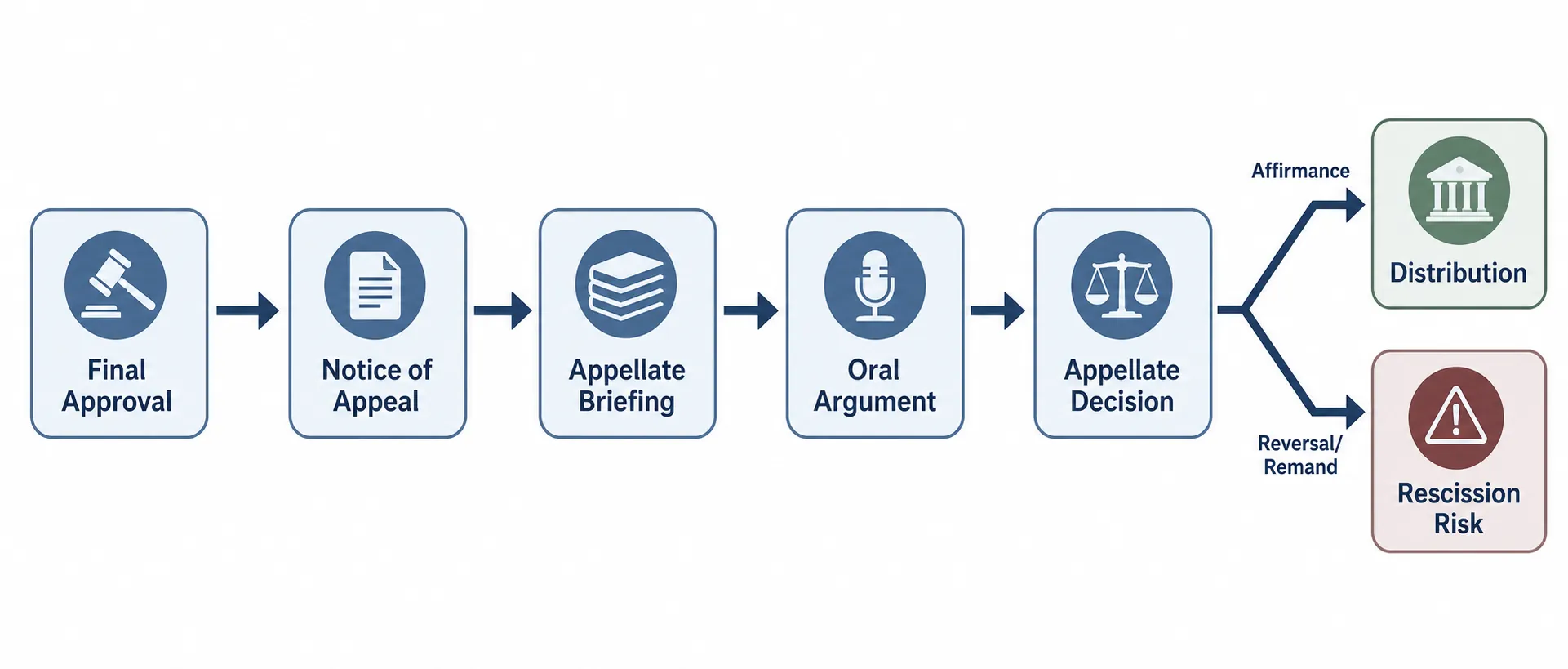
For attorneys and legal operations teams, this is the point to separate court approval from executable finality. A final approval order may answer the district court’s Rule 23 settlement questions, but an appeal keeps open the risk that the settlement will not be implemented in the form the administrator had been preparing to administer.
Delay is not the same as rescission
The most important word in the available appeal materials is not “delay.” It is “rescind.” Wolf Popper’s notice says the objecting class member seeks to rescind the settlement, and class counsel characterizes the appeal as meritless.[2] The public materials identified so far do not set out the appellant’s full argument, so the merits should not be guessed into existence. But the requested remedy, as described, is not a request to adjust a claims formula or correct a notice problem while preserving the deal.
That difference changes the stakes. The approved settlement includes a $425 million cash fund.[2] It also includes prospective rate-matching relief that the Special Master valued at $722.6 million to $877.5 million.[2] Those prospective numbers should not be treated as money already sitting in an account; their value depends on future interest-rate conditions and the operation of the relief. Still, rescission would put both categories at risk in a way that a narrower objection would not.
That is why the appeal creates two separate problems. The first is temporal: class members wait, administrators pause, and counsel manage expectations without a reliable payment date. The second is substantive: if the settlement is undone, the existing package of cash and prospective relief may vanish rather than simply arrive later.
What is actually known about the appellant’s position
The public record available from the cited materials supports only a narrow description: an objecting class member filed a notice of appeal after final approval, and the appeal seeks rescission of the settlement.[2] It does not support a confident account of the appellant’s legal theory, the strength of the appellate issues, or the likelihood that the Fourth Circuit will reach any particular ground.
That limitation cuts both ways. It would be too casual to dismiss the filing as just another postponement; rescission is a serious requested remedy. It would also be too aggressive to predict reversal from the existence of a notice of appeal alone. A notice starts the appellate process. It does not prove the appellant can carry it.
Why the settlement was already being watched
The appeal did not arise in a settlement that had gone unnoticed by public enforcers. In September 2025, Reuters reported that a group of U.S. states urged rejection of Capital One’s $425 million settlement with depositors, arguing that the proposal should not be approved in its then-current form.[5] That earlier opposition is useful context for why the deal drew scrutiny, but it is not the same thing as the present appeal.
The attorney general posture later changed after renegotiation. On January 12, 2026, the New York Attorney General announced support for a new Capital One settlement, pointing to changes that included prospective relief for depositors.[6] That shift helps explain why final approval could follow despite earlier objections. It does not resolve the current appellate risk, because the June 18 notice is a separate procedural act by an objecting class member.
What administrators and counsel should be tracking now
The useful monitoring question is not whether a new payment date has been posted. It is whether the appellate posture has changed in a way that makes distribution legally and operationally safe. Until then, communications should be anchored to the appeal, not to informal guesses about check runs.
- Track the settlement site for distribution-status changes, because it is the direct administrative channel for class members.[1]
- Track appellate filings for the appellant’s actual arguments, because the notice confirms the remedy sought but not the full theory.[2]
- Avoid promising a payment month while the appeal is pending; the administrator’s public estimate is “potentially over one year,” not a date certain.[1]
- Separate cash-fund exposure from prospective-relief exposure, because the latter is valued by estimate and depends on future conditions.[2]
- Preserve a record of member communications, especially if class members ask why a previously expected July payment window disappeared.[3]
For class members, the same structure can be stated more simply: there is no current distribution date, the delay is tied to an appeal, and the appeal is aimed at undoing the settlement rather than merely changing when payments go out. That is an informational description of the status, not legal advice about whether any individual class member should take action.
Likely paths from here
Several outcomes are procedurally possible. The appeal could be dismissed before a merits decision. The approval could be affirmed, allowing the settlement administration process to move back toward distribution. The approval could be reversed, or the matter could be remanded for further proceedings that require changes or renewed district-court review. The available materials do not justify assigning probabilities to those outcomes.
The planning consequence is clearer than the appellate prediction. Anyone carrying this matter on an operations calendar should assume the late-July payment expectation is gone and that a 12–18 month delay is a reasonable working range, with the administrator’s own public language already warning of a delay potentially exceeding one year.[1] If the settlement survives, the administrative question becomes how quickly distribution can restart. If rescission succeeds, the question changes entirely: the approved $425 million fund and the prospective rate-matching relief may no longer be the operative deal.[2]
References
- Frequently Asked Questions, Capital One 360 Savings Account Litigation settlement website.
- Notice of Appeal Filed Following Final Approval of Capital One 360 Savings Interest Rate Settlement, Wolf Popper LLP.
- Capital One settlement payout to customers substantially delayed, MLive, July 22, 2026.
- Judge Approves Capital One Settlement Deal. Here’s How Much You’ll Get, U.S. News.
- Capital One $425 million settlement with depositors should be rejected, US states say, Reuters, September 24, 2025.
- Attorney General James Applauds New Capital One Settlement, New York Attorney General, January 12, 2026.
Comments
Join the discussion with an anonymous comment.