
The Capital One settlement eligibility requirements are unusually simple: if you held a Capital One 360 Savings account at any point from September 18, 2019 through June 16, 2025, you are included automatically. The class covers people, entities, and joint account holders, and there is no claim form to file or opt-in step to complete.[1]
That does not mean checks are in the mail. As of July 23, 2026, no class member has been paid. The settlement received final approval on April 20, 2026, but a single objecting class member filed a Notice of Appeal on June 18, 2026. The official settlement site says distributions are stayed while the appeal is pending and warns that resolution could take “potentially over one year.”[1] Coverage of the appeal has described the payout as substantially delayed, which is the practical answer for anyone wondering why an automatic settlement has not produced an automatic payment.[2]

Who Is Eligible
Eligibility turns on account history, not on whether a customer still banks with Capital One. The class definition reaches anyone who held a 360 Savings account during the settlement period, even if the account was later closed. The relevant dates are September 18, 2019 through June 16, 2025.[1]
- Eligible: a person who had a Capital One 360 Savings account at any time during the covered period.
- Eligible: a former account holder who closed the account before the settlement.
- Eligible: joint account holders, subject to the administrator’s handling of account records.
- Eligible: entities that held covered 360 Savings accounts.
- Not required: a claim form, separate registration, or proof-of-purchase-style submission.
The automatic design matters because many consumer settlements make payment depend on a class member noticing an email, trusting a settlement website, finding account records, and filing before a deadline. This one is different. The administrator is expected to use Capital One’s account data to identify class members and calculate distributions. For a comparison point, settlements such as the Fidelity data breach payout eligibility process turn much more heavily on claim filing and benefit selection. The Capital One settlement removes that front-end burden, then gets stuck at the back end because of the appeal.
Eligibility Is Not the Same as a Payment Amount
The settlement is often described as a $425 million deal, but that number is not a pile of identical checks waiting to be mailed. The structure has two parts: a $300 million cash settlement fund and a $125 million forward-looking interest component tied to current account holders.[3]
The cash payments are individualized. The benchmark is the approximate additional interest a 360 Savings account would have earned if it had received the 360 Performance Savings rate instead of the 0.30% 360 Savings rate. That computed shortfall is then adjusted pro rata against the available $300 million cash fund, after settlement costs and any approved fees are taken into account.[3][4]
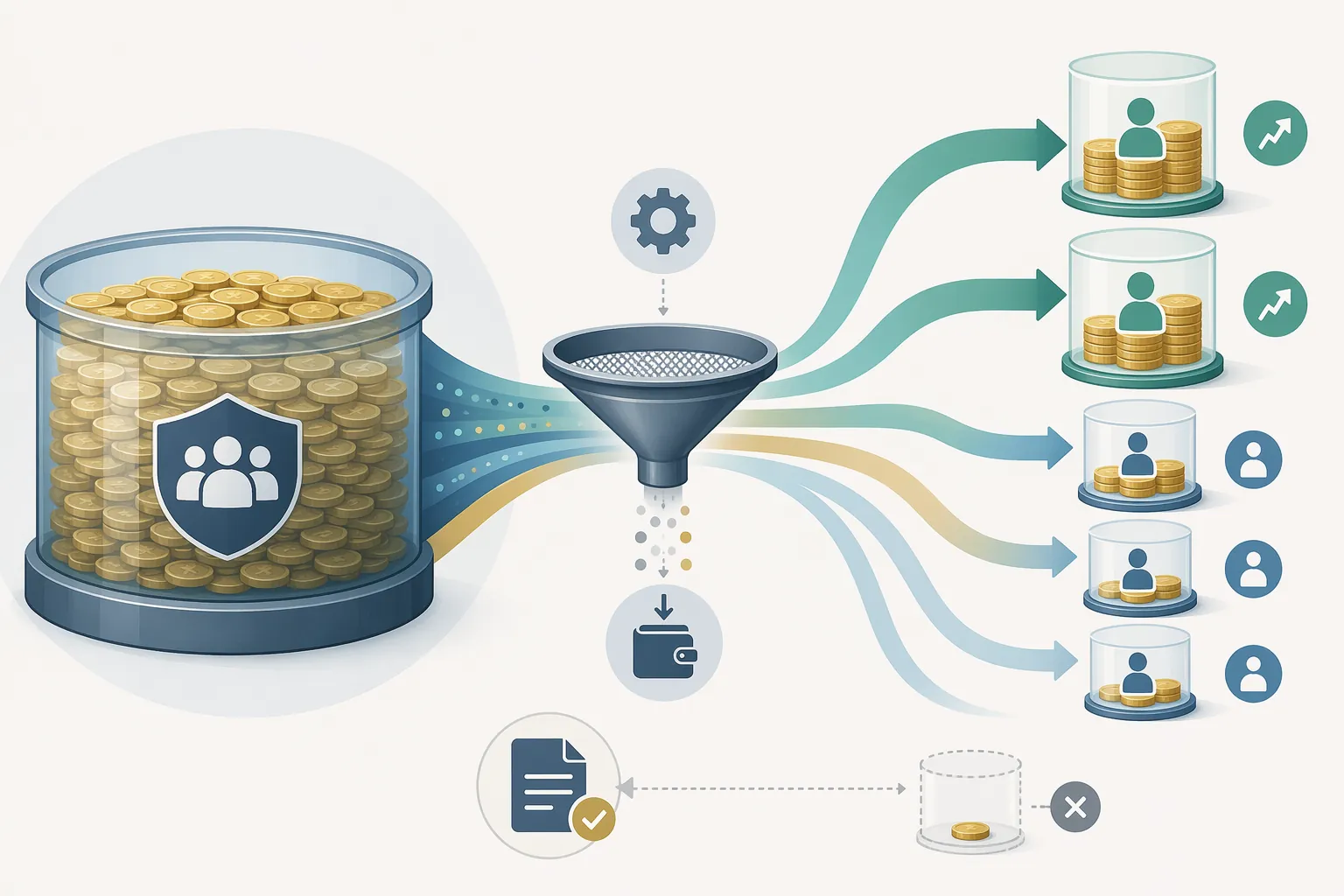
In plainer terms, the administrator is not asking, “Was this person in the class?” and then assigning one standard amount. It is asking how the covered account behaved over time: when it was open, what balance history it had, and how the interest comparison works under the settlement formula. Two eligible account holders can therefore receive different cash payments.
| Question | Answer supported by the settlement materials |
|---|---|
| Do eligible class members file claims? | No. Eligibility and payment processing are automatic, based on account records. |
| Is the cash payment flat? | No. It is individualized using an interest-differential formula and pro rata adjustment. |
| Has the administrator calculated final individual amounts? | No public distribution has occurred, and individual payment amounts should be treated as uncalculated as of July 23, 2026. |
| Are estimates final? | No. Estimates describe settlement mechanics and class counsel projections, not actual payments. |
The $5 Threshold
Consumer-facing summaries have reported a $5 minimum cash-payment threshold: accounts with less than $5 in computed interest differential would not receive a cash payout.[5][6] That should not be read as a guarantee that every eligible person will receive at least $5. It is a threshold within the administrator’s calculation process, and the actual payment population has not yet been paid.
Why Former Account Holders May Receive More Cash
Class counsel and settlement summaries have estimated that former account holders may receive cash payments about 15% larger than current account holders.[3][4] The reason is structural: current account holders are also positioned to receive the forward-looking interest benefit, while former account holders are not. That 15% figure is an estimate tied to the settlement design, not evidence that any former account holder has already received a larger payment.
The $125 Million Benefit Is Not the Same Thing as the Cash Fund
The forward-looking interest obligation is the easiest part of the headline number to misunderstand. The $125 million component is not another immediate cash pool to be divided among every class member. It is a rate-related benefit for current account holders, tied to future interest treatment under the settlement.[3][4]
That distinction affects what different class members are waiting for. A former account holder is waiting only on the cash distribution. A current account holder may have a smaller cash payment estimate because part of the settlement’s value is assigned to ongoing interest treatment. Both groups can be eligible, but they are not receiving the same mix of benefits.
Why Payments Have Not Gone Out
The settlement’s final approval order did not end the case for payment purposes. The June 18, 2026 Notice of Appeal stayed distribution, which means the administrator cannot simply proceed with checks or electronic payments while the appeal is unresolved.[1] That is the point most likely to be lost in headline summaries: “approved” describes one procedural milestone, not money received.
The official settlement site’s warning of a delay lasting “potentially over one year” is not a payment date.[1] It is a caution about appellate timing. The actual schedule depends on the appeal process, including court deadlines and resolution in the Fourth Circuit. As of July 23, 2026, there is no distribution date that class members can safely treat as fixed.
This creates the odd practical result at the center of the settlement: a person can be in the class automatically, owe the administrator nothing, miss no claim deadline, and still have no payment timeline. The bottleneck is not consumer action. It is the appeal.
Fees, Waivers, and the Rest of the Settlement Architecture
The settlement also includes attorneys’ fees and costs that affect the money available for distribution. ClassAction.org reported that fees are capped at 15% of the $425 million settlement value, or $63.75 million, and are deducted before individual payments are made.[7] That fee cap is not an individual payout estimate; it is part of the settlement’s cost structure.
Class members who did not opt out also give up the right to sue Capital One separately over the same claims covered by the settlement.[7] That is standard enough in class settlements that it can sound routine, but it is still consequential: automatic inclusion usually comes with automatic release of covered claims unless a class member took the required opt-out step.
The case also sits against a broader enforcement and litigation background. The CFPB previously sued Capital One, alleging that consumers were cheated out of more than $2 billion in interest payments on savings accounts, though that enforcement action was later dropped in February 2025.[8] Separately, state attorneys general opposed the original class settlement, and New York Attorney General Letitia James filed a separate state lawsuit that has been conditionally dismissed.[9]
Those surrounding disputes help explain why the settlement attracted scrutiny, but they do not change the basic answer for a class member trying to understand status in Q3 2026. Eligibility is broad and automatic. The cash formula is individualized and still unexecuted. The decisive fact is that the appeal has frozen distribution indefinitely.
References
- Official Settlement Website, Capital One 360 Savings Account Litigation
- Capital One settlement payout to customers substantially delayed, al.com
- $425 Million Settlement Reached in Capital One 360 Savings Account Interest Rate Litigation, PRNewswire
- The $425 Million Capital One Settlement: Find Out Who’s Eligible for a Payout and What Happened, Kiplinger
- Capital One settlement: Who qualifies, USA Today
- See Who Qualifies for the $425 Million Capital One Settlement, AARP
- $425M Capital One Settlement Resolves Lawsuit Over High-Yield 360 Savings Accounts, ClassAction.org
- CFPB Sues Capital One for Cheating Consumers Out of More Than $2 Billion in Interest Payments on Savings Accounts, Consumer Financial Protection Bureau
- States Ask Court to Reject Proposed Class Action Settlement in Capital One Case, PYMNTS
Comments
Join the discussion with an anonymous comment.