
CBS’s July 16 problem was not abstract. While President Trump was speaking in prime time about election security, he was also demanding license consequences for networks that did not carry him. ABC and NBC declined the address entirely. CBS carried roughly the first 15 minutes, then cut away to real-time fact-checking by Major Garrett and David Becker. CNN kept the speech off its cable feed and streamed it on digital platforms only.[1][2][3]
The legal answer is cleaner than the operational one: CBS had no duty to keep airing the speech, and the FCC cannot lawfully revoke broadcast licenses because a network made an editorial judgment about presidential remarks. That is not because presidential speech is unimportant. It is because the Communications Act does not convert public interest in hearing a president into a presidential right to commandeer a network’s live programming.
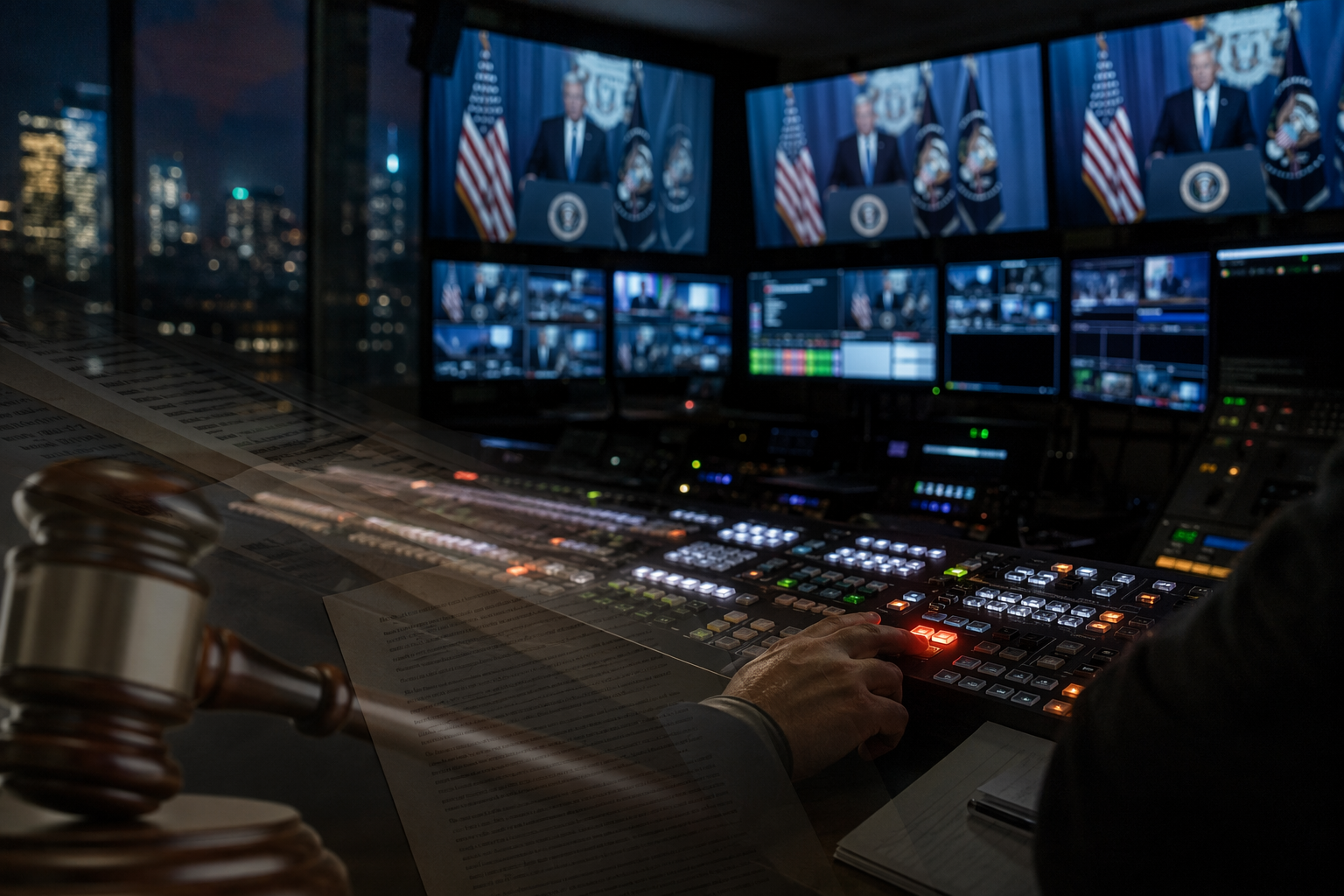
The Access Rules Do Not Give a President an Unedited Live Slot
The first statutory place to look is Section 312(a)(7), which gives legally qualified federal candidates a right of reasonable access to broadcast stations. The second is Section 315, the equal-opportunities provision. Neither required CBS, ABC, NBC, or CNN to carry this address live and uninterrupted. As summarized in reporting citing First Amendment lawyer Robert Corn-Revere of FIRE, those provisions do not impose a general obligation to air a sitting president’s address as live network programming.[4]
That distinction matters. A president may be a political actor, a candidate, or both, depending on the context. But the broadcast statutes do not say that every presidential address on election security becomes mandatory carriage. They regulate certain candidate-access and equal-treatment problems; they do not erase editorial control over news judgment, timing, format, verification, or whether a speech belongs on the main feed at all.
The July 2026 decisions were also not unprecedented as a matter of network practice. Reuters reported that networks had previously declined to carry President Biden’s 2022 prime-time speech and President Obama’s 2014 immigration address.[1] Those examples do not decide the legal question, but they are useful guardrails: declining a presidential address is not, by itself, some exotic breach of broadcast duty.
Section 326 Is the Statutory Wall Trump’s Theory Runs Into
Section 326 of the Communications Act is unusually direct for this area of law. It prohibits FCC censorship and bars the Commission from interfering with the right of free speech by means of radio communication.[5] The FCC’s own consumer guidance reflects the same limit: the agency does not have authority to censor broadcast speech simply because it disagrees with editorial content.[5]
A license-revocation threat aimed at a network’s decision to stop airing a president’s speech is therefore not just politically aggressive. It collides with the part of the statute that tells the FCC what it may not do. The relevant editorial choice was not a technical failure, a sponsorship disclosure problem, an indecency issue, or a refusal to comply with a valid rule. It was a newsroom judgment about whether to continue carrying live political claims and how to contextualize them.
That is the exact category where the “public airwaves” shorthand becomes dangerous. Broadcast licensees do use spectrum under federal license. That does not mean the White House gets a live microphone on demand, or that the FCC can punish a station group because its editors decided to stop carrying one. The public-interest standard is not a roving license for viewpoint discipline.
Revocation Is Not a Content-Displeasure Remedy
Section 312 does authorize revocation in defined circumstances, including willful or repeated violations of the Act or FCC rules.[6] But a network’s refusal to air political speech, or its decision to cut away from it, is not itself a violation of the Act. The premise of the threat would have to be that the editorial decision somehow becomes a license offense. The statute does not supply that bridge.
The constitutional frame points the same way. In NBC v. United States, the Supreme Court upheld aspects of broadcast regulation, but not a power to license based on political orthodoxy. As James B. Speta has emphasized, the Court said Congress “did not authorize the Commission to choose among applicants upon the basis of their political, economic or social views.”[6] That principle constrains revocation as well as initial licensing. If the FCC cannot award licenses based on political viewpoint, it cannot take them away because a network declined to carry the president’s preferred presentation.
The post-1996 renewal structure reinforces the point. Congress eliminated comparative renewal hearings in the Telecommunications Act of 1996, codified at Section 309(k)(4), removing a mechanism that had once made content-based challenges to license renewals a more potent threat.[7] Renewal is still a serious regulatory event, but it is not supposed to become a referendum on whether station owners made the right political programming choice on a particular night.
| Claim | Legal problem |
|---|---|
| A president is entitled to uninterrupted live broadcast carriage. | Sections 312(a)(7) and 315 do not create that general entitlement. |
| The FCC can revoke licenses because a network cut away. | Section 326 bars FCC censorship and interference with broadcast speech. |
| The public airwaves theory gives the government content control. | NBC v. United States rejects licensing based on political, economic, or social views. |
| Renewal review can be used to punish the editorial decision. | Section 309(k)(4) removed comparative renewal hearings, and renewal standards are not content-displeasure tools. |
Cutting Away Was an Editorial Act, Not a License Violation
CBS did not merely go dark. It moved from live carriage to live editorial treatment. Garrett and Becker fact-checked the remarks in real time after the network cut away.[2] That matters because the legally protected decision was not only whether to air the president. It was also whether to air him in a format that reduced the risk of broadcasting unsupported election-fraud claims without context.
The concern was not fanciful. The Fox News settlement with Dominion Voting Systems, reported at $787.5 million in 2023, remains part of the risk environment for any outlet handling election-fraud allegations.[10] That settlement does not mean every live presidential statement creates defamation exposure, and it does not prove CBS’s motive. It does explain why a lawyer or standards executive would treat unverified election claims as more than ordinary political rhetoric.
In that setting, continuing live carriage, cutting away, delaying the feed, streaming digitally, or adding fact-checking are all editorial risk choices. The First Amendment does not require the same choice from every outlet, and the Communications Act does not make the FCC the after-action reviewer of which choice was sufficiently deferential to the president.
Why the Threat Still Matters
Stopping at “the FCC would lose in court” is legally tidy and professionally incomplete. Regulatory pressure can matter before a notice of apparent liability, before a renewal denial, before a formal revocation hearing, and before a judge has anything final to review. It matters through timing, uncertainty, transaction leverage, document demands, board anxiety, and the possibility that a newsroom’s next hard call will be made with a regulator already in the room.
The Supreme Court’s 2024 NRA v. Vullo decision supplies the modern bridge. The Court held that even threatened adverse government action designed to suppress disfavored speech can independently violate the First Amendment.[4] That doctrine is important here because coercion does not have to wait for a completed license revocation. A regulator who uses official leverage to make intermediaries or regulated entities suppress speech may create a constitutional problem at the threat stage.
That does not mean every angry public statement by an FCC chair is automatically actionable coercion. Context matters: authority, specificity, timing, pending proceedings, and whether the target reasonably understands the statement as a threat backed by government power. But broadcast regulation supplies exactly the kind of context in which a threat can be heard as more than a press release.

The 2026 ABC Proceedings Show the Pressure Point
The pressure concern is not hypothetical in 2026. Reuters and NBC News reported that FCC Chair Brendan Carr brought a February 2026 enforcement action against ABC’s “The View” over equal-time rules.[1][7] NBC News also reported an April 2026 early-renewal order for ABC’s eight owned-and-operated stations, years before their 2028-and-later renewal dates, and quoted Commissioner Anna Gomez calling it “the most egregious action this FCC has taken in violation of the First Amendment to date.”[7]
Those facts do not prove that CBS cut away because of FCC pressure. They do show why station counsel would not treat revocation rhetoric as legally irrelevant noise. Early renewal review changes the calendar. An enforcement inquiry changes the internal audience for editorial decisions. A general counsel who believes the network would ultimately win may still spend the weekend managing risk, preserving documents, and warning executives that process itself can become punishment.
Transaction Review Adds Another Channel of Leverage
The transaction backdrop makes that risk more concrete. Reuters reported that the Paramount/Warner Bros. Discovery merger had DOJ approval in June 2026 but still needed FCC approval; KSL reported that David Ellison, son of Trump ally Larry Ellison, would gain control of CNN through the deal.[1][8] Reuters and KSL also reported employee concerns about possible ownership-transition pressure, while noting CBS’s denial of political interference.[1][8]
That reporting should stay in its lane. Unnamed employee concerns are not proof that CBS made its July 16 call at an owner’s direction, and a denial is not proof that no pressure existed anywhere in the institution. The point is narrower and more important for media law: when a broadcaster or affiliated corporate family has a major transaction before the FCC, editorial decisions can be made under a regulatory shadow even if no one issues an unlawful order.
CBS also had a fresh litigation backdrop. TIME reported that CBS had previously settled Trump’s lawsuit over “60 Minutes” editing for $16 million.[9] Again, that settlement does not establish why the network cut away from the election-security speech. It does show why executives would understand that editing, truncation, and framing of presidential remarks were no longer merely programming questions; they were litigation, regulatory, and corporate-governance questions at the same time.
The Practical Legal Advice Is Narrower Than the Politics
For a broadcaster, the safest legal analysis starts with separation. The network’s editorial right to decline, truncate, delay, or contextualize the speech is one issue. The FCC’s lack of authority to punish that decision is a second. The practical burden created by threats, investigations, early renewals, or transaction review is a third. Collapsing those categories helps no one except the official trying to make pressure feel like ordinary oversight.
The record also should be built in real time. If a network cuts away because editors judge claims to be newsworthy but unverified, the documents should say that. If fact-checking is added because election-related statements present known verification and defamation risks, the editorial record should say that. If a decision is made for scheduling, format, or audience reasons, those reasons should not be improved after the fact into constitutional theater.
The government side has its own boundary. The FCC may enforce valid statutes and rules. It may not use licensing, renewal timing, or merger review as a workaround for Section 326. It may not turn “public interest” into a demand that networks carry a president’s speech in the form he prefers. And after NRA v. Vullo, officials should assume that threats backed by regulatory authority can create First Amendment exposure even before the threatened punishment is imposed.[4]
CBS was legally protected when it cut Trump’s election-fraud speech and moved to fact-checking. A license-revocation theory based on that editorial act would run into Section 326, Section 312’s limited revocation standard, NBC v. United States, the post-1996 renewal structure, and the First Amendment. The harder problem is not whether that punishment should survive judicial review. It is how much editorial behavior can be reshaped by the threat of proceedings, renewal disruption, and transaction leverage before any court gets the chance to say what the law already makes plain.
References
- US networks face dilemma over whether to air Trump's election security speech, Reuters
- CBS cuts away from Trump election speech, Yahoo News
- Trump threatens ABC, NBC licenses over election speech, Deadline
- Trump election speech FCC ABC NBC networks, USA Today
- The FCC and Speech, Federal Communications Commission
- The FCC Lacks Authority to Punish Broadcasters for Their Viewpoints, Yale Journal on Regulation
- First Amendment advocates blast FCC's early review of ABC broadcast licenses, NBC News
- Trump threatens to revoke licenses of US networks for not carrying primetime speech, KSL
- Trump demands major TV networks lose licenses in speech broadcast row, TIME
- Trump threatens networks over speech coverage, TVTechnology
Comments
Join the discussion with an anonymous comment.