
The uncomfortable moment for a wedding vendor is not the celebrity client asking for privacy. That part is predictable. The real moment is the signature page: a photographer, planner, florist, caterer, bandleader, or design studio is handed a non-disclosure agreement that says they cannot disclose, display, acknowledge, publish, promote, or use anything connected to the event.
For a guest, that language usually means silence about what they saw. For a vendor, it can mean something larger: no portfolio images, no credited work, no public association with the event, no future referral value from a job that may have been priced partly because it could attract the next one. That is where the celebrity wedding NDA legal implications stop being gossip and become a commercial drafting problem.
The current public hook is the reported Taylor Swift and Travis Kelce wedding NDA discussion. TMZ reported anonymous-source details about alleged confidentiality measures, while other commentary has treated the reports as a privacy-planning example; the actual NDA has not been released, and the reported terms should not be treated as a document-backed record of what any guest or vendor signed.[1][2]
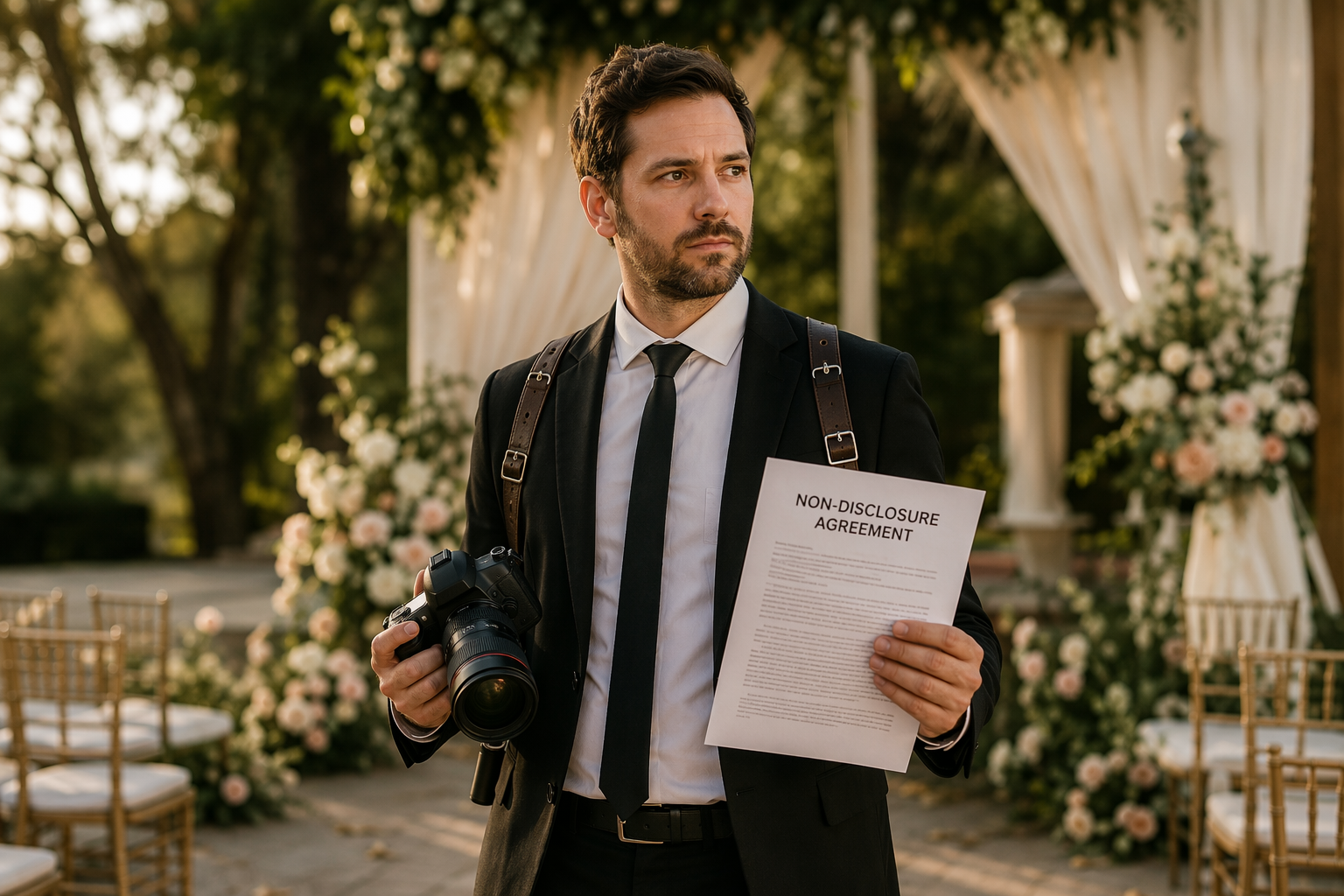
The Vendor Is Giving Up More Than Speech
A vendor-side NDA should be read against the vendor contract, not in isolation. The services agreement may say who owns photographs, design assets, floral sketches, planning materials, music recordings, social media clips, behind-the-scenes images, or edited deliverables. The NDA may then say none of that can be displayed, referenced, or used. If the two documents do not speak to each other, the vendor is left with a signed contradiction.
That contradiction matters most for creative vendors. Weinberg Legal’s wedding NDA guidance identifies three compromise structures for clients who want privacy without eliminating vendor portfolio value: client approval of specific detail shots, one-by-one image approval, and anonymized or no-name sharing.[3] Those are not decorative compromises. They are the clauses that decide whether the vendor retains any commercially usable residue from the job.
| Carve-out | What it protects | Where it fits |
|---|---|---|
| Detail-shot approval | The ability to show work without exposing faces, location cues, guest identities, or event timing | Florals, tablescapes, stationery, food, lighting, décor, and other non-identifying work |
| One-by-one image review | Client control over specific images instead of a blanket ban on display | Photography, videography, planning, production, and design portfolios |
| Anonymized or no-name sharing | Vendor portfolio use without identifying the couple or event | Websites, private pitch decks, trade submissions, and social feeds that can avoid names and tags |
The practical drafting question is not whether the couple has a legitimate privacy interest. They plainly may. The question is whether the NDA uses privacy as a scalpel or as a broom.
Portfolio Rights Are Not a Courtesy Clause
A confidentiality clause that prevents a photographer from posting a guest’s face is one thing. A clause that prevents the photographer from displaying their own non-identifying composition, lighting work, detail shots, or edited images is something else. It starts to occupy the same space as copyright ownership and licensing.
General NDA doctrine treats a non-disclosure agreement as a contract restricting disclosure of confidential information.[4] Copyright law asks a different question: who owns the protected expression in the work, and what exclusive rights attach to it. In a creative-services setting, the photographer or studio may own the underlying work absent a work-for-hire arrangement, assignment, or sufficiently clear license transfer. A celebrity wedding NDA that says the vendor may never display anything from the event is therefore not merely a privacy clause; it can operate like a practical restriction on use of the vendor’s own copyrighted work.
That does not mean every portfolio ban is invalid. It means the contract needs to say what it is doing. If the client wants total control of display rights, the services agreement should address ownership, license scope, work-for-hire language where legally available, assignment terms, usage restrictions, approval rights, and compensation. Silence is the expensive choice, because it invites both sides to believe they bought something different.
Monge v. Maya Magazines is not a wedding-vendor NDA case, and it should not be stretched into one. It is useful only as a reminder that unpublished celebrity wedding images can carry copyright significance separate from the privacy instincts surrounding them.[5] A vendor NDA sits closer to the contract side of the street, but copyright still matters when the restricted material is the vendor’s own creative output.
This is why approval mechanics matter. A clause allowing “portfolio use with prior written approval” is better than silence, but it is still thin if the client has no deadline to respond, no standard for approval, and no consequence for ignoring the request. The more workable version says what the vendor may submit, who reviews it, how long review takes, whether non-response means denial or deemed approval, and which identifying elements must be removed before publication.
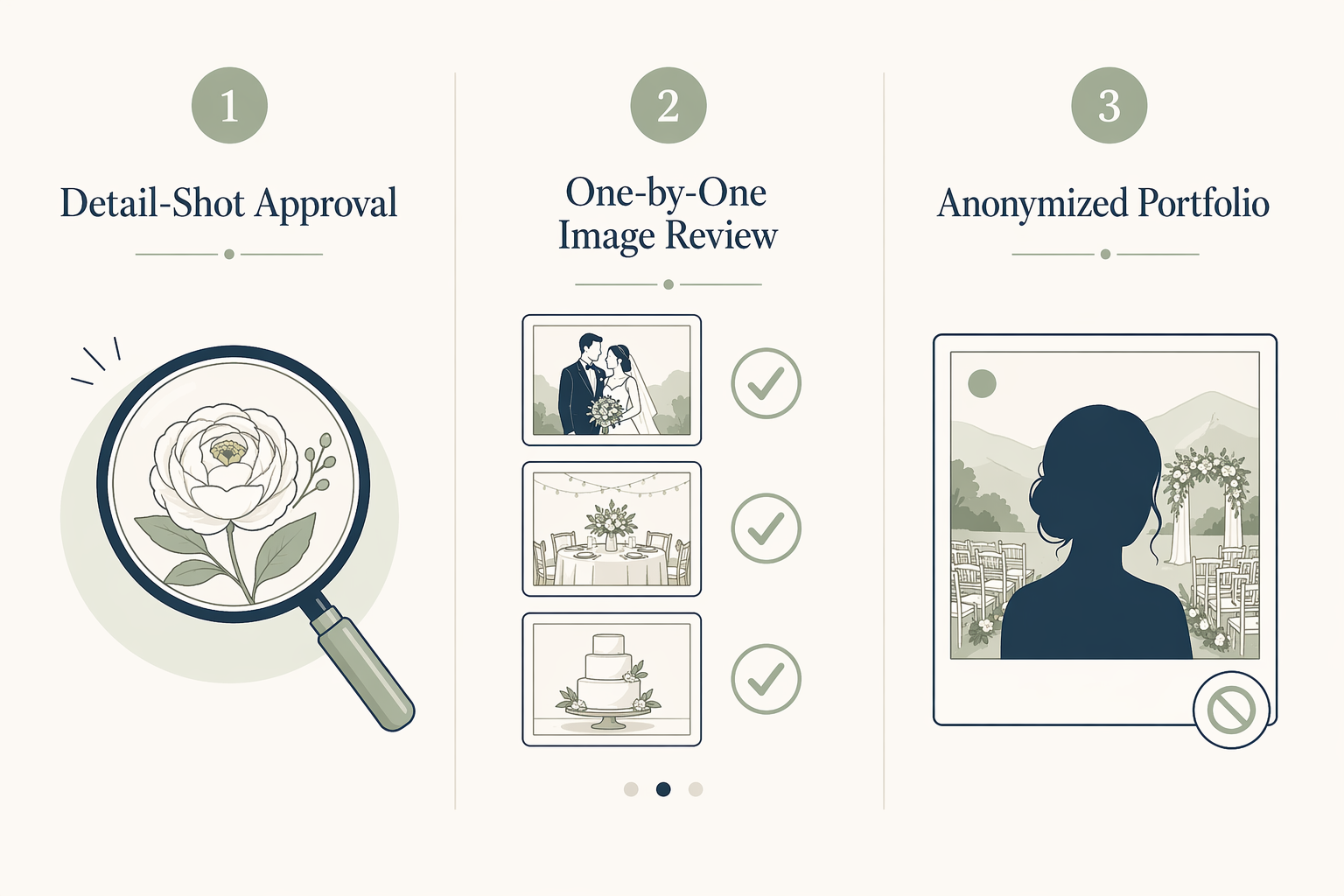
The safer portfolio clause is specific
A workable carve-out might allow the vendor to use images that do not identify the couple, guests, private residence, precise location, date, security arrangements, unpublished attire, vows, invitations, seating charts, or other sensitive details. For higher-risk images, the vendor can submit them one by one. For lower-risk material, such as a cropped floral installation or place setting with names removed, the agreement can permit use after detail-shot approval or after a defined embargo.
That approach serves the client better than a vague ban, because it identifies the actual harm: exposure of identity, timing, location, guests, and private details. It also lets the vendor preserve proof of competence. A luxury florist who cannot show a single installation from the largest event of the year has not just kept a secret; they have lost marketing inventory.
The Exposure-for-Discount Trap
The cleanest vendor contract is money for services. The messier one is money plus “exposure.” The worst version is a discounted fee in exchange for a soft promise that the vendor will receive credit, tags, press, public association, portfolio rights, or future referrals, followed by an NDA that prohibits every route by which that promotional value could materialize.
Weinberg Legal warns that when a vendor accepts reduced fees in exchange for crediting or portfolio rights, the arrangement becomes vulnerable if the promotional benefit is not tied to quantifiable commitments. The problem is not that “exposure” can never be part of a bargain; it is that the bargain needs measurable promotional deliverables if it is going to support the discount.[6]
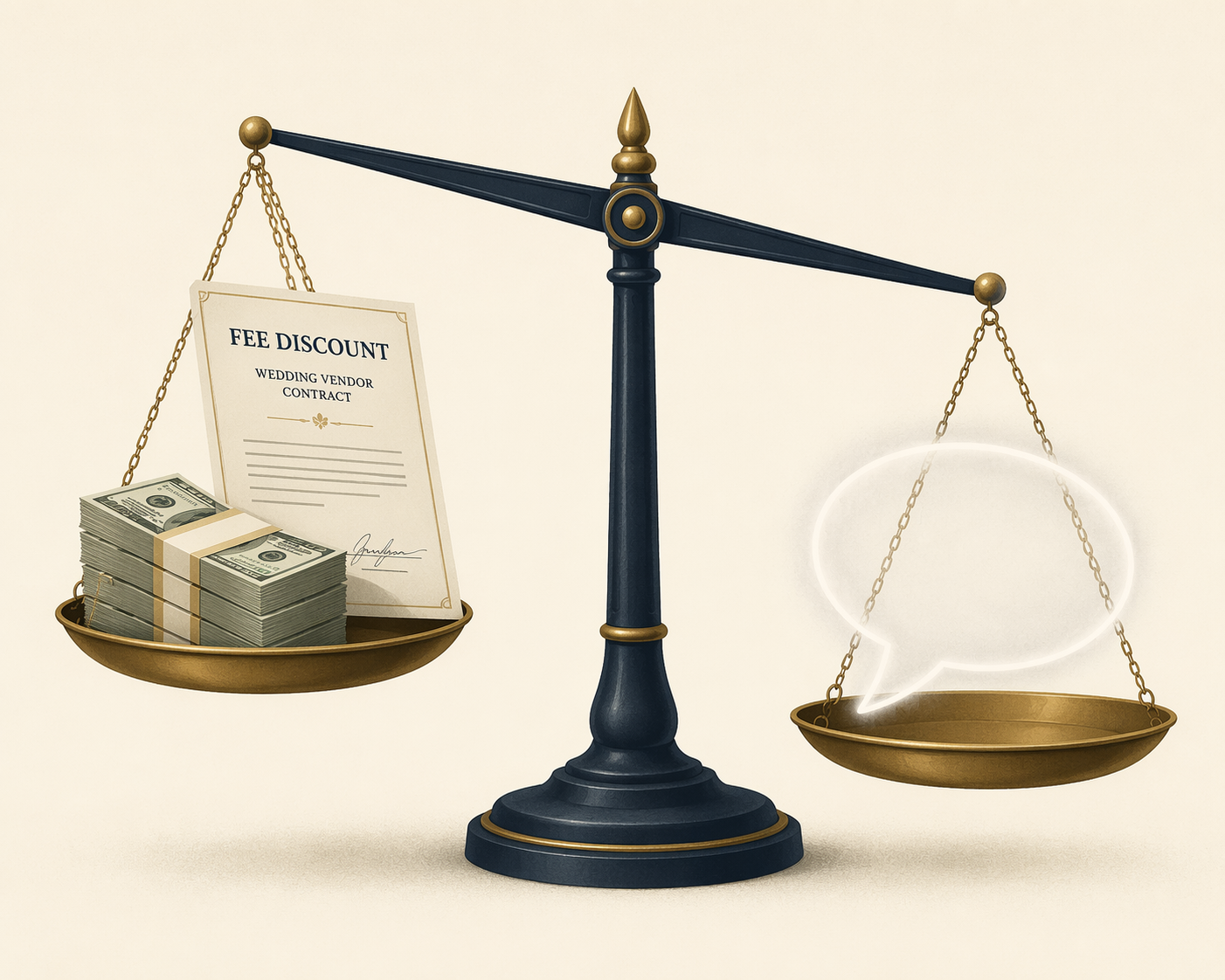
A contract that says “vendor agrees to a reduced fee in recognition of the promotional value of the event” does not tell anyone what the vendor receives. A tagged post by whom? A credit in which publication? A license to use how many images? A private reference to future clients? A right to submit the work for awards? A press embargo followed by public use? Without those details, the vendor has discounted a real invoice for a benefit that can disappear into the NDA.
The fix is not to dress up exposure in grander language. It is to price it. If the client wants total silence forever, the fee should reflect that. If the client wants a discount, the agreement should define the promotional consideration: for example, approved anonymized portfolio use after a stated period, a limited number of pre-cleared detail images, a named credit in agreed media if any public release occurs, or a written testimonial that does not reveal private details. Those examples are drafting structures, not a claim that any particular celebrity agreement used them.
The same issue appears in referral language. “Future opportunities” is not much consideration unless the contract identifies an actual obligation. A client cannot guarantee fame will produce business, and a vendor should not price a job as though it will unless the contract gives them something definite enough to enforce or value.
The Planner’s Problem: Everyone Else With a Phone
Vendor NDAs also fail when they pretend the signer is the only person performing the job. A planner may contract with florists, rental companies, lighting teams, security coordinators, tent crews, drivers, assistants, and freelance day-of staff. A photographer may bring second shooters and editors. A caterer may use outside staffing. If the lead vendor signs a strict NDA but the subcontractor chain does not, the paper trail points back to the lead vendor when someone posts an Instagram story from load-in.
General NDA enforceability commentary emphasizes that agreements should be drafted with the actual parties and obligations in mind, including downstream handling of confidential information.[7][8] In the wedding context, that means the lead vendor needs express authority to disclose confidential information to approved subcontractors solely as needed to perform the work, plus a duty to impose matching confidentiality obligations on them.
Indemnity should follow control. If the planner chooses and supervises a subcontractor, the planner may be asked to stand behind that subcontractor’s breach. If the client insists on a particular vendor, the allocation may look different. If a leak comes from a guest, venue employee, or someone outside the vendor’s control, the NDA should not make the creative vendor the insurer of the entire event.
Time Limits Do Real Work
A celebrity wedding has a privacy curve. The risk before and during the event is not the same as the risk after the couple has publicly released selected images, confirmed the location, or allowed press coverage. A perpetual NDA treats all those moments as identical.
Sirion’s NDA enforceability guidance notes that industry practice increasingly favors a 12- to 24-month privacy window followed by permission to share, and that courts are more likely to enforce NDAs with reasonable time limits than perpetual restrictions.[7] That is not a universal rule for every jurisdiction or every fact pattern, but it is a useful drafting pressure point.
A time limit can be paired with content limits. The vendor might remain permanently barred from disclosing guest lists, security plans, private family details, unreleased vows, or financial terms, while gaining the right to use anonymized, approved work samples after an embargo. That structure protects the information that remains sensitive and releases the material whose secrecy value has diminished.
What Should Be Written Back In
The vendor-side review should move line by line from prohibition to carve-out. If the NDA says no disclosure, define confidential information. If it says no display, define whether that includes non-identifying work product. If it says no acknowledgement, decide whether private client pitches, award submissions, or confidential portfolio decks are also barred. If it says all affiliates, employees, agents, and subcontractors are bound, decide who signs what and who pays for whose breach.
- Ownership and license: state whether the vendor retains copyright, grants a client license, assigns rights, or creates work made for hire where legally available.
- Portfolio use: permit approved detail shots, one-by-one reviewed images, anonymized use, private pitch use, or post-embargo publication.
- Approval process: identify the reviewer, submission method, response deadline, permitted redactions, and whether approval may be withheld in the client’s sole discretion.
- Promotional consideration: tie any discount to specific credit, image-use rights, testimonial rights, media credit, or other measurable deliverables.
- Subcontractors: allow need-to-know disclosure, require flow-down NDAs, and allocate indemnity according to control.
- Duration: separate short-term event secrecy from longer-term protection for genuinely sensitive information.
The Speak Out Act is a reminder that lawmakers have become more skeptical of certain pre-dispute secrecy obligations, but it does not do much direct work for wedding vendors because it addresses a different employment-related harassment context. Likewise, broad statements about enforceability are not useful without jurisdiction. California, New York, Florida, and other states may approach NDA limits, public policy, settlement confidentiality, and restrictive drafting differently. There is also no reported wedding-vendor NDA case that supplies a neat rule for every photographer, planner, or florist.
That uncertainty is exactly why the contract should not rely on vibes. “Great exposure” is not a payment term. “Client privacy” is not an ownership clause. “No use” is not a substitute for deciding whether the vendor has been paid for silence, paid for transfer of rights, or merely asked to protect sensitive information while preserving a narrow path to show the work.
Celebrity privacy and vendor commercial survival can coexist, but only if the NDA says so before the work begins. The better agreement does not ask a vendor to choose between discretion and a future portfolio. It identifies what must stay private, what may be shown, who approves it, when the embargo ends, and what the vendor received if the answer is total silence.
References
- Taylor Swift & Travis Kelce Wedding Celebration NDA Details, TMZ
- NDAs In The Spotlight: What Taylor Swift And Travis Kelce's Wedding Reveals About Protecting Your Privacy, Mondaq
- 3 Resolutions For Clients Who Want an NDA For Their Wedding, Weinberg Legal
- Non-disclosure agreement (NDA), Cornell Legal Information Institute
- Monge v. Maya Magazines, Inc., U.S. Copyright Office
- What To Know About Wedding Non-Disclosure Agreements, Weinberg Legal
- Do NDAs Hold Up in Court?, Sirion
- Eight Reasons the NDA You Signed Might Not Be Enforceable, NachtLaw, 2024
Comments
Join the discussion with an anonymous comment.