
In the court testimony so far, the Celeste Rivas Hernandez murder case has turned less on one dramatic exhibit than on whether dozens of digital and physical fragments can be made to hold together. At the preliminary hearing that began July 21, 2026, Los Angeles prosecutors described a broad evidence web against David Burke, the recording artist known as D4vd: Amazon purchases made under an alleged alias, Tesla vehicle data, an iPhone connection timestamp, surveillance video, delivery records, text messages, iCloud material, and physical tools recovered in the investigation. The hearing was still ongoing as of July 22, 2026, with testimony expected to continue later in the week.[1]
That timing matters. A preliminary hearing is not a trial, and the record being built there is narrower than what a jury may eventually hear. The prosecution’s job at this stage is to show enough evidence to move forward. The defense’s job is to test the weak seams early: who collected the evidence, how it was logged, what was not recovered, and which links require inference rather than direct proof.
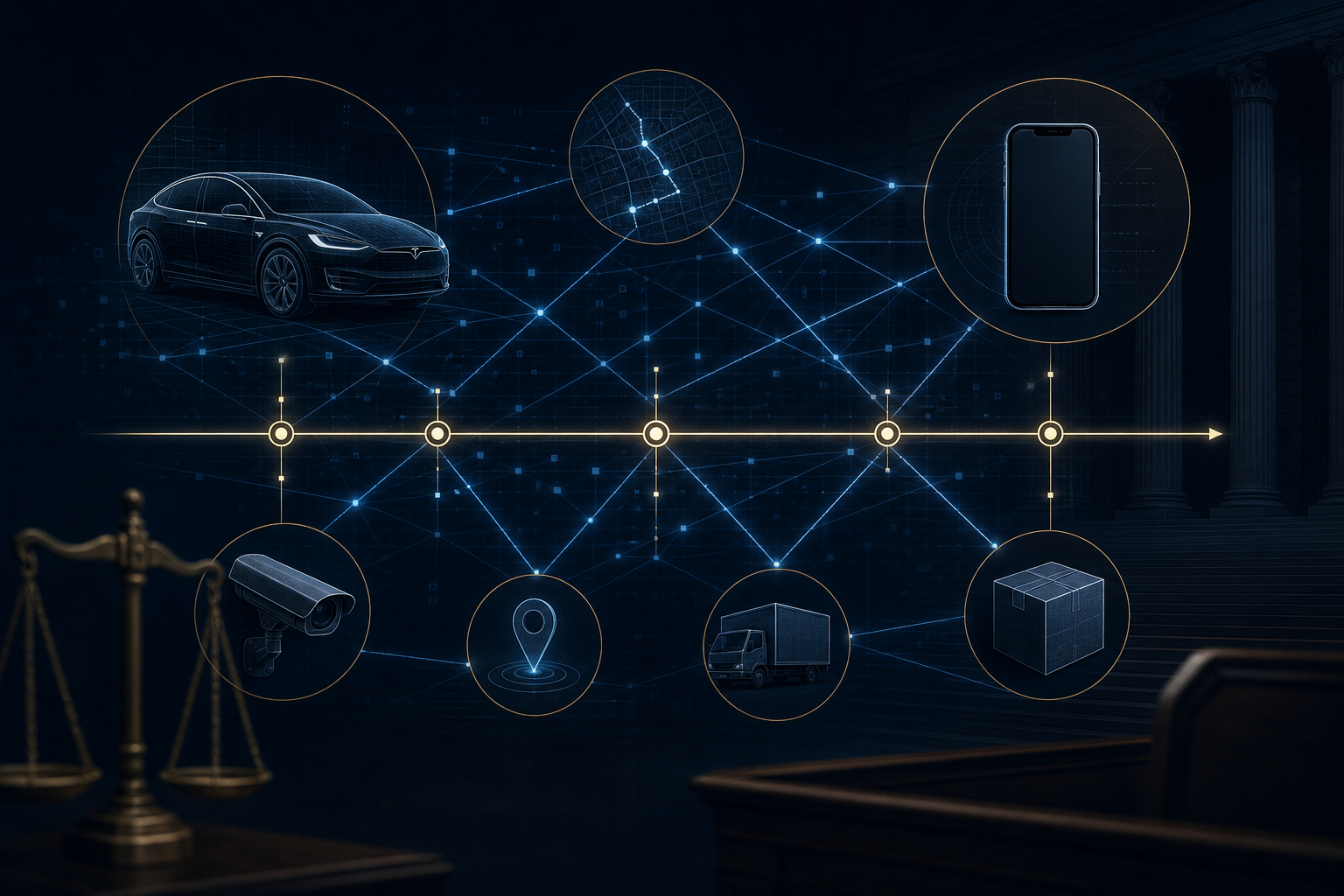
The prosecution’s digital timeline
The core sequence prosecutors presented is compact but dense. They alleged that Amazon purchases tied to Burke were made under the alias “Trayvion Davis,” including two chainsaws ordered May 1, 2025, along with a body bag, heavy-duty laundry bags, and an inflatable pool. They also described a third, unrecovered 10-inch Makita chainsaw delivered through Uber Postmates on May 4, 2025.[2]
The timeline then moves from purchases to movement. Prosecutors said Tesla data showed Burke’s iPhone 16, named “Tranquilizer,” last disconnected from the vehicle at 2:18 p.m. on July 29, 2025. They paired that with surveillance footage they said showed him walking away through an alley two minutes later.[2]
Other digital categories widened the frame: text message threads referencing sex, pregnancy, abortion, and Plan B; body-camera footage from a February 2024 welfare check; automated license-plate reader and surveillance material; iCloud data; and what prosecutors described as a “significant amount” of child pornography on Burke’s iCloud account.[1][2]
| Evidence category | What prosecutors used it to support | Immediate evidentiary pressure point |
|---|---|---|
| Amazon records under alleged alias | Purchases of tools and supplies before the alleged killing | Attribution of the alias and account activity to Burke |
| Tesla and iPhone timing | Vehicle and phone movement near a key July 29, 2025 moment | The iPhone 16 was not recovered |
| Surveillance video | Visual movement corresponding to the vehicle and phone timeline | Identification, camera context, and synchronization |
| Recovered chainsaws | Possible connection between purchases and physical tools | Negative luminol results, no DNA testing, and an unrecovered Makita chainsaw |
| Scene evidence handling | The route from discovery to courtroom exhibits | Destroyed cadaver bag and missing scene sign-in logs |
The table is not a verdict map. It is closer to what the hearing record requires: each artifact has to do a specific job, and each has its own point of possible failure. A purchase record can be powerful without proving who clicked “buy.” A phone disconnection can help place a device without placing a person, especially when the phone itself is not in evidence. A surveillance clip can corroborate a timestamp while still leaving room for argument about identification, continuity, or context.
Amazon records are useful only if attribution holds
The Amazon evidence is one of the prosecution’s clearest narrative engines because it gives the case an apparent before-and-after structure. The alleged May 1 chainsaw orders and related purchases come before the later movement evidence; the May 4 Postmates delivery adds a separate delivery channel; the recovered and unrecovered tools then become physical reference points for investigators.[2]
But account evidence does not authenticate itself. The important courtroom question is not merely whether Amazon produced records showing the orders. It is whether prosecutors can prove, through account identifiers, delivery locations, payment information, device access, witness testimony, or other corroboration, that Burke controlled the account activity attributed to “Trayvion Davis.” The alias may look incriminating in a timeline; in court, it still has to be tied to a person.
That distinction is easy to lose in coverage of a celebrity defendant. David Burke’s public identity as D4vd explains why the case drew national attention, but it does not answer the evidentiary question. The hearing record has to connect the performer, the accounts, the devices, the deliveries, and the alleged conduct without letting name recognition carry weight that belongs to proof.
The Tesla and iPhone evidence gives the timeline both force and a gap
The 2:18 p.m. iPhone disconnection is the sort of timestamp prosecutors like because it appears precise and machine-generated. It also lands close to the surveillance evidence: two minutes before the footage prosecutors described as showing Burke walking away through an alley on July 29, 2025.[2]
That pairing is stronger than either artifact alone. A vehicle system can show a device relationship. A surveillance camera can show movement in physical space. Together, they can help prosecutors argue that the person and the device were moving through the same story at the same time.
The weakness is equally concrete: the iPhone 16 named “Tranquilizer” was never recovered, according to the evidence described in the hearing coverage.[2] That does not make the Tesla record useless. It does mean the defense can press on what investigators could not test directly from the device: local artifacts, deletion history, user access, physical possession, and whether the phone’s absence limits the state’s ability to explain the full context of the connection event.
A missing device also changes the tone of authentication. Prosecutors may still rely on provider records, vehicle logs, cloud data, and corroborating surveillance. But they have to persuade the court that the substitute paths are reliable enough. In a digital case, “not recovered” is not a footnote; it is a cross-examination lane.
Physical tools do not automatically complete the digital story
The chainsaw evidence sits at the uncomfortable junction between digital records and physical proof. Prosecutors have order and delivery evidence. Investigators also recovered chainsaws. But the defense elicited that the recovered chainsaws had negative luminol results and were not DNA-tested, while the 10-inch Makita chainsaw allegedly delivered through Uber Postmates was not recovered.[2][3]
That does not erase the purchasing evidence. It does prevent a cleaner argument: order, delivery, recovery, biological confirmation, courtroom exhibit. The actual record, as reported from the hearing, is more uneven. Some tools were recovered but not biologically tied to Celeste Rivas Hernandez. One allegedly delivered tool was not recovered at all. That leaves prosecutors relying on the broader fit of timing, account attribution, movement, and other surrounding evidence.
The chain-of-custody attack is not a technicality
Defense attorney Blair Berk’s cross-examination focused on the kind of scene-management problems that can quietly reshape a digital-heavy case. The defense brought out that three separate law enforcement units responded before criminalists arrived, that the cadaver bag was destroyed before evidence collection, and that no scene sign-in logs were produced.[3]
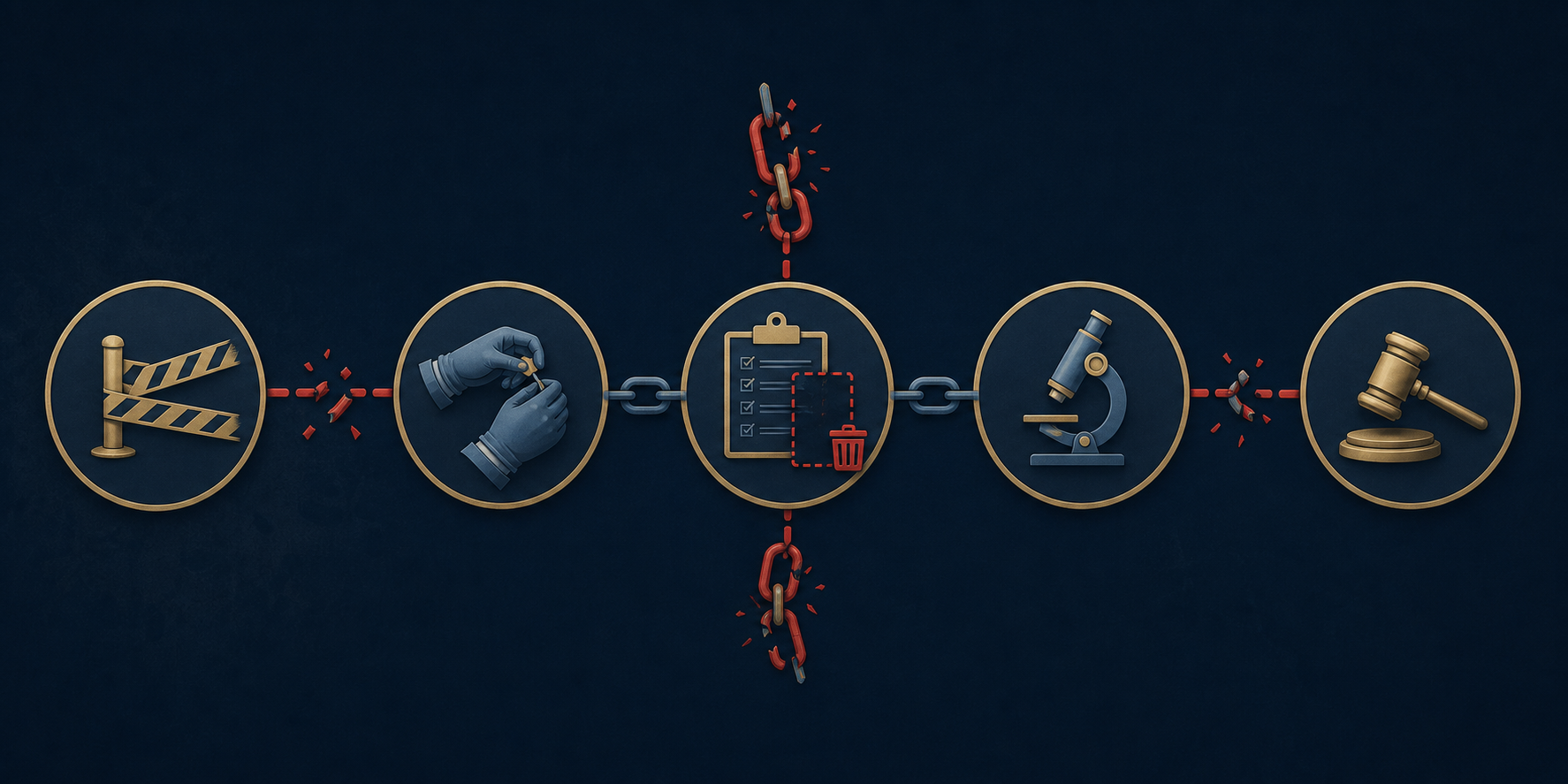
Those facts matter because chain of custody is not limited to a paper label on a sealed bag. It is the record of access, movement, preservation, and decision-making that lets a court understand whether an item or data extract is what the proponent says it is. When a scene has multiple responding units before criminalists arrive, the number of people who may have observed, moved near, or affected evidence increases. When a cadaver bag is destroyed before collection, a potentially relevant container is gone. When sign-in logs are missing, the record of who entered and when becomes harder to reconstruct.
The defense does not have to prove contamination at the preliminary hearing to make those issues useful. It can show that the state’s evidence path contains undocumented stretches. Later, those stretches can become arguments about weight, admissibility, reliability, or reasonable doubt, depending on the evidence and the court’s rulings.
Former federal prosecutor Neama Rahmani told The Guardian that the defense appeared to be attacking chain of custody and police handling of evidence, while noting the prosecution’s case included substantial circumstantial evidence.[3] That is the practical shape of the hearing: prosecutors have volume and convergence; the defense has preservation and attribution questions.
The 40-terabyte evidence set still has to become admissible proof
The reported evidence set is enormous: roughly 40 terabytes of digital material.[1] Size can help an investigation because it gives analysts more opportunities to corroborate a timeline. It can also complicate litigation because every extraction, filter, report, export, and handoff may become a point where the defense asks what was included, what was omitted, and who made the call.
That is especially true when the data sources differ in kind. Amazon records come from a commercial account system. Tesla data may come from vehicle and connected-device logs. iCloud records come from Apple’s cloud environment. Surveillance footage depends on camera placement, retention, export quality, and time settings. License-plate reader data has its own collection and database path. A single neat timeline in court may be assembled from systems that were never designed to serve as one unified forensic record.
The prosecution can still use that diversity to its advantage. Independent systems that point toward the same period, place, or actor can be more persuasive than a single source. But the convergence has to be demonstrated rather than assumed. If a timestamp is off, if an account attribution is weak, if a device is missing, or if the scene record is incomplete, the defense can ask whether the timeline is being stitched more tightly than the evidence allows.
The family-impact evidence belongs in the record, not as spectacle
Celeste Rivas Hernandez was 14. BBC coverage of the hearing described the images shown in court as a “worst nightmare” for her family, and other reports described family members reacting as prosecutors displayed disturbing exhibits.[4] The fact of that pain is part of the public record, but it should not be used to blur the procedural questions the hearing is trying to answer.
The same restraint applies to the allegations involving sexual communications, pregnancy, abortion, Plan B, and child pornography. They are legally important to the extent prosecutors use them to explain motive, relationship context, state of mind, or separate charges. Repeating their details for shock adds little to an evidence analysis and can make the case look more certain than the courtroom record has yet established.
What the preliminary hearing can and cannot settle
The broader chronology is not in serious dispute at the level needed here: Celeste Rivas Hernandez was a teenager whose disappearance and death led to a murder case against Burke, whose public profile as D4vd brought unusual attention to the proceedings.[5] What remains contested in the hearing is not whether investigators found a large amount of material. It is how much legal weight that material can carry.
At this stage, prosecutors have shown a case built from mutually reinforcing records: purchases, vehicle data, phone timing, surveillance movement, delivery evidence, texts, cloud material, and physical recovery. The defense has already identified gaps that are not cosmetic: an unrecovered phone, an unrecovered chainsaw, recovered tools without DNA testing after negative luminol results, a destroyed cadaver bag, multiple units at the scene before criminalists, and missing sign-in logs.[2][3]
If the case proceeds to trial, the jury may be asked to rely on a timeline that looks strong in the aggregate. The state’s burden will be to prove not only what the data appears to show, but how each piece traveled from account, vehicle, phone, camera, cloud, delivery system, or scene into a courtroom record sturdy enough to survive scrutiny.
References
- D4vd murder case: Prosecutors reveal gruesome photos of teen girl's dismembered body, Los Angeles Times, July 21, 2026.
- D4vd Evidence Hearing Begins With Celeste Rivas Hernandez Photos, Rolling Stone, July 21, 2026.
- LA prosecutors present gruesome evidence in murder case against singer D4vd, The Guardian, July 21, 2026.
- Gruesome images in D4vd hearing are 'worst nightmare' for Celeste Rivas Hernandez's family, BBC News.
- What to know about singer D4vd and the killing of 14-year-old Celeste Rivas Hernandez, AP News.
Comments
Join the discussion with an anonymous comment.