
The most important moment in the July 2026 cetirizine recall did not happen in a conference room, a batch-release review, or an FDA inspection. It happened at the pharmacy counter, when a retail pharmacy technician noticed red discolored dots on white cetirizine tablets during routine dispensing. The recalled product was cetirizine HCl tablets, NDC 16571-401-10, lots GY825029 through GY825032, distributed by Rising Pharma Holdings and manufactured by Unique Pharmaceutical Laboratories in Gujarat, India.[1]
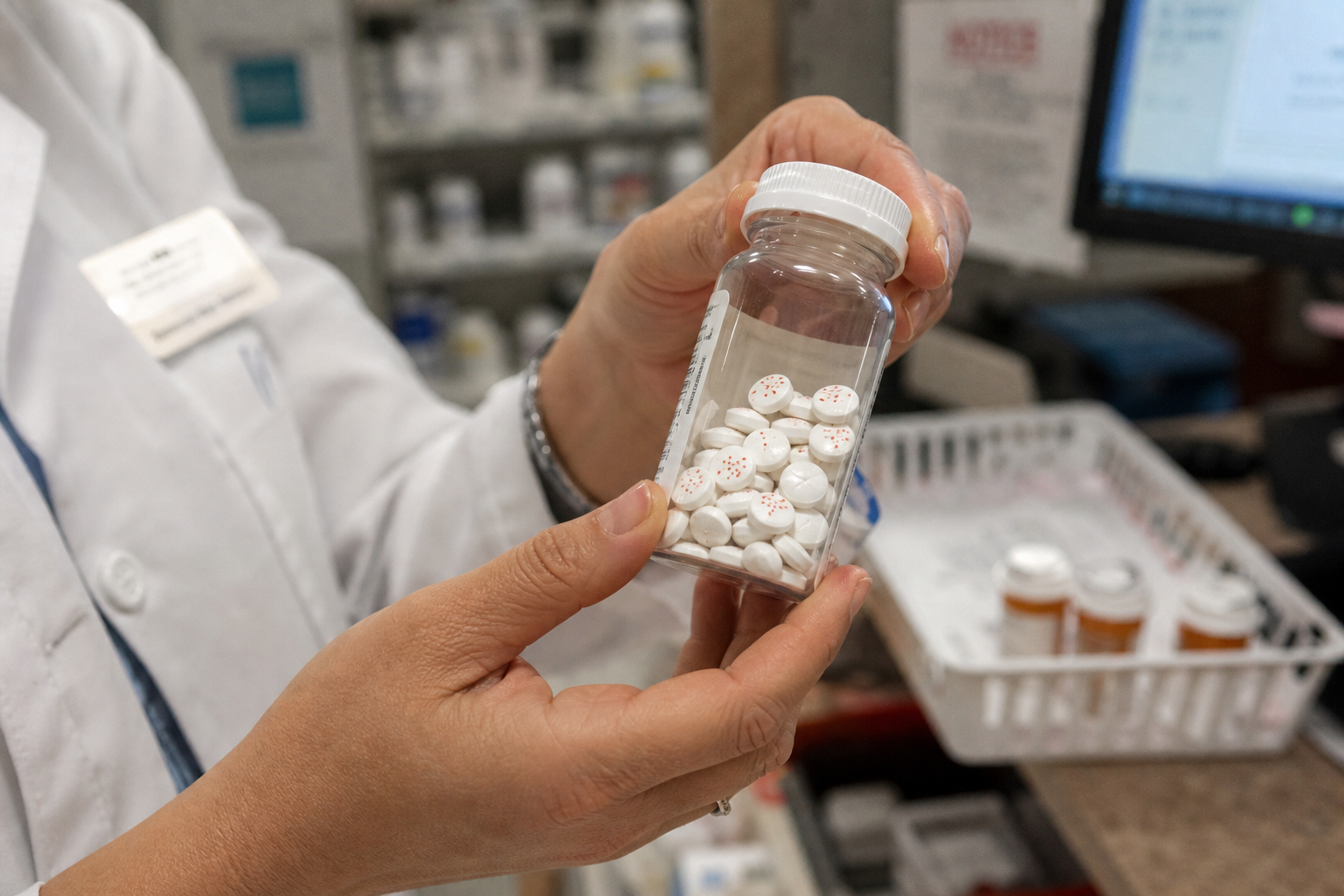
That discovery location matters for consumer-facing legal liability because it changes the first question. The issue is not only whether contaminated tablets reached patients. It is how tablets with visible red discoloration passed through manufacturing release, distribution, and ordinary quality checks before anyone closer to the patient saw the problem.
Rising Pharma’s recall notice identified ranitidine as the contaminant and warned that people with hypersensitivity to ranitidine could face allergic reactions that may be life-threatening. As of July 21, 2026, no adverse events had been reported, and the number of affected bottles had not been disclosed.[1][2] Those two absences should be read carefully. No reported injury narrows the present record; it does not make the quality failure disappear. An undisclosed bottle count leaves exposure analysis unfinished, particularly for pharmacies, insurers, and counsel trying to reconstruct how far the product moved before the recall.
The visible defect points backward
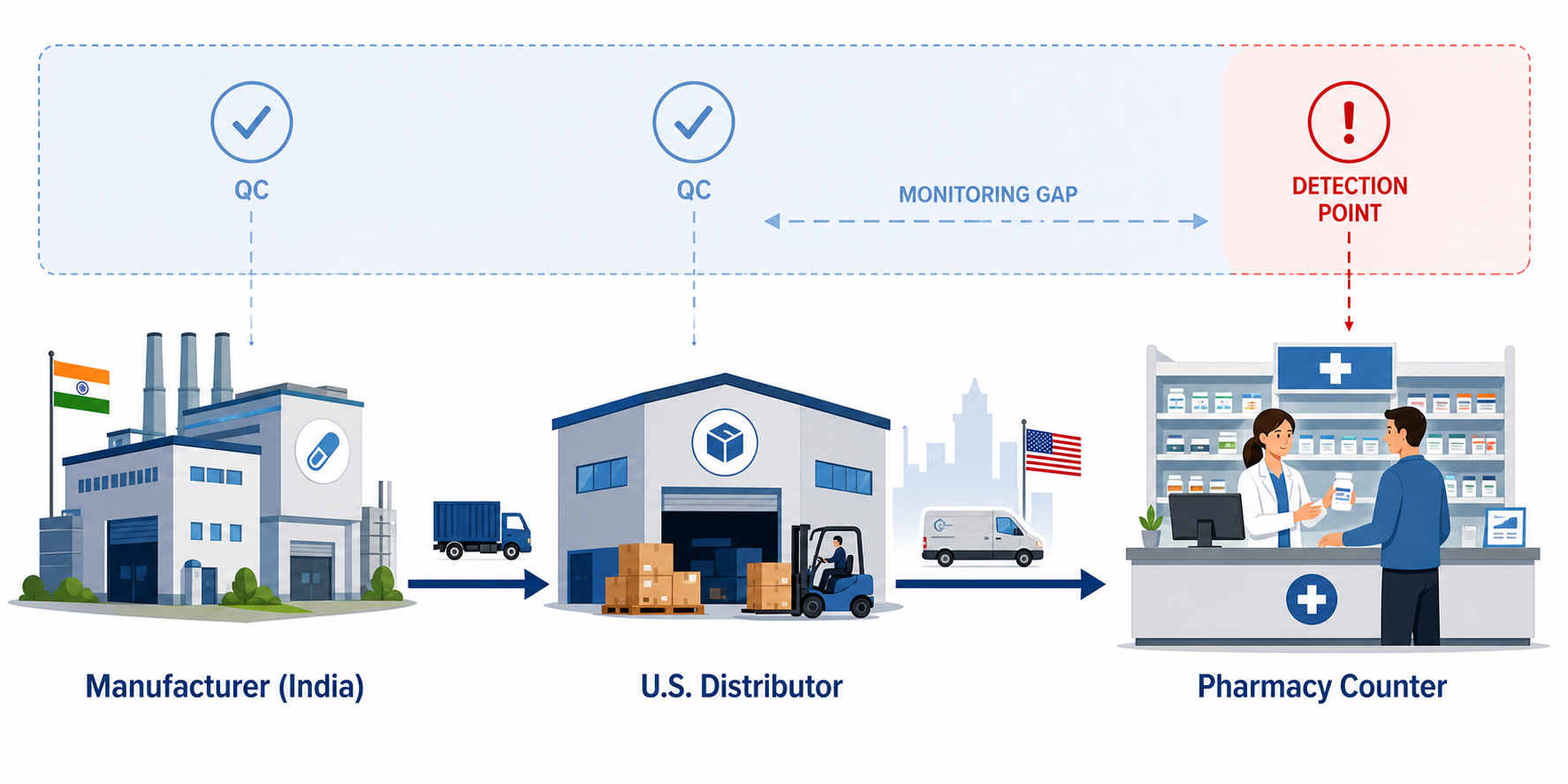
A recall notice can make the chain look orderly: manufacturer, distributor, pharmacy, consumer. This one does the opposite. The visible defect surfaced at the final practical checkpoint before patient use. That is why the pharmacy technician’s observation carries more weight than it might in a recall involving only paperwork, expiration dating, or a label correction.
Ranitidine also is not a neutral contaminant. FDA requested withdrawal of all ranitidine products from the market in April 2020 after determining that NDMA levels in some ranitidine products could increase over time and when stored at higher-than-room temperatures.[3] The Zantac product-liability litigation remains on appeal before the 11th Circuit as of Q3 2026, keeping ranitidine legally visible even though the July 2026 cetirizine recall is not the same case and should not be treated as proof of the same defect theory.[4]
For consumers, ranitidine’s history understandably raises the emotional temperature. For a supply-chain liability analysis, it does something more specific: it makes cross-contamination harder to dismiss as a low-salience manufacturing irregularity. The contaminant was a drug FDA had already pushed off the market, and the tablets were visibly abnormal before dispensing.
One recall can be an event. Two recalls test the oversight story.
The July 2026 recall was not the first cetirizine recall involving this manufacturer-distributor chain. In September 2025, the same Unique Pharmaceutical Laboratories–Rising Pharma chain recalled approximately 23,376 bottles of cetirizine tablets, NDC 16571-402, after a wrong-imprint issue. FDA classified that earlier recall as Class III.[5]
| Recall | Product identifier | Reported issue | Known regulatory detail | Why it matters for liability allocation |
|---|---|---|---|---|
| September 2025 | Cetirizine tablets, NDC 16571-402 | Wrong imprint ID | Class III recall; approximately 23,376 bottles | Creates prior notice of a quality-system problem in the same manufacturer-distributor chain |
| July 2026 | Cetirizine HCl tablets, NDC 16571-401-10, lots GY825029-GY825032 | Ranitidine cross-contamination visible as red discolored dots | FDA recall class not yet assigned in the available notice | Moves the inquiry from isolated labeling or imprint deviation toward contamination controls and failure to detect |
The two recalls are not identical. A wrong-imprint Class III recall does not prove ranitidine cross-contamination ten months later, and the public record does not establish that the same equipment, line, personnel, or batch records were involved. But the repetition changes what a distributor can comfortably say. After the September 2025 recall, a U.S. distributor had reason to ask whether the supplier’s quality system needed closer review, tighter release documentation, more targeted audits, or a different escalation threshold.
That is the significance of the ten-month interval. It is not a magic period that proves knowledge. It is a short enough window that the earlier recall becomes part of the July 2026 oversight file. Counsel evaluating negligence, warranty, consumer-protection, or regulatory exposure will look for what changed after the first recall and whether those changes were proportionate to the risk that another quality defect could reach the market.
Where the manufacturer’s exposure begins
For the manufacturer, the cleanest regulatory starting point is current good manufacturing practice. FDA regulations require facilities to be designed and operated to prevent contamination and mix-ups, including through adequate separation and control of operations.[6] Cross-contamination between drug products is the kind of fact that points directly at those controls, especially where the contaminant appears visibly on tablets rather than only through later chemical testing.
The public record does not yet say how ranitidine entered the cetirizine product. It does not identify the equipment history, cleaning records, line-clearance documentation, supplier materials, packaging records, or release-testing results. Those facts would matter. A contamination event caused by residue on shared equipment presents a different proof path than one caused by a packaging mix-up, raw-material error, or warehouse commingling.
Still, the manufacturer’s duties do not depend on reported injuries. Under the FDCA, a drug may be adulterated if the methods, facilities, or controls used for its manufacture, processing, packing, or holding do not conform to cGMP requirements.[7] If red-dotted tablets containing ranitidine reached distribution, the manufacturer’s batch-control and contamination-prevention systems become the first technical file to examine.
Why the U.S. distributor is not just a mailbox
Foreign manufacture complicates jurisdiction, document collection, witness access, and practical enforcement. It does not turn the U.S. distributor into a passive conduit. The FDCA prohibits introducing or delivering for introduction into interstate commerce any adulterated drug, and it also prohibits certain acts involving adulterated drugs after shipment in interstate commerce.[7] That statutory structure is why distributor duties matter even when the physical manufacturing occurred abroad.
Rising Pharma’s U.S. role supplies the more accessible anchor for American claims and regulatory scrutiny. It distributed the recalled cetirizine into the U.S. market, issued the recall notice, and sat in the chain position closest to U.S. customers, pharmacies, and regulators. If consumer plaintiffs or state regulators pursue claims, they are more likely to begin with the U.S. entity that placed or helped place the product into domestic commerce than with a foreign manufacturing site alone.
The harder question is not whether a distributor can rely on a contract manufacturer at all. Generic drug supply chains require delegated trust. The harder question is what reliance remains reasonable after a prior recall from the same chain. If the September 2025 wrong-imprint recall led only to narrow corrective action around appearance or labeling, the July 2026 ranitidine event may force a broader inquiry into whether the distributor treated the earlier event as a warning about supplier quality culture, not merely as a closed deviation.
Post-recall litigation analysis has increasingly focused on what companies knew, when they knew it, and whether recall conduct exposes a broader failure to monitor known risks.[8] That framing fits this recall better than a simple foreign-manufacturer fault story. The visible defect was caught by a pharmacy technician, and the same chain had already produced a cetirizine recall within the prior ten months.
Failure to detect is the pressure point
In a personal-injury case, causation and damages usually dominate. In this recall, with no adverse events reported as of July 21, 2026, the stronger present questions are different: what monitoring existed, what it was designed to catch, and why the consequential observation occurred during dispensing rather than before distribution.[1][2]
A failure-to-detect theory does not need to claim that every distributor must retest every tablet. That would be too broad and not supported by the public facts. The more precise theory is that a distributor with recent recall experience involving the same product category and same manufacturer may have had a heightened reason to verify whether the supplier’s corrective actions were effective. That verification could include audit follow-up, review of deviation trends, sampling expectations, quality agreements, supplier scorecards, complaint trending, or release documentation tied to the affected products.
The July recall class remains another important gap. FDA had not yet assigned a public Class I, II, or III classification in the available recall notice, even though the notice described potentially life-threatening risk for people hypersensitive to ranitidine.[1] Until classification appears in enforcement reports, it is better to state the risk language than to label the event. Classification will matter for regulatory triage, insurance reporting, customer notices, and internal board-level escalation.
What consumer liability looks like before injury reports
The absence of adverse-event reports shifts the present liability discussion away from proven personal injury and toward economic loss, refund, medical-monitoring arguments where available, consumer-protection theories, and regulatory noncompliance. It also affects settlement value and pleading strategy. A consumer who purchased a recalled bottle but suffered no reaction stands in a different position from a ranitidine-hypersensitive consumer who can document exposure and symptoms.
That distinction is why the recall should not be inflated into a completed injury case. The available facts support concern about contamination controls and distributor oversight; they do not establish how many consumers ingested affected tablets, whether any consumer was hypersensitive to ranitidine, or whether any medical injury was caused by the recalled lots. Consumer-side remedies, refund questions, California-specific product-liability theories, and preemption issues turn on separate legal details that should be analyzed case by case.
The compliance file now has to answer different questions
For a compliance officer or supply-chain lawyer, the July 2026 recall calls for a document chronology more than a press-release chronology. The relevant record starts before the red dots were seen at the pharmacy counter.
- What corrective and preventive action followed the September 2025 wrong-imprint recall?
- Did Rising Pharma reassess Unique Pharmaceutical Laboratories after the first cetirizine recall?
- Did quality agreements require escalation of repeated deviations involving the same product line or facility?
- Were complaint trends, visual inspection results, batch records, and supplier audit findings reviewed before the July 2026 lots were released or distributed?
- Who decided the scope of the July 2026 recall, and on what volume, distribution, and risk information?
Those questions do not assume wrongdoing. They identify the places where liability allocation will be argued. The manufacturer will face the technical cGMP questions first: contamination prevention, line clearance, cleaning validation, visual inspection, and release controls. The distributor will face the oversight questions: supplier qualification, repeat-recall response, domestic distribution decisions, recall execution, and whether the earlier recall should have changed monitoring behavior.
Rising Pharma’s broader regulatory environment will not decide the case by itself. The company has been associated with FDA import-alert issues involving a Sun Pharmaceutical facility in Gujarat during 2023 and 2024, a fact that may interest regulators and counsel evaluating supplier oversight in the Indian generic manufacturing ecosystem.[9] But that background should not be treated as proof that the July 2026 cetirizine lots were defective for the same reason. Its practical value is narrower: it adds context for why U.S. distributors cannot treat overseas manufacturing risk as someone else’s compliance problem.
The supported conclusion
The public record supports a measured conclusion. The July 2026 cetirizine recall is not merely a consumer-alert story, and it is not yet a proven injury case. It is a supply-chain liability problem created by three facts in combination: ranitidine cross-contamination, detection by a pharmacy technician rather than upstream quality controls, and a prior cetirizine recall from the same Unique Pharmaceutical Laboratories–Rising Pharma chain within ten months.
Foreign manufacture may complicate jurisdiction and proof, but Rising Pharma’s U.S. distribution role makes it the clearer anchor for domestic claims and regulatory scrutiny. Until FDA classifies the July recall and more facts emerge about affected volume, internal controls, and post-September 2025 oversight, the distributor’s duty to detect and respond to recurring quality deficiencies has become harder to minimize.
This article is informational only and is not legal advice. Companies and consumers should consult licensed counsel for advice on specific facts, jurisdictions, and claims.
References
- Rising Pharma Holdings, Inc. Issues Voluntary Nationwide Recall of Cetirizine Hydrochloride Tablets Due to Potential Ranitidine Cross-Contamination, FDA, July 18, 2026, link
- Popular allergy medicine recalled over life-threatening risk, USA Today, July 21, 2026, link
- FDA requests removal of all ranitidine products (Zantac) from the market, FDA, April 1, 2020, link
- In re: Zantac (Ranitidine) Products Liability Litigation, U.S. Court of Appeals for the Eleventh Circuit, link
- Cetirizine Recall Database, NDCList.com, link
- 21 CFR 211.42 - Design and construction features, Electronic Code of Federal Regulations, link
- Federal Food, Drug, and Cosmetic Act Sections 331 and 351, U.S. Food and Drug Administration, link
- Post-Recall Litigation Trends, Cozen O'Connor, March 2026, link
- Import Alerts, U.S. Food and Drug Administration, link
Comments
Join the discussion with an anonymous comment.