
The July 2026 cetirizine recall starts with a dispensing counter, not a cancer epidemiology chart. Unique Pharmaceutical Laboratories recalled four lots of cetirizine hydrochloride 5 mg tablets after a pharmacy technician noticed visible red spots and discoloration on tablets during dispensing. The products had been distributed nationwide through Rising Pharma Holdings of East Brunswick, New Jersey, and manufactured by Unique Pharmaceutical Laboratories in Panoli, Gujarat, India. The FDA notice warns that ranitidine cross-contamination may cause serious or life-threatening allergic reactions, including anaphylaxis, in patients with ranitidine hypersensitivity, although no adverse events had been reported to date in the notice.[1]
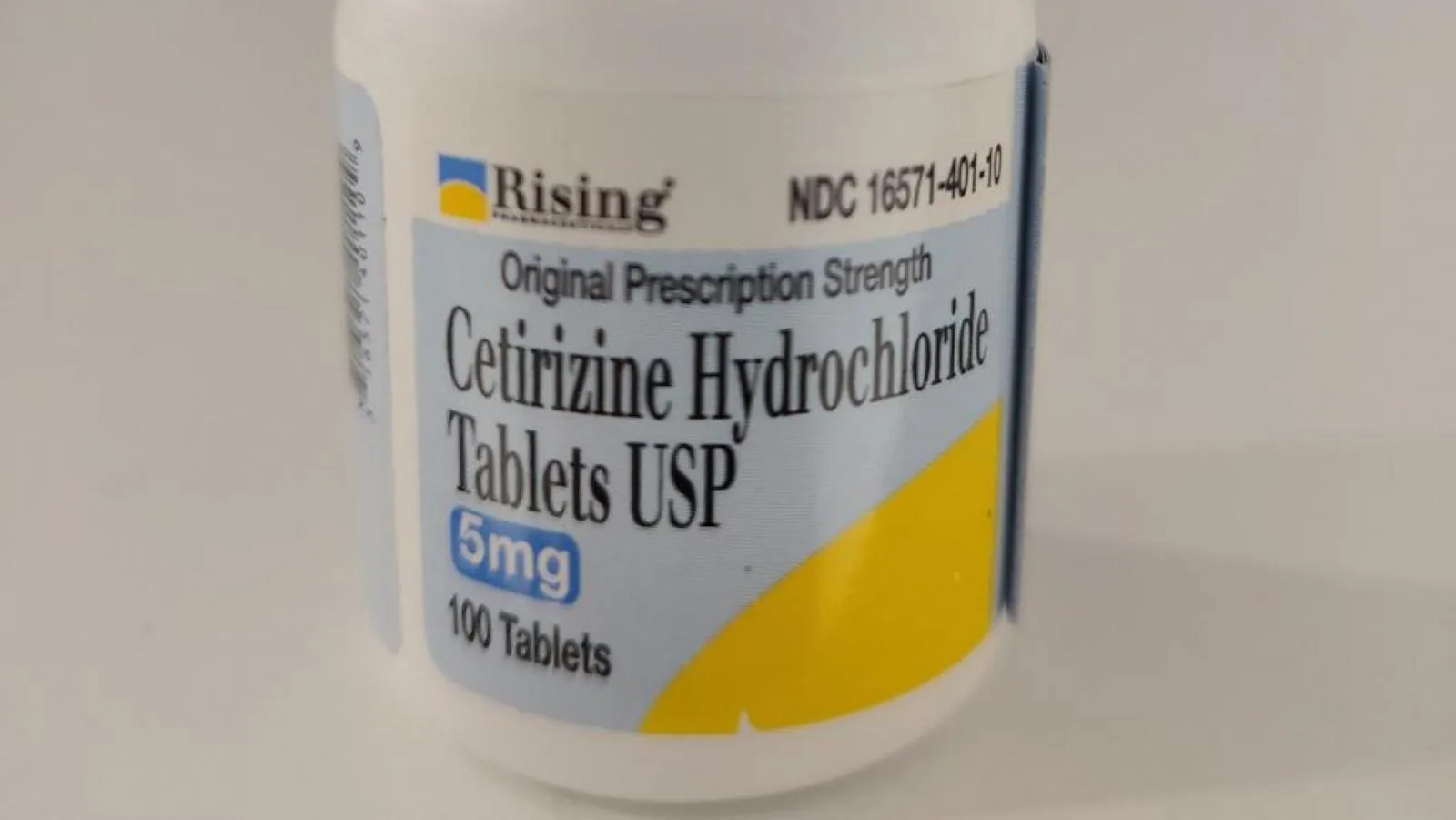
That is the practical entry point for any cetirizine recall cross contamination litigation in 2026. The first legal question is not whether ranitidine can be rebranded into a new Zantac case. It is whether a patient took tablets from one of the recalled cetirizine lots, whether those tablets were physically contaminated with ranitidine, and whether the patient suffered an acute hypersensitivity reaction on a medically plausible timeline.
The difference matters because visible tablet defects change the workup. A pharmacy technician saw red spots and discoloration before the product reached the patient’s medicine cabinet. That fact does not prove a manufacturing violation by itself, and it does not substitute for chemistry, medical records, or lot verification. But it does put the alleged defect in a very different posture from a hidden degradation theory reconstructed years after ingestion.
The Recall Theory Is Physical Cross-Contamination
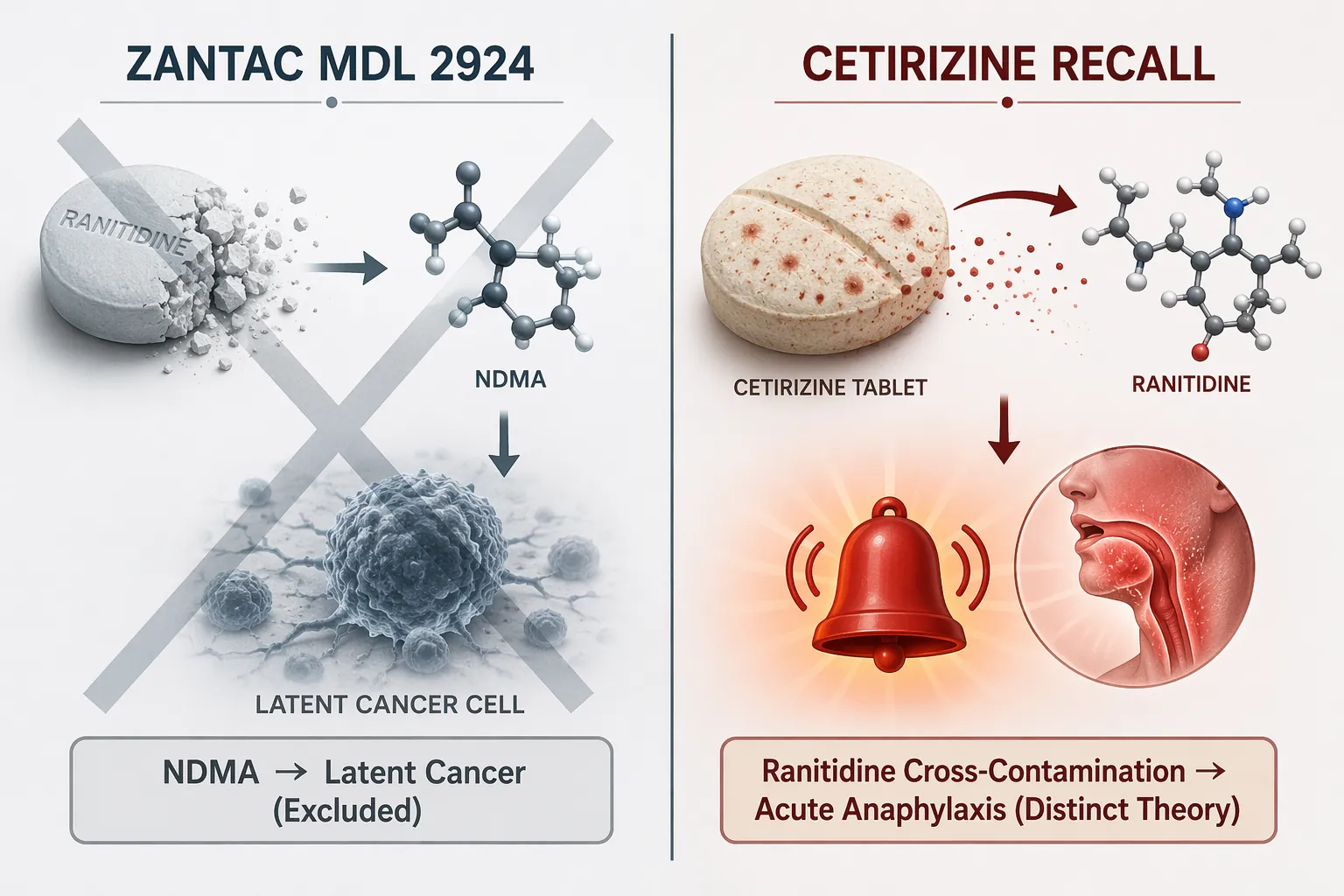
The recalled product is cetirizine, an allergy medication. The alleged contaminant is ranitidine, a different active pharmaceutical ingredient. The FDA notice frames the risk as ranitidine exposure in patients with known ranitidine hypersensitivity, including the possibility of anaphylaxis.[1] That is a narrower and more immediate injury mechanism than the ranitidine cancer cases that dominated the Zantac litigation.
For a plaintiff lawyer, that narrower mechanism is not a weakness. It may be the only reason the theory deserves separate evaluation. Acute allergic injury has a different evidentiary shape: ingestion, timing, symptoms, treatment, prior sensitivity, and differential causes. A latent cancer theory asks a court to accept general causation evidence across longer exposure windows and disease development. The recall notice does not require attorneys to start there.
| Issue | Zantac MDL cancer theory | July 2026 cetirizine recall theory |
|---|---|---|
| Product problem | NDMA allegedly formed from ranitidine degradation | Ranitidine allegedly present as a physical cross-contaminant in cetirizine tablets |
| Primary injury mechanism | Latent cancer causation | Immediate hypersensitivity or anaphylaxis |
| Core proof burden | General causation evidence linking NDMA from ranitidine to cancer | Lot identification, ingestion, contamination evidence, and medical proof of acute reaction |
| Initial defect signal | Scientific and regulatory concern over ranitidine stability | Visible red spots and discoloration reported during pharmacy dispensing |
The table is not a merits ruling. It is a triage tool. If a complaint pleads the cetirizine recall as though it were simply another NDMA cancer complaint, defense counsel will have an easy script. If the case is built around a contaminated cetirizine lot and an acute allergic event, the Zantac MDL becomes context rather than the governing injury model.
What the Zantac Daubert Ruling Does, and Does Not, Answer
The federal Zantac MDL cannot be ignored. In December 2022, Judge Robin L. Rosenberg excluded plaintiffs’ general causation expert testimony linking NDMA from ranitidine to various cancers, a ruling that effectively ended the federal multidistrict litigation.[2] Any lawyer evaluating ranitidine-adjacent claims should expect defendants to cite that order early and often.
But the MDL order was a gatekeeping decision about expert proof for cancer causation. It did not decide whether a manufacturer may be liable when one drug is physically cross-contaminated with another drug and a patient with sensitivity to the contaminant suffers an immediate allergic reaction. Those are different proof problems. The first turns on whether the plaintiffs’ experts could reliably establish that NDMA exposure from ranitidine causes the alleged cancers. The second would turn first on whether recalled cetirizine tablets contained ranitidine, whether the claimant ingested them, and whether the reaction followed in a medically supported way.
The Delaware Supreme Court’s July 2025 decision adds a jurisdictional warning against treating the federal MDL as the last word everywhere. In In re Zantac (Ranitidine) Products Liability Litigation, the court reversed a trial-court Daubert exclusion and allowed state-court ranitidine claims to proceed.[3] That ruling does not make the cetirizine recall stronger on its facts. It simply reminds attorneys that expert admissibility outcomes can vary by forum, especially when state courts apply their own gatekeeping standards.
The better lesson is more disciplined: do not borrow the Zantac MDL’s defeat as a blanket defense to every ranitidine-related fact pattern, and do not borrow Delaware’s reversal as a shortcut around proof. The cetirizine recall has to stand on its own product, contaminant, injury mechanism, and medical record.
The Pharmacy Technician’s Discovery Is More Than Color
A visible defect found during dispensing is the sort of fact intake teams should not flatten into generic recall language. The FDA notice says the issue was identified when a pharmacy technician observed red spots and discoloration on tablets.[1] That places the first public detection point outside the manufacturer’s quality-control system.
That fact may support several lines of investigation. It may raise questions about visual inspection, segregation of active pharmaceutical ingredients, equipment cleaning, batch release, packaging review, complaint handling, and distributor communication. At this stage, those are questions, not established regulatory findings. Current public materials do not identify FDA warning letters against Unique Pharmaceutical Laboratories for 2024 through 2026, so any claim of good manufacturing practice failure would need document support rather than assumption.
Still, the dispensing-counter discovery has practical value. It gives plaintiff counsel a concrete preservation target. If tablets with visible discoloration remain in the bottle, they may be testable. If the pharmacy segregated stock, photographed tablets, logged a complaint, or communicated with the distributor, those records may become more important than broad corporate statements about quality systems.
Intake Should Start With Lot Proof, Not Injury Narratives
The absence of publicly filed lawsuits as of July 23, 2026 should keep the screening process sober. There may be viable claims, but there is not yet a litigation wave to describe. The case-development work begins with product identification and only then moves to medical causation.
- Confirm the exact recalled lot. The claimant’s bottle, pharmacy label, prescription record, dispensing log, or pharmacy inventory record must connect the patient to one of the four recalled cetirizine HCl 5 mg tablet lots.
- Establish ingestion. Possession of a recalled bottle is not the same as proof that the claimant swallowed the tablets before symptoms began.
- Build the symptom timeline. Acute hypersensitivity claims depend heavily on timing: when the dose was taken, when symptoms started, what symptoms appeared first, and when treatment occurred.
- Document the reaction medically. Emergency records, EMS notes, urgent-care records, epinephrine administration, airway symptoms, hives, hypotension, medication lists, and discharge diagnoses will matter more than a claimant’s later summary.
- Identify ranitidine allergy or sensitivity history. The FDA’s risk statement focuses on patients with ranitidine hypersensitivity, so prior allergy history, prior ranitidine exposure, and allergy documentation may be central.
- Preserve tablets and packaging. Remaining tablets, blister packs or bottles, outer cartons, pharmacy labels, photographs, receipts, and recall communications should be treated as evidence.
A strong intake file will not treat “I took cetirizine and felt ill” as enough. Cetirizine itself is commonly used for allergy symptoms, so the underlying condition that led the patient to take the medication may complicate causation. Counsel will need to distinguish an allergic episode already in progress from a reaction allegedly triggered by ranitidine-contaminated tablets. That distinction will often require treating-provider records and, in filed litigation, expert review.
The Best Early Files Will Have Boring Documents
The most useful early evidence may look administrative: the prescription fill date, the national drug code, the lot number, the pharmacy’s purchase records, the date the pharmacy received recall notice, the date tablets were pulled from shelves, and any internal incident report about discoloration. Those records place the claimant inside or outside the recall with less drama than a narrative interview.
Pharmacy records also help address a common intake problem in drug recalls: substitution and refills. A patient may have several bottles of the same medication from different fills, different manufacturers, or different dates. Without a lot-specific chain from distributor to pharmacy to claimant, the case risks becoming a recall-adjacent injury rather than a recalled-product injury.
Liability Runs Through Cross-Contamination Controls
If claims are filed, the liability theory is likely to focus on failure to prevent cross-contamination between chemically unrelated active pharmaceutical ingredients. The public recall notice identifies ranitidine as the contaminant and cetirizine as the recalled product.[1] That pairing invites discovery into how ranitidine could appear in cetirizine tablets at all.
The important documents would likely include batch manufacturing records, cleaning validation materials, equipment-use logs, raw material movement records, deviation reports, environmental or residue testing, visual inspection procedures, quality-unit review, retained samples, and communications between Unique Pharmaceutical Laboratories, Rising Pharma Holdings, pharmacies, and regulators. Plaintiff counsel should resist treating those categories as proof before seeing them. They are the map of where proof may exist.
Failure-to-warn theories may also appear, but they will need careful timing. A manufacturer or distributor cannot warn about a specific discovered defect before it is known. The better early question is what the companies knew or should have known about cross-contamination risk before the pharmacy technician’s discovery, how quickly they investigated once the discoloration was reported, and how quickly pharmacies and patients were alerted after the recall decision.
Damages Will Not Look Like a Zantac Cancer Inventory
The FDA notice states that no adverse events had been reported to date, while also describing the potential reaction as serious or life-threatening anaphylaxis.[1] That combination produces an unusual early posture: the hazard is severe, but the public record has not yet identified injured patients.
If claimants emerge, the damages profile would likely be acute rather than latent. Emergency treatment, hospitalization, airway compromise, epinephrine use, missed work, follow-up care, fear after a severe allergic episode, and aggravation of known allergy risk may be more relevant than cancer diagnosis, oncology treatment, or long-term disease latency. Severe anaphylaxis can be life-threatening, but not every allergic reaction will support the same damages theory.
That difference also affects case valuation and aggregation, though it is too early to predict either. A claimant who kept the recalled bottle, has emergency records showing rapid-onset anaphylaxis after ingestion, and has documented ranitidine hypersensitivity presents a different file from someone with nonspecific symptoms, no bottle, no lot number, and no treatment record. The recall may open a path, but it does not erase ordinary proof burdens.
The September 2025 Recall Is Context, Not Yet a Pattern
The prior September 2025 Rising Pharma cetirizine recall may attract attention because lawyers look for recurrence. On the present record, it should be handled cautiously. The research materials identify that earlier recall as involving different batches and different reasons, which means it cannot simply be folded into the July 2026 cross-contamination event as proof of a pattern.
It may become relevant if discovery later shows overlapping facilities, repeated quality failures, shared decision-makers, or similar missed controls. Without that bridge, it is only background. A pattern argument filed too early can weaken the cleaner theory that the July 2026 recall involves a specific contaminant, specific lots, and a specific acute injury risk.
Ranitidine’s Regulatory Return Does Not Collapse the Distinction
Ranitidine’s regulatory history continues to complicate how lawyers and judges hear the word. The FDA approved a reformulated ranitidine product for VKT Pharma on November 24, 2025, after a comprehensive safety review and with strict storage and dispensing conditions.[4] That development may affect how parties discuss ranitidine generally, but it does not answer whether ranitidine belonged in recalled cetirizine tablets.
A contaminant does not become acceptable because the same active ingredient may be lawful in a different approved product under different conditions. The relevant question is authorization and control: whether the cetirizine product contained an unintended API, how it got there, and whether that unintended exposure caused the claimant’s acute injury.
Filing Decisions Should Wait for Claim-Specific Proof
The current record supports investigation, not mass filing language. As of July 23, 2026, the recall is only days old, no public lawsuits specific to this recall have been identified, and the FDA notice reports no adverse events to date.[1] That makes premature predictions about an MDL, settlement ranges, or a complaint wave more distracting than useful.
The viable path is narrower and stronger than a recycled Zantac pitch: recalled cetirizine tablets allegedly contained ranitidine as a physical cross-contaminant; a patient with relevant sensitivity ingested tablets from an affected lot; the patient experienced an acute reaction on a medically supported timeline; and documents show preventable manufacturing, quality-control, distribution, or warning failures. Each element has to be built before the case can carry its own weight.
That is why the Zantac MDL’s Daubert ruling is a boundary marker, not a locked gate. It warns attorneys not to smuggle excluded NDMA-cancer causation into a new label. It does not foreclose a properly developed claim about physical cross-contamination and immediate allergic injury. The July 2026 cetirizine recall creates a litigation path because the alleged defect and injury mechanism are different; whether any claimant can walk that path depends on lot proof, medical timing, preserved evidence, and the manufacturing record still to be developed.
References
- Unique Pharmaceutical Laboratories, a div. of J. B. Chemicals & Pharmaceuticals Ltd. Issues Voluntary Nationwide Recall of Cetirizine Hydrochloride Tablets USP 5 mg Due to Potential Cross Contamination With Ranitidine, FDA, July 2026, link
- MDL 2924 Zantac, MDL Update, link
- In re Zantac (Ranitidine) Prods. Liab. Litig., 342 A.3d 1131, MDL Update, July 2025, link
- FDA Approves Reformulated Ranitidine Following Comprehensive Safety Review, FDA, November 24, 2025, link
Comments
Join the discussion with an anonymous comment.