
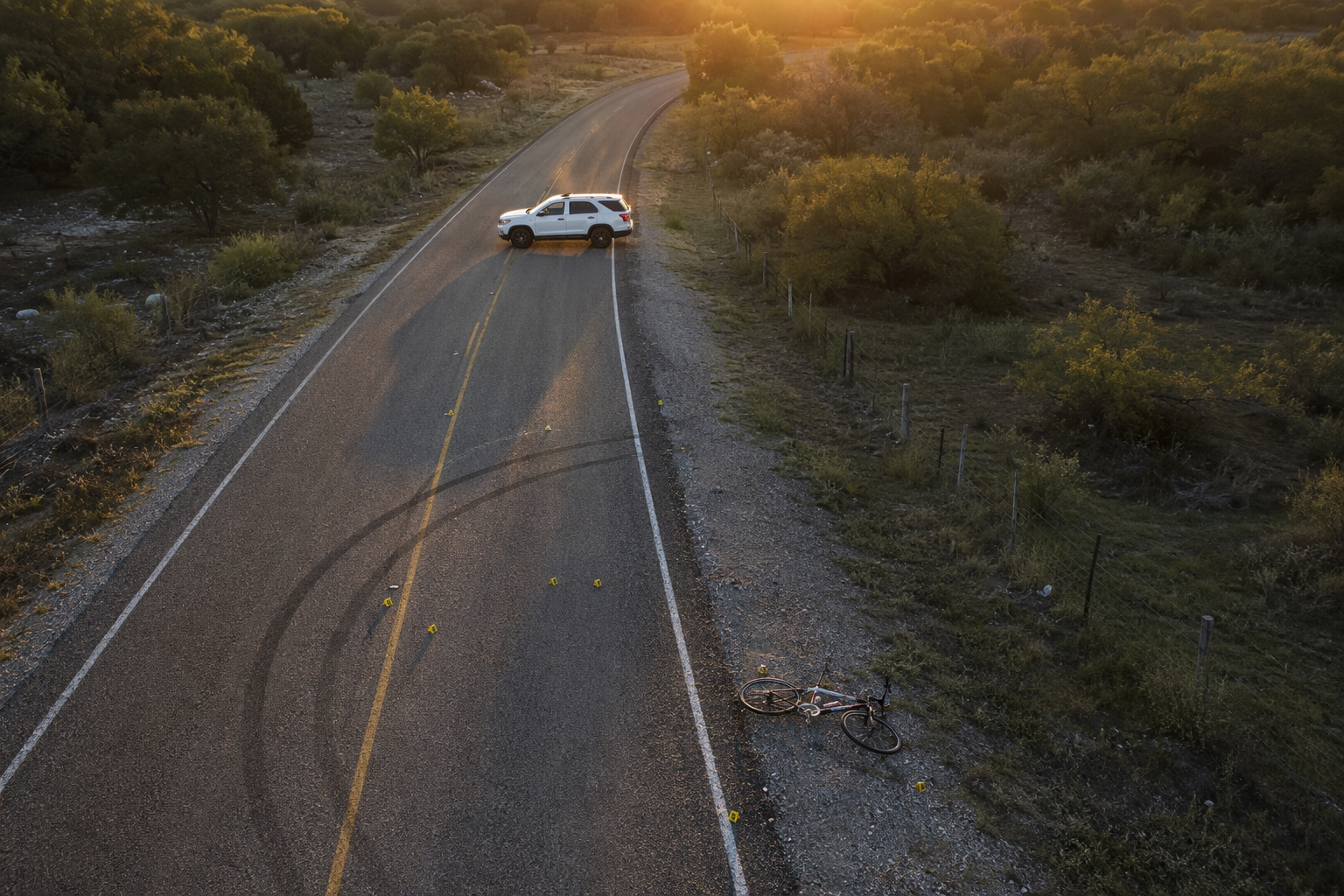
The reported steering path is the first hard fact in the Charles Medina manslaughter case, because it is where danger starts to become proof. Public reports of Deputy Stumpf’s probable-cause affidavit describe Medina passing a group of cyclists at high speed within about one foot, braking hard, then reversing rapidly. The affidavit reportedly says reverse skid marks appeared to “steer toward something while backing up.” Hannah Rapp, a boxer known as Hannah “Hanarchy” Rapp, was struck and suffered a fatal head injury in the July 18, 2026 incident; Medina was arrested the next day and charged with manslaughter.[1][2]
Medina’s reported explanation cuts in the other direction, at least legally. He allegedly said he thought cyclists were flagging him down and that he did not see Rapp until the last moment.[1] That sentence does not make the conduct safe, reasonable, or innocent. It does, however, go directly to the state’s burden on manslaughter: whether Medina consciously disregarded a substantial and unjustifiable risk when he reversed, or instead failed to perceive the risk until it was too late.
That is a narrower question than the public anger around the case. A driver can create an extreme risk and still fight over the mental-state label. Texas manslaughter is not proved merely by showing a death, a vehicle, and outrageous driving. The charge depends on recklessness.
The Statute Starts With Conscious Disregard
Texas Penal Code §19.04 defines manslaughter as recklessly causing the death of an individual. It is a second-degree felony, carrying a punishment range of two to 20 years in prison.[3] The operative word is “recklessly,” and Texas Penal Code §6.03(c) gives that word its bite: a person acts recklessly when he is aware of but consciously disregards a substantial and unjustifiable risk, and the disregard is a gross deviation from the standard of care an ordinary person would exercise under the circumstances.[3]
That definition has two different jobs. One is objective: Was the risk substantial and unjustifiable, and was disregarding it a gross deviation from ordinary care? The other is subjective: Was this defendant actually aware of the risk and did he consciously disregard it? In a vehicle-death case, the objective component can feel obvious long before the subjective component is proved.
Criminally negligent homicide under §19.05 sits one rung lower. It applies when a person causes death by criminal negligence — the person ought to be aware of a substantial and unjustifiable risk, but does not actually perceive it. Texas sources commonly distinguish it from manslaughter on that awareness line: recklessness involves conscious disregard; criminal negligence involves failure to perceive.[4][5]
Murder under §19.02 sits higher, requiring a different mental state, such as intent to cause death or serious bodily injury in the relevant statutory forms. Nothing in the public record, as reported, establishes that Medina set out to kill Rapp. The legal fight made visible by the affidavit reporting is not principally murder versus manslaughter. It is manslaughter versus criminally negligent homicide.
The Objective Risk Is the Easier Part
On the publicly reported facts, the state has a strong objective-danger case. Passing cyclists at high speed within about one foot puts vulnerable road users in a zone where a small steering error, a startle response, or road-surface change can become catastrophic. Braking hard after the pass changes the movement from a close pass into a confrontation. Reversing rapidly toward cyclists turns the vehicle into a moving hazard aimed back into the group’s space.
The skid-mark detail matters because it is physical evidence, not a mood word. “Road rage” can be too shapeless for criminal proof if it is used only to describe anger. Skid marks, vehicle path, braking, distance, and impact location are different. They give the factfinder something to test against the driver’s later explanation.
If the reverse marks truly show a vehicle steering toward something while backing up, the state can argue the reverse was not a confused straight-line maneuver. It can argue Medina made a directional choice while moving backward into a space he knew contained cyclists. The more controlled the reverse appears, the harder it is for the defense to characterize the event as a pure failure of perception.
That still leaves room for dispute. A skid mark can show movement. It does not, by itself, narrate the driver’s mind. Reconstruction evidence may support one inference or narrow it. The full unredacted affidavit, discovery, vehicle data if any exists, witness statements, and expert analysis are not publicly available.
How the State Proves Subjective Awareness
The prosecution does not need Medina to confess, “I knew I might hit a cyclist.” Subjective awareness is often proved circumstantially. In this case, the state’s best route is the sequence: a close high-speed pass, immediate hard braking, a rapid reverse, the presence of cyclists behind the vehicle, and physical evidence allegedly showing a steering path toward something. Put together, those facts can support an inference that Medina knew people on bicycles were in the danger zone and disregarded that risk anyway.
The close pass is not just prelude. If Medina passed within about one foot of the cyclists, a factfinder could infer he knew where they were, knew they were exposed, and knew his vehicle was close enough to them that small movements mattered.[1] The hard brake then tends to show the encounter remained active in his attention. A person who has just passed cyclists and braked hard is not in the same position as a driver who backs out of a driveway unaware anyone is nearby.
The reverse maneuver is the decisive act. A vehicle moving backward gives the driver less natural visibility and less time to react. If done rapidly, it magnifies the risk. If done while steering toward the cyclists’ area, it becomes much more than bad judgment. The state can argue Medina did not merely create a risk in the abstract; he drove back into a risk he had just helped create and had reason to understand.

Texas law permits vehicles to be treated as deadly weapons depending on their manner of use. Drichas v. State is useful only for that limited point. In that case, the Texas Court of Criminal Appeals addressed a deadly-weapon finding involving a vehicle used during evading arrest; it did not decide whether a reverse-into-cyclist fact pattern proves manslaughter recklessness.[6] The analogy helps explain why a vehicle’s movement can carry criminal significance, but it does not answer Medina’s mental-state question.
Why Medina’s Statement Cannot Be Ignored
Medina’s reported statement is the defense’s opening. If he thought cyclists were flagging him down and did not see Rapp until the last moment, the defense can argue he misread the scene rather than consciously disregarded the risk. That theory does not require the jury to find his conduct reasonable. It requires only enough doubt about whether he actually perceived the specific risk and chose to disregard it.
There is a temptation to treat “I didn’t see her” as an automatic downgrade to criminal negligence. That is too quick. Drivers who have just interacted with cyclists cannot always erase awareness by pointing to the final instant before impact. A factfinder may reject a statement as self-serving if the physical evidence shows a controlled reverse toward the place where cyclists were located.
There is an opposite temptation to treat the ugliness of the driving as automatic proof of recklessness. That is also too quick. Texas recklessness asks what Medina was aware of, not only what a careful driver would have perceived. If the state’s proof shows he ought to have known Rapp was in the path but leaves reasonable doubt that he actually knew the danger existed, the facts may fit criminally negligent homicide more cleanly than manslaughter.
This is where the exact timing matters. When did Medina first see any cyclist after braking? Did he look backward? Did witnesses describe eye contact, gestures, yelling, or a pause before the reverse? How far did the vehicle travel in reverse before impact? Were the reverse marks consistent with acceleration, braking, or evasive correction? The public reports do not answer all of that. Those details are not ornamental; they are the difference between an inference and a verdict.
The Manslaughter–Negligence Boundary in This Fact Pattern
The same external facts can support different offenses depending on the accepted inference about Medina’s awareness. That is why the manslaughter charge is legally plausible without being legally inevitable.
| Potential offense | Mental-state line | How the public facts could matter |
|---|---|---|
| Murder | Intent or other higher culpable mental state under §19.02 | The public reporting does not establish an intent to kill Rapp. |
| Manslaughter | Awareness of a substantial and unjustifiable risk, followed by conscious disregard | The close pass, hard brake, rapid reverse, and alleged steering path can support an inference Medina knew cyclists were in danger and reversed anyway. |
| Criminally negligent homicide | Failure to perceive a substantial and unjustifiable risk that he ought to have perceived | Medina’s reported claim that he thought cyclists were flagging him down and did not see Rapp until the last moment supports the defense’s narrower mental-state argument. |
The prosecution’s cleanest manslaughter theory would not be “road rage caused death.” It would be more specific: Medina knew cyclists were behind him or near him after the close pass; he braked and reversed rapidly into their space; the physical marks show a steering path toward something rather than away from it; and the fatal strike was the result of consciously disregarding the obvious risk created by that maneuver.
The defense’s cleanest answer would be equally specific: the reverse was an attempt to respond to people Medina thought were flagging him down; he did not see Rapp until the last moment; the state is converting a catastrophic perception failure into conscious disregard; and any ambiguity in the physical evidence should be resolved against the higher mental state.
Neither argument can be evaluated honestly by flattening the facts into “dangerous driving.” Almost all vehicular homicide cases involve dangerous driving by the time the law is involved. The Medina case turns on whether the danger was apprehended by the driver before the fatal movement, not merely visible to everyone after the scene was reconstructed.
What the Public Record Can and Cannot Carry
As of July 20, 2026, this is a pre-indictment case based on public reporting of a probable-cause affidavit. That matters. Probable cause is not proof beyond a reasonable doubt. Charging language is not jury-tested evidence. A brief reported excerpt from an affidavit is not the same as the full document, much less the discovery file.
KBTX and NBC News supply the central reported affidavit facts used here.[1][2] The Guardian’s coverage independently identifies Rapp and reports the death in the broader news account of the incident.[7] Yahoo News appears to have republished secondary coverage rather than adding an independent factual basis, so it does not add much to the legal analysis.[8]
The missing evidence cuts both ways. The state may have witness statements, reconstruction analysis, body-camera footage, vehicle data, or additional admissions that sharpen conscious awareness. The defense may have sightline evidence, timing evidence, or expert reconstruction that weakens the inference drawn from the reverse marks. Public outrage cannot fill those gaps, and neither can a neat statutory chart.
On the reported facts, the manslaughter charge is legally plausible. The objective danger is strong, and the steering evidence matters because it may show purposeful movement back into a known risk zone. But conviction on manslaughter will turn on whether the state can prove conscious disregard rather than failure to perceive. That question remains open on the incomplete public record.
References
- Navasota man arrested, charged with manslaughter in death of boxer Hannah ‘Hanarchy’ Rapp, KBTX, July 19, 2026.
- Boxer Hannah Rapp killed after Texas driver strikes bicycle, NBC News.
- Texas Manslaughter Laws, Saputo Toufexis.
- Manslaughter vs Murder in Texas, Deandra Grant Law.
- Difference Between Murder, Manslaughter, and Criminally Negligent Homicide, Varghese Summersett.
- Drichas v. State, 175 S.W.3d 795, Texas Court of Criminal Appeals, 2005.
- Boxer Hannah Rapp dies after being struck by car, The Guardian, July 19, 2026.
- Texas man charged after investigators say he reversed, Yahoo News.
Comments
Join the discussion with an anonymous comment.