
Charles Medina has been arrested and charged with manslaughter in Brazos County after the death of Hannah Rapp, a cyclist and boxer struck while riding on FM 159 on July 18, 2026. The legal question at this early stage is narrower than the public reaction to the words “road rage” may suggest: Texas prosecutors are not yet alleging that Medina intentionally killed Rapp. They are alleging that his conduct recklessly caused her death.
The probable-cause facts reported so far are severe enough without dressing them in a charge the state has not filed. Medina allegedly passed a group of cyclists in a Chevrolet Trailblazer, stopped about 100 feet ahead, got out and argued with them, returned to the vehicle, then reversed in an arc toward the cyclists before striking Rapp. The affidavit narrative reported by KBTX describes damage to the vehicle’s rear hatch and rear window, plus forward braking marks and reverse skid marks tied to the vehicle’s movement.[1]
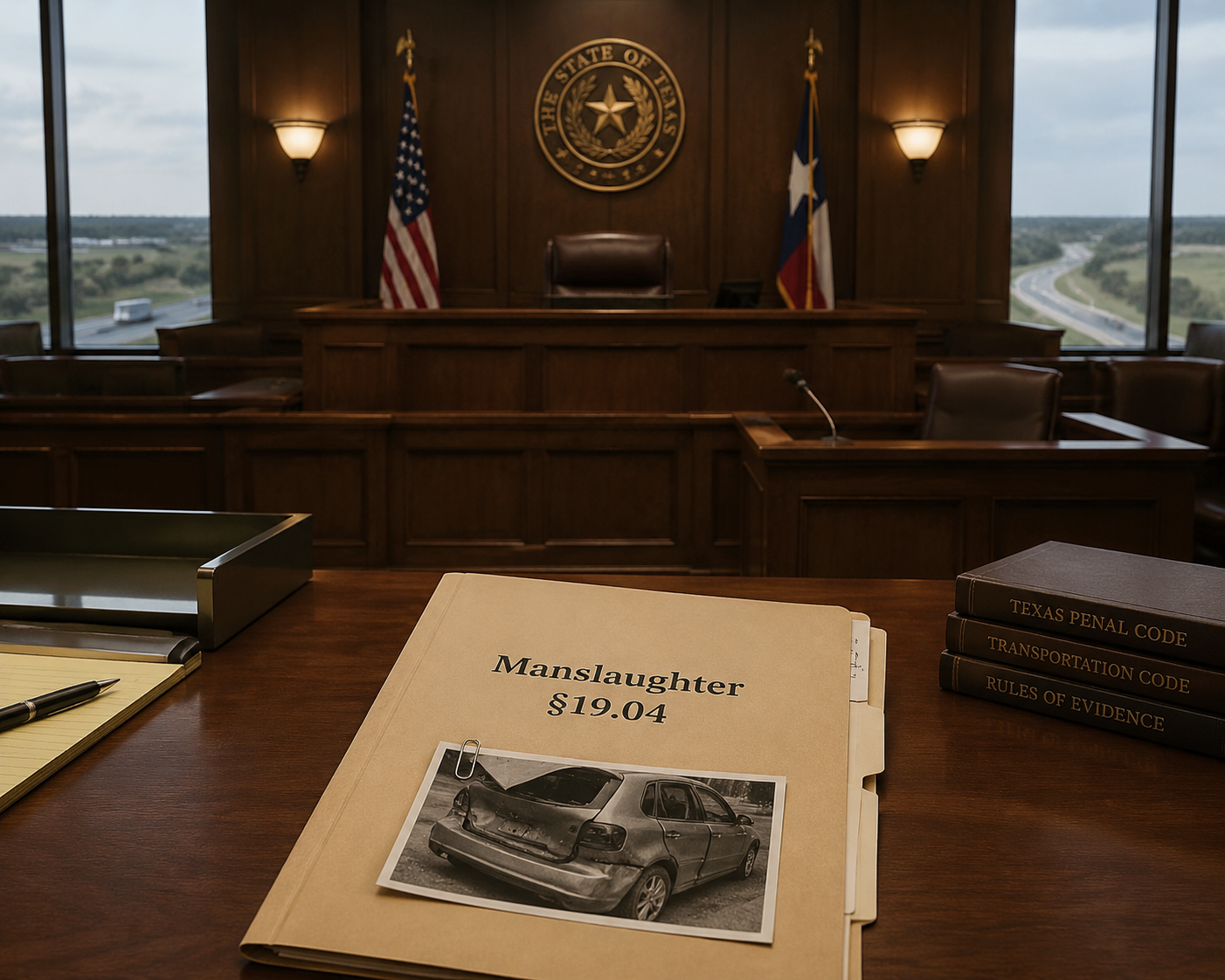
Law & Crime’s account of the affidavit adds the contradiction that matters for charging: Medina allegedly told investigators he believed the cyclists were flagging him down for help and that he backed up at about 15 mph, while the physical evidence described by police included a crushed rear hatch, shattered rear window, and skid marks showing a reverse movement in an arc, meaning the vehicle was being steered while backing.[2]
That is the bridge between the road and the penal code. A manslaughter charge does not require the state to prove that Medina set out to kill Rapp. It requires proof that he was aware of a substantial and unjustifiable risk and consciously disregarded it, causing a death. In a case involving cyclists and a reversing SUV, the state’s first burden is to make that mental state visible through conduct, sequence, and physical evidence.
What Texas Manslaughter Actually Requires
Texas Penal Code §19.04 states that a person commits manslaughter if the person “recklessly causes the death of an individual.” The same statute classifies manslaughter as a second-degree felony.[3] That single word, “recklessly,” is doing most of the work.
Recklessness is not an accident in the ordinary conversational sense. Nor is it the same as intending the result. Under Texas law, the focus is whether the actor was aware of a substantial and unjustifiable risk and consciously disregarded that risk. In a vehicle case, the prosecution usually has to infer that awareness from surrounding facts: what the driver saw, what the driver did next, how the vehicle moved, and whether the account given afterward fits the physical record.
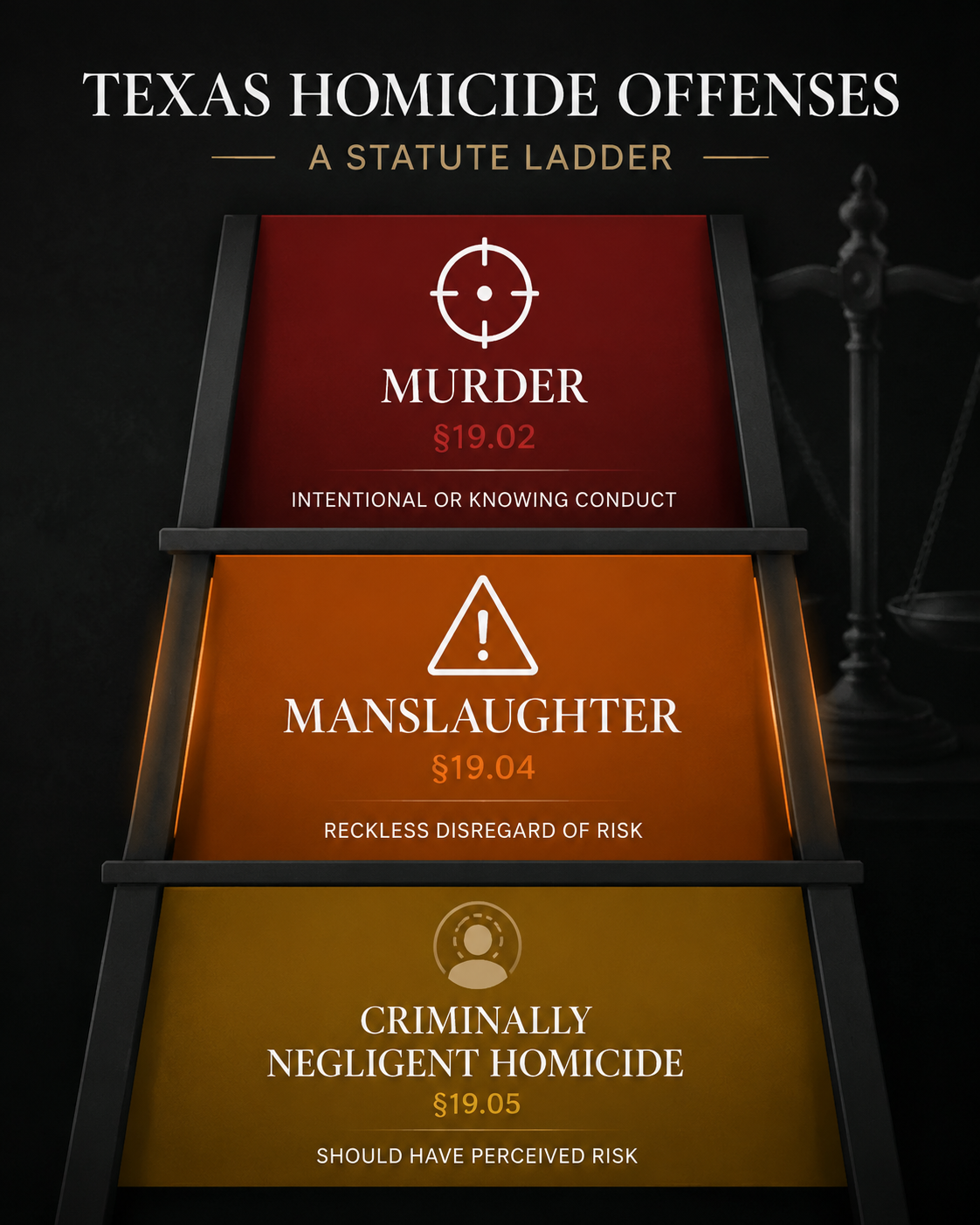
The usual statutory ladder matters here because it keeps the analysis from collapsing into one emotional category. Murder under Texas Penal Code §19.02 generally requires intentional or knowing conduct; manslaughter under §19.04 requires reckless causation of death; criminally negligent homicide under §19.05 sits lower, where the actor should have perceived the risk but did not.[3][5]
| Charge | Mental state | What the state must generally prove |
|---|---|---|
| Murder | Intentional or knowing | The defendant intended the death or knew the conduct was reasonably certain to cause death |
| Manslaughter | Reckless | The defendant was aware of a substantial and unjustifiable risk and consciously disregarded it |
| Criminally negligent homicide | Criminal negligence | The defendant should have perceived a substantial and unjustifiable risk but failed to do so |
That ladder is why the legal implications of Medina’s arrest should not be answered with a generic road-rage label. “Road rage” may describe the alleged encounter in ordinary speech, but Texas prosecutes conduct through existing crimes such as assault, deadly conduct, manslaughter, or murder depending on the facts and mental state. It is not, by itself, the charging answer.[6]
Why the Affidavit Points Toward Recklessness
The reported affidavit facts do not treat this as a simple backing collision. They describe an encounter that allegedly began when Medina passed cyclists, stopped roughly 100 feet ahead, exited the vehicle, argued, and then returned to the driver’s seat before reversing toward the group. That sequence matters because it gives prosecutors an argument that the cyclists were not an unseen hazard suddenly appearing behind the vehicle; they were the people with whom Medina had just interacted.[1]
The reverse arc also matters. A straight-line backup can sometimes be explained by panic, confusion, poor visibility, or careless misjudgment. A reversing movement in an arc, if proved as described, allows the state to argue that the driver was steering while moving backward in the direction of vulnerable road users. That does not automatically prove intent to kill. It does, however, strengthen a reckless-homicide theory because it makes the risk harder to characterize as merely unnoticed.
The vehicle damage and skid evidence are equally important. Medina’s reported claim of a 15-mph backup is not just a statement for jurors to believe or disbelieve in the abstract. It has to be tested against the crushed rear hatch, shattered rear window, and skid marks described in the affidavit. When physical evidence appears inconsistent with a low-speed account, prosecutors gain a way to argue that the event was more forceful, more directed, or more dangerous than the defendant’s version suggests.[2]
That is also why Rapp’s status as a boxer, while part of the public identity now attached to the case, is not the core legal fact. The core legal fact is that she was a cyclist on a roadway, exposed to a vehicle that allegedly reversed back toward a group after an argument. The affidavit’s physical sequence is the basis for the charge.
Why Not Murder, at Least on the Initial Charge?
The obvious objection is that the conduct described sounds too grave for manslaughter. That objection confuses seriousness with the specific mental state the state must prove. Manslaughter is not a polite word for an accidental death. In Texas, it is a homicide charge carrying felony prison exposure. The difference is that manslaughter alleges reckless disregard, while murder requires proof of intentional or knowing conduct.[3][5]
On the facts reported as of July 20, 2026, the affidavit supports an argument that Medina consciously disregarded a grave risk to cyclists. It does not, at least from the public reporting now available, contain a quoted threat to kill, a confession of intent, evidence of a planned attack, or another fact that cleanly moves the case into an intentional-or-knowing murder theory. Prosecutors can infer mental state from conduct, but they still have to choose a charge they can prove.
That choice may change. Early charging decisions are made on the evidence available at the time, not on the full record that may exist months later. Surveillance footage, additional witness accounts, vehicle data, phone evidence, or further forensic analysis could sharpen or alter the state’s theory. A murder charge would require more than the fact that the death was horrifying; it would require proof that matches the statute.
There is another reason not to rush the label. Overcharging can create trial risk. If prosecutors file a charge that asks jurors to find intent without enough evidence, the moral force of the case does not cure the proof problem. Manslaughter, on the reported affidavit facts, is not a concession that the conduct was minor. It is a charge aimed at the mental state the evidence most directly supports.
Sentencing Exposure: 2 to 20 Years
Because Texas manslaughter is a second-degree felony, the ordinary punishment range is 2 to 20 years in prison and a possible fine of up to $10,000.[4] That is the baseline exposure if Medina is convicted of manslaughter without a punishment enhancement that changes the range.
The parole question may become more consequential than the headline sentencing range. If the vehicle is treated as a deadly weapon and the factfinder makes a deadly-weapon finding, Texas law can require the defendant to serve at least half of the sentence before becoming eligible for parole.[7] In practical terms, a deadly-weapon finding can make two sentences with the same number of years behave very differently.
That finding has not been reported as formally entered in the charging documents now available. It is an analytical possibility because Texas law can treat objects, including vehicles, as deadly weapons depending on their manner of use. The prosecution would still have to prove the vehicle was used or exhibited in a way that met the legal standard.
Prior Bookings Are Not the Same as Prior Convictions
KBTX reported that online jail records showed 13 prior bookings for Medina since 2012, including assault, deadly conduct, hit-and-run, evading arrest, and drug or alcohol offenses.[1] That information is attention-grabbing, and it may eventually matter. But bookings are not convictions.
For punishment enhancement purposes, the legally important questions are which prior cases resulted in final convictions, what offenses they involved, when they became final, and whether they qualify under Texas enhancement statutes. A booking history may explain why the public or investigators looked closely at a defendant. It does not by itself raise the sentencing range.
The same caution applies to trial use. Prior acts generally do not become admissible merely because they make a defendant look dangerous. If prosecutors later seek to use prior convictions or incidents, the court will have to decide whether the evidence is legally relevant and whether any unfair-prejudice problem bars or limits it.
What the Road-Rage Label Adds, and What It Does Not
National coverage has described Rapp as a professional boxer killed in a Texas road-rage incident, bringing wider attention to a case that began as a Brazos County charging decision.[8] That context explains why the story traveled quickly. It does not replace the elements of the offense.
In court, “road rage” is more likely to function as a descriptive frame than as a legal element. The state still has to prove what Medina did, what risk he perceived, how he disregarded that risk, and how that conduct caused Rapp’s death. The defense, in turn, can be expected to test the affidavit’s account of direction, speed, visibility, cyclist positioning, and causation.
That proof will likely depend less on adjectives than on reconstruction: the position of the cyclists, the length and angle of skid marks, the point of impact, vehicle damage, witness vantage points, and any recorded evidence not yet public. If the affidavit’s physical account holds, it gives prosecutors a coherent recklessness case. If later evidence changes the movement sequence or Medina’s awareness, the charge analysis changes with it.
The Procedural Posture Is Still Early
As of July 20, 2026, this is an initial-charge analysis, not a verdict prediction. The public record described in news accounts is still centered on a probable-cause affidavit. Probable cause is not proof beyond a reasonable doubt, and an affidavit is not the whole case file.
The manslaughter charge against Medina is legally coherent because the reported facts point to reckless causation of death: an alleged confrontation with cyclists, a return to the vehicle, a reverse arc toward them, and physical evidence inconsistent with an innocent low-speed backing explanation. That is not an exonerating downgrade from moral seriousness. It is the current statutory fit.
If later evidence supports intentional or knowing conduct, prosecutors may revisit the charging posture. If the current affidavit remains the central proof, Texas manslaughter under §19.04 is the charge that most directly tracks what the state says it can prove today.
References
- Navasota man arrested, charged with manslaughter in death of boxer Hannah Rapp, KBTX, July 19, 2026.
- Boxer Hannah Rapp ran down on her bicycle by motorist: Cops, Law & Crime.
- Texas Penal Code §19.04, FindLaw.
- Texas Manslaughter Laws and Penalties, Joseph Ruiz Law.
- Manslaughter vs. Murder: Legal Distinctions and Implications in Texas, Fulgham Hampton.
- Is Road Rage a Criminal Offense?, Texas Criminal Defense Group.
- Everything is a deadly weapon, TDCCAA.
- Pro boxer Hannah Rapp killed in road rage incident in Texas, USA Today.
Comments
Join the discussion with an anonymous comment.