
As of July 23, 2026, the Charleston White shooting story is still not a charging story. No public criminal complaint, arrest warrant, indictment, or prosecutor-filed case has been identified from the July 21–22 incident reported outside Nickel Bar and Grill in Houston’s 5th Ward. That matters, because the legal question is not which side of an internet feud sounds more believable. It is what Texas charge could survive once someone has to put facts into a sworn affidavit.
The current incident frame comes primarily from Houston Stringer, which reported that White said he was fired upon after leaving Dr. Matthews’ birthday party and that he accused J Prince Sr. and Mob Ties of involvement. The same report supplies the basic public sequence now circulating: the date window, the 5th Ward location, the Nickel Bar and Grill setting, and White’s own allegations. It does not, by itself, establish who fired, where the shot was aimed, whether shell casings were recovered, whether a formal FBI report exists, or whether Houston police have adopted White’s account as fact.[1]
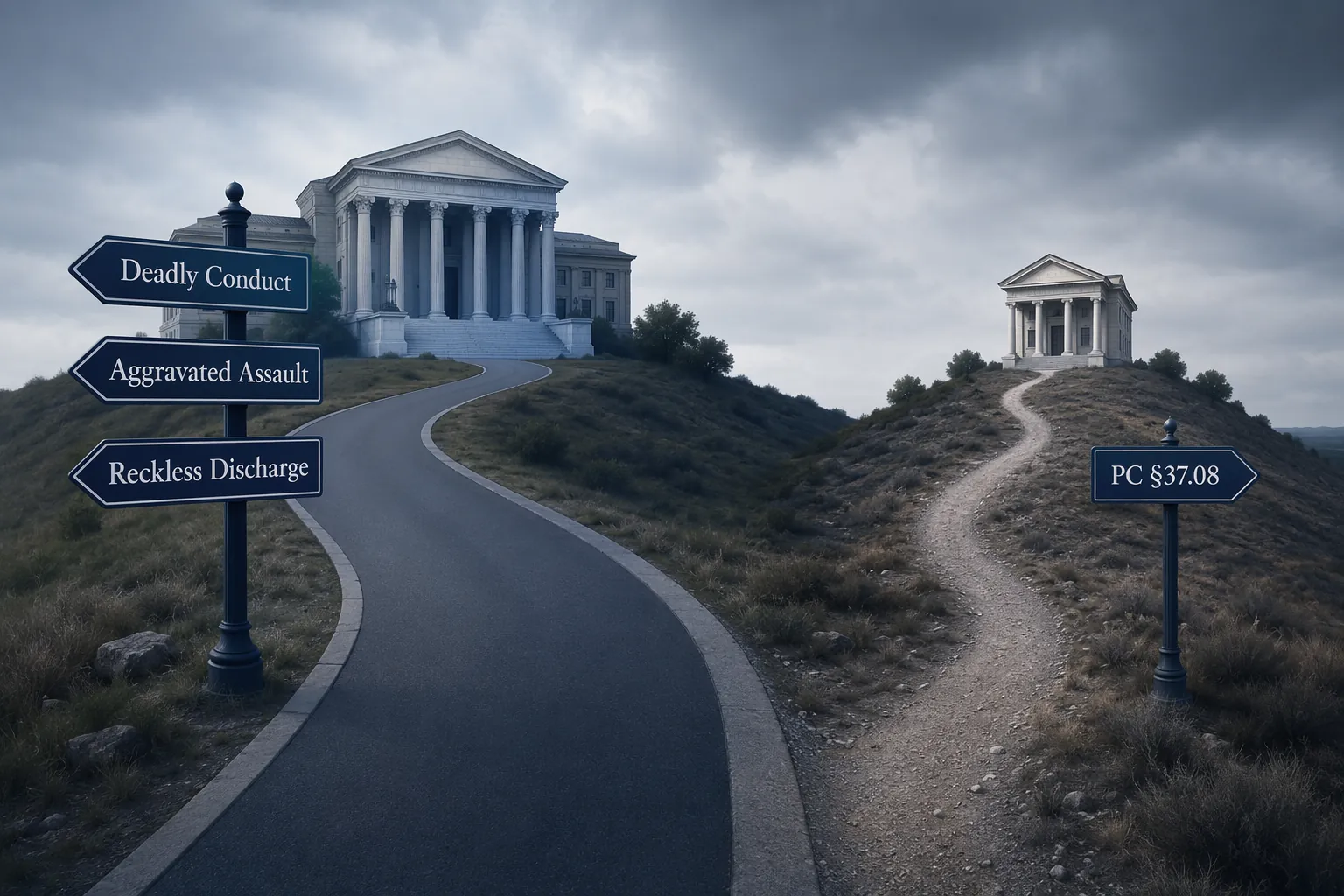
The charge map starts with two separate tracks
Any charging analysis has to separate two possible defendants before it does anything else. One track concerns whoever fired the shot. The other concerns White only if he made a materially false report to law enforcement. Those tracks can coexist, but they do not prove each other.
| Track | What prosecutors would need | Likely statute under current public facts |
|---|---|---|
| Shooter liability | Proof of discharge, direction of fire, mental state, and whether people were placed in danger or threatened | Deadly conduct, aggravated assault with a deadly weapon, or reckless discharge |
| White’s possible exposure | Proof that he made a materially false statement to a peace officer with intent to implicate another | False report to a peace officer |
That division is not a technicality. A bad public accusation does not erase a real shooting. A real shooting does not automatically make every named allegation true. Investigators would have to build each theory with its own witnesses, physical evidence, recordings, reports, and admissible statements.
If a shot was fired toward people, deadly conduct becomes the first serious statute
Texas deadly conduct law is the most natural starting point because it is built for firearm conduct that creates danger even when no one is hit. Texas Penal Code §22.05 includes a misdemeanor form for recklessly engaging in conduct that places another in imminent danger of serious bodily injury, and a felony form when a person knowingly discharges a firearm at or in the direction of one or more individuals, or at or in the direction of a habitation, building, or vehicle while reckless about whether it is occupied.[2]
The hinge is direction and mental state. “A gun went off nearby” is not the same thing as “the shooter knowingly fired toward White or toward people leaving the venue.” If the evidence shows a firearm was discharged in the general area but does not show it was aimed at or toward a person, the felony deadly-conduct theory weakens. If surveillance video, trajectory evidence, witness statements, or recovered casings support that the shot was fired toward White or a group, the exposure changes sharply.
The public record does not yet answer the questions a complaint would need to answer: where the shooter stood, where White stood, whether anyone else was in the line of fire, how many rounds were fired, whether a projectile struck a vehicle or building, and whether investigators can connect a weapon or shooter to the scene. Those are not color details. They are the difference between internet certainty and probable cause.
Aggravated assault requires more than a frightening gunshot
Aggravated assault with a deadly weapon is also possible, but it needs a more disciplined analysis than the phrase usually gets online. Under Texas Penal Code §22.02, aggravated assault can apply when an assault is committed and the actor uses or exhibits a deadly weapon during the assault. The commonly cited punishment range for a second-degree felony aggravated assault is two to 20 years in prison and a fine of up to $10,000.[3]
For a shooting incident, prosecutors would look for either bodily-injury evidence or threat evidence. If no one was struck, the threat theory becomes important: did the shooter intentionally or knowingly threaten another person with imminent bodily injury while using or exhibiting the firearm? A firearm can satisfy the deadly-weapon part. It does not solve the assault part by itself.
That is why witness language matters. A witness saying “someone fired in the parking lot” gives investigators a starting point. A witness saying “the shooter raised the gun toward White’s group and fired as they walked out” gives prosecutors a different statute to consider. Video showing the direction of the muzzle, the movement of people, and the timing of the shot could matter more than any later post naming enemies.
Aggravated assault with a deadly weapon also carries procedural consequences in Texas. It is treated as a so-called 3G offense under Code of Criminal Procedure Article 42A.054, a classification that affects judge-ordered community supervision and parole timing; criminal-defense summaries commonly describe the practical consequence as no judge probation and a 50% minimum-service rule before parole eligibility.[4]
Those consequences are serious enough that prosecutors do not need to stretch the charge for headline value. If the evidence supports a directed threat with a firearm, the aggravated-assault theory is real. If the evidence only supports reckless discharge without a provable target or threat, a lesser charge may fit better.
Reckless discharge may fit if the evidence stays narrower
Texas also has a separate reckless-discharge statute for municipalities. Penal Code §42.12 makes it an offense to recklessly discharge a firearm inside the corporate limits of a municipality with a population of 100,000 or more. The offense is a Class A misdemeanor, and Houston qualifies under that population threshold.[5]
That provision matters because it does not require the same directed-at-a-person showing as felony deadly conduct. If investigators can prove a firearm was recklessly discharged within Houston but cannot prove the shot was knowingly fired at or toward White, a group, a vehicle, or an occupied structure, §42.12 may become the more defensible fit.
This is where physical evidence does quiet work. A casing location can help place the shooter. A bullet strike can show direction. Surveillance can show whether people were in the path of fire. A 911 call can preserve timing before everyone has watched the story mutate online. None of that has been publicly laid out in a charging instrument as of this writing.
White’s own legal exposure depends on a report to law enforcement, not just a post
The false-report track is narrower than many readers assume. Texas Penal Code §37.08 applies when a person, with intent to deceive, knowingly makes a false statement that is material to a criminal investigation to a peace officer or certain law-enforcement employees, or makes a false report of a crime. In this incident, the relevant exposure would be a Class B misdemeanor if White made a materially false statement to a peace officer with intent to implicate another.[6]
The statute does not criminalize every reckless social-media allegation as a false police report. A public accusation can be defamatory, irresponsible, strategically stupid, or impossible to prove without automatically becoming a Penal Code §37.08 case. For criminal exposure, prosecutors would need a law-enforcement statement or report, material falsity, knowledge or intent, and some connection between the falsehood and the investigation.
If White merely posted that he believed J Prince Sr. or Mob Ties were involved, that is not the same as making a sworn or reported statement to HPD naming them as perpetrators. If he gave detectives specific false facts—such as claiming to have seen a named person direct the shooting when he knew he had not—then the analysis changes. The difference is not moral; it is statutory.
The unverified FBI-report claim sits in the same category. If a formal federal report exists, its contents would matter. If the claim is only circulating through White or secondary coverage, it cannot carry a criminal-law conclusion. A false-report case would need the actual recipient agency, the statement, its materiality, and proof of falsity.
Prior arrests explain public interest, not July 2026 probable cause
White’s prior legal history is part of why this story draws legal-search traffic, but it is a poor substitute for evidence in the July 2026 incident. The Star-Telegram reported in October 2023 that White faced charges with a $15,000 bond for assault and a $1,000 bond for animal cruelty.[7] Complex reported in February 2025 that White was held without bond on two aggravated-assault-with-a-deadly-weapon counts.[8]
White later claimed, through coverage cited in the available materials, that the 2025 charges were “cleared,” but no independently confirmed court docket or prosecution statement was located.[9] That distinction should stay visible. A self-reported clearance is not the same thing as a verified dismissal, and neither would prove what happened outside Nickel Bar and Grill.
Prior arrests may become relevant for bond arguments, credibility fights, or background reporting if a case is filed. They do not prove the shooter’s identity, the direction of fire, the truth or falsity of White’s allegations, or whether any July 2026 statement to law enforcement was materially false.
What would actually change the analysis
The next legally meaningful development would not be another personality reacting to the allegation. It would be an HPD statement, a probable-cause affidavit, an arrest warrant, a filed complaint, an indictment, or a court docket entry. Those records would show which facts investigators are willing to put behind a charge.
- A deadly-conduct filing would likely identify the alleged shooter, the firearm conduct, and whether the shot was fired at or toward people, a vehicle, a building, or another occupied place.
- An aggravated-assault filing would likely describe the assault theory: bodily injury, threat of imminent bodily injury, use or exhibition of the firearm, and the named complainant.
- A reckless-discharge filing would likely focus on firearm discharge inside Houston and the facts supporting recklessness.
- A false-report filing against White would need the law-enforcement statement or report, why it was material, why it was false, and how prosecutors intend to prove intent to deceive or implicate another.
Until one of those records appears, the strongest defensible conclusion is conditional. The shooting could generate serious felony exposure for whoever fired if investigators can prove direction, intent, and danger to identifiable people. White’s exposure is more limited and more specific: a potential Class B misdemeanor false-report theory only if a materially false law-enforcement report is proven. As of July 23, 2026, both tracks remain prospective rather than filed criminal charges.
References
- Charleston White claims he was fired upon leaving Dr. Matthews’ birthday party in Houston’s 5th Ward, Houston Stringer, July 22, 2026.
- Texas Penal Code §22.05 Deadly Conduct, Saputo Law.
- Texas Penal Code §22.02 Aggravated Assault, Saputo Law.
- Aggravated Assault With a Deadly Weapon in Texas, Versus Texas.
- Texas Penal Code §42.12 Discharge of Firearm in Certain Municipalities.
- Texas Penal Code §37.08 False Report to Peace Officer, Federal Special Investigator, Law Enforcement Employee, Corrections Officer, or Jailer.
- Charleston White arrested in Tarrant County on assault, animal cruelty charges, Star-Telegram, October 2023.
- Charleston White Held Without Bond on Two Aggravated Assault With Deadly Weapon Counts, Complex, February 2025.
- Charleston White Says Charges Were Cleared, AllHipHop.
Comments
Join the discussion with an anonymous comment.