
A daycare teacher arrested for child cruelty is not facing one nationally uniform charge. The headline may sound the same from state to state, but the criminal exposure can change sharply once the case is put against a particular statute: in Georgia, first-degree cruelty to children can carry a felony range of 5 to 20 years; in Florida, ordinary child abuse is a third-degree felony with a 5-year maximum, while aggravated child abuse can reach 30 years; in Pennsylvania, prosecutors may work from endangering-welfare, assault, or aggravated-assault theories depending on the proof.
The July 2026 Georgia arrest of Debora Schlueter shows why the distinction matters. Police said Schlueter, a teacher at Small World Education Center, was arrested for cruelty to children after surveillance video allegedly showed her restraining, slapping, and pulling two brothers, ages 3 and 4, by their arms.[1] Those allegations are vivid, but the case remains an arrest and ongoing proceeding, not a conviction. Charges can be amended, reduced, dismissed, or tried, and the facts that matter in court are the facts the state can prove.

The Same Allegation Can Land in Very Different Statutes
In a daycare setting, the conduct usually described in public reporting as “child cruelty” may be charged under child cruelty, child abuse, aggravated child abuse, endangering welfare of a child, assault, or aggravated assault statutes. The label chosen is not a matter of word preference. It determines the felony degree, the sentencing range, the elements the prosecutor must prove, and the plea leverage in the case.
| State | Common Charging Framework | Penalty Range or Maximum in the Research Materials | Why It Matters |
|---|---|---|---|
| Georgia | Cruelty to children under O.C.G.A. §16-5-70 | First degree: 5 to 20 years; second degree: 1 to 10 years; third degree may be misdemeanor or felony depending on circumstances | The statute can convert proof of willful cruel or excessive pain into a high-exposure felony. |
| Florida | Child abuse or aggravated child abuse under §827.03 | Child abuse: third-degree felony, up to 5 years and a $5,000 fine; aggravated child abuse: first-degree felony, up to 30 years | The charging line between abuse and aggravated abuse drives the difference between a 5-year and 30-year ceiling. |
| Pennsylvania | Endangering welfare of a child, assault, or aggravated assault on a minor | Endangering welfare may be a first-degree misdemeanor up to 5 years, escalating to felony when willful or repeated; aggravated assault on a minor may carry 10 to 20 years | The same daycare fact pattern may be framed as neglect, endangerment, assaultive conduct, or serious bodily injury risk. |
Georgia supplies the sharpest example in the current materials. Under the Georgia cruelty-to-children framework identified in the research, first-degree child cruelty involves willfully depriving a child of necessary sustenance or maliciously causing a child under 18 cruel or excessive physical or mental pain, and the felony sentencing range is 5 to 20 years. Second-degree cruelty carries 1 to 10 years, while third-degree cruelty can be treated as a misdemeanor or felony depending on the circumstances.[2]
That range explains why the early description of conduct matters. Restraining a 3-year-old or 4-year-old, slapping a child, pulling a child by the arms, and doing so in a licensed childcare setting are not just moral facts. They are facts prosecutors may use to argue willfulness, excessive pain, vulnerability, and more than momentary loss of control. Defense counsel will usually press the other side of the same record: what the video actually shows, whether injury occurred, whether force was disciplinary, protective, or excessive, and whether the statutory mental state can be proved beyond a reasonable doubt.
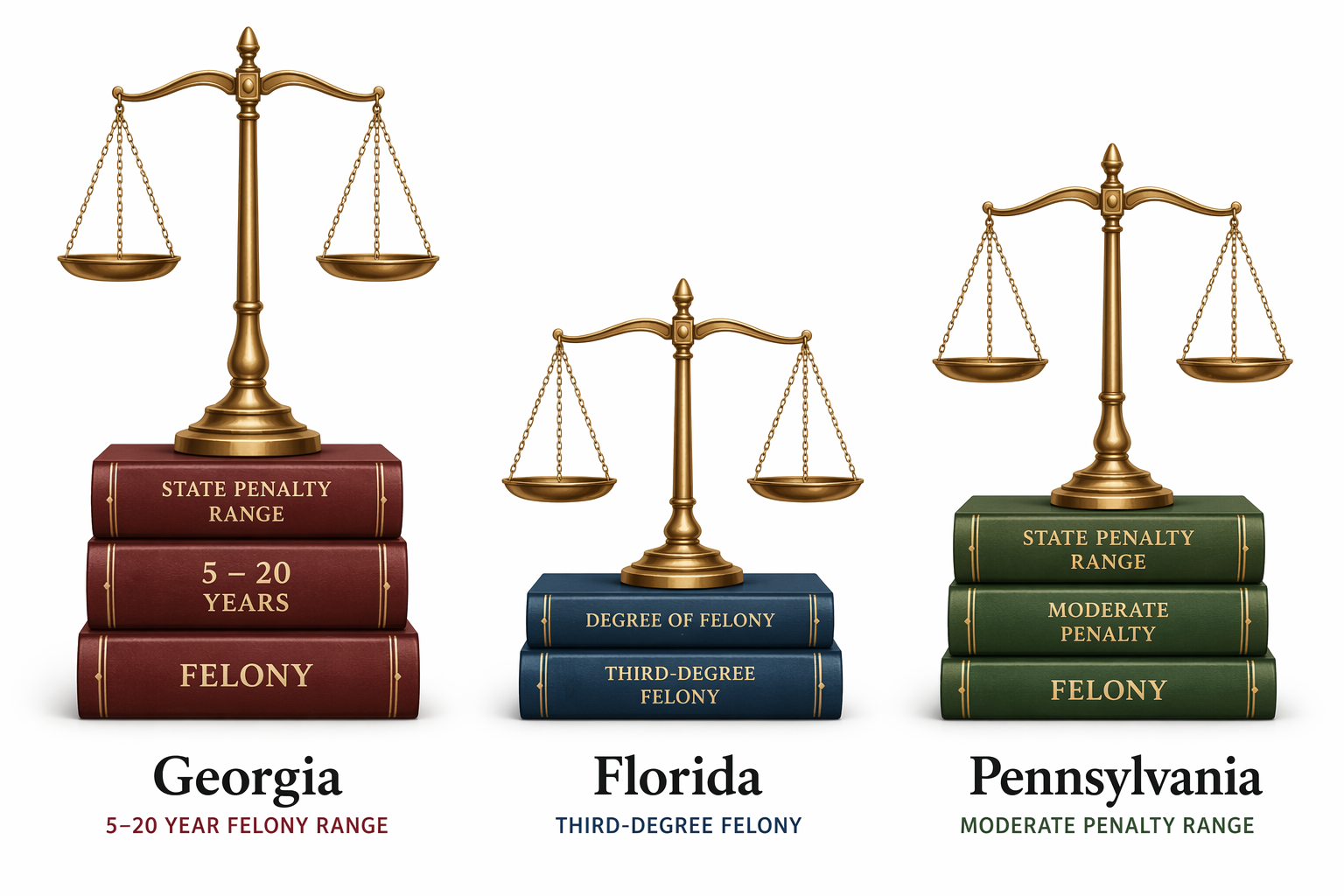
Georgia: Why First-Degree Cruelty Is the High-Exposure Charge
Georgia’s cruelty statute is a useful anchor because it separates degrees of cruelty rather than treating every daycare allegation as one generic offense. First-degree cruelty is the most serious of the degrees identified in the research materials, and its 5-to-20-year range makes it materially different from a misdemeanor handling of inappropriate discipline.[2]
The reported Schlueter allegations, if charged under Georgia law, raise the questions prosecutors regularly have to answer before an indictment or accusation: Was the force willful? Was the pain cruel or excessive? Were there visible injuries or medical findings? Did the conduct happen once or repeatedly? Does the video show an isolated ambiguous movement, or does it show a sequence a jury could understand without relying entirely on a very young child’s testimony?
Surveillance evidence does not decide the case by itself. It can be incomplete, lack audio, miss what happened immediately before or after the event, or require context from staff and medical witnesses. But it can change the charging posture because it gives prosecutors a concrete exhibit for force, duration, restraint, and the conduct of other adults in the room. In a case involving preschool-age children, that may matter as much as any single witness statement.
Florida: The Five-Year Charge Is Not the Thirty-Year Charge
Florida illustrates a different danger in reading daycare-abuse headlines too quickly. The research materials distinguish child abuse from aggravated child abuse under Florida law. Child abuse is described as a third-degree felony punishable by up to 5 years in prison and a $5,000 fine, while aggravated child abuse is described as a first-degree felony punishable by up to 30 years.[3]
For charging purposes, that difference can turn on the severity of injury, the nature of the act, and whether the state can prove a level of conduct that fits the aggravated statute rather than the baseline abuse offense. A slap, grab, shove, or restraint allegation should not be automatically translated into aggravated child abuse. Nor should it be minimized as a lower-level case before the medical evidence, video, and witness accounts are reviewed.
That is the legal work behind a child-cruelty arrest. The first question is not whether the facts are disturbing. The first question is which statute the prosecutor can actually satisfy.
Pennsylvania: Endangerment, Assault, and the Escalation Problem
Pennsylvania materials point to a broader charging menu. A daycare worker may face endangering welfare of a child, which is described as a first-degree misdemeanor carrying up to 5 years, with escalation to felony treatment when the conduct is willful or repeated.[4] Separate Pennsylvania defense materials also identify aggravated assault on a minor as a charge that can carry 10 to 20 years.[5]
The difference is not just severity; it is theory. Endangering welfare focuses attention on duty, supervision, and whether the adult knowingly placed the child at risk or failed to protect the child. Assault charges focus more directly on physical force, injury, attempted injury, or serious bodily injury risk. In a daycare case with multiple adults in a classroom, Pennsylvania prosecutors may have to decide whether one worker is the actor, another is a non-intervening witness, or both belong in the charging document under different theories.
Sentencing Examples Show Exposure, Not the Average Result
Individual sentencing reports are useful, but only if kept in their lane. In January 2026, two daycare workers at Happy Hearts Christian Academy in Dale County, Alabama, received split sentences involving 5 years in prison as part of a 20-year term, with no parole eligibility, after a case involving workers who took turns striking a child.[6] That example shows how severe punishment can look after conviction. It does not establish a national average, a typical daycare-abuse sentence, or a reliable predictor for an unrelated Georgia, Florida, or Pennsylvania case.
It does, however, underline a practical point. When the state can prove repeated blows, more than one participating adult, and conduct that a sentencing judge views as a breach of custodial trust, the case may move far beyond a low-end plea posture. Sentencing is where statutory exposure, the video record, injury evidence, the defendant’s role, criminal history, and victim-impact evidence all converge.

What Moves a Daycare Case Up or Down the Charging Ladder
Charging decisions in daycare child-cruelty cases usually turn on a small set of facts that have large legal consequences. Some go to the degree of the offense. Some go to proof. Some affect both.
- Degree of harm: visible injury, pain, medical findings, or serious bodily injury risk can move a case toward aggravated or higher-degree charges.
- Victim age and vulnerability: toddlers, preschoolers, and non-verbal children may make the conduct appear more dangerous and may affect how prosecutors prove the case without relying on a child’s full testimony.
- Intent and willfulness: statutes often require more than a bad outcome; prosecutors must fit the adult’s mental state to the statutory language.
- Restraint or force: holding a child down, pulling arms, striking, or using force as control can matter differently from neglect or passive failure to supervise.
- Multiple victims or repeated incidents: a single ambiguous incident is charged differently from a pattern involving more than one child.
- Surveillance video: video can supply direct proof of conduct, but it still has to be authenticated, interpreted, and matched to the charged elements.
- Prior complaints: earlier warnings or complaints may affect intent, notice, facility response, and charging judgment if they are supported by admissible evidence.
- Multiple-staff involvement: prosecutors may examine who participated, who watched, who reported, and who had a legal duty to intervene.
The multiple-staff question deserves particular care. A 2023 review of empirical studies on maltreatment in daycare settings reported that multiple perpetrators were involved in about half of daycare maltreatment cases in the studies reviewed.[7] That finding does not mean half of criminal prosecutions involve multiple defendants, and it does not prove anything about a specific classroom. It does explain why investigators may look beyond the person seen striking or restraining a child when the facts suggest other staff members participated, ignored, or failed to report.
Why Video Often Changes the Case
Video is powerful in daycare cases because the children are often too young to narrate events in the way adult witnesses can. It can show whether an adult used both hands, how long a restraint lasted, whether a child recoiled or cried, whether other children were present, and whether other employees saw what happened. It can also undercut overcharging if the recording shows a less forceful contact than a complaint suggested.
That is why prosecutors, defense attorneys, and judges tend to slow down around the actual footage. A police summary of a video is not the video. A parent’s reaction to a video is not an element of the offense. A still image may capture the worst-looking frame and miss the seconds that matter most. The charging decision may begin with a report, but the courtroom fight often turns on the recording itself.
Why Injury Is Not the Only Question
A serious injury can plainly aggravate a case. But lack of a documented injury does not automatically remove criminal exposure. Some statutes focus on cruel or excessive pain, risk, endangerment, or willful conduct toward a child, not only on broken bones or hospital treatment. Conversely, a visible mark does not automatically prove the highest available felony; the state still has to prove the statutory elements and the defendant’s role.
The child’s age affects that analysis without replacing it. A forceful act against a 3-year-old may be judged differently from the same physical movement involving an older child because the risk of injury, ability to resist, and ability to explain what happened are different. Age is not a shortcut to conviction. It is one of the facts that makes the legal assessment more severe.
Separate Legal Tracks Should Not Be Blended Into the Criminal Charge
A daycare abuse allegation can also trigger facility licensing action, civil claims, employment consequences, mandated-reporting issues, and insurance disputes. Those tracks matter, but they answer different questions. A license revocation proceeding may focus on regulatory compliance. A civil case may focus on negligence, supervision, hiring, or damages. A failure-to-report case may focus on what another adult knew and when that adult had a duty to act.
The criminal case is narrower and harsher: what offense can the state prove, against which defendant, under which statute, and beyond a reasonable doubt. Keeping that boundary clear prevents two mistakes at once: treating an arrest as a conviction, and treating a childcare job title as if it automatically determines the felony degree.
The Practical Framework
For lawyers and legal analysts reading a daycare child-cruelty arrest, the useful sequence is straightforward:
- Identify the state statute and the exact charge, not the headline label.
- Separate ordinary abuse, aggravated abuse, cruelty degrees, endangerment, assault, and aggravated assault.
- Match the alleged conduct to statutory elements: force, pain, injury, risk, intent, duty, and willfulness.
- Review the evidence source: surveillance footage, medical records, staff statements, parent reports, prior complaints, and facility records.
- Ask whether the case involves one child, multiple children, one employee, multiple employees, or a failure to intervene.
- Keep sentencing examples separate from sentencing predictions unless the jurisdiction, conviction offense, record, and facts are comparable.
Under that framework, the legal consequences of a daycare teacher’s child cruelty arrest are not set by the words “daycare teacher” or “child cruelty.” They are set by the jurisdiction, the provable conduct, the child’s vulnerability, the degree of harm or risk, the required mental state, and the evidence prosecutors can actually put in front of a court.
References
- Daycare teacher arrested for child cruelty, accused of abusing 2 young brothers, police say — 29news.com, Jul 18, 2026
- Georgia Day Care Center Employee Arrested for Child Cruelty — Georgia Criminal Lawyer
- Florida Daycare Worker Child Abuse Defense Lawyer — Musca Law
- What Criminal Charges Can Pennsylvania Daycare Workers Face? — Logue Law Group
- Possible Criminal Charges Against Daycare Workers in Pennsylvania — Fienman Defense
- Day care workers who took turns striking child receive prison sentences — weau.com, Jan 9, 2026
- Maltreatment in Daycare Settings: A Review of Empirical Studies in the Field — PMC, 2023
Comments
Join the discussion with an anonymous comment.