
When a custodial parent asks whether a child can legally drop a father’s surname, the answer rarely turns on whether the father’s refusal feels fair. The first questions are more procedural: is he a legal parent, do his parental rights still exist, must he receive notice, and can the petitioner prove that the proposed surname change serves the child’s best interests?
This is informational analysis, not legal advice. Minor name-change procedure remains jurisdiction-specific, and a petition that is viable in one state can fail elsewhere if the wrong exception is pleaded or service is handled casually. As a general baseline, courts expect both legal parents to consent or at least receive proper notice before a child’s surname is changed, and the court still evaluates the child’s best interests rather than treating either parent’s preference as controlling.[1]
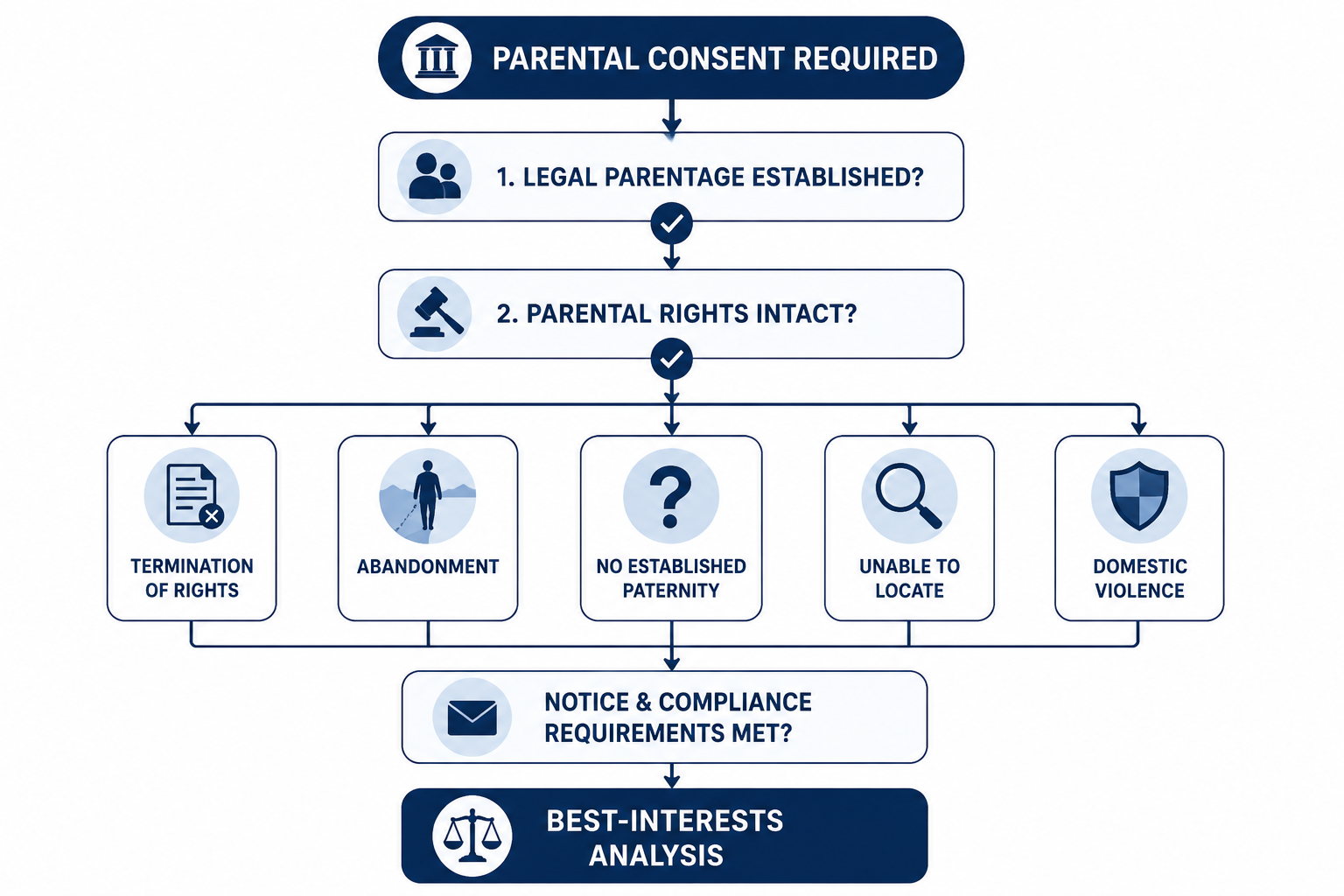
The consent question is really five narrower questions
A missing father’s consent is not one legal problem. It can mean several different things, and each one sends the petition down a different path. The father may object. He may have disappeared. He may never have been legally adjudicated or acknowledged as the child’s parent. His rights may have been terminated. Or notice itself may create a safety problem because of domestic violence.
| Situation | What the petitioner must usually establish | What changes legally |
|---|---|---|
| Father’s parental rights were terminated | A valid termination order or equivalent court record | Consent is generally no longer required from a person who no longer has parental rights |
| Father abandoned the child | Jurisdiction-specific findings or evidence of failure to maintain a parental relationship | The court may treat nonparticipation as relevant to consent, notice, and best interests |
| Paternity was never established | No legal father exists under the state’s parentage rules | The petitioner may not need consent from a biological father who is not a legal parent |
| Father cannot be located | A documented diligent search and compliance with substitute-service rules | The court may allow the case to proceed without personal service |
| Domestic violence makes notice dangerous | Evidence that notice would threaten safety and that the requested protection fits state law | The court may consider waiving, sealing, or modifying notice requirements |
That taxonomy matters because “without consent” can hide two different requests. Sometimes the petitioner asks the court to proceed over a father’s objection. Sometimes the petitioner asks the court to excuse notice altogether. The second request is harder to treat as routine because notice protects a parent’s opportunity to be heard. A petition should say which requirement is being addressed and why the record supports that result.
Start with legal parentage, not biology
The man whose surname appears on the child’s birth certificate may or may not be the person whose consent is legally required. Conversely, a biological father who has not been adjudicated, acknowledged, or otherwise established as a legal parent may not occupy the same procedural position as a legal father. The petition should begin by identifying the child’s legal parents under the governing parentage statute and court orders.
Maryland’s public guidance illustrates the practical framing: a parent filing to change a child’s name must address consent and service for the child’s parents, guardians, and custodians, and the form process changes when a required person cannot be located.[2] The same logic appears in many jurisdictions even when the forms and terminology differ. Before arguing abandonment or best interests, counsel should know who is legally entitled to notice.
Where paternity has never been established, the evidentiary task is usually documentary. The petitioner may need the birth certificate, any parentage orders, acknowledgment records, custody orders, support orders, or child-welfare orders showing whether a legal father exists. If there is an open parentage dispute, a name-change petition is a poor substitute for resolving parentage first.
Termination of parental rights is the cleanest consent exception
If a father’s parental rights have been terminated, the consent analysis changes because the legal relationship has changed. The petitioner should attach or be prepared to produce the termination order, adoption order, dependency order, or other controlling record. A pleading that merely says the father is “not involved” is not the same thing as a termination of rights.
Texas materials provide one example of a state-specific approach: Texas name-change guidance recognizes exceptions to the ordinary need for the other parent’s permission where parental rights have been terminated and in certain other statutory circumstances, including some criminal-conviction scenarios.[3] That does not make Texas a national template. It shows why counsel should separate statutory exceptions from equitable arguments before drafting the petition.
Abandonment is useful only if the jurisdiction gives it legal work to do
Abandonment often supplies the facts that make a surname change feel justified: no visits, no support, no school involvement, no medical decision-making, no reliable contact. But abandonment does not always operate as a freestanding consent exception. In some states it may support a best-interests finding. In others it may matter only if it has already been reduced to a court finding or fits a statutory ground.
Illinois practitioner materials, for example, discuss a child’s name change through a best-interests lens and emphasize that lack of consent does not end the inquiry; the court may still evaluate factors such as parental involvement, the child’s use of the name, and the child’s welfare.[4][5] That is a different argument from saying abandonment automatically waives consent. The pleading should not blur the two.
A stronger abandonment record is specific without becoming punitive. It identifies missed periods of contact, unpaid support if support is relevant and admissible, lack of participation in school or medical matters, returned mail, protective orders if any, and prior findings from custody, support, neglect, or termination proceedings. The court needs facts that connect the father’s absence to the child’s name, identity, safety, continuity, or daily functioning.
Diligent search is where good equities can still lose
Inability to locate the father is not the same as not wanting to deal with him. Courts and clerks usually need a record showing that the petitioner tried to find and serve him through the methods required by local rule or statute. Maryland’s guide is direct on this point: if a person who must be served cannot be found, the petitioner must describe efforts to locate that person and may need to request alternative service or publication under the applicable procedure.[2]
The phrase “diligent search” should be treated as a litigation task, not a caption. A useful record may include last known addresses, certified-mail results, returned envelopes, process-server affidavits, contact attempts through known relatives when safe and lawful, searches of available court records, correctional records where relevant, military-status checks if required, child-support agency information, and any state-specific database searches the court expects.
The failure point is often chronology. A declaration that says “I do not know where he is” does little work. A declaration that states when the father was last known to reside at a specific address, when mail was sent, what came back, which records were checked, and why no better address is available gives the court something to review. If the petitioner is also seeking to keep an address confidential, that request should be made under the jurisdiction’s privacy or safety rules rather than buried in the search narrative.
Publication can create its own problems. It may be expensive, slow, and ill-suited to families trying to keep location information private. But if publication or another substitute method is the authorized route, skipping it can leave the eventual order vulnerable. Counsel should confirm whether the court may waive publication, permit alternative service, seal identifying information, or require a specific affidavit before the hearing is set.
Domestic violence cases put notice and safety in direct conflict
Domestic violence is the hardest exception to write about responsibly because the ordinary procedural instinct—give notice and build a clean record—can itself create danger. A parent seeking to change a child’s surname may also be trying to prevent an abuser from locating the family, disrupting school or medical records, or using litigation contact as another form of control.
New York advocacy materials discussing In re Application of M.M. and Matter of Jane Doe describe decisions that allowed identity-change petitions to proceed without notice to abusive fathers where the courts credited evidence of domestic violence and treated the fathers’ conduct as an abandonment of parental responsibility.[6] The important point is not that notice disappears whenever domestic violence is alleged. It is that some courts have recognized that notice can undermine the safety purpose of the petition.
That distinction should shape the record. The petitioner is not simply proving that the father was a bad partner or that the relationship ended badly. The petitioner is asking the court to connect notice, disclosure, or continued use of the surname to a concrete safety risk for the child or custodial parent. Useful evidence may include orders of protection, criminal records, custody findings, child-protective findings, sworn descriptions of stalking or threats, shelter or address-confidentiality documentation, and prior litigation conduct showing misuse of contact information.
The New York cases are also a warning against overclaiming. They are meaningful precedent for survivors and children seeking identity changes, but the research record supports treating them as developing and jurisdiction-specific rather than settled national law.[6] A petition filed elsewhere should identify the local authority for sealing, notice waiver, alternative service, address confidentiality, or ex parte handling. If no direct name-change authority exists, counsel may need to analogize from domestic-violence, family-court, or civil-procedure rules without pretending the analogy is already a rule.
Best interests still decide the merits
Clearing the consent or notice problem does not automatically win the name change. Courts still ask whether the requested surname change serves the child’s best interests. That inquiry is where the petition should move from adult grievance to child-centered proof: school records, medical records, sibling names, household identity, safety concerns, the child’s expressed preference when age-appropriate, and the likely effect on the child’s relationship with each parent.
New Jersey’s Fried v. Vance framework is a useful model because it lists multiple factors rather than reducing the issue to paternal custom or custodial preference. Practitioner summaries describe the test as considering factors such as the length of time the child has used a surname, the child’s identification with a family unit, potential embarrassment or anxiety, the strength of the child’s relationship with each parent, parental misconduct or support issues, and the child’s preference depending on age and maturity.[7]
The best-interests record should be tailored to the exception already pleaded. In a diligent-search case, the strongest proof may be the child’s long-term use of the custodial household’s surname and the father’s long absence. In a domestic-violence case, the strongest proof may be safety, privacy, and the child’s need to use records without exposing a protected location. In a no-established-paternity case, the proof may focus on continuity and the legal family structure rather than fault.
Courts are less likely to be helped by broad claims that children are generally better off with one naming convention or another. The petition should explain this child’s circumstances. If the child has used the proposed surname informally at school or in medical settings, say how long and with what effect. If the current surname creates confusion at enrollment, travel, insurance, or healthcare appointments, identify the recurring problem. If the child is old enough to have a view, preserve it in the form the jurisdiction allows.
A practical pleading sequence
A careful petition usually does not begin with the sentence “the father will not consent.” It begins with status and authority. Who are the child’s legal parents? What orders already exist? Who has custody or decision-making authority? Has any parent’s status changed through termination, adoption, parentage adjudication, or another court order?
- Identify the child’s legal parents and attach the records that establish parentage, custody, guardianship, or termination.
- State whether the missing consent problem is an objection, an absent parent, no legal parentage, terminated rights, abandonment, or safety-based notice issue.
- Serve every required person unless a statute, rule, or court order permits substitute service, confidentiality, or waiver.
- If the father cannot be located, file a detailed diligent-search affidavit before asking the court to proceed without personal service.
- If domestic violence is the basis for limiting notice, request the specific protection available in that jurisdiction and support it with admissible safety evidence.
- Present a best-interests record focused on the child’s identity, stability, safety, records, relationships, and day-to-day consequences.
That sequence also helps avoid a common drafting mistake: treating the father’s absence as proof of best interests before the court has authority to proceed without him. Notice, consent, and merits overlap factually, but they are not the same ruling.
What should be left out unless verified
There are tempting shortcuts in this subject area: claims about how often fathers win contested surname cases, cultural trend pieces about adult children dropping paternal names, and summaries of recent appellate decisions without a caption or docket number. Those materials may be useful leads for further research, but they should not carry a petition or a legal analysis unless counsel can verify them from primary sources.
The same caution applies to filing fees and publication costs. They change by state and by date. A client needs current local numbers from the court, not a national estimate borrowed from another jurisdiction.
The litigation judgment
A child’s surname can be changed without the father’s consent in recognized circumstances, but the route matters. Terminated rights require the order. No established paternity requires a parentage record. Abandonment requires facts that the governing law actually recognizes. Inability to locate requires a documented diligent search and proper substitute procedure. Domestic violence requires a safety record strong enough to justify whatever protection from notice the court is being asked to grant.
The final question is not whether the father’s consent is emotionally or socially necessary. It is whether the petitioner can identify the correct exception, satisfy its evidentiary burden, complete or lawfully avoid notice, and present a child-centered best-interests record.
References
- Father’s Right To Change His Child’s Name, FindLaw
- Name Change for a Child, Maryland People’s Law Library
- Changing a Child’s Last Name Without the Other Parent’s Permission in Texas, Patrick Toscano Law Firm
- Changing a Child’s Last Name in Illinois, Sterling Lawyers
- Can I Change My Child’s Last Name Without Other Parent’s Approval?, Manassa Law
- Decisions Provide Meaningful Precedent for Victims of Domestic Violence and Their Children Seeking Identity Changes, Empire Justice
- Can the Last Name of a Child Be Changed Over One Parent’s Objection?, Sarno da Costa D’Aniello Maceri Webb
Comments
Join the discussion with an anonymous comment.