
The compliance event was not the press language around cartels. It was the effective date. As of February 20, 2025, Cártel de Jalisco Nueva Generación, or CJNG, was inside two legal systems at once: Foreign Terrorist Organization designation under INA § 219 and Specially Designated Global Terrorist status under Executive Order 13224, following Executive Order 14157 on January 20, the State Department’s February 6 designation, and Federal Register publication at 90 FR 10030 on February 20.[1][2]
That combination is the center of the legal impact for operations in 2025. A company does not need a cartel-facing business plan for the designation to matter. A payment, shipment, bank service, local supplier contract, plant operating expense, or route decision can move into a different legal category if the surrounding facts connect the transaction to an FTO, an SDGT, or an entity that is blocked because of ownership.
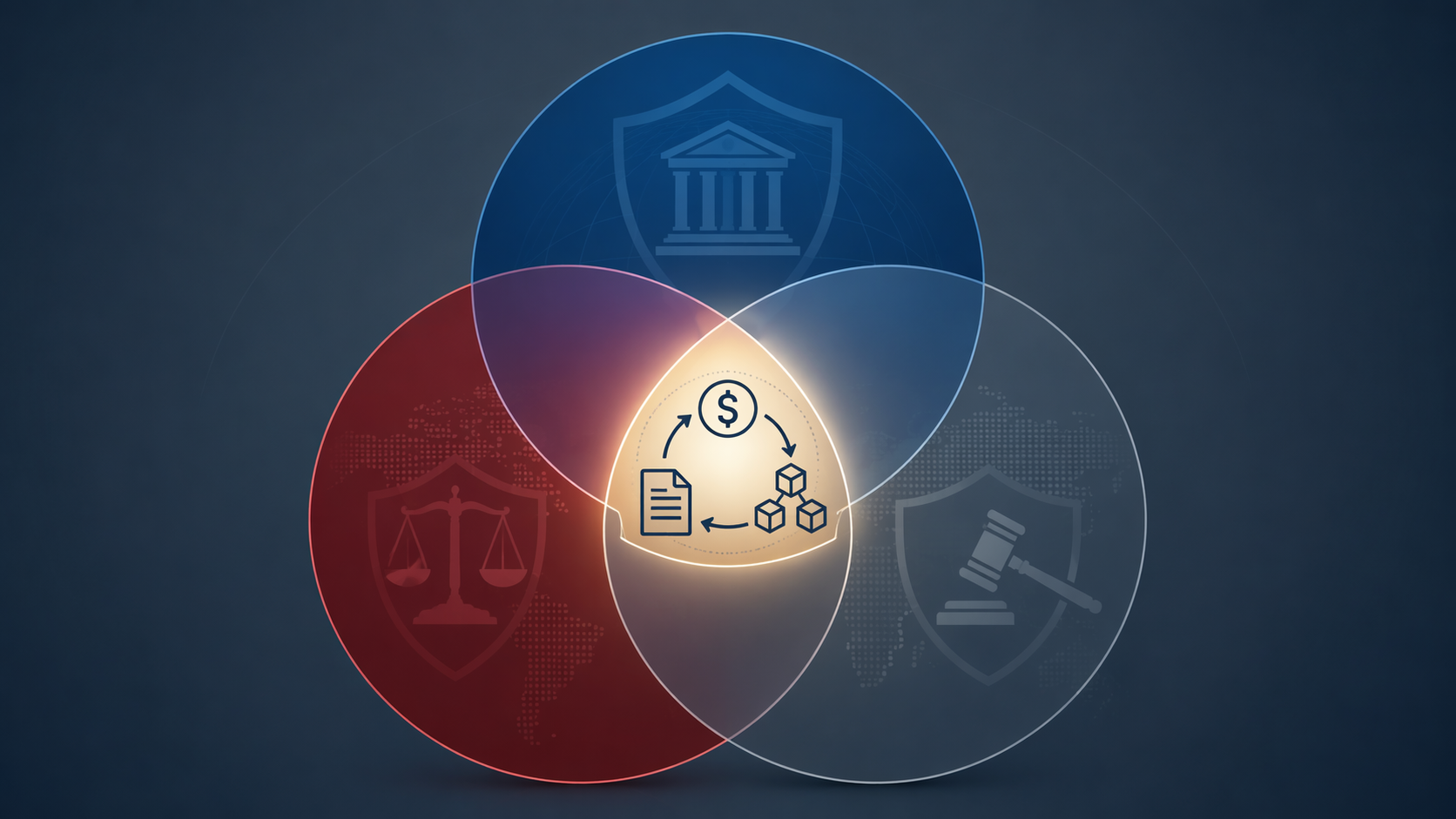
The Three Tracks Now Running at the Same Time
The FTO and SDGT labels do different work. FTO designation opens the door to criminal material-support liability under 18 U.S.C. § 2339B and immigration consequences. SDGT designation brings OFAC blocking rules, including the automatic blocking of certain unlisted entities, and it also creates secondary sanctions pressure for foreign financial institutions.[3]
| Legal track | What it changes for operations | Why direct-name screening is not enough |
|---|---|---|
| 18 U.S.C. § 2339B material support | Knowingly providing material support or resources to an FTO can be prosecuted criminally, including extraterritorially. | The issue may be the intended payment, logistics service, purchase, or operating support, not a stated desire to support terrorism. |
| OFAC SDGT blocking rules | Property and interests in property of SDGTs are blocked, and U.S. persons generally must not deal in them. | Entities owned 50% or more by blocked persons can be blocked even when the entity name is not on the SDN List. |
| ATA/JASTA civil exposure | U.S. nationals injured by international terrorism may seek treble damages under 18 U.S.C. § 2333. | Plaintiffs may test whether services, payments, or support were provided despite red flags or in unusual ways. |
These tracks do not wait politely for one another. The same operating fact pattern can draw a criminal inquiry, an OFAC blocking analysis, and civil plaintiff scrutiny. That does not mean every Mexico-facing company is a likely prosecution target. It does mean the legal consequence of an otherwise familiar business act now depends heavily on who benefits, who owns the intermediary, what territory or route is involved, and what the company knew before it signed, paid, shipped, or renewed.
Material Support Is the Sharpest Change
Section 2339B makes it a crime to knowingly provide material support or resources to a designated FTO. The difficult point for business operators is the statute’s general-intent structure: prosecutors need not prove that the defendant intended to further terrorism. The government must prove that the defendant intended the underlying conduct, such as making the payment or providing the logistics service, with the required knowledge of the organization’s status or conduct.[4]
That distinction is not academic. A commercial team may describe the conduct as a local fee, a security expense, a toll, a transportation arrangement, or a necessary payment to keep a facility open. Section 2339B analysis asks a colder question: did the company knowingly provide something of value that falls within material support or resources to an FTO? The answer does not turn on whether the company endorsed the organization’s violence.
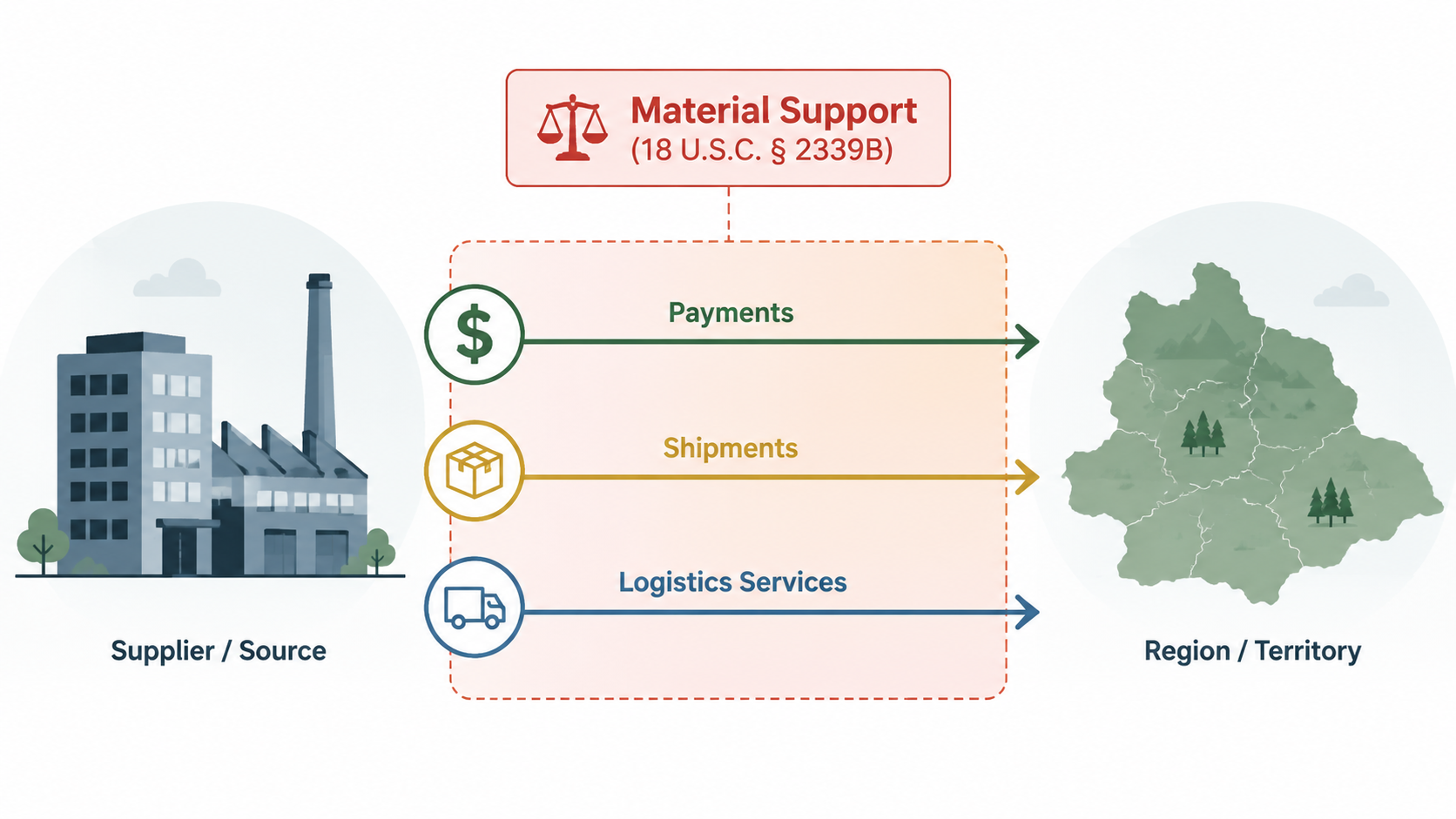
Lafarge is the precedent that should make operating teams uncomfortable in a useful way. In 2022, Lafarge SA and its Syrian subsidiary were convicted of providing material support to ISIS and other FTOs after paying fees to keep a cement plant operating in territory controlled by designated groups, buying raw materials from FTO-linked suppliers, and paying “taxes.” The resolution included $778 million in forfeiture and criminal fine.[5]
The Lafarge lesson is not that Mexico is Syria, or that every plant in a high-risk region is a criminal case waiting to happen. The lesson is narrower and more operationally important: routine business continuity decisions can become material-support evidence when the counterparty environment is controlled by a designated organization and the company continues to route value through that environment.
Chiquita shows the same problem through protection payments. Chiquita Brands International pleaded guilty to material support for payments made from 1997 to 2004 to the Colombian FTO Autodefensas Unidas de Colombia, or AUC, and paid a $25 million criminal fine. Later, civil plaintiffs obtained a $38.3 million jury verdict against Chiquita under a separate liability track.[6]
For companies operating in or moving goods through areas where CJNG influence is a known concern, Chiquita matters because “we paid to protect people and assets” is not a clean answer to a material-support problem. It may explain commercial pressure. It does not by itself neutralize the statutory consequence of intentionally making a payment to a designated organization or through a structure that benefits one.
OFAC Risk Starts Where the SDN Search Ends
The SDGT side of the designation changes the screening burden. OFAC’s 50 Percent Rule treats entities as blocked when they are owned 50% or more, directly or indirectly, individually or in the aggregate, by one or more blocked persons. Those entities can be blocked even when their own names do not appear on the SDN List.[7]
That rule exposes the weakness of a one-name sanctions search. A counterparty can clear a direct SDN screen and still be unavailable for lawful dealings because its ownership chain leads to blocked persons. In practice, the question moves from “Is this supplier listed?” to “Who owns this supplier, who owns the owners, and are any blocked interests aggregated to 50% or more?”
The operating consequence is tedious but unavoidable. Procurement needs beneficial-ownership diligence before onboarding and at renewal. Treasury needs to understand whether a payment route touches a blocked party or blocked property interest. Logistics teams need escalation channels when a local carrier, warehouse, broker, or security provider appears through an intermediary rather than a clean corporate parent. Legal cannot fix this after shipment if the company never collected the ownership information in the first place.
The 50% rule also changes how companies should read silence. The absence of a name on the SDN List is not affirmative clearance. It is only the beginning of the inquiry where SDGT ownership may be present.
Civil Plaintiffs Have a Treble-Damages Route, but Not a Free Pass
The Anti-Terrorism Act allows U.S. nationals injured by an act of international terrorism to sue for treble damages. JASTA expanded secondary-liability theories, but the Supreme Court’s 2023 decision in Taamneh v. Twitter tightened the inquiry: plaintiffs must show conscious, voluntary, and culpable participation in the relevant terrorist act.[7]
That standard should restrain overstatement. ATA exposure is not automatic because a company operates in Mexico, banks a customer with regional exposure, or sells ordinary goods into a difficult market. Plaintiffs still need to connect the defendant’s conduct to the legal elements, and post-Taamneh courts are not supposed to treat ordinary arm’s-length services as enough without more.
The risk becomes more serious where services are allegedly provided in unusual ways or where known red flags are ignored. Banks, logistics companies, agricultural businesses, and other firms with recurring payment and movement data may be attractive defendants because their records can show patterns: repeated counterparties, unexplained routing, payment descriptions, rejected diligence requests, or escalation notes that were closed without a defensible reason.[5][7]
Chiquita’s civil verdict is a reminder that criminal resolution does not necessarily end the matter. A company that survives, settles, or resolves a government case may still face private plaintiffs working from the same underlying payment history, especially where victims can frame the payments as support that helped sustain the designated organization’s violence.[6]
What Changes Inside the Company
The designation does not make all business in Mexico unlawful. It does make several ordinary controls insufficient if they stop at the face of the invoice.
- Vendor onboarding should capture beneficial ownership, not just legal name, tax number, and banking details.
- Payment review should look at purpose, recipient, intermediary, region, and whether the description masks a security, toll, access, or protection function.
- Logistics approvals should account for route changes, broker substitutions, storage sites, and repeated use of local providers whose ownership is opaque.
- Contract renewals should refresh sanctions and ownership diligence instead of relying on the counterparty’s clean status at original onboarding.
- Escalation records should show who reviewed red flags, what facts were available, and why the company proceeded, paused, or exited.
The last point is often where liability and defensibility separate. If commercial personnel already know that a payment is being demanded because goods cannot move without it, the company has a different problem than a routine vendor-screening miss. If the ownership chain is unavailable because the supplier refuses to disclose it, that refusal is itself a risk fact. If a bank repeatedly processes transactions with similar red flags, the pattern may matter more than any single transfer.
The Unsettled Edges
Several important points remain unsettled. DOJ’s charging strategy for cartel-related material-support cases is still developing, so the existence of statutory authority should not be confused with a fully demonstrated enforcement pattern. OFAC interpretive guidance may also refine how companies apply blocking obligations in cartel-linked ownership and control settings. Secondary sanctions pressure on foreign financial institutions, including CAPTA-like provisions discussed in the compliance bar, may further change how non-U.S. banks treat Mexico-linked transactions.
Those uncertainties do not reduce the need for controls. They increase the value of showing that the company understood which legal regime it was dealing with at the time it acted. A file that shows only an SDN screenshot for the named counterparty will be thin evidence if the later issue is indirect ownership, payment purpose, or repeated use of a route associated with a designated organization.
The Operational Bottom Line
CJNG’s February 2025 dual designation matters because it lets multiple legal consequences attach to the same business conduct. FTO status brings material-support exposure under a general-intent statute. SDGT status brings OFAC blocking rules, including unlisted majority-owned entities under the 50% rule. ATA and JASTA litigation may test whether companies ignored red flags or provided services in unusual ways. Foreign financial institutions also face pressure to avoid transactions that could be characterized as support for designated cartel activity.
The practical conclusion is narrower than a warning against Mexico or Latin America operations. Direct-party screening is no longer enough. A defensible program has to reach ownership, payment purpose, route, region, and known control indicators before the contract is signed, the invoice is released, or the shipment moves. This article is an informational risk map, not legal advice, but the operating implication is clear: after February 20, 2025, the legal question often begins where the counterparty name search ends.
References
- Designation of International Cartels, U.S. Department of State.
- Foreign Terrorist Organization Designations, Federal Register, February 20, 2025.
- United States Designates Eight Cartels and Transnational Criminal Organizations, White & Case.
- Designating Cartels as Terrorists Has Sweeping Legal Consequences, Lawfare.
- Compliance, Enforcement and Litigation Risk Considerations from President Trump’s Executive Order, Baker Botts, January 2025.
- The Designation of Cartels as Foreign Terrorist Organizations and Its Implications for Immigration Law, Princeton Legal Journal.
- Implications of EO 14157 and Recent Foreign Terrorist Organization and Specially Designated Global Terrorist Designations, WilmerHale, April 22, 2025.
- Trump Administration Announces Designation of International Cartels, Holland & Knight, February 2025.
Comments
Join the discussion with an anonymous comment.