
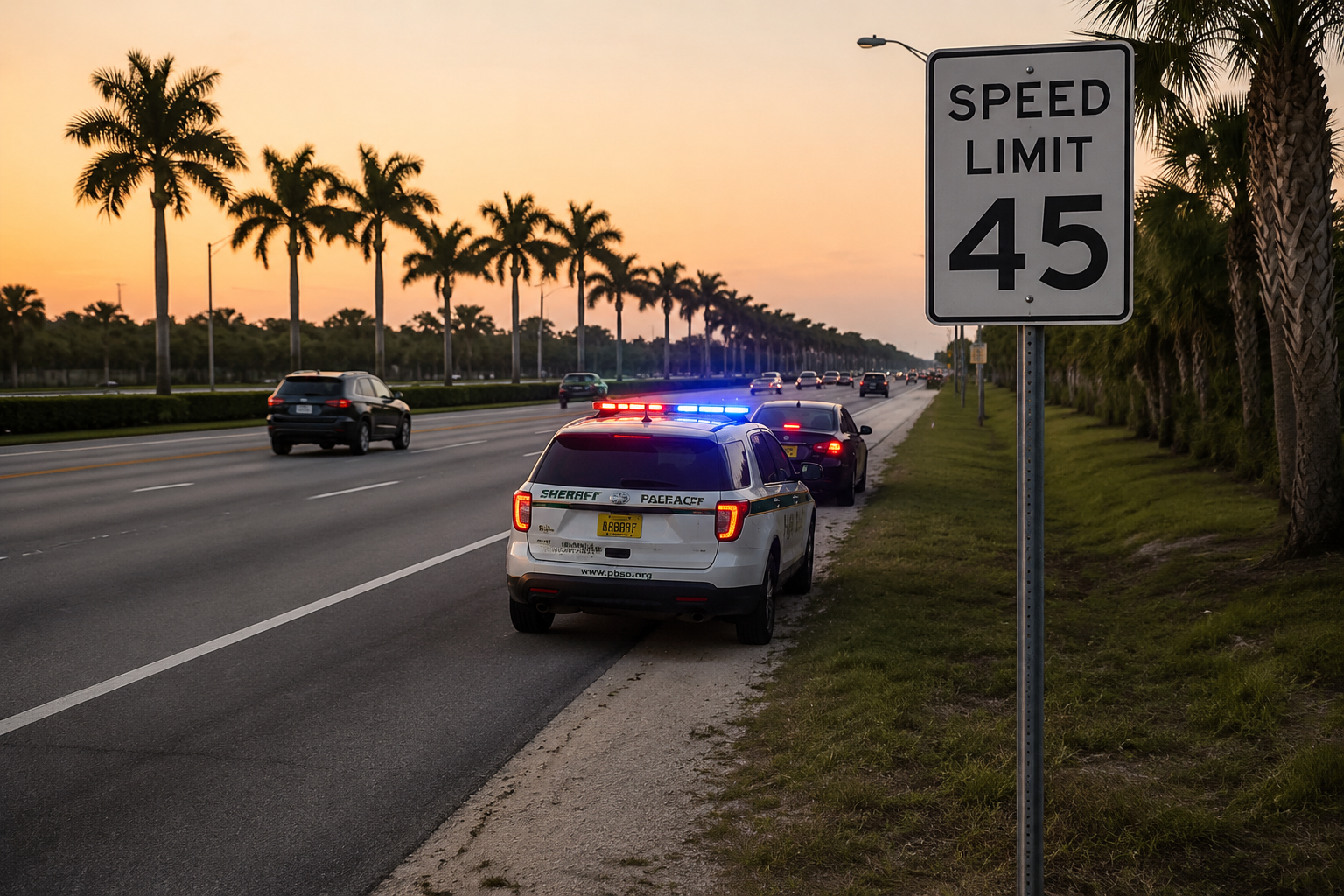
A Clay County deputy stopped a driver on July 17, 2026, clocked at 111 mph in a 45 mph zone, issued a criminal citation, and transported him to Clay County Jail. That sequence matters because it is the point where a speeding stop stops looking like a payable ticket and starts looking like a misdemeanor case with booking, court dates, and a record that does not disappear when the fine is paid. [1]
Why 111 in a 45 zone is already past the traffic-ticket line
Florida’s dangerous excessive speeding statute reaches two kinds of conduct: driving 50 mph or more over the posted limit, and driving 100 mph or more regardless of the limit. A 111 mph stop in a 45 mph zone meets both prongs on its face, so the case is not hanging on a close reading of the threshold. [2]
That is why the arrest is the useful doorway for this topic. The speed is extreme enough that the legal issue is not whether the officer was being dramatic; the issue is what the criminal process does next. The ordinary questions become intake, bond or release conditions, the citation language, the court’s handling of the first appearance, and the consequences that attach even if jail time never becomes part of the final sentence.
Florida has been treating the statute as a real criminal enforcement tool
The first year of statewide enforcement does not read like a symbolic law on the shelf. Florida Highway Patrol recorded 967 arrests from July 2025 through June 2026, with 390 under the 50-over prong and 583 under the 100-mph prong. That split is useful because it shows the law is catching both kinds of conduct the statute names, not only the most obvious highway blasts. [3]
A separate report put total arrests across all agencies at more than 4,000 during the first year, which is the key distinction for anyone trying to read the FHP number correctly: FHP is one agency inside a much broader enforcement picture. That same reporting showed Orange County Sheriff’s Office at 323 arrests, a top speed of 150 mph, and roughly one in six arrests at 120 mph or higher. [4]
Disposition data from the 18th Circuit, covering Seminole and Brevard, is especially revealing because it shows how these cases tend to move once they get to court. In a sample of 415 cases, 223 were pleaded as charged, 159 ended with adjudication withheld plus a fine and driving course, there were zero trials, and only five dismissals. That is not Clay County data, and it should not be treated as such. No Clay-specific outcome dataset surfaced in the material reviewed. But the sample does cut against the idea that these arrests are usually disappearing as ordinary traffic matters. [3]
Clay County already sits inside a busy traffic-criminal environment
Clay County context helps explain why an extreme-speeding arrest lands in a familiar enforcement setting rather than a vacuum. One county statistics page puts Clay County at more than 22,000 moving infractions a year and more than 3,600 criminal citations, with US 17, US 301, and SR 21 among the roadways it highlights most often. Those numbers are context, not proof of how § 316.1922 cases are currently disposed of, but they do show that local traffic enforcement already lives in the criminal-citation lane. [5]
The penalty stack is broader than the headline jail exposure
Available penalty summaries describe a first offense as a second-degree misdemeanor with exposure of up to 30 days in jail and a $500 fine. That sounds limited only until the rest of the case is added back in: court costs that can exceed $300, towing or bond costs where they apply, and a mandatory 12-hour Advanced Driver Improvement Course that several summaries place at roughly $250 or more. [6]
The second-offense structure is what makes the first case matter even when jail is not imposed. Within five years, the exposure rises to up to 90 days in jail, a $1,000 fine, and a mandatory license revocation period of 180 days to one year. That escalation is part of the practical risk assessment from the start, because a record built on the first arrest can become the reason the next one is treated more harshly. [6]
The misdemeanor record itself is another lasting consequence. Even when a court withholds adjudication or resolves the case without jail, the arrest does not become a harmless citation in the way many drivers expect when the lights first come on. The person still has the booking, the court case, the compulsory driving course, and the possibility that the record follows a background check long after the fine is paid.
What a Clay County speeding arrest usually means in practice
The working conclusion is narrower than the worst-case rhetoric and sharper than a traffic-ticket shrug. A first-offense Clay County super-speeder arrest is not the same thing as a felony-level crisis, but it is also not a routine citation with a payment stub attached. It is a criminal case with a real booking record, ordinary court costs, a mandatory driving-education component, and a penalty structure that gets steeper if the conduct repeats.
That is why competent legal representation is a serious consideration rather than a luxury. The issue is not only the fine printed on the statute summary; it is the combination of arrest, misdemeanor exposure, course requirements, and the way a second case can move the numbers and the licensing consequences quickly in the wrong direction. This is informational reporting, not legal advice.
References
- Clay County 'super-speeder' arrested after deputy clocks him at 111 mph in 45 mph zone: sheriff's office — News4Jax — July 20, 2026
- 2025 Florida Statutes, Chapter 316 Section 1922 — Florida Senate (link)
- Florida's 'super speeder' law turns 1: Arrests, consequences pile up in Seminole County — ClickOrlando — July 2, 2026
- A look at 'Super Speeder' law's first year in Orange County — Spectrum News 13 — July 9, 2026
- Clay County page and Florida county statistics — FightYourTicket.com
- Florida super-speeder penalty and cost summaries — Brancato Law, Musca Law, and Law Office of James P. Kelly
Comments
Join the discussion with an anonymous comment.