
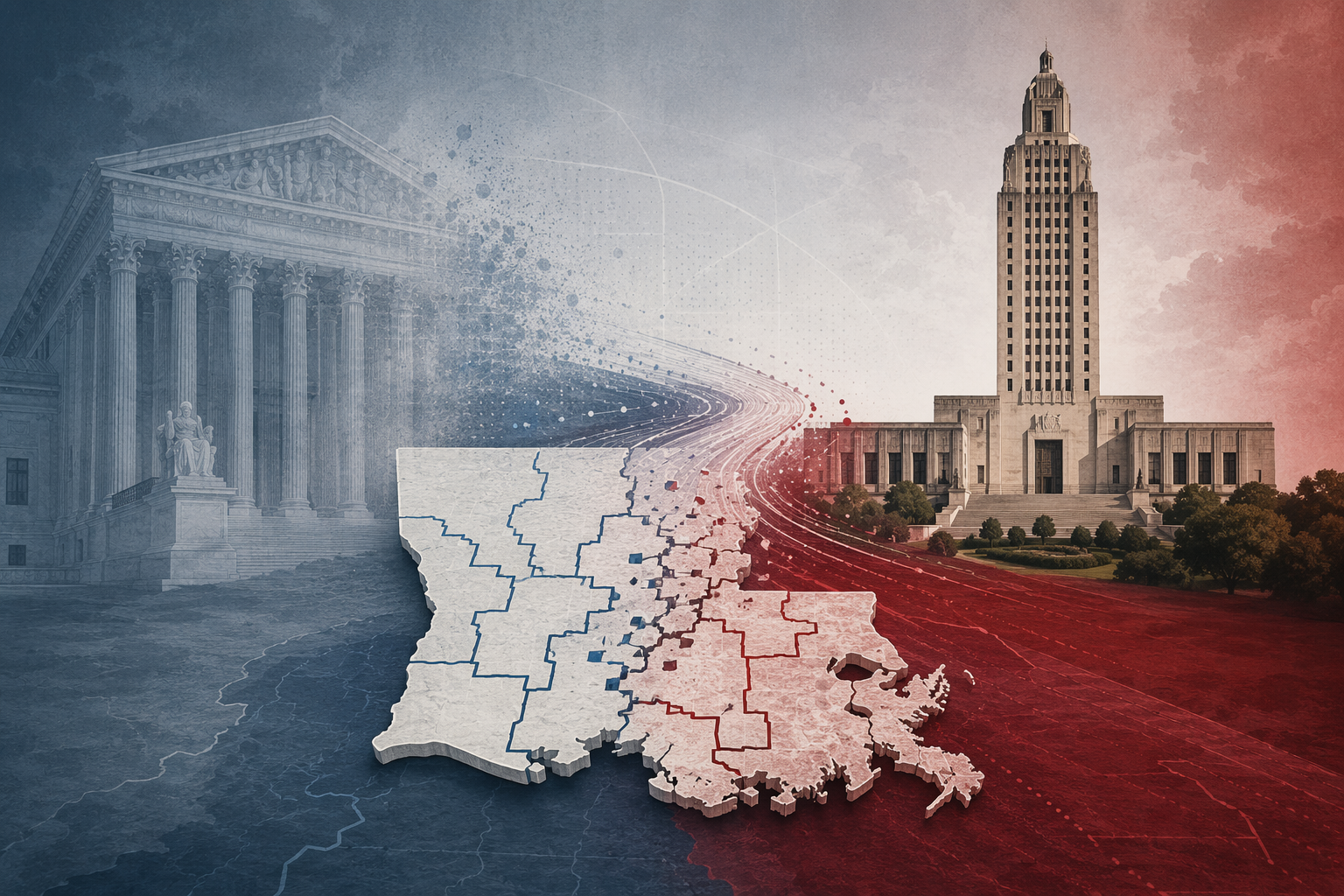
Cleo Fields’ move toward Louisiana Senate District 14 is not, strictly speaking, a state senate redistricting case. That distinction matters. The seat opened because Sen. Larry Selders died on July 7, 2026, and Fields announced on July 21 that he would not seek reelection to Congress but would instead run for the state Senate seat.[1] The redistricting event that pushed him there was congressional: after the Supreme Court’s decision in Louisiana v. Callais, Louisiana enacted SB 121, replacing a map with two majority-Black congressional districts with one that has only one, while making a 5-1 Republican delegation the likely result.[2]
That sequence is why searches connecting Cleo Fields, Louisiana state senate redistricting, and legal implications point to something larger than Fields’ next campaign. His bid is the visible political consequence of a doctrinal shift. A federal voting-rights remedy helped create a congressional seat; the Supreme Court narrowed the legal basis for that remedy; the state redrew the congressional map; and the displaced member now seeks a state legislative office. For the personal arc, see Cleo Fields’ Career Tracks the Voting Rights Act’s Dismantling. The legal question here is different: after Callais, where can redistricting claims still go?
What Callais Changed About the Federal Route
Before Callais, Section 2 of the Voting Rights Act remained the central federal tool for challenging maps that diluted minority voting strength. It was already demanding. Plaintiffs had to work through the Gingles framework, including proof that the minority group was sufficiently large and geographically compact to form a majority in a reasonably configured district, that the group was politically cohesive, and that majority voters usually voted as a bloc to defeat the minority-preferred candidate. Callais did not merely make that showing harder at the margins. It changed the constitutional risk attached to the remedy.
Justice Samuel Alito’s opinion held that compliance with Section 2 is not automatically a compelling interest that justifies race-conscious districting. A state must first show that the Voting Rights Act actually required the specific district under a narrowed version of the Gingles inquiry before it can rely on Section 2 as a defense to an equal-protection challenge.[3][4] That sequencing matters. A legislature trying to avoid vote dilution now has to anticipate that the very act of drawing a district with race in mind may become the constitutional defect unless it can prove, with sufficient specificity, that federal law required that district.
The practical compression is what made Justice Elena Kagan’s dissent so important. She warned that the decision “renders Section 2 all but a dead letter” because it moves the statute away from Congress’s 1982 results-based standard and toward something resembling proof of intentional discrimination.[5] That is not just a rhetorical disagreement about the Voting Rights Act’s purpose. It describes a litigation trap: the plaintiff needs a race-conscious remedy to cure vote dilution, while the state needs to defend that same remedy against an equal-protection rule suspicious of intentional racial line-drawing.
For a fuller doctrinal account of the holding, see What the Supreme Court Changed About Section 2 in Louisiana v. Callais. The point for the Fields-Louisiana sequence is narrower: once Section 2 compliance became harder to prove and less reliable as a constitutional defense, Louisiana no longer faced the same federal constraint that had supported a second majority-Black congressional district.
Louisiana Shows the Speed of the Remedial Reversal
The Louisiana aftermath was not abstract. Gov. Jeff Landry halted congressional primaries by executive order, called lawmakers into special session, and the legislature enacted SB 121.[2] The new map reduced the number of majority-Black congressional districts from two to one.[2] Fields, whose congressional path depended on the prior remedial map, then declined to run again for that seat and turned toward SD 14.[1]
There is a temptation to describe that as a move from congressional redistricting into state senate redistricting. The better description is that a congressional redistricting ruling changed the incentives around a state senate race. Section 2 doctrine applies beyond congressional maps, including state legislative maps, but the available materials do not show a new Callais-driven challenge to Louisiana’s Senate District 14. The vacancy, not a district-line change, created the office Fields is seeking.
Still, the political consequence is real. Redistricting experts told the Associated Press that Callais could produce “the largest drop in Black representation in Congress since Reconstruction.”[5] That warning should not be used as a substitute for legal analysis, but it explains why a single Louisiana candidacy now reads as part of a national remedial retreat.
Where the Litigation Pressure Moves Next
Callais did not end redistricting litigation. It changed the forum calculus. If federal Section 2 vote-dilution claims become nearly impossible to win or nearly impossible to translate into durable race-conscious remedies, plaintiffs and map defenders have to look harder at state law. State courts, state constitutional provisions, and state Voting Rights Acts now carry more of the load than they did before.
| Route | What remains available | Main constraint after Callais |
|---|---|---|
| Federal Section 2 | Vote-dilution claims can still be filed, but the standard is narrowed. | Race-conscious remedies require a specific showing that Section 2 actually compelled the district. |
| State constitutional claims | Challenges may rely on state equal protection, free elections, or anti-gerrymandering principles where doctrine supports them. | Southern state constitutional doctrine is thin and can shift with court composition. |
| State Voting Rights Acts | State statutes remain viable in jurisdictions that have adopted them. | Equal-protection challenges to race-conscious statutory remedies are now a foreseeable target. |
That table is deliberately uneven. These routes are not substitutes of equal strength. A federal Section 2 claim still has a familiar vocabulary, but Callais makes the remedy constitutionally precarious. A state constitutional claim may avoid some federal statutory obstacles, but only if the state court has developed doctrine that can bear the weight. A state VRA may give litigants a statutory foothold, but that foothold may itself invite the next constitutional challenge.
State Courts Matter More, But Not Everywhere in the Same Way
The strongest immediate claim about state courts is also the most modest: they are more important because federal law now does less. State Court Report’s post-Callais analysis put the point directly, observing that “any legal constraints on these attempts to draw new maps will come from state law.”[6] That does not mean every state courthouse is suddenly a hospitable venue for redistricting plaintiffs.
The southern map is especially constrained. State Court Report identified only two southern state supreme courts, Florida and Kentucky, as having recognized state constitutional limits on partisan gerrymandering.[6] North Carolina supplies the cautionary example: its state supreme court reversed course after a partisan shift on the court.[6] For lawyers thinking beyond the next complaint, that fragility matters as much as the existence of the claim.
State constitutional litigation also changes the object of the case. A Section 2 vote-dilution claim asks whether minority voters have less opportunity than others to participate in the political process and elect representatives of their choice. A state partisan-gerrymandering claim may ask whether a map entrenches one party beyond constitutional limits. Those theories can overlap in political reality, especially in racially polarized states, but they are not the same cause of action. Treating them as interchangeable invites dismissal or a remedy that does not reach the injury plaintiffs are trying to address.
State Voting Rights Acts Are Viable, Not Immune
State Voting Rights Acts are the more interesting post-Callais instrument because they look, at first glance, like the obvious answer to federal retrenchment. Ten states have adopted state-level Voting Rights Acts.[6] These statutes can create state-law claims against vote dilution or discriminatory election structures even where federal law has become less useful. They also allow litigation to proceed in a forum whose governing law is not simply the federal Section 2 standard as narrowed by Callais.
But the premise that makes state VRAs attractive also makes them vulnerable. If a state statute requires or authorizes race-conscious remedies, opponents can argue that the statute triggers the same equal-protection concern Callais applied to race-conscious districting. State Court Report notes that constitutional challenges to state VRAs have not yet succeeded, while also warning that new challenges are “nearly certain.”[6] That is the correct level of confidence: not invalidation, not immunity, but a known theory waiting for a test case.
The difference between “still viable” and “secure” is not semantic. A state VRA can support litigation today. A court has not, on the cited materials, used Callais to strike one down. Compliance officers and state legislators should not behave as though these statutes disappeared overnight. But litigators should also assume that any remedy explicitly designed around racial vote dilution will be examined through the language of suspicion that Callais sharpened.
That creates a second-order problem for states that want to preserve minority electoral opportunity. If they do nothing, they risk entrenching maps that dilute minority voting strength. If they act under a state VRA, they may be accused of intentional racial sorting. If they try to describe the remedy in purely partisan or community-of-interest terms, they may weaken the evidentiary basis for the very protection the statute was meant to provide. Callais does not supply an easy answer to that triangle; it makes the triangle harder to deny.
Why Fields Is a Marker, Not the Whole Story
Fields’ return to a state-level race gives the legal shift a human outline, but it should not be asked to prove more than it can. His decision does not show that state legislative redistricting is now the central battlefield in Louisiana. It shows that a congressional map remedied under the old Section 2 regime could be unwound quickly once the Supreme Court changed the constitutional treatment of that remedy.
The parallel to Alabama’s redistricting disputes is useful for the same reason: not because every displaced member of Congress creates a new doctrine, but because the affected careers show how fast remedial assumptions can collapse. For that neighboring case study, see Shomari Figures and Alabama’s Redistricting Reversal. The legal lesson is not that all voting-rights remedies are gone. It is that the old federal sequence—prove dilution, draw a remedial district, defend it as VRA compliance—now contains a constitutional weak point at the remedy stage.
That weak point will shape the next generation of filings. Some claims will be pleaded under state constitutions. Some will rely on state VRAs. Some will still invoke Section 2, especially where the factual record is unusually strong. But the center of gravity has moved. After Callais, redistricting litigation is less a national federal vote-dilution regime than a state-by-state contest over which courts, statutes, and constitutional theories can still sustain race-conscious remedies without becoming the next target.
References
- Louisiana Rep. Cleo Fields won’t seek reelection after Democrat’s seat was redrawn, AP via ClickOrlando, July 22, 2026.
- Cleo Fields won’t seek reelection after redistricting, The Hill.
- In major Voting Rights Act case, Supreme Court strikes down redistricting map challenged as racial, SCOTUSblog, April 2026.
- Louisiana v. Callais, slip opinion, Supreme Court of the United States.
- Supreme Court Voting Rights congressional redistricting Louisiana, AP News.
- The Aftermath of Callais, State Court Report.
Comments
Join the discussion with an anonymous comment.