
The legal problem in the Coca-Cola Fairlife cyber attack is sitting in the first few lines of Coca-Cola’s July 16 Form 8-K. The company filed under Item 1.05, the cybersecurity incident item created for material incidents, and then said it “has not yet determined whether the incident is reasonably likely to materially affect the Company.”[1] That is not a drafting footnote. It is the hinge for the securities-law analysis, the parent-company oversight question, and the consumer privacy investigation activity now forming around Fairlife.
The phrase matters because Item 1.05 is supposed to come after the materiality determination, not before it. In May 2024, Erik Gerding, then Director of the SEC Division of Corporation Finance, warned companies that Item 1.05 “is not a voluntary disclosure, and it is by definition material because it is not triggered until the company determines the materiality of an incident.” He pointed companies toward Item 8.01 when they want to disclose a cyber incident before they have decided whether it is material.[2]

That staff statement does not rewrite the rule. It is not a statute, and it is not a court holding. But it is the SEC’s own practical instruction to issuers and their disclosure counsel, and it describes exactly the awkward posture Coca-Cola adopted: telling the market quickly about a serious subsidiary ransomware incident while still reserving judgment on whether the incident is materially consequential to the parent.
What Coca-Cola disclosed before the facts settled
The operational facts available in the first reporting cycle were serious but incomplete. Reuters reported that the attack gained access to Fairlife “production-related systems,” that all Fairlife production in the United States was halted, that Canadian operations were not affected, and that Coca-Cola had not given a timeline for resuming production.[3] The Associated Press likewise reported that Fairlife had paused U.S. production after the cyberattack and that Coca-Cola was working with outside cybersecurity experts.[4]
BleepingComputer described the incident as ransomware and noted the corporate structure that makes this more than a subsidiary-only event: Coca-Cola fully acquired Fairlife in 2020.[5] That ownership fact is what keeps the analysis from being boxed inside Fairlife’s operating team. A wholly owned subsidiary’s production halt can be operationally local and legally consolidated at the same time.
The business scale is also relevant, though it should not be overstated. Newsweek reported Fairlife at $4 billion in annual retail sales in 2024, while other reporting has described the brand as above $3 billion. The difference matters less than the direction: this was not a fringe asset whose shutdown could be dismissed without analysis.[6]
Still, the missing facts are as important as the known ones. As of July 19, 2026, there is no public identification of the ransomware group, no confirmed ransom demand in the cited public record, no public confirmation that customer or employee data was exfiltrated, and no announced final materiality determination. A securities complaint, a derivative demand, or a consumer breach lawsuit would have to live with those gaps unless later facts fill them.
Why Item 1.05 is doing so much work
There are plenty of reasons a public company may want to speak fast after a subsidiary ransomware attack. Customers are waiting on product, business partners are asking whether orders will ship, employees are trying to understand system access, and reporters are already calling. The disclosure team does not get to wait for the forensic report to be final before deciding whether silence has become its own risk.
But the SEC’s cyber disclosure framework makes the label on the filing matter. Item 1.05 tells investors that the company has determined a cybersecurity incident is material. Item 8.01 tells investors something different: the company is voluntarily providing information outside the specifically triggered material cyber incident item. Gerding’s 2024 statement was aimed at that distinction, because using Item 1.05 for still-undetermined events can make the filing read more conclusive than the company’s own words allow.[2]
| Filing route | Practical signal to the market | Problem in the Fairlife posture |
|---|---|---|
| Item 1.05 | The company has determined the cybersecurity incident is material. | Coca-Cola also said it had not yet determined whether the incident was reasonably likely to materially affect the company. |
| Item 8.01 | The company is voluntarily disclosing an event before or outside a triggered materiality determination. | This is the route the SEC staff guidance recommended for incidents whose materiality has not yet been determined. |
That is the first legal exposure: not necessarily that Coca-Cola disclosed too much or too little, but that its chosen item may create ambiguity about what exactly had been decided. A plaintiff in a later securities case would likely point to the Item 1.05 label and argue that the company had already crossed the materiality threshold. The company would point to the text of the same filing and say the opposite: it disclosed promptly while expressly preserving the materiality question.
Both readings have something to work with. That is what makes the filing useful as a case study and uncomfortable as a precedent. The rule asks for a materiality judgment within the disclosure architecture. The incident-response record often develops in fragments: system access first, business interruption next, restoration timeline later, data impact later still. “Reasonably likely to materially affect” is not the same operational task as “we know enough tonight to tell the market exactly how this ends.”
For securities-law purposes, the strongest future claim would not be built on the mere fact of ransomware. It would need a misstatement or omission that mattered to investors. The potential theories are more concrete: that Item 1.05 overstated the company’s materiality determination; that the filing understated the operational impact if the U.S. production halt proved longer or broader than described; or that later disclosures contradicted the early statement about what the company knew when it filed. Those are record-dependent theories, not conclusions available three days after the attack.
The subsidiary issue does not stay inside the subsidiary
The parent-company question is not whether Coca-Cola personally ran every Fairlife system or every plant-floor recovery decision. That is too crude. The sharper question is whether the parent had reporting, escalation, and board-level visibility proportionate to a wholly owned subsidiary whose U.S. production could be halted by a cyber event.
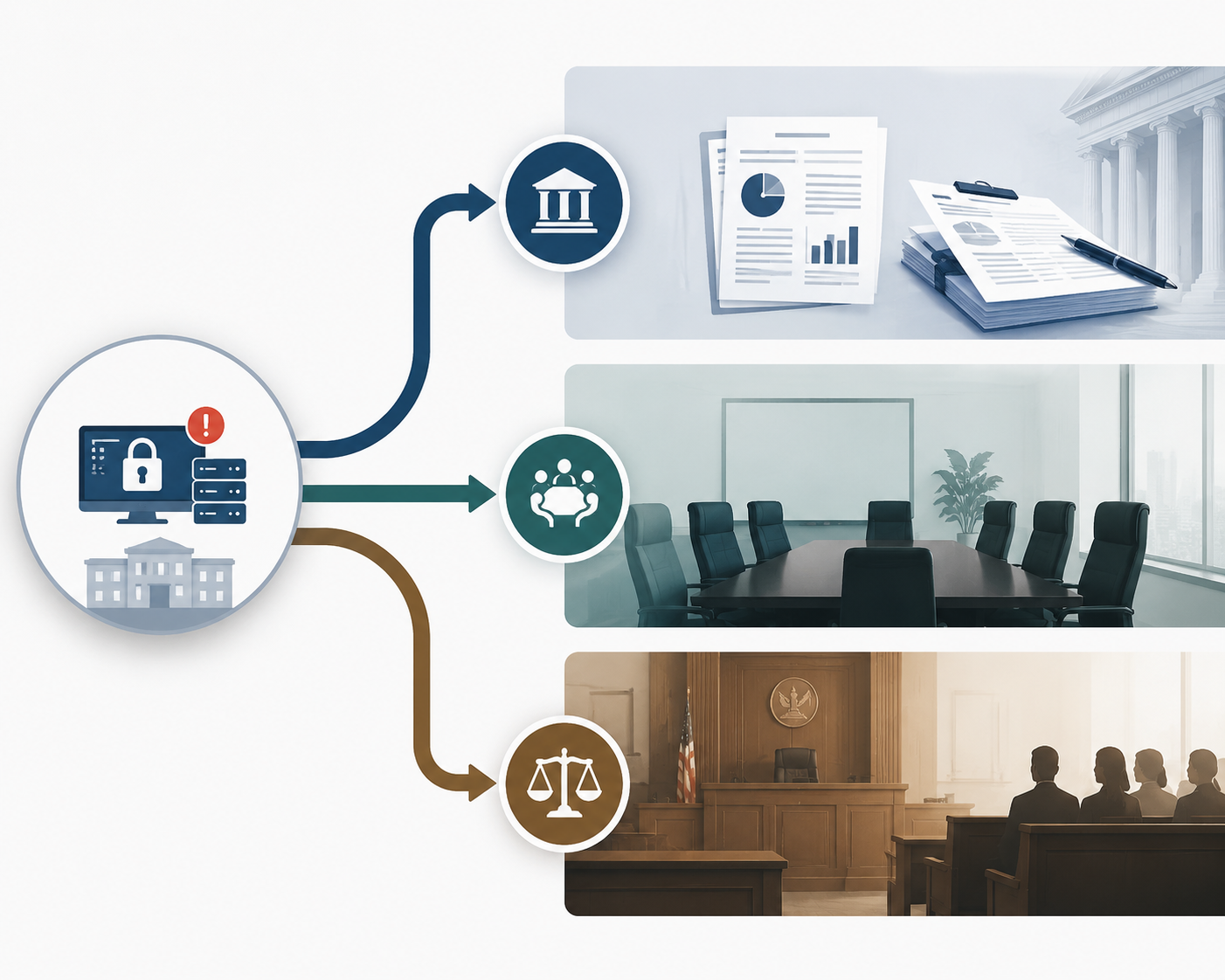
That is where Caremark-style oversight exposure enters. A derivative plaintiff would not win by saying, in effect, “a ransomware attack happened, therefore the board failed.” The harder and more legally relevant theory would be that directors or officers ignored red flags, failed to maintain a reasonable cyber reporting system for critical subsidiary operations, or allowed known control gaps to persist at a business that had become significant to the parent.
The public record available now does not establish that kind of failure. It establishes a serious disruption at a wholly owned subsidiary, a rapid parent-company filing, and unresolved facts about data, duration, and recovery. That is enough to invite questions in a books-and-records demand or demand letter. It is not, by itself, enough to prove bad-faith oversight failure.
The most plausible derivative theory would track process, not malware. Did management report cyber resilience for Fairlife’s production environment to the right parent-level committees? Did the board receive meaningful information about subsidiary cyber risk before the incident? Were production-related systems included in enterprise risk reporting, or treated as an operating-company detail until the outage reached the parent disclosure channel? Those are the questions that matter once a subsidiary event becomes a parent filing.
This is also why the filing choice feeds the fiduciary-duty analysis. If the incident was important enough to disclose under the item reserved for material cybersecurity incidents, plaintiffs will ask why the board and senior officers were not already positioned to understand the risk. If the incident was not yet known to be material, plaintiffs will ask why the parent chose the material cyber incident item anyway. The same ambiguity that complicates securities disclosure becomes useful pleading material for oversight claims.
Consumer privacy litigation is possible, not yet filed
The consumer side needs a cleaner line than the headlines may give it. ClassAction.org has opened an investigation soliciting people who believe their information may have been affected by the Fairlife incident.[7] That is not the same thing as a filed class action. It is lawyer intake activity, and it signals interest in a potential data breach case if facts support one.
A consumer privacy complaint would need facts that are not yet public. The most basic is whether personal information was accessed or exfiltrated. A ransomware attack on production-related systems can involve data theft, but it does not always do so, and the available reporting does not confirm it in this incident. Without that bridge, a consumer case has a factual problem before it reaches standing, damages, notice obligations, or state-law privacy theories.
If later notices confirm that personal information was compromised, the litigation posture changes quickly. Plaintiffs’ firms would have a public parent-company filing, a documented production halt, and a large consumer brand. They would still need to plead injury and causation, but the early disclosure record would likely become part of the narrative: what Coca-Cola knew, when it knew it, and whether the company moved quickly enough to notify affected individuals.
Sector risk explains the pressure, not the legal outcome
Food and agriculture ransomware is not background decoration here; it helps explain why a production outage at a dairy brand drew immediate legal attention. Cybersecurity Dive, citing Food and Agriculture ISAC data, reported 205 attacks on the food and agriculture sector in 2026, representing 4.9% of all attacks, and quoted ISAC Executive Director Scott Algeier on threat actors looking for pressure points where disruption can force payment.[8]
That context does not prove Coca-Cola’s incident was material, nor does it prove oversight failure. It does show why the disclosure team was unlikely to treat a halt in U.S. Fairlife production as routine. In food production, the practical harm is not limited to data confidentiality. It can include shipment delays, customer allocation, spoilage questions, plant restart sequencing, supplier coordination, and retailer communications. Those consequences are exactly the kind that rarely arrive in one clean packet before the securities filing deadline.
The near-term liability map
The immediate legal exposure is best understood as overlapping tracks rather than a single “cyber liability” bucket. The same incident record can be read differently by the SEC staff, securities plaintiffs, derivative plaintiffs, privacy plaintiffs, insurers, lenders, retailers, and the board. They are not asking the same question.
- SEC disclosure exposure: whether Item 1.05 was the right vehicle before Coca-Cola had determined materiality, and whether later facts make the initial disclosure look incomplete or misleading.
- Securities litigation exposure: whether investors can identify a false or misleading statement, materiality, scienter, loss causation, and damages tied to the filing or later corrective disclosures.
- Derivative exposure: whether directors or officers had adequate systems to monitor cyber risk at a wholly owned subsidiary whose production disruption could reach the parent-company disclosure process.
- Consumer privacy exposure: whether personal information was actually compromised and whether any notice, security, or privacy representations become actionable under state or federal theories.
- Commercial exposure: whether customer, supplier, insurer, or counterparty disputes develop from the production halt, even if no consumer data breach claim is ever filed.
The parent-subsidiary structure affects each track differently. For disclosure, Coca-Cola is the issuer and cannot outsource investor-facing obligations to Fairlife. For derivative claims, the question is whether parent-level fiduciaries had appropriate oversight of subsidiary risk. For consumer claims, the identity of the data controller, the systems involved, and the notices issued will matter more than corporate ownership as a slogan. For commercial claims, contract language and force majeure provisions may do more work than public-company cyber doctrine.
What the filing teaches before any lawsuit is filed
The Fairlife incident is legally important because Coca-Cola did not wait for perfect information. That may be defensible, and in some circumstances it may be the only responsible course. But the decision to use Item 1.05 while disclaiming a completed materiality determination exposed the unresolved seam in the SEC’s cyber disclosure regime.
The disclosure lawyer’s problem is not academic. If the company waits, it may be accused of sitting on a market-relevant operational disruption. If it files under Item 8.01, investors may still treat the incident as significant and ask why the company avoided Item 1.05. If it files under Item 1.05 too early, the SEC’s own staff guidance gives critics a ready argument that the filing label and the filing text are fighting each other.
That is the structural lesson for large enterprises with wholly owned subsidiaries. A ransomware incident does not wait for the legal categories to align. The operations team is restoring systems, the disclosure committee is drafting against uncertainty, the board is asking what it needs to know, and plaintiffs’ firms are already looking for affected individuals. Coca-Cola’s Fairlife filing shows how quickly a subsidiary production event can become a parent-company securities, fiduciary-duty, and consumer-litigation problem before the factual record has settled.
References
- Form 8-K, The Coca-Cola Company, July 16, 2026, link
- Disclosure of Cybersecurity Incidents Determined To Be Material and Other Cybersecurity Incidents, U.S. Securities and Exchange Commission, May 21, 2024, link
- Coca-Cola says Fairlife halts US production after cyber attack, Reuters, July 16, 2026, link
- Fairlife milk production halted after cyberattack, The Associated Press, July 2026, link
- Coca-Cola says Fairlife ransomware attack halts US dairy production, BleepingComputer, July 2026, link
- Hackers shut down Coca-Cola Fairlife brand in United States ransomware cyberattack, Newsweek, July 2026, link
- Fairlife Data Breach Lawsuit Investigation, ClassAction.org, July 2026, link
- Ransomware attack prompts Coca-Cola to suspend Fairlife production, Cybersecurity Dive, July 2026, link
Comments
Join the discussion with an anonymous comment.