
A Code Orange air quality alert puts many employers in an awkward compliance position. The Air Quality Index is high enough to be labeled “Unhealthy for Sensitive Groups,” but not necessarily high enough to trigger a specific workplace rule. For a manager looking at an AQI of 125 before an outdoor shift, the narrow federal answer is this: as of July 2026, there is no specific federal OSHA wildfire-smoke standard that automatically tells the business what to do during a Code Orange alert.[1][2]
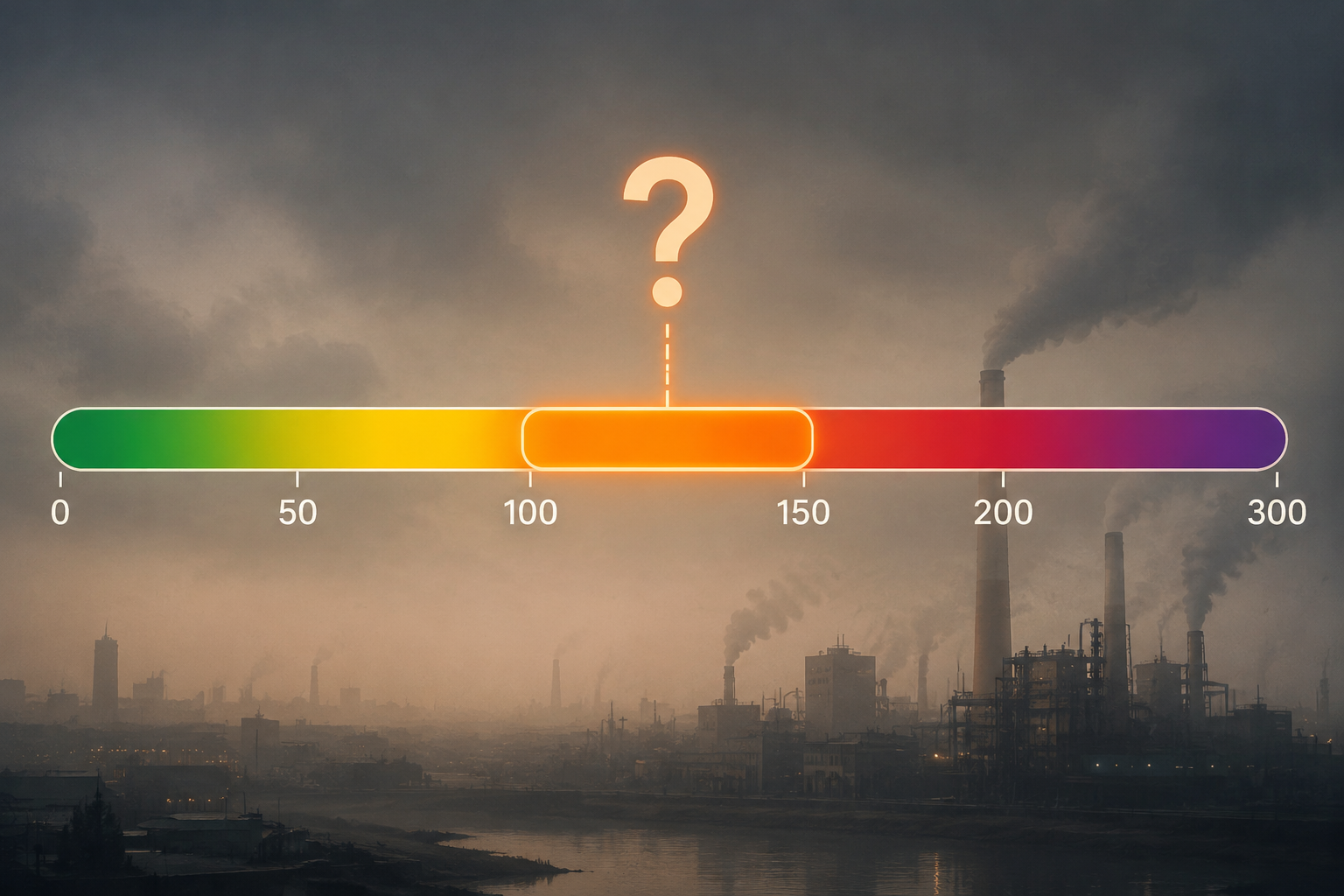
That answer is accurate, but it is too easy to misuse. Code Orange means AQI 101–150.[1] Whether that number creates a mandatory duty depends first on the pollutant and the state. The wildfire-smoke rules discussed here are aimed at PM2.5 exposure, not every ozone-based summer alert that also appears as Code Orange. A business that treats all Code Orange alerts as identical is already skipping the most important legal step.
The Same Code Orange Number Can Mean Four Different Things
The state wildfire-smoke patchwork is where the simple “no federal standard” answer starts to lose its usefulness. California, Oregon, Washington, and Nevada all use AQI or PM2.5-based triggers, but they do not draw the line in the same place. A Code Orange reading may be below the rule in one state, inside the rule in another, and already late in a third.
| State | Wildfire-smoke trigger | What Code Orange means | Important limits |
|---|---|---|---|
| California | AQI 151+ under Cal/OSHA section 5141.1 | Code Orange, AQI 101–150, is below the mandatory wildfire-smoke trigger | Rule applies to wildfire-smoke PM2.5; respirator mandates escalate at much higher levels |
| Oregon | AQI 101+ under Oregon OSHA wildfire-smoke rules | Code Orange is inside the mandatory trigger range | Employers must make N95s available and use exposure controls when the rule applies |
| Washington | AQI 72, equivalent to PM2.5 of 20.5 µg/m³, under WAC 296-820 | Code Orange is already above the initial trigger | Washington uses multiple escalating tiers |
| Nevada | AQI 150+ under SB 260, effective January 2026 | Most of Code Orange is below the threshold; AQI 150 sits at the edge | Applies to employers with 10 or more employees; implementation details may depend on final regulations |
California’s rule is often cited first because it has been in place since 2019, but its trigger is AQI 151+ for wildfire-smoke PM2.5.[3] That means a Code Orange day at AQI 130 is below California’s mandatory wildfire-smoke threshold. It may still be a day when sensitive workers struggle, but it is not the same as being inside the California rule.
Oregon is different. Its wildfire-smoke requirements have applied since 2022 and begin at AQI 101+, which puts the full Code Orange range inside the rule.[3] For an Oregon employer with covered outdoor work, Code Orange is not merely a public-health advisory. It is the beginning of a regulated condition requiring, among other things, exposure controls and N95 availability when the rule applies.
Washington moved the line lower still. Its wildfire-smoke rule begins at AQI 72, corresponding to PM2.5 of 20.5 µg/m³, and uses six escalating tiers.[3] By the time Washington reaches Code Orange, the employer is not deciding whether the rule has started. It has.
Nevada sits near the other edge. SB 260 became effective in January 2026 and uses an AQI 150+ threshold for covered employers with 10 or more employees.[3] That places most of Code Orange below the stated trigger, with the top of the range requiring careful attention. The available summaries also note that implementation details depended on regulatory development, so Nevada employers should not rely on a one-line threshold without checking current state materials.
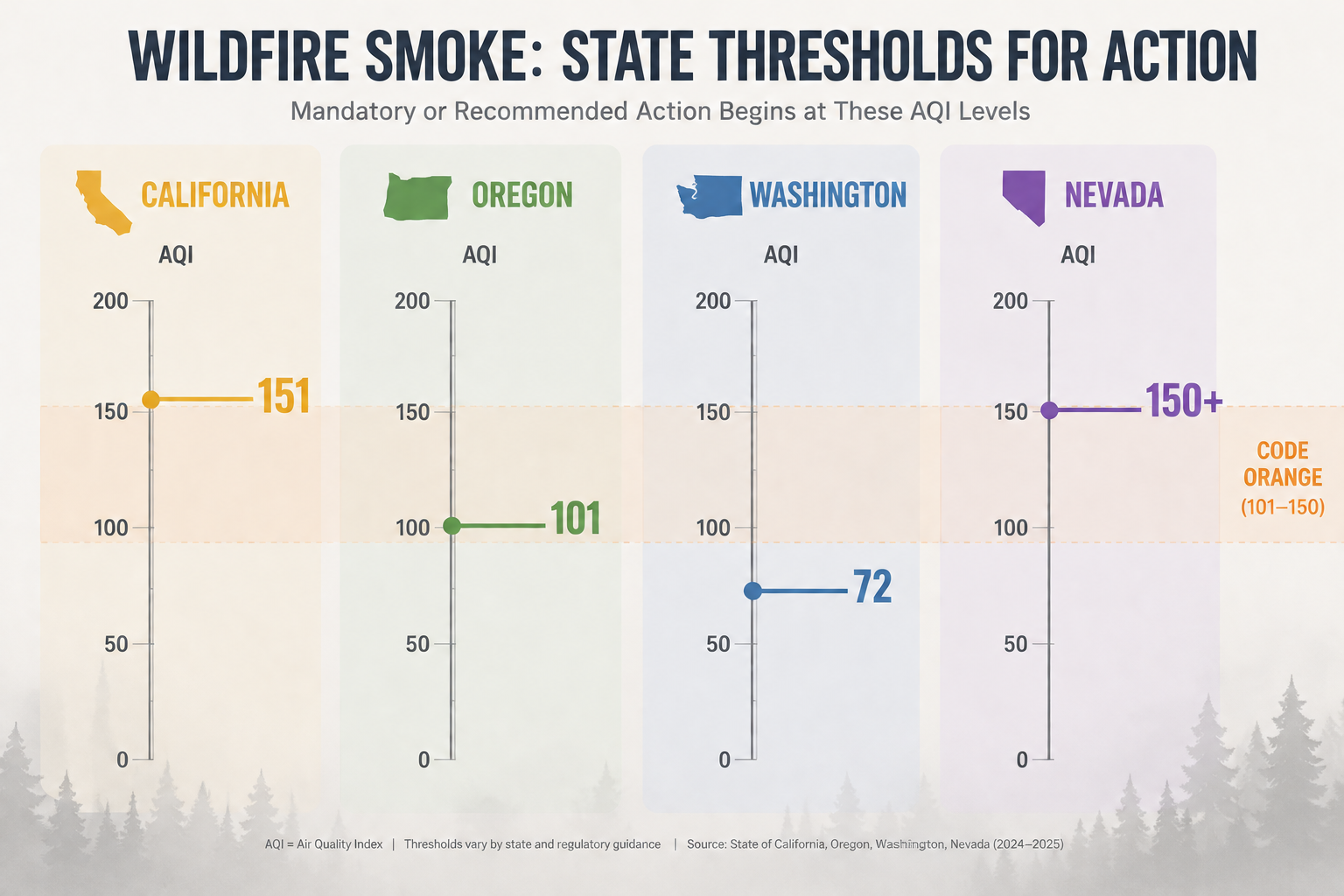
This is why the phrase “Code Orange air quality alert legal requirements for businesses” needs a jurisdictional answer. In California, Code Orange PM2.5 wildfire smoke may be below the specific wildfire-smoke rule. In Oregon, it may be squarely inside it. In Washington, the first compliance trigger has already passed. In Nevada, most of the range may be below the threshold, but AQI 150 cannot be treated casually by a covered employer.
PM2.5 Wildfire Smoke Is Not the Same Legal Question as Ozone
Code Orange is an AQI category, not a workplace standard. The AQI can reflect different pollutants, including PM2.5 from wildfire smoke and ozone.[1] The state wildfire-smoke rules above are directed at PM2.5 exposure from smoke. That distinction matters because a summer ozone alert may carry the same orange color on a public map without activating the same wildfire-smoke duties.
This does not make ozone irrelevant to employee health. It means the legal analysis should not borrow a PM2.5 wildfire-smoke regulation and apply it to a different pollutant. A defensible response starts by asking what pollutant is driving the alert, where the work is occurring, and whether workers are outdoors, in vehicles, in open-bay facilities, or in buildings with meaningful filtration.
No Specific Mandate Is Not the Same as No OSHA Exposure
At the federal level, the General Duty Clause remains the principal hook. OSH Act section 5(a)(1) requires employers to furnish employment and a place of employment free from recognized hazards that are causing or are likely to cause death or serious physical harm.[4] That is not a Code Orange rule. It is broader, less predictable, and more fact-dependent.
Wildfire-smoke PM2.5 is not an obscure hazard. The July 2026 employer analysis cited EPA, NIOSH, and CDC recognition of wildfire smoke as hazardous and noted that OSHA attention to smoke hazards has increased.[2] For General Duty Clause purposes, the more important question is not whether the AQI crossed a magic number. It is whether the employer knew or should have known about a recognized hazard, had exposed employees, had feasible ways to reduce exposure, and did nothing.
That inquiry can look very different across businesses. A sealed, filtered office with employees who can remain indoors does not present the same facts as a landscaping crew, a loading dock, a farm operation, a construction site, or a warehouse with open bay doors and poor filtration. The same AQI number can also have different implications when supervisors know that particular workers have respiratory or cardiovascular vulnerabilities.
The practical mistake is waiting for a regulator to say “stop work” before doing anything at all. Feasible abatement at Code Orange may be modest: checking the pollutant driving the alert, reviewing state thresholds, reducing strenuous outdoor tasks for sensitive workers, moving work into filtered areas where possible, rotating duties, communicating conditions, or making respirators available when appropriate. Not every Code Orange day requires the same response. But no documented decision at all is difficult to defend after an employee’s exposure becomes an incident.
Workers’ Compensation Does Not Wait for an OSHA Citation
Workers’ compensation is a separate channel. An illness tied to workplace air conditions may create compensability questions even without proof that the employer violated OSHA or acted negligently.[5] State workers’ compensation rules differ, and causation can be contested, but the risk does not disappear simply because Code Orange fell below a specific wildfire-smoke trigger.
For HR and risk teams, this matters because the first paperwork may not be a citation. It may be a report of wheezing after an outdoor shift, an urgent-care visit after smoke exposure, or a claim from an employee assigned to non-climate-controlled work during a known alert. The business may believe it had no regulatory duty to shut down. The claim may still ask whether the work environment contributed to the condition.
Accommodation Requests Are Where Code Orange Becomes Individual
The ADA issue is not that every employee who dislikes smoky air receives the schedule they prefer. The issue is that some employees with asthma, COPD, cardiovascular conditions, or similar impairments may have disabilities that require an interactive accommodation process.[6] Code Orange can be the condition that turns a general air-quality alert into a specific employee request.
Reasonable accommodations may include modified duties, remote work where the job allows it, temporary reassignment away from outdoor or high-exposure tasks, or access to filtered-air spaces.[6] Whether any one of those is required depends on the job, the employee’s limitations, the duration of the condition, and undue-hardship analysis. The legal problem is not denying every request. It is failing to recognize that the request triggers a process.
This is also where a blanket policy can fail quietly. A supervisor may tell a worker, “The AQI is only Orange, so we are operating normally.” That may be true for the site as a whole and still incomplete for an employee with a documented respiratory condition. The employer does not have to turn every alert into an emergency plan, but it should give managers enough guidance to route health-related requests before the shift is already underway.
What a Defensible Code Orange Process Looks Like
For many employers, the right Code Orange response is not a shutdown. It is a short, repeatable decision process that can be explained later. The point is to avoid treating the absence of a bright-line mandate as permission to ignore known conditions.
- Identify the pollutant: confirm whether the alert is driven by PM2.5 wildfire smoke, ozone, or another pollutant.
- Check the state rule before the shift: California, Oregon, Washington, and Nevada do not use the same trigger.
- Map the exposure: distinguish indoor filtered work, vehicle work, outdoor work, open-bay facilities, and strenuous tasks.
- Account for sensitive workers: give supervisors a way to escalate asthma, COPD, cardiovascular, or similar concerns without making medical judgments on the floor.
- Consider feasible controls: adjusted tasks, breaks in filtered spaces, reduced exertion, temporary relocation, communication, or respirator availability where appropriate.
- Document the decision: record the AQI source, pollutant, affected work areas, controls considered, and accommodation requests received.
That framework is intentionally narrower than a universal Code Orange mandate. A small employer with one outdoor task and no dedicated EHS department may not have a formal air-quality program. It can still make a defensible record: the alert was checked, the pollutant was identified, state thresholds were reviewed, vulnerable employees had a channel to raise concerns, and feasible changes were considered.
Emerging enforcement signals make that discipline more important. In July 2026, Michigan EGLE issued enforcement reminders, and employer-side analysis noted OSHA’s increasing attention to smoke hazards.[2] Those signals do not create a new national Code Orange rule. They do suggest that air-quality episodes are no longer background weather events that employers can assume will stay outside workplace-safety scrutiny.
Where Code Orange Ends and Higher-Alert Analysis Begins
Code Orange sits in a gray zone because it is high enough to matter for sensitive groups and low enough that many workplace rules do not automatically activate. That makes it different from more severe AQI conditions. Employers comparing the lower end of the AQI scale with severe-alert planning may find the companion discussion of Pennsylvania employers’ duties during Code Purple air quality alerts useful as a separate severe-condition reference.
For Code Orange, the better question is not whether every business must take the same action. Most do not. The question is whether this business, in this state, with this workforce and this pollutant, can explain why it kept operating as usual. When the work is outdoors or poorly filtered, when wildfire-smoke PM2.5 is the issue, when a state threshold has been crossed, or when a vulnerable employee asks for help, “no specific federal standard” is only the beginning of the analysis.
References
- AQI Basics, AirNow.gov.
- Where There’s Wildfire Smoke, There Are Safety and Compliance Concerns for Employers, Faegre Drinker, July 17, 2026.
- Protection from Wildfire Smoke: California, Washington and Oregon, Specto Technology.
- SEC. 5. Duties, Occupational Safety and Health Administration.
- Employer Responsibility for Air Quality, Pierce, Sloan, Kennedy & Early LLC, July 2021.
- How to Protect Your Employees from Unhealthy Air Quality, Health Action Alliance.
Comments
Join the discussion with an anonymous comment.