
A Code Orange wildfire-smoke forecast looks administratively tidy until someone has to turn it into worksite instructions. At AQI 101–150 for PM2.5, the same morning condition can mean mandatory respirator availability in one state, engineering or administrative controls in another, no wildfire-smoke-specific trigger in a third, and a federal General Duty Clause analysis somewhere else. The color band is useful public-health shorthand. It is not a national compliance trigger.
That distinction matters most for employers with outdoor work in more than one jurisdiction. A supervisor in Washington may need to act before the AQI ever reaches orange. A supervisor in Oregon may need to act at the lower edge of orange. A California or Nevada supervisor may not hit the state wildfire-smoke trigger until the condition is at or just above the top of the orange band. A federal-OSHA-state supervisor has no comparable bright line at all.
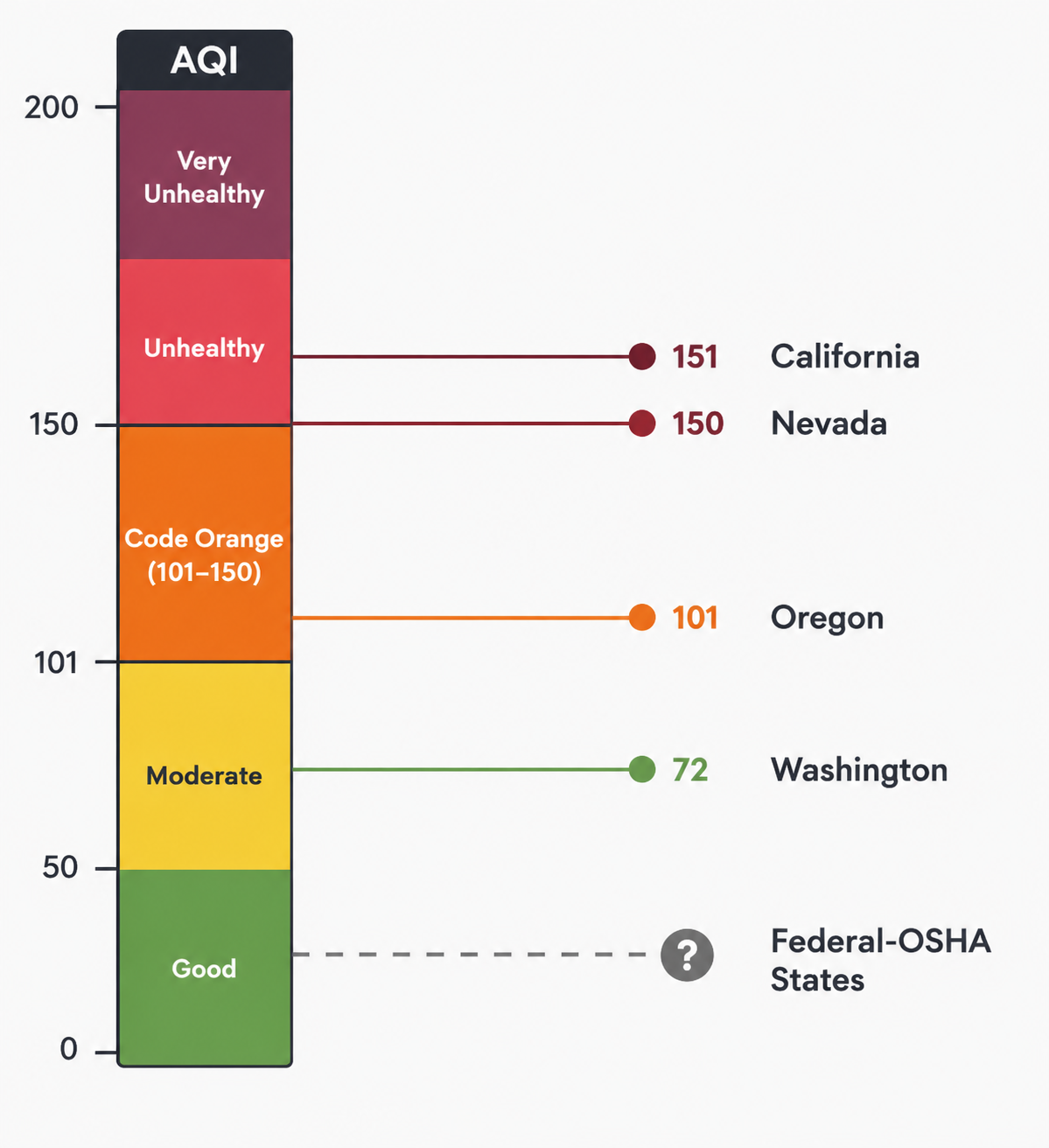
The Threshold Map Employers Actually Need
For employer compliance with Code Orange wildfire-smoke conditions, the first question is not whether the AQI color is orange. It is which state rule, if any, attaches duties to the measured PM2.5 level at the worksite.
| Jurisdiction | Relevant trigger described in current materials | What Code Orange means operationally |
|---|---|---|
| Washington | Wildfire-smoke obligations begin at PM2.5 20.5 µg/m³, approximately AQI 72, with exposure controls and mandatory N95 availability; the rule has been effective since January 2024 and updated in May 2025 to align AQI values with the current EPA framework.[1] | Code Orange is already above the state trigger. Waiting until AQI 101 would be late. |
| Oregon | Oregon’s wildfire-smoke requirements begin at PM2.5 35.5 µg/m³, approximately AQI 101, including engineering or administrative controls and voluntary respirators.[2] | The lower edge of Code Orange is the compliance trigger. |
| California | Cal/OSHA Title 8 §5141.1 applies at AQI 151 for PM2.5, with the current trigger at the Code Red boundary rather than inside Code Orange.[3] | Code Orange alone does not trigger the current wildfire-smoke standard, though other safety duties may still matter. |
| Nevada | Nevada SB 260, effective January 1, 2026, creates wildfire-smoke obligations at AQI 150, making the state’s trigger date-sensitive and close to the upper end of Code Orange.[4] | Most of the Code Orange band sits below the new statutory trigger. |
| Federal-OSHA states | The 26 federal-OSHA states have no wildfire-smoke-specific bright-line trigger in the current materials; employers instead face fact-specific General Duty Clause analysis, with OSHA penalties listed at $16,550 per violation as of January 2026.[5] | Code Orange may be evidence of a hazard, but it is not a self-executing federal wildfire-smoke standard. |
The table is deliberately uneven because the law is uneven. The operational mistake is to treat “western states” as a single category or to write one Code Orange playbook that assumes AQI 101 means the same thing everywhere. It does not.
Washington: Code Orange Is Too Late as a Starting Point
Washington is the clearest warning against color-band compliance. Its wildfire-smoke obligations begin at PM2.5 20.5 µg/m³, which current materials place at approximately AQI 72, below Code Orange.[1] By the time a forecast or monitor reads AQI 101, the employer is not approaching the first legal checkpoint; it has passed it.
That earlier trigger changes the morning decision tree. The person assigning crews does not simply wait for orange on a map. The worksite needs monitoring tied to the applicable PM2.5 level, a way to decide when exposure controls are required, and a process for making N95 respirators available when the rule requires them. If those steps depend on a public-facing color label alone, the system is built to miss Washington’s lower threshold.
Washington also illustrates why source freshness matters. The state’s wildfire-smoke rule has been effective since January 2024, and current materials note a May 2025 update realigning AQI values with the EPA’s current framework.[1] Older summaries can look authoritative while carrying outdated AQI conversions. For a compliance program, that is not a citation problem; it is an instruction problem.
Oregon: The Lower Edge of Orange Matters
Oregon sits closer to the intuitive Code Orange question. Its wildfire-smoke page identifies PM2.5 35.5 µg/m³, approximately AQI 101, as the point at which engineering or administrative controls and voluntary respirators come into play.[2] That makes the start of the orange band legally meaningful in a way it is not in every state.
For an Oregon worksite, the first orange reading is not merely a cautionary color. It is the point at which the employer should be able to show who checked the measurement, which work areas were affected, what controls were considered or implemented, and how respirators were made available on a voluntary basis. The practical burden is not solved by recognizing the AQI category; it is solved by assigning responsibility before the air-quality number arrives.
Oregon and Washington are often grouped together because both impose wildfire-smoke-specific duties at or below Code Orange. Even there, the triggers are not identical. A multi-state employer that uses Oregon’s AQI 101 threshold as a Pacific Northwest default may under-respond in Washington.
California and Nevada: Similar Contrast, Different Legal Posture
California’s current wildfire-smoke standard, Cal/OSHA Title 8 §5141.1, uses AQI 151 for PM2.5 as the operative trigger.[3] In AQI terms, that places the rule at the Code Red boundary, not inside the Code Orange band. The contrast with Oregon is sharp: AQI 101 can matter immediately in Oregon, while the current California wildfire-smoke standard does not attach at that same point.
That does not make Code Orange irrelevant in California. It means the specific wildfire-smoke regulation is not triggered merely because the AQI is 101–150. Employers still have to evaluate actual workplace conditions, other safety obligations, and any internal standards they have adopted. But as a matter of the cited wildfire-smoke standard, the bright-line number is higher.
California is also not static. Current legal syntheses note that Cal/OSHA has announced discussion drafts for a revised wildfire-smoke standard.[5] That is a live uncertainty boundary, not a current rule change. Employers should not treat a possible revision as controlling law, but they also should not build long-lived policies on the assumption that the California gap will necessarily remain unchanged.
Nevada now belongs in the same conversation for a different reason: timing. SB 260 is new, effective January 1, 2026, and current analysis describes a wildfire-smoke trigger at AQI 150.[4] That places Nevada near California’s threshold for practical purposes, but the compliance task is not identical because the Nevada obligation comes from a new state enactment with its own implementation details.
Federal-OSHA States: No Bright Line Does Not Mean No Exposure
The most tempting shortcut in federal-OSHA states is to say that because there is no wildfire-smoke-specific AQI trigger, there is no wildfire-smoke compliance issue. That overstates what the absence of a standard means. Current materials identify 26 federal-OSHA states without a bright-line wildfire-smoke trigger, but those employers remain subject to the General Duty Clause and its fact-specific analysis of recognized hazards.[5]
The General Duty Clause is less mechanical than Washington’s or Oregon’s rule. The inquiry does not begin and end with whether AQI is 101, 150, or 151. It turns on facts such as the nature of the work, the exposure conditions, hazard recognition, feasible means of abatement, and the evidence OSHA would rely on in a particular enforcement setting. Code Orange may be part of that record, but it is not a federal wildfire-smoke switch.
The penalty context is not academic. Current materials list OSHA penalties at $16,550 per violation as of January 2026.[5] That number does not convert Code Orange into a per se violation. It does explain why counsel and EHS teams should document the analysis rather than assume that the lack of a state-style threshold ends the inquiry.
There is also a pending interpretive boundary. A July 1, 2025 OSHA proposed rule concerning General Duty Clause interpretation has been flagged in current multi-state wildfire-smoke analysis, and its final status could affect enforcement framing in federal-OSHA states.[5] Until that issue is settled, employers should be careful about advice that treats federal OSHA wildfire-smoke exposure as either fully unregulated or already governed by a fixed AQI number.
Why Older AQI Summaries Need a Second Look
AQI references are not immune from revision. Current reporting notes that states have been updating wildfire-smoke rules to match the EPA’s 2024 AQI framework changes.[6] Washington’s May 2025 AQI realignment is the practical example: a memo written before that update may describe a threshold in terms that no longer match the state’s current presentation.
For a multi-state employer, that means wildfire-smoke procedures need source controls as much as operational controls. A useful protocol identifies the legal source for each state, records the last review date, distinguishes PM2.5 concentration from AQI color, and flags whether the rule creates a mandatory action point or merely informs a broader hazard assessment.
- Use state-specific triggers rather than a single Code Orange instruction.
- Track PM2.5 concentration and AQI, because some rules are expressed or updated through both concepts.
- Separate mandatory respirator availability from voluntary-use programs and from general hazard analysis.
- Review Washington, Oregon, California, Nevada, and federal-OSHA guidance on different update calendars.
- Treat legal syntheses as maps, not substitutes for the underlying rule text.
A Workable Multi-State Decision Rule
A national employer can still write a common wildfire-smoke procedure, but the common part should be the process, not the threshold. The policy can require each worksite to monitor PM2.5 conditions, identify the controlling jurisdiction, apply that jurisdiction’s trigger, document controls, and escalate when conditions approach a state-specific action point.
The state addendum is where the legal work belongs. Washington should not inherit California’s AQI 151 trigger. Oregon should not be treated as if orange is merely advisory. Nevada should not be left out because its rule is recent. Federal-OSHA states should not be assigned a fake bright line just because the spreadsheet needs one.
Code Orange is therefore a useful signal, not the answer. As of Q3 2026, the controlling compliance question is where the worksite is, which wildfire-smoke rule or federal framework applies there, and whether the employer is operating under a bright-line state standard or a fact-specific federal-OSHA analysis.
References
- Wildfire smoke rules, Washington State Department of Labor & Industries, lni.wa.gov
- Wildfires, Oregon OSHA, osha.oregon.gov
- California Code of Regulations, Title 8, Section 5141.1, Protection from Wildfire Smoke, Cal/OSHA, dir.ca.gov
- Nevada Enacts Workplace Heat Illness and Wildfire Smoke Safety Law, Ogletree Deakins, February 11, 2026, Ogletree Deakins
- Wildfire Smoke Legal Update, Faegre Drinker, July 17, 2026, Faegre Drinker
- States Updating Wildfire Smoke Rules to Match EPA AQI Framework Changes, Vigilant, September 2024, Vigilant
Comments
Join the discussion with an anonymous comment.