
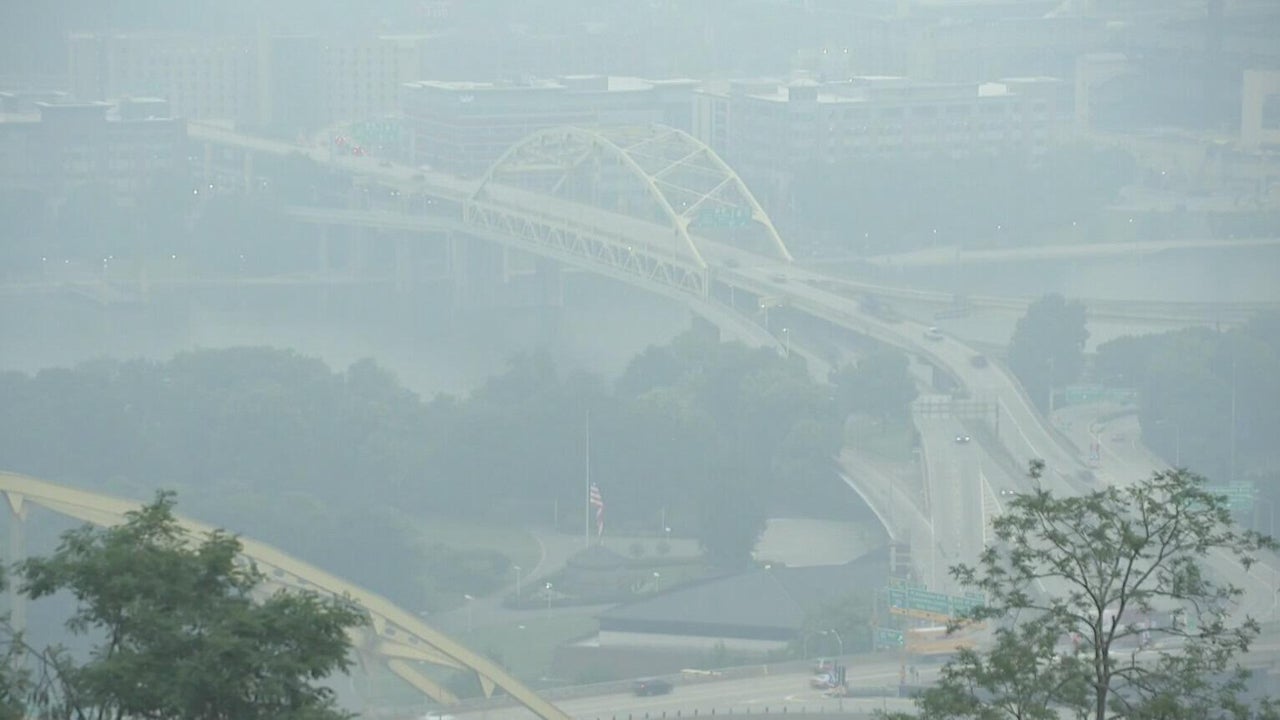
A Code Purple air quality alert is useful to employers because it tells people to stop treating smoke as background weather. It is much less useful as a legal answer. In July 2026, wildfire smoke from Canada pushed multiple U.S. cities into Code Purple or Code Maroon conditions, Pennsylvania issued a statewide Code Purple alert, and Philadelphia activated its local alert system. For employers, the immediate question was not whether the map looked severe. It was whether crews could stay outside, who had authority to change a shift, and which rule actually supplied the threshold.
The answer depends heavily on location. Code Purple generally refers to an Air Quality Index of 201 to 300, labeled “Very Unhealthy.” But employer wildfire-smoke duties in several states begin well before AQI reaches that band, while federal OSHA still has no wildfire-smoke-specific standard with a bright-line Code Purple trigger.[1]
Code Purple Is a Warning Signal, Not a Uniform Legal Switch
A company with outdoor crews in Sacramento, Spokane, Portland, Reno, and Philadelphia cannot use one national Code Purple rule and expect it to hold. California, Washington, and Oregon have operational wildfire-smoke rules. Nevada’s newer statutory framework is operative, but the final regulatory details remain unsettled. In states without a wildfire-smoke standard, federal OSHA analysis is more fact-specific and less convenient.
That mismatch matters before the AQI reaches 201. If a compliance team waits for Code Purple before monitoring exposure or communicating controls, it may already be late in California, Washington, or Oregon. The practical work starts with the applicable jurisdiction, not the color on the public alert.
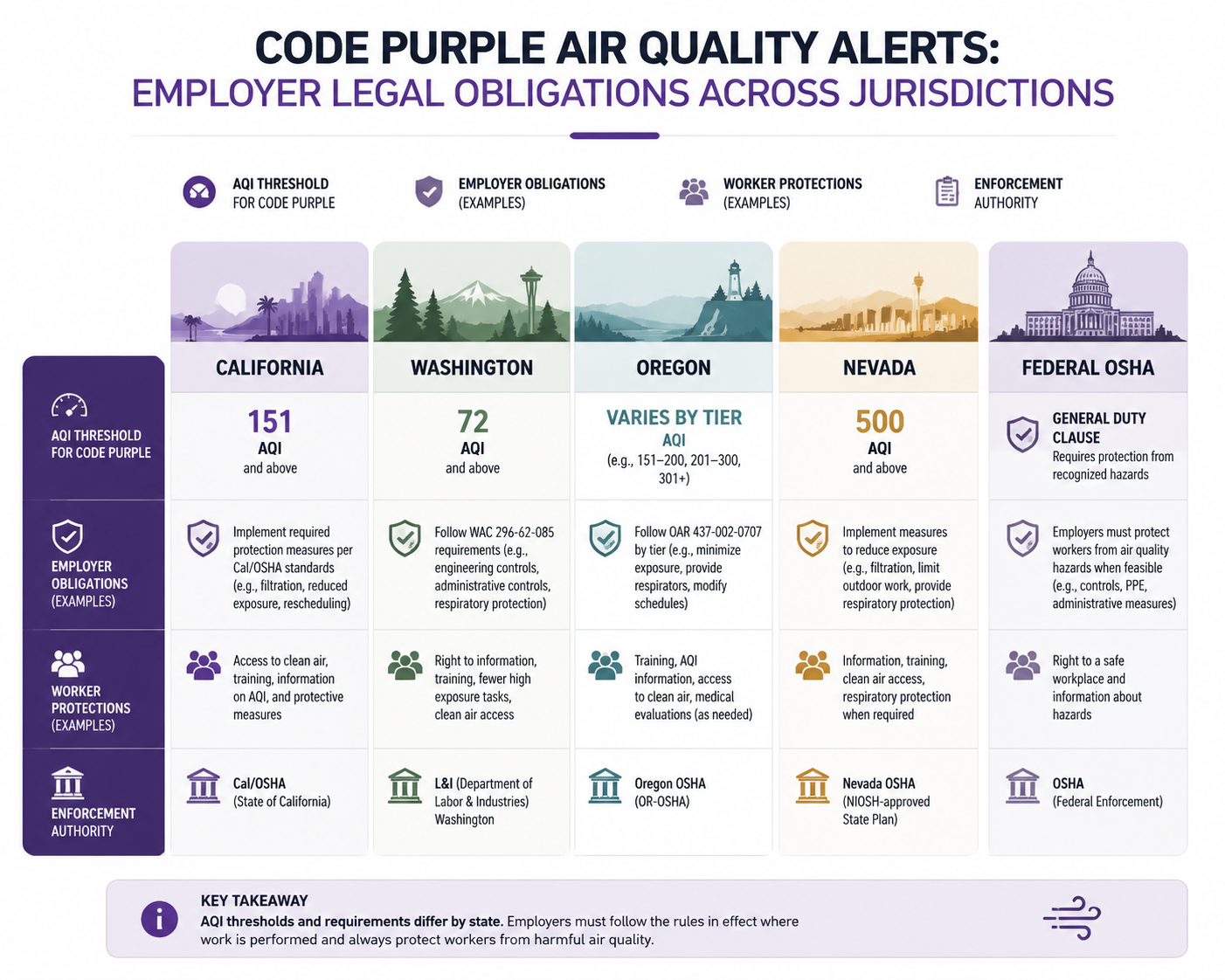
| Jurisdiction | When Duties Begin | What Code Purple Usually Means for Employers |
|---|---|---|
| California | AQI 151 or higher for PM2.5 under Cal/OSHA section 5141.1 | Code Purple is already above the rule’s trigger; employers should be operating under monitoring, communication, training, and control duties. |
| Washington | AQI 72 or higher under WAC 296-820 | Code Purple falls inside a tiered system that has already required earlier action and may require escalated protections. |
| Oregon | Permanent wildfire-smoke rules effective July 2022 | Code Purple sits within a state-specific tiered wildfire-smoke compliance framework. |
| Nevada | SB 260 operative January 2026 | Employers have a new wildfire-smoke framework, but some AQI-specific regulatory details remain in draft form. |
| Federal OSHA | No wildfire-smoke-specific standard | There is no Code Purple-specific federal trigger; analysis generally runs through the General Duty Clause. |
California: The Trigger Arrives Before Code Purple
California is the wrong place to ask whether Code Purple begins the employer’s legal obligation. Cal/OSHA’s wildfire-smoke regulation applies when the current AQI for PM2.5 is 151 or greater and an employee may be exposed to wildfire smoke.[2] That is Code Red territory, below Code Purple.
Once the California rule applies, the employer is not merely watching the forecast. The regulation requires employers to determine employee exposure, communicate wildfire-smoke hazards, provide training and instruction, and implement controls where required.[2] Cal/OSHA’s July 2026 reminder to employers emphasized that smoke hazards can affect workers outdoors and in indoor workplaces where the air is not adequately filtered.[3]
The rule is also tiered. At AQI 500 or greater for PM2.5, respirator use becomes mandatory for covered employees under California’s wildfire-smoke regulation.[2] That matters during Code Maroon conditions, but it should not distract from the earlier point: at Code Purple, California employers are already inside the compliance structure.
- Confirm whether employees may be exposed to wildfire smoke at the worksite.
- Use a current AQI for PM2.5 rather than a general regional impression.
- Document communications to affected employees and supervisors.
- Match respirator decisions to the applicable AQI tier, not to informal discomfort alone.
Washington: Duties Start at AQI 72
Washington’s wildfire-smoke rule is even more aggressive at the front end. WAC 296-820 establishes a six-tier structure, with employer obligations beginning at AQI 72 for PM2.5.[4] By the time conditions reach Code Purple, the employer should not be holding its first internal conversation about smoke.
The Washington framework escalates through exposure monitoring, information and training, communication, medical response planning, voluntary respirator availability, and mandatory respirator use at specified thresholds.[4] It is designed to force decisions before the air becomes visibly dramatic. For employers with field operations, that means someone must know who is checking AQI, how employees are being notified, and when the next tier of protection begins.
The operational friction is easy to underestimate. A public alert may be issued for a region, while employees are moving between job sites, vehicles, yards, and partially enclosed locations. Washington’s structure does not remove judgment, but it gives compliance teams a staged map for that judgment. Code Purple is one point inside the system, not the system itself.
Oregon: Permanent Rules, Not Seasonal Guidance
Oregon OSHA’s wildfire-smoke rules are permanent rules, effective July 2022.[5] That status matters. Employers should not treat wildfire smoke as an exceptional event handled only by temporary advisories or ad hoc emails when the state has already embedded the issue in occupational safety requirements.
Oregon’s framework requires employers to address wildfire-smoke exposure through a tiered compliance approach, including monitoring, communication, training, exposure controls, and respiratory protection obligations tied to AQI conditions.[5] The exact task list depends on the level of exposure and the rule’s conditions, but the compliance posture is clear enough: Code Purple is not the beginning of awareness. It is a high-severity condition inside an existing regulatory program.
For multi-state employers, Oregon often creates a documentation problem as much as a safety problem. A company may have one corporate wildfire-smoke playbook, but Oregon supervisors need instructions that reflect Oregon’s rule rather than a blended West Coast average. Blended policies are comforting until someone asks which threshold authorized the shift change.
Nevada: New Duties, With Regulatory Details Still Developing
Nevada belongs in the comparison, but with a tighter claim. SB 260 became operative in January 2026 and created a new wildfire-smoke safety law for employers.[6] Draft regulations reportedly proposed an AQI 500 stop-work threshold, with a January 2026 draft and a March 2026 workshop process, but those final details should be treated as developing rather than settled.[6]
That uncertainty does not mean Nevada employers can wait for perfect final text before building a response. It means legal and safety teams should separate what is operative from what is proposed. If a Nevada policy cites a stop-work number, it should say whether that number comes from final law, draft regulation, or a conservative internal standard.
Federal OSHA: No Wildfire-Smoke-Specific Code Purple Rule
Federal OSHA is the baseline, not the center of the story. As of July 2026, OSHA has no wildfire-smoke-specific standard that tells employers what to do at Code Purple.[1] In states without a specific wildfire-smoke rule, enforcement analysis generally depends on the General Duty Clause, which requires employers to provide a workplace free from recognized hazards that are causing or likely to cause death or serious physical harm.[1]
That is a very different compliance tool from a state AQI table. It asks fact-specific questions: Was the hazard recognized? Were employees exposed? Was serious harm likely? Were feasible means of abatement available? A Code Purple alert may help answer those questions, but it does not function as a federal wildfire-smoke switch by itself.
This is where some employers become too comfortable. The absence of a federal wildfire-smoke standard is not the same as the absence of federal risk. It simply means the federal path is less administrable than the state regimes that have already written AQI thresholds into their rules.
The Accommodation Track Runs Beside the Safety Track
The most common mistake is to stop once the wildfire-smoke checklist is complete. A safety team may confirm AQI monitoring, distribute N95 respirators, move a task indoors, and believe the issue is closed. For some employees, it may not be closed at all.
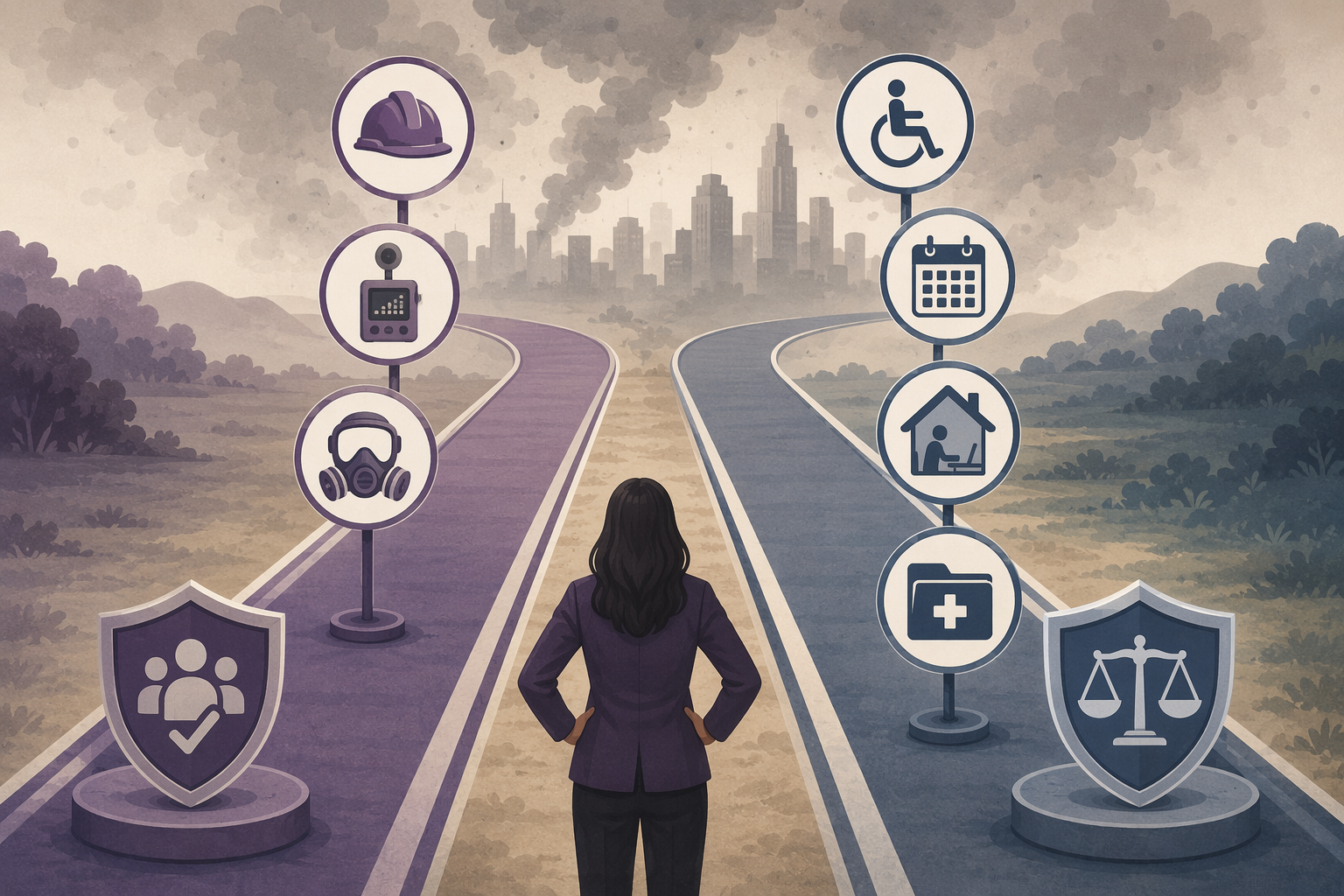
Employees with asthma, COPD, cardiovascular conditions, pregnancy complications, or episodic conditions may have separate rights under the ADA or FMLA. Legal analyses of wildfire-smoke compliance have specifically warned that employers should consider reasonable accommodations such as remote work, indoor reassignment, modified schedules, N95 respirators, and HEPA-filtered spaces for vulnerable workers, even where the employer has complied with workplace safety standards.[1][7]
The ADA point is especially easy to miss because wildfire smoke can make an episodic condition newly limiting. An employee whose asthma is usually controlled may still need an accommodation during a smoke event. A worker with a cardiovascular condition may not be adequately protected by the same measure used for the general outdoor crew. The legal question shifts from “Did we meet the state smoke rule?” to “Did we engage with this employee’s limitation and evaluate a reasonable accommodation?”
That does not mean every requested change must be granted, or that every smoke complaint becomes protected leave. It means the employer should avoid treating a public AQI threshold as the only relevant threshold. The individual medical limitation may require a separate review, and the person handling that review may not be the person who bought the respirators.
| Issue | Safety Rule Question | Accommodation Question |
|---|---|---|
| Outdoor assignment | Does the state wildfire-smoke rule require controls at the current AQI? | Can this employee perform the role with indoor reassignment, schedule changes, or temporary remote work? |
| Respirator use | Is respirator use voluntary or mandatory at this AQI tier? | Does this employee need a different or additional measure because of a medical condition? |
| Indoor work area | Is smoke entering the workplace or vehicle? | Would a HEPA-filtered space or alternate location address an individual limitation? |
| Absence or reduced schedule | Has the employer addressed general exposure risk? | Does the condition potentially implicate protected leave or intermittent leave analysis? |
What a Defensible Q3 2026 Response Looks Like
A defensible response starts with jurisdiction. If employees are in California, Washington, or Oregon, the relevant question is not whether Code Purple has arrived but which AQI tier applies under the state rule. If employees are in Nevada, the employer should identify which SB 260 obligations are operative and avoid overstating draft regulatory thresholds as final. If employees are in a federal OSHA state without a wildfire-smoke standard, the analysis should be documented under recognized-hazard and feasible-abatement principles rather than a nonexistent federal Code Purple rule.
- Identify every jurisdiction where exposed employees are working that day.
- Use the AQI measure required by the applicable rule, especially PM2.5 where specified.
- Assign responsibility for monitoring, employee communications, work modification, and respirator decisions.
- Record why a shift continued, changed location, moved indoors, or stopped.
- Route medical-condition and leave issues through the ADA and FMLA process instead of leaving them inside the safety checklist.
There are boundaries to what can responsibly be said. The available materials do not provide reliable workers’ compensation claim frequency, approval-rate, or settlement data for wildfire-smoke exposure, and law-firm marketing pages are not a substitute for statistical reporting. New York’s Department of Labor wildfire-smoke guidance exists, but the PDF content was not available for full review, so it is not treated as a load-bearing source for employer obligations.
This is a regulatory reference, not legal advice. For employers making same-day decisions during a Code Purple event, the practical legal position is narrower and more demanding than the public alert language suggests: identify the jurisdiction, apply the state AQI-triggered duties where they exist, preserve uncertainty where rules are still developing, and separately evaluate accommodations for workers whose medical conditions make wildfire smoke more than a general workplace hazard.
References
- Where There’s Wildfire Smoke, There Are Safety and Compliance Concerns for Employers, Faegre Drinker, July 17, 2026
- Protection from Wildfire Smoke, California Department of Industrial Relations
- Cal/OSHA reminds employers to protect workers from wildfire smoke, California Department of Industrial Relations, July 2026
- Chapter 296-820 WAC Wildfire Smoke, Washington State Legislature
- Wildfires, Oregon OSHA
- Nevada Wildfire Smoke Safety Law for Employers in 2026, Vensure
- Wildfire Smoke and Workplace Safety: What Employers Need to Know, Ogletree Deakins
Comments
Join the discussion with an anonymous comment.