
The legal controversy over homeschooling regulation begins with a distinction that is easy to lose in advocacy briefs: the Constitution protects parental authority over a child’s education, but the Supreme Court has not recognized a freestanding fundamental right to homeschool without state oversight. That distinction does most of the work. Parents have constitutional room to direct education. States also retain constitutional room to require notice, keep records, and impose reasonable conditions tied to compulsory education.
The strongest current answer is therefore narrower than either side often wants. A state that asks homeschooling parents to register or notify an education agency is on comparatively firm constitutional ground. A state that turns homeschooling into a licensing system, demands prior official approval, prescribes curriculum in detail, or requires teacher certification enters a more uncertain field. The difference is not simply political moderation. It is doctrinal fit: some rules preserve the state’s ability to administer compulsory education; others interfere more directly with the parental choice the Supreme Court has treated as constitutionally protected.
What Meyer and Pierce Actually Protect
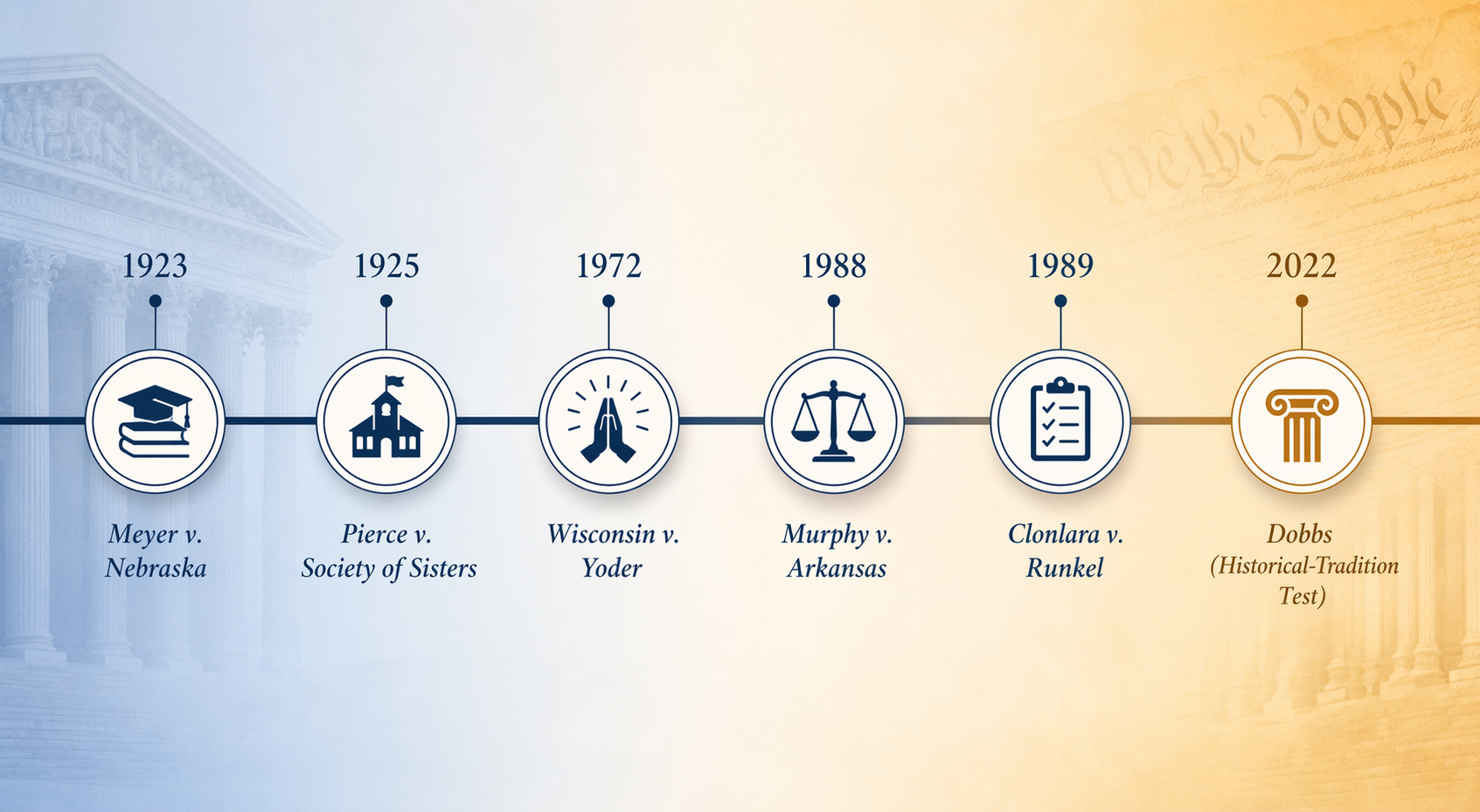
The parental-rights foundation usually starts with Meyer v. Nebraska and Pierce v. Society of Sisters. Meyer, decided in 1923, invalidated a Nebraska law restricting foreign-language instruction and recognized the liberty of parents to control the education of their children. Pierce, decided in 1925, struck down Oregon’s requirement that children attend public schools, making clear that the state could not “standardize its children” by forcing all instruction into the public system.[1][2]
Those cases matter. They prevent the state from treating parental educational choice as a mere permission slip revocable at will. They also explain why a compulsory-public-school law would face serious constitutional trouble. But neither case decided that parents may educate a child at home free from reasonable state regulation. Pierce is especially important because it contains the limiting language that homeschooling arguments often glide past: the Court preserved the state’s power to “reasonably regulate” schools, teachers, and pupils while rejecting the particular public-school mandate before it.[2]
That reservation is not decorative. It is the bridge between parental liberty and the state’s compulsory-education authority. A state may not erase private educational choice, but it may still ask whether a child is receiving education at all, whether the child falls within compulsory-attendance coverage, and whether the family has complied with basic administrative requirements. The hard cases arise when the state’s chosen tool does more than create a record and begins to control the substance or personnel of the home instruction.
Yoder Is a Religious-Exemption Case, Not a Homeschooling Charter
Wisconsin v. Yoder is the next case usually invoked, and it is both important and easy to overread. In 1972, the Supreme Court held that Wisconsin could not apply its compulsory-school-attendance law through age 16 to Amish parents whose religious community objected to formal high-school attendance.[3]
Yoder does not announce a general constitutional right to homeschool. It rests on the particular interaction between compulsory schooling and the Free Exercise Clause, in a record involving a long-established religious community and a specific objection to additional formal schooling. Its force is real where religious-objector claims are properly presented. Its usefulness is limited when a plaintiff argues that all homeschooling regulation, religious or secular, is presumptively unconstitutional.
That limitation matters for agencies and legislatures. A notification rule that is constitutional as applied to most families may still require a different analysis when a religious claimant argues that a testing rule, curriculum rule, or approval process burdens religious exercise. Yoder complicates particular applications; it does not eliminate the state’s regulatory authority across the field.
The Most Direct Federal Homeschooling Case Cuts Against a Fundamental-Right Theory
For the homeschooling question itself, Clonlara v. Runkel deserves more attention than it often receives. The case is only a federal district court decision from the Eastern District of Michigan, so it is not a nationwide rule. But it speaks far more directly to homeschooling regulation than Meyer, Pierce, or Yoder did. In 1989, the court held that there is “no fundamental right to educate children at home free from reasonable government regulation.”[4]
That formulation is careful. It does not say parents lack constitutional interests. It does not say the state may impose any condition it wants. It says the claimed right must be stated at the right level of specificity. The constitutional tradition protects parental direction of education; it has not clearly constitutionalized a right to run a home school outside reasonable oversight.
Clonlara’s practical consequence is significant for litigation posture. If there is no fundamental right to homeschool free from reasonable regulation, then ordinary oversight rules are unlikely to trigger strict scrutiny merely because they apply to homeschooling families. A plaintiff may still have a stronger claim under a state constitution, a free-exercise theory, or an unusually intrusive statutory design. But the federal substantive-due-process claim, standing alone, starts on weaker ground than many broad parental-rights arguments imply.
After Dobbs, the Scrutiny Question Is Even Harder for Homeschooling Plaintiffs
The modern substantive-due-process question became sharper after Dobbs. The Supreme Court’s current method asks whether an asserted unenumerated right is deeply rooted in the nation’s history and tradition and implicit in the concept of ordered liberty. A 2024 U.C. Law Review analysis argues that homeschooling is unlikely to satisfy that test, noting that homeschooling was not legal in all 50 states until the 1990s.[5]
That argument is not a Supreme Court holding. It is academic analysis, and future courts could frame the asserted right more broadly as parental control over education rather than more narrowly as homeschooling free from oversight. Characterization matters in substantive-due-process cases. A broad description makes Meyer and Pierce do more work; a narrow description makes the historical record of homeschooling regulation harder for plaintiffs.
Even so, the post-Dobbs framework likely makes it harder to argue that homeschooling regulation automatically receives heightened scrutiny. The older parental-rights cases remain relevant, but they do not answer the modern question at the level of specificity homeschooling plaintiffs often need. If a court asks whether there is a deeply rooted right to educate children at home without reasonable registration, notice, or testing obligations, the answer is likely to be no on the materials now available.
That does not make every regulation safe. A court can reject a fundamental-right theory and still invalidate a law that is irrational, vague, discriminatory, hostile to religion, or inconsistent with state constitutional guarantees. But for ordinary federal due-process review, Dobbs weakens the argument that homeschooling occupies the same constitutional category as the parental choice protected in Pierce.
Religious Challenges Can Change the Standard
Murphy v. Arkansas shows why homeschooling regulation cannot be analyzed as one undifferentiated category. In 1988, the Eighth Circuit considered a challenge by religious-objector homeschooling parents to Arkansas’s standardized-testing requirement. The court applied a least-restrictive-means standard in that religious-objection context, yet upheld the mandatory testing requirement.[6]
Murphy should not be inflated into the general rule for all homeschooling oversight. Its significance is more targeted. When a plaintiff properly raises religious-liberty claims under federal or state law, a court may ask a more demanding question than it would in an ordinary substantive-due-process challenge. The state then needs to explain not just that the rule is administratively useful, but why the burdened requirement is sufficiently necessary and appropriately tailored.
The result is awkward but manageable. A generally applicable notice law may be easy to defend. A testing rule may be defensible, as Murphy indicates, but the state should expect a closer fit inquiry when sincere religious objections are raised. A curriculum-approval scheme that gives officials broad discretion over acceptable beliefs or materials would present a different and more serious problem.
Which Regulations Are Most Defensible?
The constitutional analysis becomes clearer when regulatory tools are separated by what they actually do. A state recordkeeping requirement is not the same as a state approval requirement. A test administered after instruction is not the same as a curriculum mandate imposed before instruction begins. Those differences matter because they change both the burden on parental direction and the state’s justification.
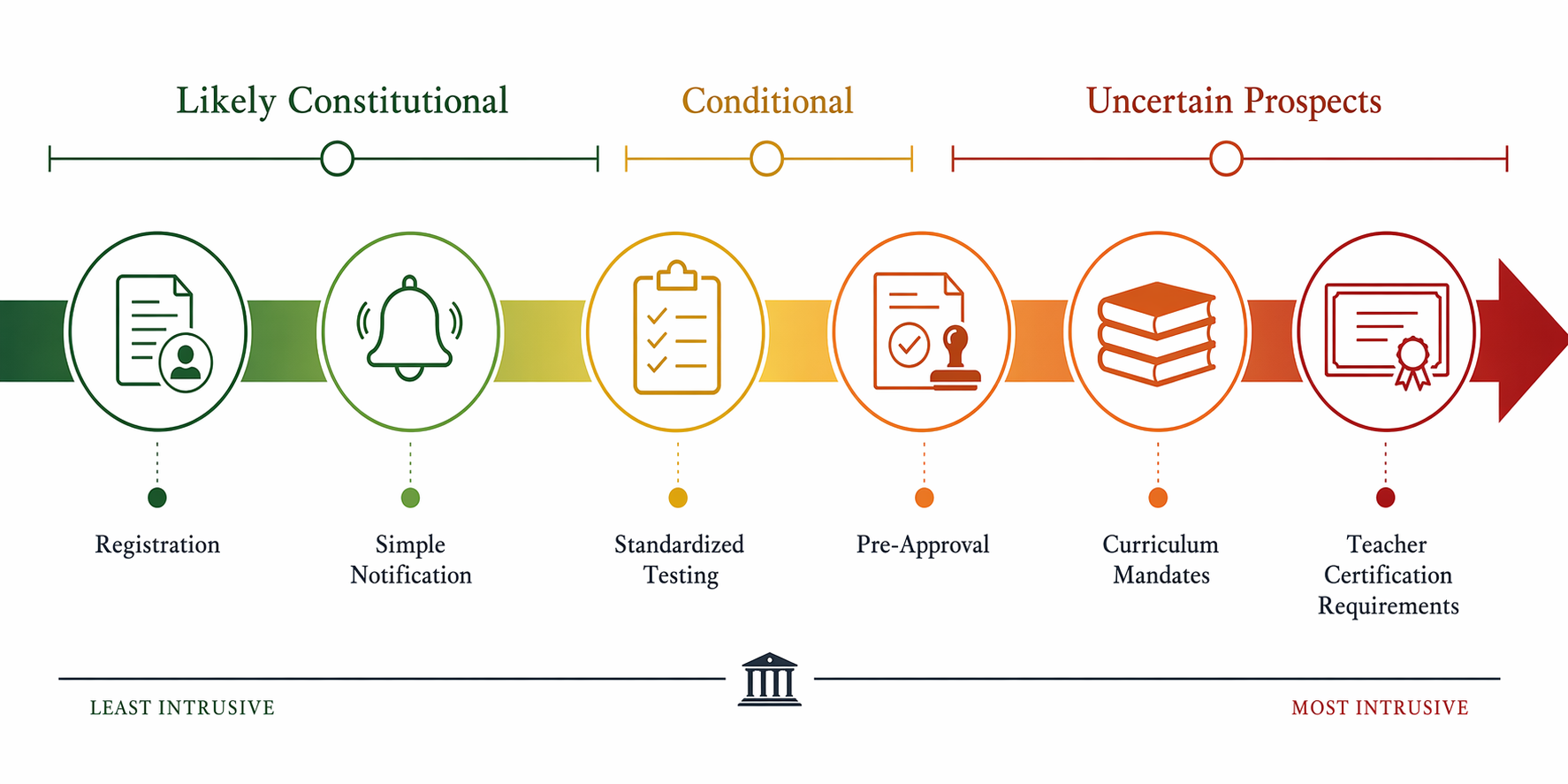
| Regulatory tool | Likely constitutional posture |
|---|---|
| Registration or notification | Strongest posture; generally tied to compulsory-attendance administration and least intrusive into educational content |
| Periodic reporting or records | Usually defensible if limited and clear, but more vulnerable if used as open-ended inspection authority |
| Standardized testing | Conditional; Murphy upheld testing against a religious-objector challenge, but context and tailoring matter |
| Pre-approval before homeschooling begins | More uncertain because it can operate as a licensing requirement for parental educational choice |
| Curriculum mandates | More vulnerable when they dictate substantive content in ways that interfere with parental or religious control |
| Teacher-certification requirements | Uncertain and potentially vulnerable because they may exclude parents from home instruction based on state credentialing rules |
Registration and Notification
Registration and notification rules are the easiest to defend because they answer a basic administrative question: which children are being educated outside the public-school system? A compulsory-education regime cannot function if the state has no way to distinguish a homeschooled child from a child simply absent from school.
A well-designed notice rule need not decide whether the parent’s pedagogy is wise, whether the curriculum is ideal, or whether home education produces better or worse outcomes than public schooling. It can simply require identifying information, a statement of intent to homeschool, and periodic confirmation. That is why this category fits comfortably with Pierce’s reservation of reasonable regulation. It preserves parental choice while allowing the state to administer attendance law.
Testing and Assessment
Testing sits in a middle position. It is more intrusive than notice because it measures educational output rather than merely recording educational status. But it is not necessarily equivalent to curriculum control. Murphy’s approval of mandatory standardized testing in the face of religious objections gives states some support, though only within the limits of that case and its posture.[6]
The safer version of an assessment rule is one that uses clear standards, predictable timing, and limited consequences. The more the rule gives officials discretion to reject a family’s educational program based on subjective disagreement, the more it begins to look like pre-approval or curriculum supervision. At that point, the state has moved from verifying that education is occurring toward controlling how the education must occur.
Pre-Approval, Curriculum Mandates, and Teacher Certification
Pre-approval requirements are constitutionally more delicate because they can transform homeschooling from a parental option into a state-licensed privilege. A notice rule says: tell the state you are exercising this educational choice. A pre-approval rule may say: wait until the state permits you to exercise it. That shift matters under Meyer and Pierce even if no court treats homeschooling as a fundamental right free from reasonable regulation.
Curriculum mandates raise a related problem. A state may have an interest in ensuring basic education, but a detailed curricular code can intrude into the very zone of educational direction that parental-rights doctrine protects. The constitutional risk increases when the rule is not confined to core administrative or academic benchmarks and instead prescribes contested content, ideology, religiously sensitive material, or method.
Teacher-certification requirements pose their own difficulty. If a state requires every homeschooling parent to hold a professional credential, the requirement may function as a categorical exclusion of many parents from home education. The state can invoke educational quality, but the burden is direct: the parent may be unable to homeschool at all. That is a different constitutional posture from asking the same parent to file a notice form.
State Constitutions May Pull the Analysis in a Different Direction
Federal doctrine is not the whole field. The research materials identify 22 state constitutions that recognize education as a fundamental right.[5] That fact does not automatically validate aggressive homeschooling regulation, but it changes the institutional setting. A state with an affirmative constitutional obligation to provide or protect education may have stronger reasons to maintain at least some oversight of children educated outside public schools.
State constitutional law can also cut the other way. Some states may protect religious exercise, parental rights, privacy, or educational liberty more strongly than the federal baseline. A homeschooling rule that survives federal rational-basis review could still face a serious challenge under state constitutional provisions or state religious-freedom statutes. For counsel, that means the federal answer is the starting point, not the closing memo.
The Empirical Debate Is Separate From the Constitutional One
Arguments about homeschooling oversight often lean quickly into child welfare, educational outcomes, family autonomy, or agency mistrust. Those issues matter to policy design, but they are not the same as the constitutional question. The available materials treat the empirical question of whether regulation improves safety or educational outcomes as contested and separate from the legal analysis.
That separation is useful. A regulation can be constitutional and still poorly designed. A rule can be politically attractive and still vulnerable when applied to religious objectors. A family’s objection to state supervision can be understandable without making every oversight rule unconstitutional. Constitutional analysis cannot carry the entire policy debate, and it should not pretend to.
A Bounded Answer for Legislatures and Agencies
For a legislature drafting a homeschooling statute, the safest federal constitutional path is moderate oversight: clear notice, basic records, administrable reporting, and carefully bounded assessment tools. Those measures align with the state’s compulsory-education responsibilities while leaving the family’s educational choice intact.
For agency counsel defending a rule, the central question is not whether parental rights exist. They do. The question is whether the challenged rule reasonably regulates education without converting parental direction into a state-approved license. Clonlara supports that distinction. Pierce anticipated it. Dobbs likely makes it harder to elevate homeschooling free from oversight into a newly protected fundamental right.
The Constitution leaves states meaningful room to regulate homeschooling. The strongest rules are the ones that create accountability without assuming custody of the educational judgment itself. The weakest are licensing systems dressed as educational concern.
References
- Meyer v. Nebraska, U.S. Supreme Court, 1923.
- Pierce v. Society of Sisters, U.S. Supreme Court, 1925.
- Wisconsin v. Yoder, U.S. Supreme Court, 1972.
- Clonlara v. Runkel, U.S. District Court for the Eastern District of Michigan, 1989.
- DIY Education: Developments in State Legislation on Homeschooling, U.C. Law Review, 2024.
- Murphy v. Arkansas, U.S. Court of Appeals for the Eighth Circuit, 1988.
Comments
Join the discussion with an anonymous comment.