
Ronald L. Fischer’s arrest in July 2026 does not put Rhode Island back at the beginning of a sexual-assault prosecution. It puts the state back in possession of a defendant who had already been tried, convicted, and sentenced after he allegedly fled while his 2005 trial was underway. The arrest scene has the elements that make a fugitive story travel: an alias, Richard Graydon; a sailboat named The Silver Lining; an online tip; and a Coast Guard intercept off the New Jersey coast before Fischer was turned over to the U.S. Marshals Service. But the legal story starts after the boarding, not with it: extradition, custody, sentencing consequences, and a bail-jumping charge tied to the years he remained unavailable. [1]
That distinction matters because a capture after a conviction in absentia is easy to misread. Fischer was not merely absent from a hearing that could be reset. He had appeared for trial, then disappeared after the proceeding began. Under the rule described in the reporting on the Rhode Island case, a defendant’s right to be present is not meaningless, but it can be waived when the defendant voluntarily absents himself after trial has started. The trial may continue, the jury may deliberate, and the verdict does not evaporate because the defendant made himself unavailable. [2]

The capture activates the old docket
The U.S. Marshals Service said Fischer was arrested on July 16, 2026, after investigators received information from an online tipster and, within a 48-hour intelligence cycle, identified him as living under the name Richard Graydon aboard The Silver Lining. The Coast Guard intercepted the vessel, and Fischer was transferred into federal custody. [1]
The publicly disclosed facts do not justify a more elaborate account of the tip. Authorities have not released the tipster’s exact method, the specific online trail, or the full chain by which the alias was connected to Fischer. For the present legal question, the important point is narrower: the tip led to a maritime arrest, and that arrest put a long-standing Rhode Island judgment back within reach of the courts.
CBS News reported additional operational detail: a Coast Guard 45-foot Response Boat was involved, and Fischer was taken through Coast Guard Station Staten Island before being transferred to the U.S. Marshals. [3] Those details explain how custody was achieved; the Rhode Island question begins once that custody is available.
Why the 2005 conviction did not dissolve
A defendant’s presence at trial is a fundamental feature of criminal procedure, not a courtesy. It allows the accused to hear evidence, consult counsel, assist in confrontation, and stand before the jury as the person whose liberty is at stake. But the right is held by the defendant, and the case law framework applied in Rhode Island allows that right to be waived when the defendant voluntarily leaves after trial has begun. [2]
The timing is the hinge. If a defendant has never been brought to trial, the state generally cannot replace the accused with an empty chair and proceed as if presence were optional. Fischer’s case was different as reported: his trial had begun, and after he sent his attorney an email, he did not return. The court permitted the proceeding to continue without him. [2]
That sequence did important legal work. It allowed the court to treat Fischer’s absence as voluntary rather than as a failure by the state to secure him before trial. It preserved the jury’s role. It also spared witnesses and court personnel from having the prosecution collapse because the defendant chose the moment of disappearance. The state still had to prove its case; absence did not become evidence of guilt by itself.
The Guardian’s account of the 2005 trial is especially useful because it does not turn the empty chair into a theatrical device. Prosecutor Carl Ricci delivered his closing argument without pointing to Fischer’s absence. The jury convicted Fischer, and he was sentenced to life, with parole eligibility after 25 years. [2]
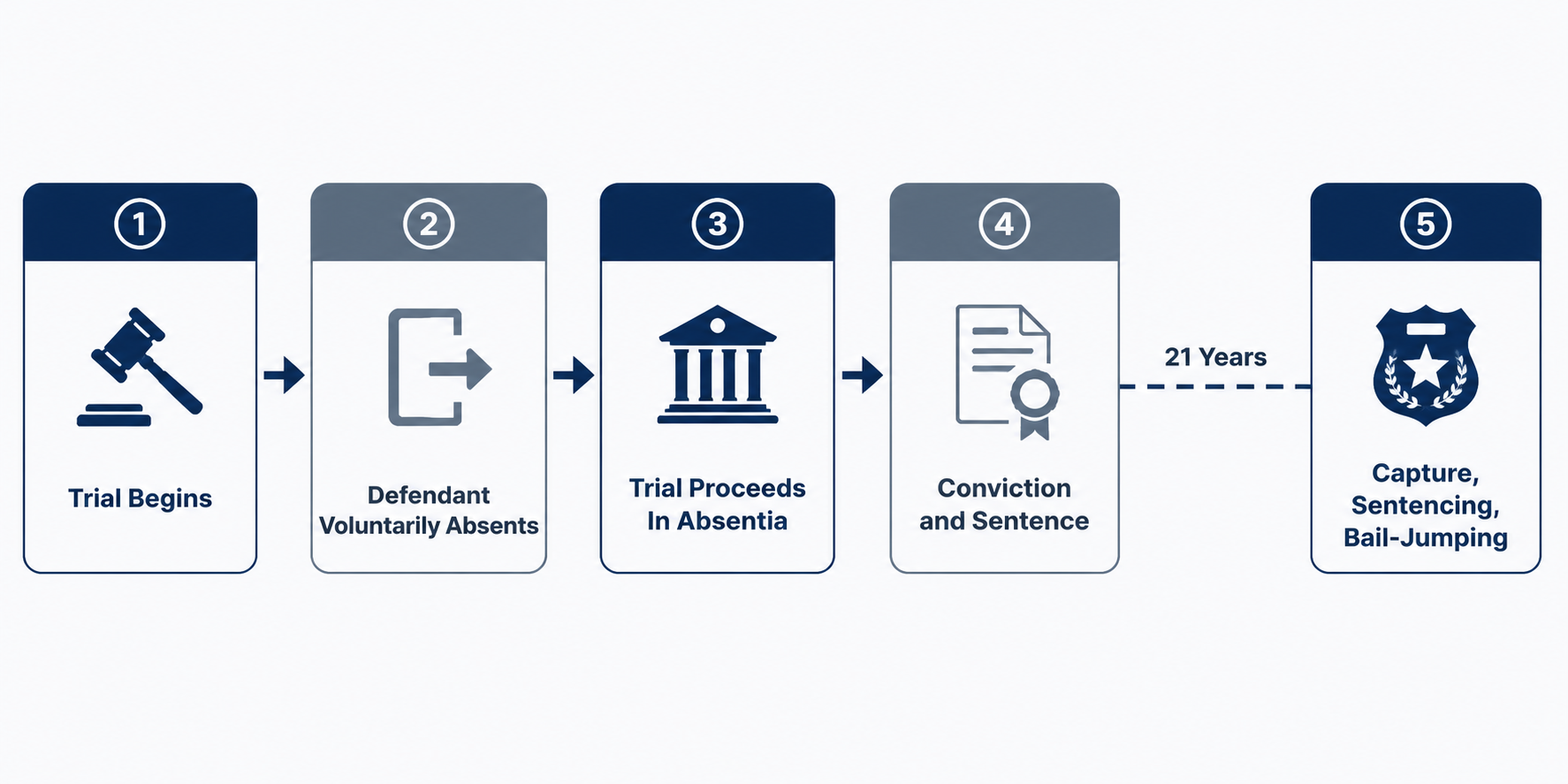
The waiver principle is narrow, but decisive
Conviction in absentia is not a general permission slip for courts to try missing people. Its force comes from sequence and voluntariness. The trial has begun. The defendant knows the proceeding is underway. The defendant then absents himself without authorization. When those conditions are met, the law can treat the absence as a waiver of the right to be physically present for the remaining stages.
In practical terms, the court is not rewarding the state for losing a defendant. It is refusing to let a defendant stop a live trial by flight. That is the difference between a prosecution that never obtained jurisdiction over the accused at trial and one in which the accused appeared, heard the case begin, and then chose not to remain.
Fischer’s later capture therefore does not automatically reopen proof of the underlying sexual assault. The jury already reached a verdict. The sentence already attached to that verdict. If Fischer has post-conviction claims available, those would belong to the ordinary mechanisms for challenging a conviction, not to the mere fact that he spent years outside the courtroom.
| Procedural point | Legal consequence in Fischer’s case |
|---|---|
| Trial had begun before Fischer disappeared | The absence could be treated as a voluntary waiver rather than a reason to start over |
| The court allowed the 2005 trial to continue | The jury could hear the remaining case and return a verdict |
| The jury convicted Fischer | The conviction remained the operative judgment after capture |
| Fischer was later arrested | Rhode Island could pursue custody, sentencing implementation, and bail-jumping proceedings |
What happens after capture
After his arrest, Fischer was arraigned in Manhattan and waived extradition, according to the Providence Journal’s report on the Rhode Island Attorney General’s Office confirmation. That waiver clears the path for his return to Rhode Island without a contested extradition fight in New York. [4]
The next steps identified by the Rhode Island Attorney General’s Office are not a new trial on the sexual-assault charge. They are a sentencing hearing on the existing conviction and an arraignment on a bail-jumping charge. [4] The bail-jumping count is legally significant, but it is ancillary. It addresses the alleged act of flight and failure to submit to the court’s authority; it does not substitute for the jury’s 2005 verdict.
That posture also limits the drama of the return. Rhode Island does not need to rebuild a two-decade-old trial from scratch merely because Fischer is now physically available. The immediate procedural burden is different: secure him in the proper jurisdiction, bring him before the court, address the sentence connected to the old conviction, and proceed on the separate charge that arose from his absence.
The biography explains attention, not the legal result
Fischer’s professional past and sailing skill help explain why the case attracted notice, but they do not supply the rule of decision. The Boston Globe reported that Fischer had been a Brown University anesthesiologist, had practiced psychiatry in Denver, had a 1994 Massachusetts assault conviction, and had his New Mexico medical license revoked. [5] Those facts may help orient readers to the public profile of the fugitive.
The same is true of the “master yachtsman” label and the case’s appearance in fugitive media. Fox News reported the “America’s Most Wanted” history in its account of the arrest. [6] That context explains why the capture read like the final act of a long chase. In court, the more important chronology is less cinematic: trial begins, defendant leaves, trial continues, jury convicts, sentence is imposed, fugitive is later found.
What remains undisclosed
Several facts remain outside the public record as of July 19, 2026. Authorities have not disclosed Fischer’s precise whereabouts or activities during the full fugitive period. They have not described the online tip in enough detail to say exactly what the tipster found or how independently each agency verified it. Public statements have also differed in emphasis about the investigative roles of federal agencies, so the safest account is the modest one: the tip helped generate investigative leads, and the Marshals and Coast Guard participated in the arrest and transfer described in the official release. [1]
Those gaps are not cosmetic, but they do not unsettle the central procedural point. Voluntary flight delayed enforcement. It did not erase the jury’s verdict, undo the life sentence reported from the 2005 case, or require Rhode Island to retry a prosecution that had already reached conviction before Fischer was captured.
References
- One of Rhode Island’s Longest Wanted Fugitive Captured After More Than 20 Years on the Run, U.S. Marshals Service, July 16, 2026.
- ‘Master yachtsman’ who fled 2005 trial for sexual assault arrested off US coast, The Guardian, July 17, 2026.
- Fugitive known as ‘master yachtsman’ captured on sailboat after 21 years on the run, CBS News, July 17, 2026.
- Ronald Fischer, one of RI’s ‘most wanted’ fugitives, caught after 20 years, Providence Journal, July 17, 2026.
- RI fugitive who fled during 2005 sexual assault trial arrested, Boston Globe, July 17, 2026.
- Ronald Fischer of ‘America’s Most Wanted’ caught on New Jersey sailboat, Fox News, July 17, 2026.
Comments
Join the discussion with an anonymous comment.