
Masaitis v. CoreWeave, Inc., No. 2:26-cv-00355 in the District of New Jersey, is still an early securities class action, not a liability finding. That caveat matters. It also does not make the complaint uninteresting. The pleaded theory puts a very specific pressure point in view: when an AI cloud company sells the market on capacity, customer demand, and contracted backlog, how much must it say about the construction chain that has to exist before those numbers can become revenue? The class period identified by plaintiffs runs from March 28, 2025 through December 15, 2025, and the lead-plaintiff deadline was March 13, 2026.[1]
The case did not arrive through one alleged revelation. The complaint and later commentary identify three market events. On October 30, 2025, Core Scientific terminated its merger agreement with CoreWeave, and CoreWeave’s share price allegedly fell 6.3%. On November 10, 2025, CoreWeave lowered guidance and cited delays involving a third-party data center developer; the stock allegedly fell 16.3%. On December 15, 2025, Wall Street Journal reporting addressed delays at a Denton, Texas data center project; the stock allegedly fell another 3.9%.[2] Hagens Berman’s announcement framed the sequence as causing roughly $14 billion in market capitalization loss and alleged that Core Scientific had been flagging delays to CoreWeave “since at least February 2025,” before the November guidance cut.[3]

That February-to-November interval is the part a disclosure reviewer should circle first. It is pleaded, not proven. But if the factual premise were developed in discovery, the relevant question would not be whether AI enthusiasm was excessive in some generic way. The question would be whether information about delayed third-party construction had become sufficiently concrete, sufficiently tied to prior capacity and backlog statements, and sufficiently important to revenue timing that the company needed to correct, update, or qualify what investors were being told.
Why this is not just another AI-washing case
Many AI securities cases are built around product-capability claims: whether a company exaggerated what its AI did, how much of the product was genuinely automated, or whether management dressed ordinary software in AI language. CoreWeave is different because its alleged misstatements turn on physical execution. The business story resolves into data centers, power availability, GPUs, leasing commitments, installation schedules, counterparties, and customer capacity.
That distinction changes the disclosure file counsel should want to see. For a software AI-washing case, the key documents may be product roadmaps, model performance materials, customer pilots, sales scripts, and internal usage metrics. For an AI infrastructure case, the file should also include construction schedules, developer correspondence, energization milestones, GPU delivery and deployment status, lease or hosting dependencies, customer allocation commitments, and internal escalation records. The legal theory may still live under Rule 10b-5, but the operational evidence looks more like project finance and data center development than marketing puffery.
The D&O Diary described the suit as potentially a new category of AI-related securities litigation, and that label is useful so long as it does not become grander than the facts.[2] The better way to state it is narrower: AI infrastructure issuers can create securities exposure when market-facing capacity and backlog narratives depend on third-party physical buildout that is slipping, under-documented, or described only through generic risk factors.
Capacity statements are only as clean as the construction dependency behind them
Capacity claims in this setting are not ordinary inventory claims. A cloud provider cannot recognize capacity merely because customer demand exists, because GPUs have been ordered, or because a lease has been signed. The promised capacity has to be installed somewhere, powered, cooled, connected, accepted, and made available under the commercial terms that management has described. If a third-party developer is late, the issuer’s capacity story can become inaccurate even though the issuer still has strong demand and valuable hardware.
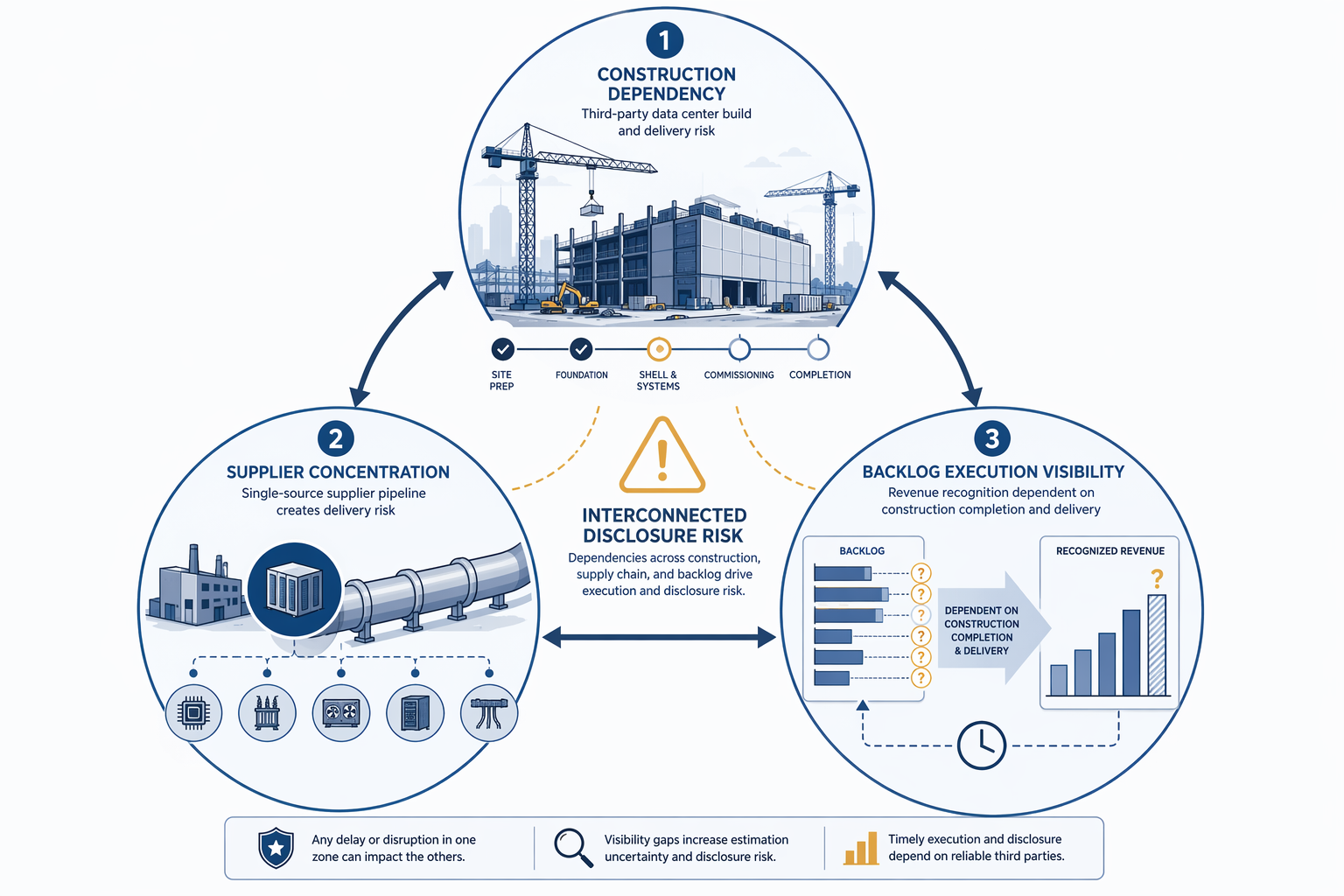
That is the first disclosure risk zone exposed by the CoreWeave complaint. Plaintiffs allege that CoreWeave overstated its ability to deliver AI cloud capacity while delays at Core Scientific projects were known internally. The allegation matters because it moves the issue from “construction risk may occur” to “a named construction dependency may already be affecting the delivery schedule.” The difference is not cosmetic. Securities filings are full of conditional phrasing that protects against future uncertainty. That language becomes weaker when the supposedly contingent risk has allegedly begun to materialize.
A competent review before an IPO, a guidance update, or a periodic report would not stop at asking whether the risk factor mentions third-party developers. It would ask which capacity statements rely on which sites; which sites rely on which developer; which milestones have slipped; whether the slipped milestones affect customer delivery dates; and whether any public statement assumes a schedule that operating personnel no longer believe is realistic. That is a different exercise from adding a longer paragraph under “risks related to suppliers.”
| Statement being reviewed | Operational file counsel should test | Disclosure problem if the file is inconsistent |
|---|---|---|
| Available or near-term AI cloud capacity | Site-level construction schedules, power milestones, GPU installation status, developer correspondence | Capacity may be described as deliverable before the physical path to delivery is on track |
| Guidance tied to deployment or utilization | Delayed site lists, customer allocation schedules, internal escalation materials | Revenue timing may depend on a bottleneck not described with enough specificity |
| General risk factor about third-party construction | Known delay notices, revised completion dates, board or committee updates | A hypothetical risk factor may be inadequate if the risk has allegedly materialized |
This is where the alleged nine-month gap does most of its work. If Core Scientific had been flagging delays since at least February 2025, as plaintiffs allege, then the disclosure analysis turns on what was known, by whom, in what form, and how those delays intersected with public capacity and financial statements.[3] A defense file would need to show more than generalized awareness that construction projects can slip. It would need to show the internal basis for treating the schedule as still achievable, immaterial, adequately disclosed, or not yet sufficiently certain to require revised public language.
Supplier concentration needs names, functions, and consequences
The second risk zone is concentration, but not in the lazy sense that every fast-growing company depends on important partners. In AI infrastructure, concentration can sit in more than one place at once. A company may depend heavily on a customer for revenue, on a developer for capacity expansion, on a chip supplier for GPU availability, on power interconnection timing, and on financing markets for buildout. Those are not interchangeable risks.
CoreWeave’s alleged concentration risk has two different faces. One is the data center development dependency at issue in the capacity-delay theory. The other is customer concentration. The D&O Diary’s discussion notes that Microsoft accounted for 62% of CoreWeave’s 2024 revenue, up from 16% in 2022, and that Microsoft’s CEO described the relationship as a “one-time thing.”[2] Those facts do not prove that CoreWeave misled investors. They do show why a generic statement that the company depends on key customers or partners may fail to answer the question investors and underwriters actually need addressed.
The drafting problem is specificity. A risk factor that says “we rely on third parties” may be accurate and still not very useful if the business model depends on a small number of counterparties performing distinct functions. A data center developer delay affects capacity delivery. A major customer shift affects revenue concentration and demand durability. A financing constraint affects the company’s ability to fund expansion. The issuer does not need to turn a filing into an operations manual, but it should not blur these dependencies into one harmless-looking basket.
For D&O professionals, this distinction matters because the claim file will not be built from the label “supplier concentration.” It will be built from the mismatch between public language and private dependency maps. If the dependency map shows one counterparty controlling a critical construction path, counsel should expect plaintiffs to argue that the company knew the real risk was narrower, more immediate, and more operationally consequential than the risk factor suggested.
Backlog visibility can become the bridge from delay to materiality
The third risk zone is backlog. CoreWeave reported $66.8 billion in revenue backlog at year-end 2025, up from $15.1 billion at year-end 2024.[4] That is the kind of number that can anchor an equity story, especially for an AI cloud company whose valuation depends on the market believing that today’s buildout converts into tomorrow’s contracted revenue. It is also the number that makes construction execution legally important.
Backlog is not cash in the door. It is a visibility metric whose usefulness depends on the assumptions behind conversion. If backlog revenue requires completed data centers, available power, installed GPUs, customer-ready capacity, and timely deployment, then construction delays can affect not only operations but also the way investors understand the backlog figure. The complaint’s theory is that CoreWeave’s backlog and demand narrative was materially misleading because revenue recognition depended on infrastructure installation that was allegedly not on track.[2][3]
This is why backlog deserves more careful treatment than a standard growth metric. A large backlog may be true as a contractual matter and still require qualification if the timing of conversion depends on known bottlenecks. The relevant disclosure questions are not limited to whether the number was arithmetically correct. They include whether management’s discussion adequately described the dependencies that control conversion, whether known delays affected the expected timing of revenue, and whether the market was given enough information to understand that signed demand did not remove execution risk.
The cleanest internal review would trace backlog by dependency rather than by headline total alone. Which contracted amounts depend on facilities still under construction? Which depend on a particular developer, site, power milestone, or GPU deployment schedule? Which customer commitments tolerate delay, and which create penalties, renegotiation risk, or revenue deferral? A disclosure committee does not need perfect foresight. It does need a process that prevents a backlog figure from floating free of the infrastructure required to earn it.
The internal-control allegation is an accelerant, not the whole fire
Plaintiffs also point to CoreWeave’s IPO disclosures about a material weakness in internal controls over financial reporting expected to persist “until at least 2026,” as discussed in later case analysis.[2] That allegation is predictable in this kind of case. If a company is accused of overstating capacity, demand, or backlog visibility, plaintiffs will look for a systems allegation that helps explain how the company supposedly failed to collect, reconcile, or escalate operational information.
The internal-control point should not be overstated. A material weakness does not automatically make every operational statement false, and financial reporting controls are not identical to construction-project controls. But the allegation can make a delay theory more durable at the pleading stage if plaintiffs can connect the control weakness to the categories of information at issue: capacity readiness, deployment timing, customer commitments, and backlog conversion.
For future AI infrastructure issuers, the lesson is not to write a more dramatic control-risk factor. It is to make sure the disclosure process has a documented path from site-level delay information to the people approving registration statements, earnings releases, and guidance. If the construction team knows one thing and the filing says another, the defense problem begins before anyone argues about adjectives.
Analyst ratings explain market sensitivity, not liability
CoreWeave’s analyst-rating record bundles together two things that should be kept separate: sell-side sentiment and securities-law exposure. Analyst ratings can show how the market was processing valuation, growth, and execution risk. They do not decide whether a statement was materially misleading when made.
The timing is important. Fortune reported on June 6, 2025 that only 3 of 19 analysts then had Buy ratings on CoreWeave, with a consensus Hold and a $72.61 average price target, while the stock was trading around $145.[5] That snapshot suggests visible analyst caution early in the public-company period. It is not the same as the later MarketBeat picture. By July 2026, MarketBeat tracked 34 analysts, with 20 Buy ratings, 12 Hold ratings, and 2 Sell ratings, an average price target of $138.87, a high target of $250 from Rosenblatt, and a low target of $32 from HSBC.[6]
| Source and date | Analyst-rating picture reported | Use in a legal-risk analysis |
|---|---|---|
| Fortune, June 6, 2025 | 3 Buy ratings among 19 analysts; consensus Hold; $72.61 average target while the stock traded around $145 | Shows contemporaneous valuation skepticism during the class-period environment |
| MarketBeat, July 2026 | 34 analysts tracked; 20 Buy, 12 Hold, 2 Sell; $138.87 average target | Shows later coverage expansion and sentiment context, not a liability conclusion |
The difference between those two snapshots likely reflects, at least in part, the expansion of analyst coverage over time. They should not be averaged together or treated as one blended consensus. For litigation purposes, the more useful point is that CoreWeave traded in an environment where valuation could move sharply on execution news. If the market is pricing a company on rapid AI infrastructure deployment, a missed construction dependency can become material faster than it would in a slower-growth industrial story.
Debt and non-GAAP performance sharpened the execution issue
CoreWeave’s financial profile also explains why construction timing mattered to the market. The company reported a $452 million GAAP net loss for Q4 2025, a $1.167 billion GAAP net loss for fiscal 2025, $898 million in Q4 adjusted EBITDA, and $3.093 billion in fiscal-year adjusted EBITDA.[4] It also reported $11.9 billion of debt against $1.28 billion of cash and cash equivalents at year-end 2025.[4] Fortune reported debt costs in the 10% to 15% range, and the company’s Q4 interest expense was $388 million.[5][4]
Those figures cut in both directions. Plaintiffs will naturally emphasize GAAP losses, leverage, and interest expense because they make delayed revenue conversion look more consequential. Defense counsel will point to adjusted EBITDA and contracted demand to argue that the market understood this was a capital-intensive growth company rather than a mature earnings story. Both points can be true. The numbers do not establish falsity. They explain why public statements about capacity timing and backlog conversion were not peripheral.
This is the appropriate role for balance-sheet material in the analysis. Debt does not turn an operational delay into securities fraud. But when a company is funding rapid buildout with substantial leverage, the market has reason to care whether promised capacity is arriving on schedule. The disclosure record should therefore connect financial guidance to the operational milestones that make the guidance achievable.
A practical review framework for AI infrastructure disclosures
The CoreWeave complaint is most useful as a checklist of questions that should be asked before the filing goes out, not after the stock drop. The framework is simple, but it requires operational specificity.
- Test every material capacity statement against site-level dependencies. If the statement assumes a facility will be available, counsel should know the construction status, power status, GPU deployment status, and responsible third party.
- Separate different concentration risks. Customer concentration, developer concentration, GPU supply concentration, and financing dependence create different consequences and should not be collapsed into one generic partner-risk paragraph.
- Map backlog to conversion constraints. A backlog total should be reviewed alongside the physical and contractual conditions required to recognize the associated revenue.
- Ask whether the risk has already materialized. If a third-party developer has delivered delay notices or revised milestones, hypothetical risk-factor language may need to be revisited.
- Document escalation. The strongest defense file is likely to show who received delay information, who evaluated materiality, what public statements were checked against it, and why the final disclosure language was chosen.
None of this requires a company to disclose every construction hiccup. Data center projects are complex, and not every delay is material. The legal problem arises when a delay affects a critical path that supports market-facing capacity, customer-delivery, guidance, or backlog statements. That is the point at which operational project management becomes securities disclosure evidence.
What the CoreWeave case does, and does not, establish
CoreWeave does not establish liability at this stage. The nine-month delay is an allegation. The market-impact sequence is pleaded and reported, not adjudicated. The company may have defenses on falsity, scienter, loss causation, risk disclosure, forward-looking-statement protection, and the actual significance of the construction issues at the time statements were made.
It does, however, expose a repeatable pattern. AI infrastructure companies are not merely AI issuers with hard assets attached. Their securities risk can arise from the conversion chain between contracted demand and usable capacity. Capacity claims tied to third-party construction, concentrated operational dependencies, and backlog disclosures dependent on infrastructure execution deserve their own review category in registration statements, earnings releases, analyst-facing materials, and D&O underwriting files.
References
- CoreWeave Class Action Lawsuit, Kessler Topaz Meltzer & Check, LLP.
- AI Infrastructure Company Hit with AI-Related Securities Suit, The D&O Diary.
- CoreWeave, Inc. (CRWV) Facing Securities Class Action..., Hagens Berman via PRNewswire.
- CoreWeave Reports Strong Fourth Quarter and Fiscal Year 2025 Results, CoreWeave Investor Relations.
- Two months after CoreWeave's IPO fizzled..., Fortune, June 6, 2025.
- CoreWeave (CRWV) Stock Forecast and Price Target 2026, MarketBeat.
Comments
Join the discussion with an anonymous comment.