
CoreWeave’s July 2026 problem is not just that CRWV fell roughly 52% from its 52-week high of $153.20 to about $73 by mid-July, or that the stock dropped about 10.6% on July 1 after reports that Meta planned to sell excess AI compute through “Meta Compute.” For legal AI buyers, the sharper issue is the collision of those events with active securities litigation over delivery-capacity statements and Meta’s awkward position as both a major CoreWeave customer and a possible compute competitor. That combination turns the stock drop and Meta Compute announcement into a procurement question: if a legal AI vendor depends on a concentrated infrastructure provider, what happens to client work when that provider’s customers, financing, delivery pipeline, or capacity assumptions move against it? [1][2]
That question is uncomfortable because most legal technology reviews still stop too early. A vendor demo may show fast document analysis, neat matter summaries, and respectable security language. The infrastructure layer underneath often appears as a phrase: enterprise cloud, dedicated GPU infrastructure, secure AI compute, private deployment. Those labels do not tell a firm whether the production workload depends on one data center supplier, one financing model, one hyperscale customer, or one provider’s ability to keep buying and delivering expensive capacity.
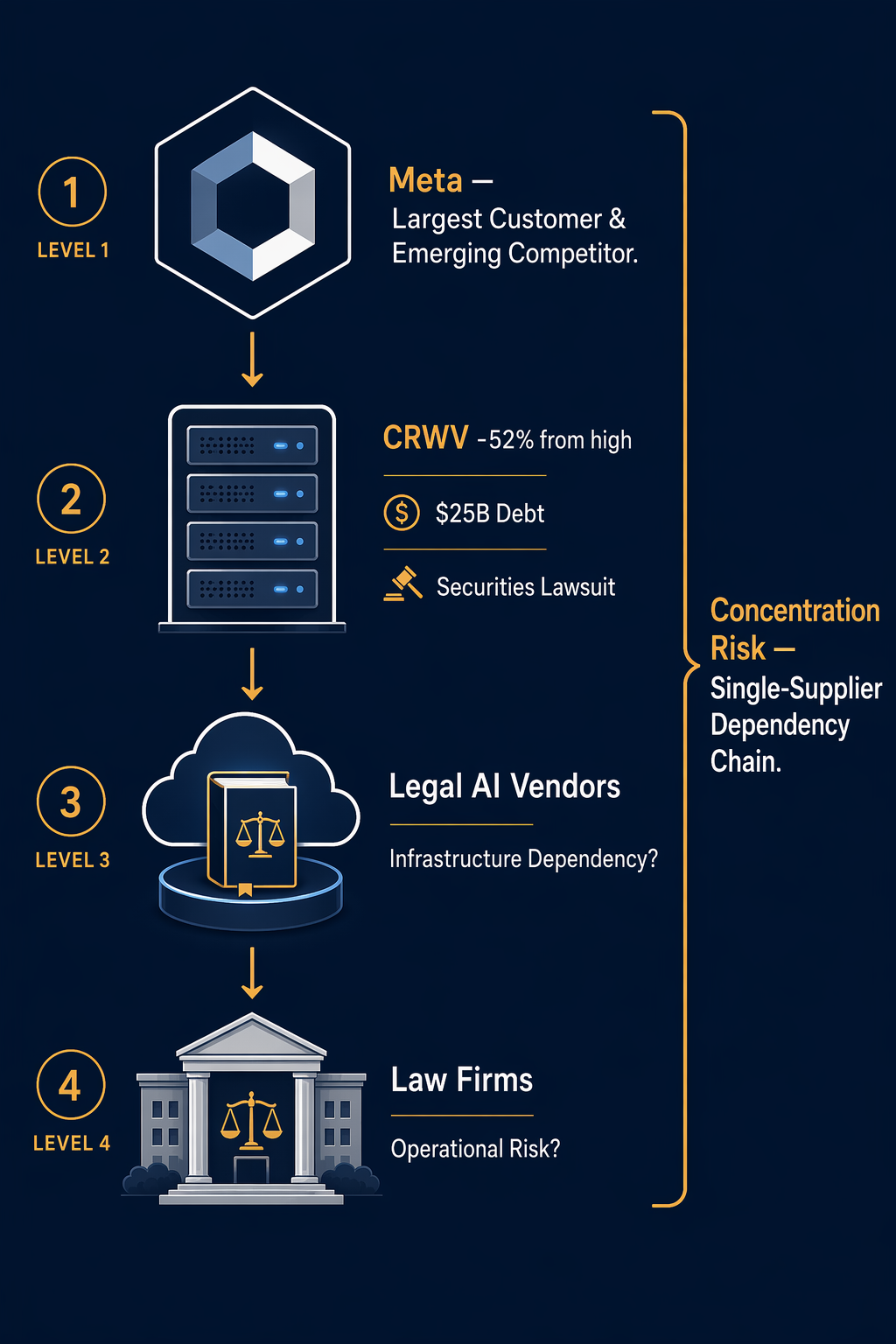
What the CoreWeave episode actually signals
A stock decline is not, by itself, a service-continuity event. Legal procurement teams should not treat market price as a substitute for uptime records, security controls, or contractual review. But a large decline can point buyers toward the right diligence questions when it appears alongside concentration exposure, leverage, disputed capacity statements, and a customer that may also become a seller of similar capacity.
Meta’s role is the cleanest example. CoreWeave’s commitments from Meta totaled about $35 billion: an earlier $14.2 billion plus a $21 billion expanded agreement announced April 9, 2026, running through 2032.[3] Then, on July 1, 2026, Reuters reported that Meta planned to sell excess AI compute capacity through a service called Meta Compute, after Bloomberg reporting on the same development.[4] Meta’s plans were still developing, and that distinction matters. A developing resale plan is not the same thing as a fully mature competing cloud business. Still, from a buyer-risk perspective, the signal is obvious enough: a large customer can become a partial substitute supplier, or at least a new source of pricing and demand uncertainty.
The dependence does not stop with Meta. Microsoft represented 62% of CoreWeave’s 2024 revenue, according to the financial-risk reporting summarized in the available sources.[5] Customer concentration of that size does not prove instability. It does mean that a vendor’s operating plan can be highly sensitive to the renewal behavior, internal build decisions, and bargaining power of a small number of very large counterparties.
Then there is debt. CoreWeave had about $25 billion in long-term debt as of Q1 2026, reported a $740 million net loss for the quarter, and saw quarterly interest expense more than double to $536 million.[6] Again, none of that proves a near-term failure. Ambitious AI infrastructure buildouts require capital, and a specialized provider may have perfectly rational reasons to lever up while demand is strong. The procurement question is narrower: if financing costs, delivery delays, or margin pressure force a provider to reprioritize customers, which downstream applications get protected first?
The backlog figure should be read with the same care. CoreWeave’s reported revenue backlog of $99.4 billion included remaining performance obligations plus non-binding components.[5] That is not the same as guaranteed cash already in the door. A legal buyer does not need to model CoreWeave’s revenue recognition. It does need to understand that “large backlog” is not a complete answer to service-continuity risk when the backlog itself contains different degrees of enforceability.
The securities complaint matters because it is about delivery capacity
The securities litigation should be handled carefully. The allegations are unproven, and the existence of a complaint is not a finding of liability. But the subject of the complaint is exactly the subject legal AI buyers should care about: whether public-facing capacity language matched the operational reality of delivering AI infrastructure.
The class action filed January 12, 2026 in the District of New Jersey, Case No. 26-cv-00355, covers a class period from March 28, 2025 through December 15, 2025 and alleges violations of Sections 10(b) and 20(a). The complaint alleges misleading statements about CoreWeave’s ability to deliver AI infrastructure capacity, including claims tied to “robust” and “unprecedented” demand, and alleges that delays associated with a single third-party data center supplier had been flagged months earlier.[7]
Available reporting identifies stock drops of 6.3% on October 30, 16.3% on November 11, and 3.9% over December 15–16 following the Core Scientific merger failure, lowered guidance, and Wall Street Journal reporting on construction delays at a Denton, Texas data center.[7][8] Those market reactions do not tell us whether the complaint will succeed. They do show why delivery-capacity representations deserve more than a passing glance when a law firm is buying a tool that may be used during filing deadlines, discovery review, investigation response, or high-volume contract work.
This is where infrastructure risk becomes legal-operations risk. If the provider behind a legal AI platform cannot obtain enough compute, must reroute workloads, or changes suppliers under pressure, the immediate consequence may land on the firm’s technology partner, legal ops lead, security reviewer, or matter team. The client does not experience an upstream GPU procurement issue. The client experiences a tool that is slower, unavailable, more expensive, or suddenly governed by a different subprocessor chain than the one reviewed at onboarding.
Why Meta Compute makes concentration risk harder to dismiss
Meta’s reported compute-resale move is plausible because it fits a broader pattern: companies building enormous AI infrastructure may look for ways to monetize unused or flexible capacity. Public reporting notes that SpaceX was already selling excess compute capacity through large deals with Anthropic and Google, generating about $26 billion annualized.[9] That example does not prove Meta will execute the same model successfully. It does make the business logic less speculative.
Meta also planned to spend $115 billion to $145 billion on AI infrastructure in 2026, and Mark Zuckerberg had indicated at the May 2026 shareholder meeting that a cloud entry was “on the table.”[10] A customer with that level of infrastructure ambition is not a passive buyer in the ordinary sense. It may still buy from CoreWeave, and CoreWeave’s CEO told CNBC that Meta’s dual role was sustainable because “there’s just too much risk not to” diversify.[10] That answer is commercially sensible. It is also an admission that concentration risk is real enough to manage, not theoretical enough to ignore.
The market can be growing and still become harder for a specialized provider. Mordor Intelligence projected the neocloud market would grow from about $24 billion in 2025 to $236.5 billion in 2031.[11] Growth does not eliminate margin pressure, customer bargaining power, financing strain, or delivery bottlenecks. In legal procurement, the relevant point is not whether neoclouds win or lose as a category. The point is whether a legal AI vendor has built its operating promises on a dependency chain it can actually explain.
The diligence questions law firms should ask now
A law firm does not need to ask every AI vendor for a tour of its GPU supply chain. It does need answers sufficient to assess continuity, confidentiality, pricing exposure, and change control. The CoreWeave case supplies a useful stress test because it combines several risks that are often reviewed separately: supplier concentration, customer concentration, financing pressure, delivery-capacity disputes, and a major customer exploring resale.
| Procurement issue | Question to ask the legal AI vendor | Why it matters |
|---|---|---|
| Production infrastructure | Which infrastructure providers support production workloads for our tenant or deployment model? | A vendor cannot be meaningfully assessed if the firm does not know whether critical workloads depend on one provider, several providers, or a black-box intermediary. |
| Failover | Can production workloads fail over to another region, data center, or infrastructure provider, and has that failover been tested? | A paper backup arrangement is not the same as a tested continuity path during a filing rush or investigation deadline. |
| Single-supplier exposure | Does service delivery depend on a single data center supplier, GPU provider, hosting partner, or capacity reservation? | The securities allegations against CoreWeave focus in part on delays tied to a single third-party data center supplier; legal buyers should know whether similar concentration exists downstream. |
| Cost shock | What happens to our subscription price, usage limits, throttling, or service quality if compute costs rise materially? | Compute-cost pressure may surface as higher renewal pricing, reduced functionality, slower processing, or changed usage caps. |
| Notice of infrastructure change | What advance notice must the vendor give before changing infrastructure providers, regions, subprocessors, or model-hosting arrangements? | Security and client-confidentiality reviews can become stale if the vendor changes the operational stack without meaningful notice. |
| Service remedies | What remedies apply if infrastructure disruption affects legal work, and are those remedies limited to small service credits? | A modest credit may be irrelevant if the business impact is missed internal deadlines, delayed client work, or emergency manual review. |
The first question is deliberately plain: who runs the production infrastructure? Some vendors will resist naming providers on security or commercial grounds. There may be legitimate limits on what can be disclosed publicly. But a firm under NDA should not have to accept a brand-safe phrase in place of a dependency map. At minimum, the vendor should disclose the categories of infrastructure providers, whether production workloads are concentrated, and whether any material subprocessor or hosting change triggers notice and review rights.
Failover deserves more scrutiny than it usually gets. A vendor may say workloads are distributed, redundant, or cloud-native. Those words are not enough. The review should ask where failover occurs, whether failover crosses providers or only regions within the same provider, what recovery-time objective applies to the AI service, and whether the vendor has tested the failover path for the same class of workload the firm will use. A discovery-review assistant that performs acceptably in a demo may behave very differently when capacity is constrained and thousands of documents are queued.
Cost-shock language is another neglected clause. Compute-intensive AI services can become economically unattractive before they become technically unavailable. If the infrastructure provider raises prices, loses favorable capacity, or faces higher financing costs, the legal AI vendor may respond by increasing renewal pricing, changing usage tiers, delaying batch jobs, limiting premium features, or routing work through a different provider. The contract should say which of those changes require notice, which require consent, and which allow the firm to terminate without penalty.
For firms already using a broader AI procurement framework, this is the infrastructure layer that should sit inside it. The existing ABA Model Rules–Mapped AI Vendor Due Diligence Checklist for Law Firms is the right place to connect confidentiality, supervision, competence, and technology-vendor review. The CoreWeave episode makes one part of that checklist harder to treat as administrative: infrastructure disclosure is not a footnote when the product depends on scarce, expensive, and potentially concentrated AI compute.
Contract language should match the operational risk
Many AI vendor agreements still handle infrastructure through general hosting, subprocessor, and service-level provisions. That may be adequate for lower-risk pilots. It is thin for a tool that will process client documents, support legal analysis, or become embedded in matter workflows. The agreement should identify what counts as a material infrastructure change and what the firm can do when that change affects security posture, data location, availability, cost, or performance.
- Define material infrastructure changes to include changes in primary hosting provider, AI compute provider, model-hosting location, data-processing region, critical subprocessor, and failover architecture.
- Require advance notice for material changes, with enough time for security, privacy, client-contract, and conflicts-related review where applicable.
- Tie service levels to the actual AI functionality the firm is buying, not only to a generic web application uptime metric.
- Require incident and degradation notice when infrastructure constraints materially affect latency, throughput, availability, or data-processing commitments.
- Preserve termination or suspension rights if the vendor cannot maintain agreed infrastructure, security, data-location, or continuity commitments.
- Avoid making service credits the exclusive remedy for disruptions that could affect client work or regulatory obligations.
The most useful vendor answers are specific without pretending to remove all uncertainty. A credible vendor can say, for example, that production inference runs on named provider categories, that client data is restricted to specified regions, that failover has been tested within a defined time window, and that any move to a new critical subprocessor requires notice. It does not need to reveal every commercial term in its infrastructure contracts. It does need to give the buyer enough information to judge whether the service can survive stress above the application layer.
What not to overclaim from the CoreWeave facts
There is a temptation to turn every AI infrastructure market event into a verdict. That would be sloppy here. The securities allegations against CoreWeave are unproven. Meta’s reported compute-resale plan was still developing as of the July 2026 reporting. CoreWeave’s backlog contains non-binding components, but that does not make the entire backlog meaningless. The company’s debt and losses show financial pressure, not automatic operational failure.
It would also be improper to claim that a named legal AI vendor depends on CoreWeave unless that relationship is public and source-verifiable. Many legal AI products rely on major cloud and AI infrastructure providers, but the specific contracts are often not disclosed. The procurement lesson is therefore structural, not accusatory: legal buyers should require enough transparency to understand whether their own vendor has a similar concentration profile.
There is also a difference between adoption and resilience. A vendor may have strong customer growth, impressive model performance, and serious security certifications while still depending on a fragile upstream arrangement. Conversely, use of a specialized infrastructure provider is not a red flag by itself. Specialized providers may offer performance, capacity, or economics that general-purpose cloud arrangements cannot. The red flag is the refusal or inability to explain dependency, failover, and change-control arrangements while asking the firm to entrust real legal work to the platform.

A tighter standard for legal AI infrastructure review
The practical standard is not perfection. A law firm does not need to know every GPU contract in the market, and most firms are not equipped to audit AI infrastructure providers directly. But “enterprise-grade cloud” is no longer a sufficient answer when the product handles client documents, supports legal workflows, or may be relied on during time-sensitive work.
The better standard is enough infrastructure transparency to understand concentration, enough continuity planning to survive supplier delays, enough notice to review material changes, and enough contractual remedy to matter if disruption affects legal work. CoreWeave is the warning example, not the whole problem. The real risk is any legal AI tool whose operational dependency chain is more concentrated than its buyer has been allowed to see.
References
- Why CoreWeave Stock Keeps Falling, The Motley Fool, July 18, 2026.
- Yahoo Finance / Benzinga article on the Meta announcement drop, Yahoo Finance / Benzinga.
- CoreWeave shares jump on expanded $21 billion AI deal with Meta, CNBC, April 9, 2026.
- Meta plans to sell excess AI compute capacity through Meta Compute, Reuters, July 1, 2026.
- TheStreet reporting on CoreWeave financial risk factors and Meta Compute, TheStreet.
- CoreWeave reports Q1 earnings, CNBC, May 7, 2026.
- CoreWeave Hit with Securities Suit Based on AI-Washing Allegations, The D&O Diary, January 2026.
- CoreWeave, Inc. Securities Class Action filing, Berger Montague.
- SpaceX sells excess compute capacity, CNBC, June 5, 2026.
- TheStreet reporting on Zuckerberg comments and Meta AI infrastructure spending, TheStreet.
- Neocloud Market, Mordor Intelligence.
Comments
Join the discussion with an anonymous comment.