
A law firm buying a legal AI platform usually asks the visible questions first: what data goes into the tool, whether prompts train the model, how access is logged, and whether the vendor will sign the firm’s security addendum. Those questions still matter. But they are no longer enough when AI workflows are moving from experiments into daily research, drafting, and document review.
The CoreWeave-versus-Applied-Digital question is not simply which company is larger or more exciting. It is where the legal AI workload actually runs, who controls the capacity underneath it, and what happens if a key infrastructure provider becomes financially strained, litigated, capacity-constrained, or dependent on a single counterparty.
That gap is becoming harder to ignore. In Tabush Group’s 2026 survey of more than 230 law firm leaders, 92% of firms reported using AI, while only 41% said they invest in AI training; reported data breaches rose from 6% to 13% year over year.[1] Those figures do not prove that AI adoption caused breach growth, and they do not say which infrastructure any particular legal AI vendor uses. They do show a profession moving faster on adoption than on the governance practices that should surround it.
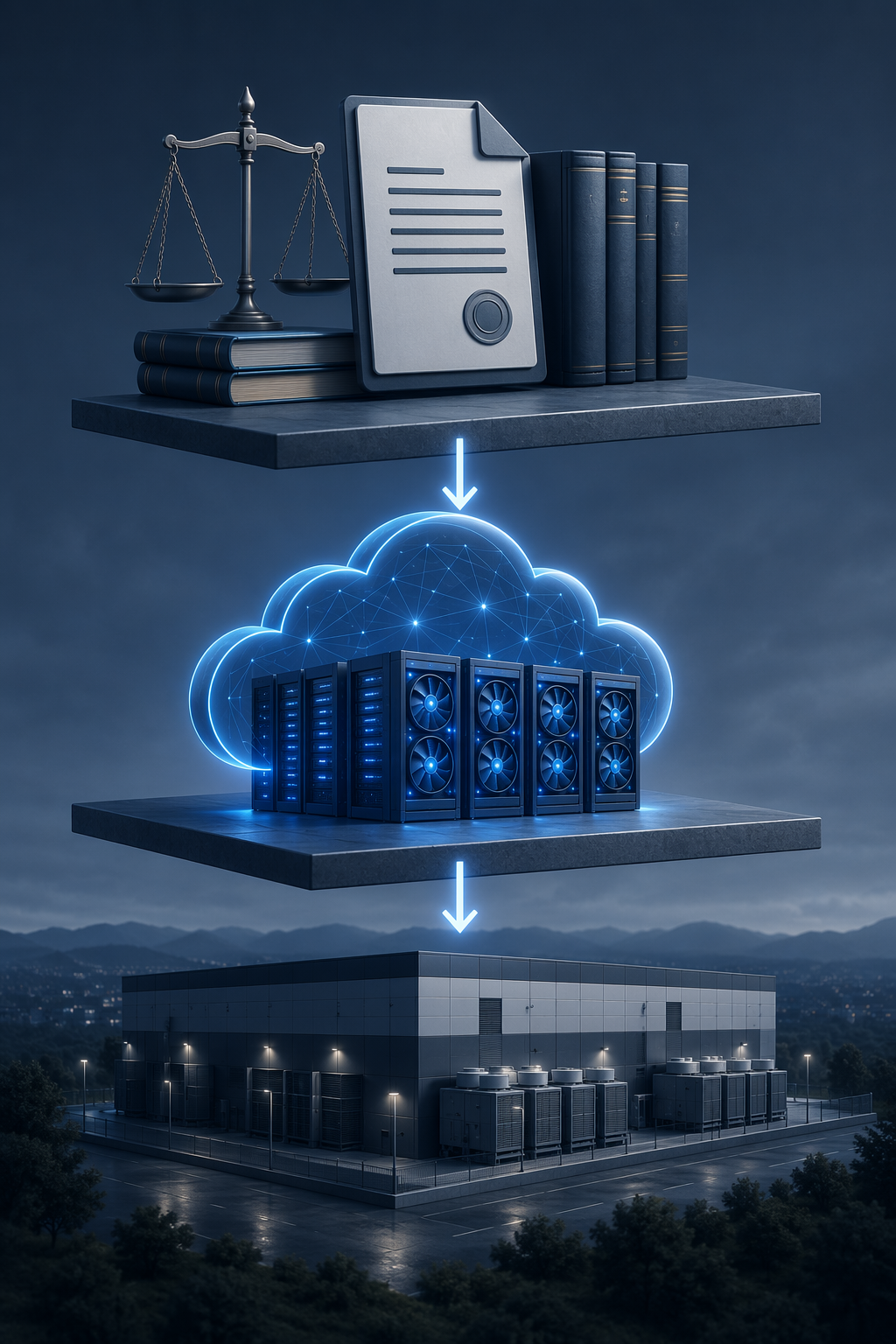
The comparison starts with the stack, not the stock chart
CoreWeave and Applied Digital are often discussed in the same AI infrastructure conversation, but they do not occupy the same layer.
- CoreWeave is the GPU cloud platform operator. Its business is built around providing accelerated cloud computing capacity for AI workloads.
- Applied Digital is closer to the physical infrastructure layer. It develops and leases data-center capacity, including major facilities intended for high-performance computing and AI customers.
For legal teams, that distinction matters because a vendor’s statement that it runs in “the cloud” hides at least two separate dependency questions. One is the cloud platform that schedules and delivers GPU compute. The other is the physical data-center capacity, power, cooling, and lease structure that make the cloud platform possible.
There is no cited basis here to say that a specific legal AI product such as Harvey, CoCounsel, or any other named tool runs on CoreWeave or Applied Digital. That connection should not be assumed as a reported fact. The practical point is narrower: legal AI products sit above AI cloud and data-center infrastructure, and firms evaluating those products should understand whether their vendors have concentrated dependencies on providers whose business models, financing, and lease relationships could affect continuity.
CoreWeave and Applied Digital are linked more than they are rivals
The “vs” framing is useful only if it does not obscure the more important relationship: Applied Digital leases major data-center capacity to CoreWeave. That makes the risk profile less like two interchangeable vendors competing for the same law firm contract and more like a dependency chain.
Applied Digital announced that it had finalized an additional 150 MW lease with CoreWeave at Polaris Forge 1, bringing the site to 400 MW under 15-year leases and representing approximately $11 billion in anticipated lease revenue from CoreWeave.[4] For a legal ops or CIO review, that is the kind of fact that belongs on a dependency map. It identifies not just a customer relationship, but a long-duration capacity commitment large enough to shape the landlord’s revenue base and the tenant’s infrastructure footprint.

CoreWeave has also been expanding toward direct control of power and data-center assets. Its $9 billion all-stock acquisition of Core Scientific, announced in July 2025, was reported as adding 1.3 GW of power capacity, with Davis Polk, Kirkland & Ellis, and Wachtell Lipton advising on the transaction.[5][6] The legal-industry detail is not which elite firms appeared on the deal sheet. It is that the AI cloud market is now a power-capacity race, and capacity strategy can reach far below the software layer that most legal buyers see.
Side-by-side risk profile
| Issue | CoreWeave | Applied Digital | Why legal AI buyers should care |
|---|---|---|---|
| Infrastructure role | GPU cloud platform operator | Data-center owner and landlord | The cloud platform and the physical data center create different failure points. |
| Recent revenue scale | $2.1 billion in Q1 2026 revenue.[2] | $126.6 million in fiscal Q3 2026 revenue.[2] | Scale can support capacity investment, but it does not eliminate debt, concentration, or litigation risk. |
| Debt load | Approximately $25 billion in debt.[2][3] | Approximately $2.6 billion in debt.[2][3] | Debt service and financing access matter when AI workloads require expensive GPUs, power, and long-term capacity commitments. |
| Key dependency structure | Needs large-scale GPU, power, and data-center capacity; has major commercial relationships with large AI and financial customers. | Relies heavily on CoreWeave as an anchor tenant at Polaris Forge 1, with approximately $11 billion in anticipated lease revenue tied to CoreWeave leases.[4] | A downstream legal AI vendor may be exposed not only to its direct cloud provider, but also to the provider’s landlords and capacity commitments. |
| Litigation exposure | Securities class action filed in the District of New Jersey on January 12, 2026, alleging demand overstatements and supply-chain nondisclosures.[8] | Securities class action filed in 2023 concerning, among other things, statements around the company’s AI pivot viability and board independence; current posture is not fully confirmed from the available materials.[10] | Pending securities allegations are not established facts, but they can affect diligence, disclosures, financing scrutiny, and management attention. |
The financial asymmetry is sharp. CoreWeave is far larger by recent quarterly revenue, but also carries a far larger debt load. Applied Digital is much smaller by revenue, yet its $2.6 billion debt figure is still substantial when set beside the reported $126.6 million fiscal quarter revenue figure.[2][3] The legal buyer’s concern is not whether either company is a good investment. It is whether a vendor’s infrastructure chain depends on companies whose growth model requires continuous access to financing, capacity delivery, and customer demand at extraordinary scale.
CoreWeave: scale, leverage, and volatility in the GPU cloud layer
CoreWeave’s advantage is obvious: it has become one of the best-known names in GPU cloud infrastructure at a moment when AI workloads are hungry for specialized compute. Its Q1 2026 revenue of $2.1 billion shows a company operating at a different commercial scale from Applied Digital.[2] That scale is relevant for legal AI users because serious AI platforms need reliable access to compute capacity, not just a polished interface.
But the same scale also comes with leverage. Reported debt of approximately $25 billion is not an abstraction when the service being purchased depends on GPUs, facilities, power contracts, and long-term capital commitments.[2][3] In vendor review terms, the question is not “Is CoreWeave successful?” It is “How dependent is our legal AI provider on any one GPU cloud supplier, and what contractual protection do we have if that supplier’s capacity, pricing, or availability changes?”
The company’s market trajectory reinforces the volatility around the infrastructure layer. CoreWeave’s stock was reported at a $40 IPO price in March 2025, reached a peak of $183.58 in June 2025, and traded around the $73 to $79 range in mid-July 2026.[2][9] A stock chart does not tell a law firm whether a legal AI tool will remain available next Tuesday. It does, however, show how quickly market expectations around AI infrastructure can reset.
CoreWeave’s customer and partnership announcements also point to its scale. Reuters reported in April 2026 that Jane Street signed a $6 billion AI cloud deal with CoreWeave, and also noted an expanded $21 billion Meta deal and an Anthropic partnership.[7] Those relationships may support demand visibility, but they also raise an ordinary operational question for smaller downstream users: if capacity is finite, who gets priority when demand surges, facilities slip, or contracts collide?
Applied Digital: the landlord risk beneath the platform
Applied Digital’s risk profile is quieter because it looks less like a software platform and more like infrastructure real estate. That can make it easier to miss in legal AI diligence. If a law firm asks only about the application vendor and the model provider, it may never reach the data-center landlord whose leases, power delivery, and financing sit below the cloud platform.
The Polaris Forge 1 leases make the issue concrete. Applied Digital’s announcement described 400 MW under 15-year leases with CoreWeave and approximately $11 billion in anticipated lease revenue from that CoreWeave relationship.[4] That is a powerful commercial validation for Applied Digital, but it also creates concentration exposure. If CoreWeave is the anchor tenant, Applied Digital’s data-center growth story and CoreWeave’s capacity story become intertwined.
For legal AI users, landlord risk rarely appears in a vendor’s standard demo. Yet it can matter in exactly the scenarios legal departments care about: delayed capacity, changed processing locations, emergency migrations, subcontractor substitutions, or service degradation during a period when lawyers have already incorporated the tool into active matters.
The litigation comparison is not a verdict
Both companies have securities litigation exposure, but the allegations should be handled carefully. A complaint is not a finding. Securities class actions can be amended, dismissed, settled, or litigated for years. They are still relevant to vendor risk because they can bring document production, disclosure pressure, financing scrutiny, insurance issues, and management distraction.
The CoreWeave class action was filed on January 12, 2026, in the District of New Jersey. Berger Montague’s notice describes allegations that CoreWeave overstated demand, concealed supply-chain constraints, and made misleading statements connected to its March 2025 IPO materials.[8] The D&O Diary characterized the case as an “AI-infrastructure-as-defendant” securities suit, distinguishing it from the more familiar pattern of AI-washing cases where companies are accused of exaggerating their use of AI.[9]
That distinction is useful for legal professionals because the alleged risk is not just marketing puffery about an AI feature. It reaches the infrastructure company’s demand, supply chain, and capacity narrative. If a legal AI vendor depends heavily on a cloud provider in that position, the firm’s diligence should not stop at the application layer.
Applied Digital faces an older securities class action filed in 2023. Rosen Law Firm’s case page describes allegations concerning the company’s AI pivot viability and board independence.[10] The precise current posture of that litigation could not be confirmed from the provided materials as of July 2026, so it should be treated as a diligence flag rather than a settled conclusion about the company’s conduct.
What this means inside a legal AI procurement review
Most law firms do not need to turn their vendor committees into AI infrastructure analysts. They do need to stop accepting “cloud hosted” as if it answers the operational question. A legal AI vendor should be able to explain its compute dependency chain at a level that supports confidentiality, continuity, and client assurance.
The better review is practical and specific:
- Which cloud, GPU, model, and data-center providers support the product’s core functions?
- Are any of those providers single points of failure for research, drafting, document review, or client-facing workflows?
- Does the vendor use subcontractors or infrastructure partners that are not named in the contract or security documentation?
- Where is client data processed, stored, cached, logged, and backed up?
- Can the vendor commit to data-location boundaries that match the firm’s client, regulatory, and professional-responsibility obligations?
- What happens if a GPU cloud provider loses capacity, changes pricing, delays deployment, or becomes unavailable?
- How much notice does the firm receive before a material infrastructure change?
- Does the vendor have a tested migration plan, or only a general right to move workloads?
- Are uptime commitments backed by meaningful remedies, or only service credits that will not compensate for disruption during a filing deadline or deal closing?
- Will the vendor disclose concentration exposure if a major infrastructure provider supports a material portion of the service?
These questions are not hostile to AI vendors. They are the same kind of dependency questions firms already ask about e-discovery hosting, document-management systems, managed security providers, and cloud storage. Legal AI merely makes the chain more expensive, more capacity-constrained, and more likely to involve providers whose names never appear in the product demo.
A useful contract right is more than a disclosure clause
Disclosure helps only if it arrives early enough to matter. A vendor agreement that allows the provider to change infrastructure partners without advance notice may leave the firm learning about a material dependency shift after workloads have moved. For sensitive legal data, that is not a paperwork problem. It can affect client consent, data residency, ethical-wall design, breach response, and incident communications.
The contract does not need to name every server or facility. It should, however, give the firm workable notice and review rights for material changes in cloud provider, model provider, data-processing location, or subcontractor role. If the vendor claims that its architecture can shift seamlessly, the follow-up is simple: ask for the tested migration plan, the last test date, the expected recovery window, and the customer communication process.
Data sovereignty depends on the infrastructure chain
Legal teams often ask whether data stays in a particular jurisdiction. The answer can change depending on where inference runs, where logs are stored, where backups sit, and which subcontractors can access support data. If a vendor relies on a GPU cloud platform that in turn relies on leased data-center capacity, the sovereignty question should travel down the stack.
A careful review distinguishes between storage location, processing location, access location, and support location. A vendor may satisfy one and leave the others vague. For legal work involving regulated clients, cross-border matters, government investigations, or strict outside-counsel guidelines, vague infrastructure language is not a harmless omission.
The disciplined answer to CoreWeave vs. Applied Digital
CoreWeave and Applied Digital carry different vulnerabilities. CoreWeave brings far greater revenue scale, major customer relationships, and aggressive capacity expansion, but also very large debt, securities litigation, and volatility around an infrastructure business that must keep securing compute and power at scale. Applied Digital brings the landlord layer, long-term lease revenue tied heavily to CoreWeave, and its own debt and securities-litigation history.
For legal professionals, the comparison should not end in a declaration that one company is safer. The better conclusion is operational: AI cloud dependency belongs in vendor risk review. If a legal AI tool becomes part of daily practice, the firm should know the compute dependencies, subcontractors, data locations, continuity plans, notice rights, and concentration exposures that sit below the interface lawyers actually use.
References
- Law Firms’ Technology Challenges, Tabush Group
- CoreWeave vs. Applied Digital: Evaluating Disparities in Revenue Scale for These Artificial Intelligence Companies, The Motley Fool, July 19, 2026
- CoreWeave Hits Profitability While Applied Digital..., Yahoo Finance
- Applied Digital Finalizes Additional 150MW Lease With CoreWeave at Polaris Forge 1 Campus, Applied Digital
- Top Firms Steer CoreWeave’s $9 Billion Core Scientific AI Buy, Bloomberg Law
- Trio of top M&A firms guide CoreWeave’s $9bn Core Scientific AI acquisition, The Global Legal Post
- Jane Street signs $6 billion AI cloud deal with CoreWeave, boosts stake, Reuters, April 15, 2026
- CoreWeave Class Action Filing, Berger Montague, January 12, 2026
- AI Infrastructure Company Hit With AI-Related Securities Suit, The D&O Diary
- Applied Digital Corporation, Rosen Law Firm
Comments
Join the discussion with an anonymous comment.