
The Cory Mills House Ethics Committee allegations are easy to flatten into a single political scandal and hard to read correctly that way. By mid-2026, the public record around the Florida Republican had grown across several forums at once: an Office of Congressional Ethics referral; an ongoing House Ethics Committee investigative subcommittee; federal contracting questions tied to companies connected to Mills; campaign-finance complaints that the Federal Election Commission dismissed on jurisdictional grounds; and, according to news reports published in July 2026, a Justice Department inquiry that concerns Mills’ finances in part. Those are not interchangeable events. They ask different questions, use different powers, and leave different kinds of public paper trails.
The strongest public record still sits with the House process. On May 11, 2026, the Committee on Ethics said its investigative subcommittee had authorized more than 20 subpoenas, collected thousands of documents, and contacted dozens of witnesses in its review of Mills; the committee also stressed that the statement did not itself indicate whether any violation had occurred.[1] The OCE referral that preceded the committee’s work is more specific about the financial and contracting allegations: it said entities associated with Mills obtained close to $1,000,000 in federal contracts, including 94 contracts after January 9, 2024, and raised questions about Mills’ disclosures, his connection to ALS, Inc., and his cooperation with the review.[2]

The newly reported Justice Department component belongs in the map, but not at the center of the evidentiary record. ABC News reported on July 21, 2026, that the Justice Department was investigating Mills, with the inquiry concerning his finances in part; NBC News also reported on July 22, 2026, that a DOJ probe existed as Mills rejected calls to resign.[3][4] As of the current public record, there is no public DOJ charging document and no formal public statement from the department. That distinction matters because anonymous law-enforcement sourcing does not do the work of an indictment, a declination, or a public investigative finding.
The same facts do not mean the same thing in every forum
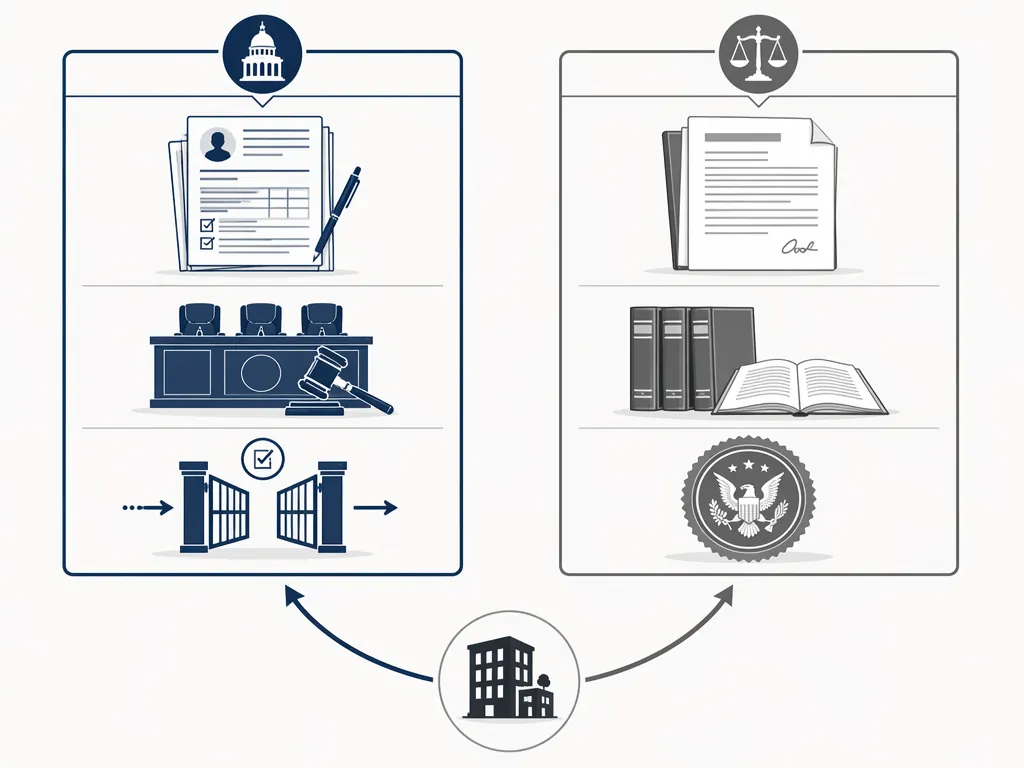
The Mills matter now sits across at least four legal or quasi-legal frameworks. House ethics rules can examine disclosures, conflicts, conduct unbecoming, and cooperation with congressional investigators. Federal procurement restrictions ask whether a member may benefit from government contracts. Campaign-finance law asks a narrower set of questions about contributions, loans, sources of funds, and FEC jurisdiction. Criminal law, if the reported DOJ inquiry matures into public action, would require its own statutes, evidence, and charging judgments.
| Framework | Main public question | Public status |
|---|---|---|
| House ethics | Whether Mills complied with disclosure, conflict, conduct, and cooperation obligations | House investigative subcommittee ongoing as of May 11, 2026 |
| Federal procurement restrictions | Whether Mills or entities connected to him benefited from federal contracts in a prohibited way | Raised in the OCE referral and under review in the House process |
| Campaign finance | Whether campaign loans or contributions violated FECA rules within the FEC’s authority | Related FEC complaints dismissed in September 2024, with OCE emphasizing the limits of that dismissal |
| Potential criminal statutes | Whether facts concerning Mills’ finances support any federal criminal theory | Reported by ABC News and NBC News; no public charge or DOJ statement |
That separation is not a lawyerly ornament. It is the difference between a finding that a complaint falls outside one agency’s reach and a finding that the underlying conduct is benign; between a House member’s failure to provide information in an ethics review and a criminal obstruction theory; between a disclosed business interest and a prohibited benefit from a federal contract. The labels may travel together in coverage. The legal tests do not.
House ethics begins with disclosure, conflicts, and cooperation
The OCE referral gave House investigators several tracks to pursue. One track concerned financial disclosures. OCE said ALS, Inc., a company affiliated with Mills’ Pacem entities, did not appear on Mills’ financial disclosure statements even though OCE identified shared corporate affiliations and addresses tying ALS to the same business ecosystem.[2] That kind of allegation belongs naturally inside the House ethics lane because congressional financial-disclosure rules are meant to let the public and the institution see the interests that may bear on a member’s official position.
A second track concerned cooperation. OCE reported that Mills refused to cooperate with its inquiry, retained outside counsel who also represented witnesses, and refused to provide tax returns. OCE characterized the pattern as “a concerted effort to limit OCE’s access to relevant information.”[2] In a criminal case, compelled evidence and counsel conflicts would be analyzed through a different body of law. In the House ethics process, the immediate question is institutional: can the fact-gathering body build a record when the member whose conduct is at issue declines to provide material it says is relevant?
That is why the House committee’s May 2026 update is more significant than a generic “still investigating” notice. The committee said the investigative subcommittee had authorized more than 20 subpoenas, collected thousands of documents, and contacted dozens of witnesses.[1] Subpoenas do not prove a violation. They do show that the committee moved from passive receipt of an OCE referral into compulsory evidence-gathering, which is often the only way to test allegations when voluntary cooperation is limited.
Procurement law is a separate lane, not a louder disclosure issue
The contracting allegations are the part of the Mills record most likely to be misread. A missing asset or business affiliation on a disclosure form is one issue. A sitting member’s possible benefit from federal contracts is another. They may arise from the same companies, addresses, or ownership claims, but they do not ask the same question.
OCE said entities owned by or affiliated with Mills secured close to $1,000,000 in federal contracts, including 94 contracts after January 9, 2024, primarily from the Bureau of Prisons for munitions, while Mills served on the Armed Services and Foreign Affairs Committees.[2] The date and count matter because the allegation is not merely that Mills had a private-sector past before entering Congress. The issue is whether federal work continued after he became a member and whether the structure of the entities left him with a prohibited benefit.
The relevant procurement restriction identified in the public materials is 18 U.S.C. § 431, alongside House Rule XXV. In broad terms, that regime is concerned with members benefiting from certain federal contracts. The House disclosure regime, by contrast, is concerned with whether interests and relationships were reported as required. A company can be fully disclosed and still raise a contracting problem; a company can be omitted from a disclosure and still require a separate inquiry into whether any federal contract benefit was legally prohibited. The Mills materials put both questions in play, which is why the OCE referral should not be reduced to paperwork allegations.
This is also where committee assignments become relevant without doing more work than the evidence permits. OCE noted that the contracts were primarily for munitions from the Bureau of Prisons while Mills served on the Armed Services and Foreign Affairs Committees.[2] That fact does not, by itself, establish that Mills used official power to obtain a contract. It does sharpen the conflict analysis because congressional ethics rules are designed to police the overlap between official duties, private interests, and public confidence in the independence of legislative work.
The FEC dismissal did not close the House ethics file
The campaign-finance material requires a narrower treatment than the contracting record. OCE noted that related FEC complaints were dismissed in September 2024, but it also stated that the dismissal rested on FEC jurisdictional limits rather than a merits resolution of the ethics questions OCE had raised.[2] That caveat is the point. An FEC dismissal can be procedurally important without being substantively exonerating for every adjacent House ethics issue.
FECA questions tend to turn on campaign-specific rules: contribution limits, the source of personal loans, reporting obligations, and whether the commission has authority over the conduct alleged. House ethics questions can ask whether a member’s broader financial relationships, disclosures, conflicts, or conduct meet congressional standards. Those standards may overlap in evidence, but they are not coextensive in jurisdiction or remedy.
For compliance readers, the practical lesson is not that one forum is stricter than the other in every case. It is that a dismissal letter from one regulator has to be read for what it actually decided. If the decision says the agency lacks jurisdiction or declines to proceed for reasons short of the merits, it should not be cited as though every institution with a different mandate has already answered the same question.
The reported DOJ inquiry adds risk, not a public finding
The reported criminal component is the least developed part of the public record and should be handled that way. ABC News reported that the Justice Department was investigating Mills and that the inquiry concerned his finances in part; NBC News separately reported the existence of a DOJ probe in the context of Mills resisting resignation calls.[3][4] Neither report supplies a public charging theory from the department. Neither turns the House ethics record into a criminal case.
Potential criminal statutes such as wire fraud or false statements would require elements that are not established by the existence of an ethics referral. A disclosure omission, a contract relationship, or a refusal to cooperate with OCE may be relevant facts in some future theory, but they are not substitutes for a public criminal allegation. The correct posture is caution: the DOJ reports make the Mills matter broader and more consequential, but the public evidentiary record remains much thinner there than it is in the House materials.
Personal-misconduct allegations sit nearby, with different proof problems
The House ethics environment around Mills is not limited to finances. The Hill reported on an October 2025 civil restraining-order filing by an ex-girlfriend and on a February 2025 Metropolitan Police Department incident involving dating-violence allegations.[5] Courthouse News Service also reported on the House Ethics Committee’s continuing review of domestic-violence-related allegations.[6] Those allegations may matter to the committee’s broader conduct review, but they should not be blended into the procurement or campaign-finance analysis as though all accusations share the same evidentiary path.
The same boundary applies to stolen-valor allegations raised by Rep. Nancy Mace in a March 2026 floor speech. The research record identifies those claims as unadjudicated and notes that Mills’ office called them “at best uninformed and at worst offensive slander.” Without a public adjudicative record, they belong in the category of political and ethics pressure points, not in the core analysis of federal contracting, disclosure, campaign-finance jurisdiction, or criminal exposure.
Mills has consistently denied the allegations against him and characterized the investigations as politically motivated. Those denials are part of the record. They do not, however, determine which institution has authority to investigate which facts, or what kind of evidence each body must obtain before it can make a finding.
What layered accountability can and cannot do
The Mills case is a useful study in member accountability precisely because no single forum supplies the whole answer. OCE can refer and document alleged noncooperation, but it cannot discipline a member on its own. The House Ethics Committee can subpoena, investigate, recommend sanctions, or impose committee-level consequences where available, but its process is institutional and often slow. The FEC can address campaign-finance violations within its jurisdiction, but its dismissal of related complaints did not resolve the House ethics questions identified by OCE.[2] DOJ, if the reported inquiry proceeds, would operate under criminal standards that are intentionally different from ethics standards.
Layering can be protective. It prevents one agency’s narrow jurisdiction from becoming the final word on conduct another body is better positioned to examine. It can also be frustratingly incomplete. Each institution may speak in caveats: no final findings yet, no jurisdiction, no public statement, no comment. For the people trying to reconstruct the record, those caveats are not evasions to be edited out. They are the architecture of the case.
That architecture leaves the Mills matter short of a final public judgment and still unusually dense. The important feature is not the number of allegations attached to one member. It is the way the same cluster of facts is being tested across internal House discipline, statutory contracting limits, campaign-finance jurisdiction, and a possible criminal inquiry, while none of those systems alone can yet give the public a complete answer.
References
- Statement of the Chairman and Ranking Member of the Committee on Ethics Regarding Representative Cory Mills, House Committee on Ethics, May 11, 2026.
- OCE Referral Regarding Rep. Cory Mills, Office of Congressional Ethics.
- DOJ investigating Rep. Cory Mills: Sources, ABC News, July 21, 2026.
- Cory Mills won't resign amid Congress ethics probe, misconduct allegations, NBC News, July 22, 2026.
- Cory Mills ex-girlfriend files restraining order, alleges threats, The Hill.
- House Ethics Committee still weeks from wrapping Cory Mills domestic violence probe, Courthouse News Service.
Comments
Join the discussion with an anonymous comment.