
Courtney Stodden’s July 2026 Instagram post did not describe a new lawsuit. It described a paperwork path. Stodden said they were a minor when they appeared in a 2012 Funny or Die sketch, that adults handled the contracts, that the paycheck went to Doug Hutchison, and that production proceeded anyway. “I was a minor working in an environment where the adults around me were responsible for my safety and well-being,” Stodden wrote, adding the line that matters most legally: “The contracts were signed by adults. The paycheck went to Doug. The production moved forward. I was the only child in the room.”[1]
That is the more precise frame for the legal issues around Stodden’s appearance in the sketch as a minor. The question is not simply whether the sketch was cruel or sexually inappropriate, although Jason Alexander has now called it “inappropriate” and offered his “sincerest apologies.”[1] The harder question is how a minor performer could pass through contracting, payroll, and production systems with no independent adult checkpoint strong enough to stop the engagement before the cameras rolled.
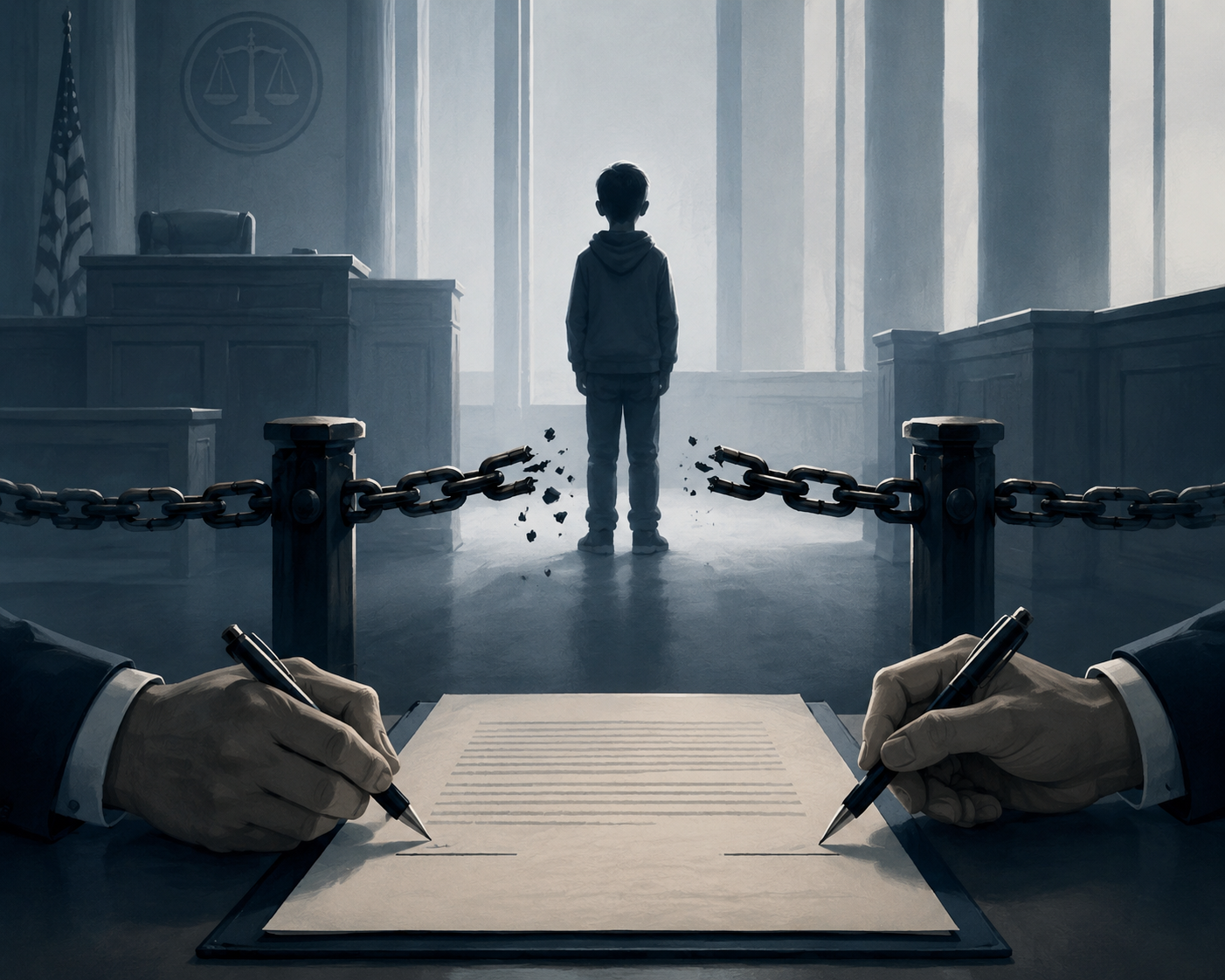
The facts that can be stated from the public record are limited. Stodden was 17 when the sketch was filmed. They had married Hutchison the year before, when Stodden was 16 and Hutchison was 51, under a California framework that then allowed a minor to marry with parental consent and a court order. Hutchison was also described as Stodden’s manager. Alexander is credited by IMDb as a writer on the sketch, a fact Stodden said made his later explanation “harder — not easier — for me to understand.”[1][2] No formal complaint or lawsuit by Stodden against Alexander, Funny or Die, or Hutchison is identified in the materials here.
The Statutory Protection That Depends on the Wrong Signature
California Family Code § 6710 gives a minor a familiar protection: with statutory exceptions, a contract of a minor may be disaffirmed by the minor before reaching majority or within a reasonable time afterward.[3] In ordinary entertainment contracting, that rule gives a young performer leverage against being held to a bargain made before legal capacity matured.
But Stodden’s account points to the failure mode. If the minor is not the visible contracting actor, the disaffirmance right loses much of its practical bite. A document signed by an adult spouse-manager is not experienced inside a production office as a child’s revocable promise. It is experienced as completed authority. The file is papered; payroll has a payee; clearance can move to the next step.
That distinction matters because § 6710 is not a roving child-protection officer. It does not sit in the room asking whether the adult who signed is independent, conflicted, or economically benefiting from the minor’s labor. It creates a legal power that someone must know to invoke and be practically able to invoke. In Stodden’s telling, the person who should have needed protection was not the person controlling the paperwork.
California also has a separate framework for court approval of minors’ entertainment contracts in Family Code §§ 6750–6753.[4] That system can make approved contracts more stable and can bring judicial scrutiny into certain minor-entertainment arrangements. But again, it depends on process. Someone must seek approval. Someone must put the agreement before the court. Someone must present the minor’s interests as interests distinct from the adults who profit from the work.
The public materials do not establish whether any court-approved entertainment contract existed for Stodden’s 2012 Funny or Die appearance. That uncertainty should not be filled in with assumption. The narrower point is enough: statutory architecture that relies on adult gatekeepers is vulnerable when the apparent gatekeeper is also the spouse-manager whose authority makes the minor less visible.
A Coogan Account Cannot Protect Money That Never Reaches the Child’s Side of the Ledger
The Coogan framework is often invoked as if it solves the minor-performer earnings problem. In California, the familiar rule requires 15% of a minor performer’s gross earnings to be placed in a blocked trust account for the minor’s benefit.[5] It is a narrow but important design choice: a portion of the child’s earnings should not be consumed by parents, managers, or the production cycle before the child reaches adulthood.
Stodden’s sentence — “The paycheck went to Doug” — is therefore not a stray accusation in a celebrity dispute. It describes a route around the protection the statute is supposed to provide.[1] If earnings are treated as payable to the adult who controls the engagement, the practical question becomes who was responsible for opening, identifying, funding, and respecting a blocked trust for the minor.

The research materials do not include production payroll records, bank records, a performer agreement, or a Coogan account file. So the point cannot be stated as a proven statutory violation. What can be said is that the Coogan model assumes that the child’s earnings are identifiable as the child’s earnings at the relevant administrative moment. If the production treats the adult spouse-manager as the payee, the law’s 15% reserve requirement depends on a chain of compliance that the minor may never see.
That is why the marriage-manager arrangement is not an incidental biographical detail. It changes the compliance environment. A parent-manager can also be conflicted, of course, but a minor spouse occupies an especially unstable legal position: adult enough, through marriage, for outsiders to treat the household as self-authorizing; still young enough that the entertainment-labor rules recognize vulnerability; and financially dependent on the very adult presenting himself as the person authorized to speak.
Work Permits and Set Oversight Are Process Rules, Not Force Fields
California requires minors working in entertainment to have entertainment work permits.[6] That requirement is meant to place a formal administrative checkpoint before a minor works. In a clean system, the existence of a work-permit process should make the minor’s age hard to miss and should make the production ask whether the engagement is being handled through the proper child-labor channels.
The available materials do not show whether Funny or Die obtained a permit for Stodden’s appearance. That gap matters. Without the permit file, there is no public basis to say whether the process was ignored, satisfied, misunderstood, or routed through an adult representative in a way that neutralized its protective function.
On-set oversight presents a second, quieter gap. California’s studio-teacher system is one of the mechanisms that can put an adult on set whose role is not creative, managerial, or financial. But the research materials identify the mandatory certified studio-teacher requirement as applying only to minors under 16; Stodden was 17.[7] That age line matters because it reduces the likelihood that a neutral adult will be physically present to recognize the problem in real time.
A 17-year-old performer can still be legally a minor. But the administrative texture changes. The production may not have the same school-hours constraints, studio-teacher presence, and day-to-day child-performer supervision associated with younger children. If the contract has been signed by an adult, the payee has been identified as an adult, and the set lacks a mandatory independent monitor, the minor’s status can become a fact everyone technically knows and no one operationally owns.
The Law Recognizes Exploitative Representation, But Not This Version Cleanly
California Labor Code § 1706 prohibits registered sex offenders from representing or providing specified services to minor artists.[8] Hutchison is not identified in the research materials as a registered sex offender, so that statute does not supply a direct answer to Stodden’s facts. Its relevance is narrower: California law has recognized that representation of minors in entertainment can itself be a site of danger, not merely a business arrangement.
The statutory line is much easier to administer when the disqualifying fact is a registration status. It is much harder when the risk comes from a lawful marriage that gives the adult social, financial, and practical control over the minor performer. The problem is not that California had no concept of predatory access to minor artists. The problem is that the specific access route Stodden describes did not require the system to treat the spouse-manager as a conflict.
Alexander’s Apology Matters Publicly, But It Does Not Resolve the Legal Question
Alexander’s 2026 response has legal significance mostly because of what it is not. He called the sketch “inappropriate” and apologized, but the materials do not indicate that he admitted legal liability, addressed compensation, or described the contracting process that allowed a 17-year-old to appear in the sketch.[1] Public accountability and legal admission are different categories.
The IMDb writing credit matters for a different reason. It places Alexander in a credited creative role on the sketch, which is why Stodden focused not only on performance after the fact but on adult authorship before the fact.[2] Still, authorship is not the same as payroll control, permit compliance, or contract approval. If the legal question is how the system failed to create a stop point, the analysis has to follow the documents as much as the jokes.
The Marriage Loophole Is the Administrative Center
California’s later debate over child marriage, including AB 1267, belongs in the background rather than the center of this analysis. The relevant point is that Stodden’s marriage was possible under a California framework that did not impose a minimum age floor and instead relied on parental consent and a court order. That legal status then interacted with entertainment work in a way the ordinary minor-performer rules were not built to handle.
Most minor-entertainment protections imagine a triangle: the child, the production, and an adult protector whose authority is supposed to be exercised for the child. Stodden’s account collapses that triangle. The adult spouse is also the manager. The manager is also the person who, according to Stodden, received the paycheck. The child’s legal vulnerability and the adult’s economic authority sit in the same file.
That is why a statute-by-statute answer can be misleading if it stops at recitation. Disaffirmance exists, but it is least useful when the minor is not the contracting face of the transaction. Coogan protections exist, but they require earnings to be routed and reserved as the minor’s earnings. Work permits exist, but they depend on production-side compliance and administrative recognition. Studio-teacher oversight exists, but the mandatory protection identified in the materials was reduced for a 17-year-old.
Stodden’s 2026 post does not give a court record to analyze. It gives a workflow to interrogate. On that workflow, the legal blind spot is plain enough: California had protections for minor performers, but those protections assumed an independent adult checkpoint. A marriage-manager arrangement can turn the supposed protector into the person controlling consent, contracts, and compensation.
References
- Courtney Stodden calls out Jason Alexander over ‘inappropriate’ Funny or Die sketch, Page Six, July 21, 2026
- Jason Alexander: Court Ordered, IMDb
- California Family Code § 6710, Justia
- California Family Code §§ 6750–6753, Justia
- Coogan Law, SAG-AFTRA
- Entertainment Work Permit, California Department of Industrial Relations
- Studio Teachers, California Department of Industrial Relations
- California Labor Code § 1706, Justia
Comments
Join the discussion with an anonymous comment.