
Craneware's July 19-20 RNS is the anchor point: the company said an unauthorized third party accessed and exfiltrated data, including employee and customer data, and that it had notified the ICO, the FBI, and other law enforcement while the investigation continued. [1]

What the filing fixes, and what it does not
Craneware is not a small downstream vendor. TechCrunch reports that it serves more than 2,000 U.S. hospitals and nearly 10,000 clinics, processes 165 million patient encounters a year, and added another 147 million patient records through its 2021 Sentry Data Systems acquisition. [2]
That scale does not prove PHI was taken, but it does explain why the legal problem spreads quickly: one vendor incident can turn into dozens or hundreds of separate compliance reviews, notice decisions, and contract questions at the customer level. Craneware's own security statement also matters here because it describes HITRUST CSF certification, SOC 2 Type II audits, annual penetration testing, and ISO 27001 alignment, so the breach will be judged against a declared control environment rather than against silence. [3]
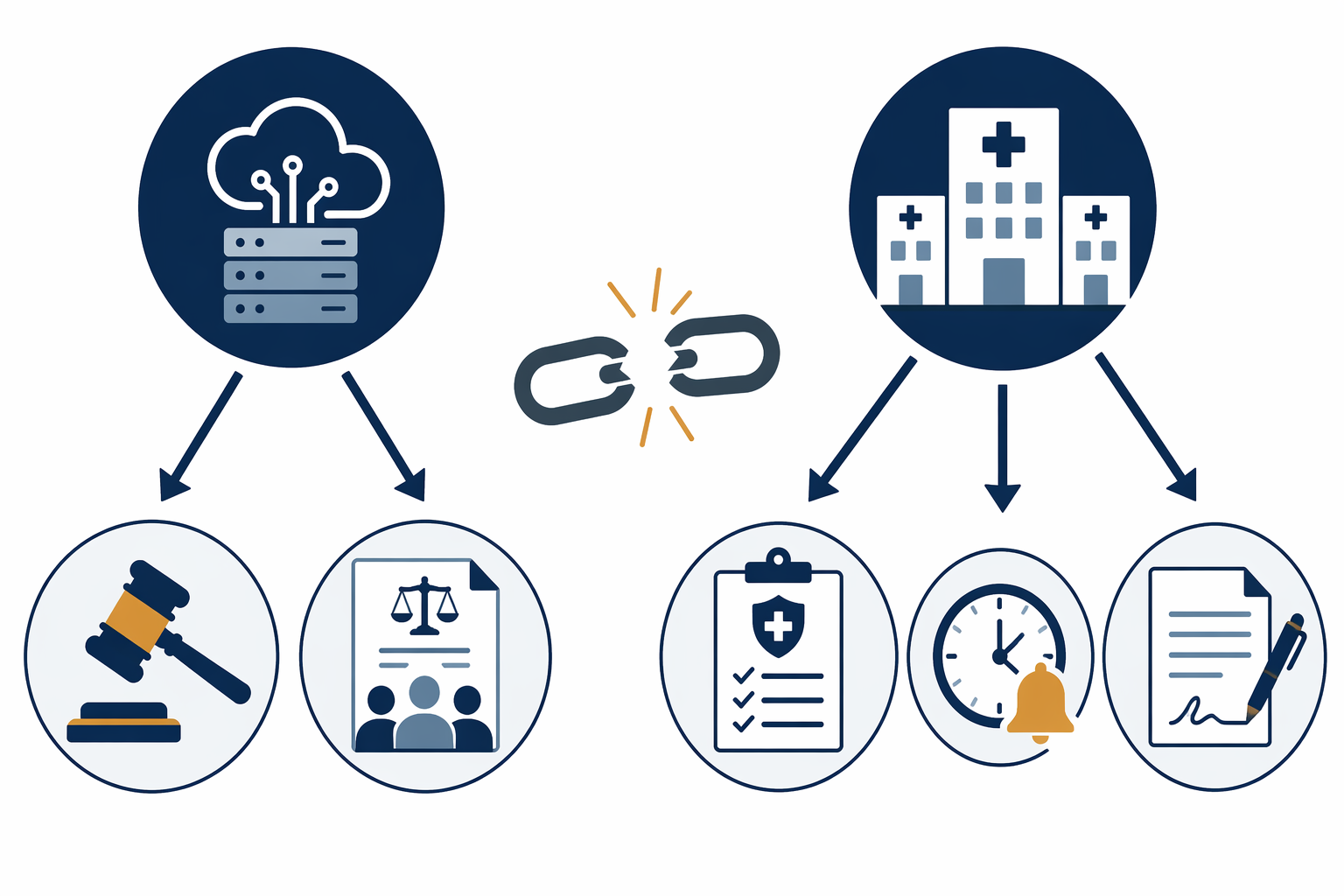
The sensitivity question is doing the real work
The immediate litigation hinge is whether Craneware's preliminary description of the stolen material as largely non-sensitive, or already public regulatory data, survives forensic review. If it does, the most aggressive class-action theories get narrower, because the First Circuit's June 2026 Santos-Pagán decision requires traceability, not merely timing, to connect a specific breach to a plaintiff's alleged identity harm. [6]
That does not end exposure, but it narrows the claims. Plaintiffs may still press disclosure, notice, and contract theories, and one investor note already called an 'Anthem-style' scenario likely off the table. [4]
The market reaction is worth a glance, but only as calibration. Craneware shares fell 6% on the initial filing and then 9.6% on the following trading day, which is enough to keep disclosure counsel alert and enough to invite plaintiffs' firms to look, but not enough by itself to define the legal outcome. [5]
Why the provider side is probably broader
The hospitals and clinics sitting behind Craneware's systems face a different and usually harsher problem. Under standard business associate agreement practice, a vendor breach can trigger independent HIPAA obligations, customer notice workflows, and state breach-notification clocks that start when the business associate discovers the incident, not when each provider finishes its own review. That is the asymmetry that makes healthcare vendor incidents so expensive for the client side.
A vendor-breach case study from Kelley Kronenberg is a useful warning rather than a prediction: the healthcare provider there absorbed $4.2 million in regulatory penalties and legal fees while the vendor's contractual liability was capped at $50,000, an 84:1 gap. [8] OCR's April 2026 enforcement actions also show the current penalty floor in healthcare data cases, with settlements of $320,000, $375,000, $225,000, and $245,000 tied to risk-analysis failures in ransomware incidents. [9]
The same April 2026 report also said nearly two-thirds of supply-chain risks in healthcare involved critical or high-severity vulnerabilities and that providers identified six times more supply-chain risks in H1 2026 than in H1 2025. [9] Put bluntly, the enforcement climate already assumes that third-party risk is not hypothetical, so every hospital client will have to decide whether Craneware's discovery date started its own response clock.
Executives and directors are not in the clear
Personal exposure for executives and board members is usually less immediate than entity exposure, but it does not vanish. If board materials, investor disclosures, or security certifications painted a stronger control picture than the systems actually supported, the risk shifts toward oversight claims, disclosure claims, and D&O coverage disputes rather than HIPAA itself. Craneware's own certification language and the market move after the filing matter here because they create the paper trail that securities and governance counsel will compare against the breach record. [3][5]
On the present record, Craneware faces real direct liability, but the preliminary non-sensitive characterization may limit the most severe class-action outcomes unless the investigation later turns up PHI or other sensitive data. The hospitals and clinics that rely on the platform face the wider immediate exposure because their HIPAA, BAA, and state-notice obligations are already in motion. If the forensic review changes the data classification, the whole risk picture changes with it.
References
- Notice of Cyber Security Incident — London Stock Exchange, July 20, 2026
- Hackers stole significant amount of data from tech firm relied on by thousands of US hospitals and pharmacies — TechCrunch, July 20, 2026
- Security Statement — Craneware Group
- Craneware shares fall as reports cybersecurity incident to FBI — Morningstar / Alliance News
- Craneware reveals cyber attack with employee and customer data stolen — Proactive Investors
- First Circuit affirms dismissal of data breach class action for lack of traceable injury — FirstClassDefense blog, June 2026
- Duane Morris Class Action Review 2026-2027 Mid-Year Class Action Settlement Report Analysis — Duane Morris Class Action Defense, July 1, 2026
- Your Vendor's Data Breach Just Cost You $4.8 Million: Why Your Business Bears Full Legal Liability — Kelley Kronenberg
- April 2026 Health Care Data Breach Report — HIPAA Journal, April 2026
Comments
Join the discussion with an anonymous comment.