
For hospital counsel, the first legal question after the Craneware cyberattack is not whether the vendor has a problem. It plainly does. The sharper question is whether the hospital can safely treat that problem as Craneware’s alone. On the facts disclosed so far, that would be a dangerous assumption.
Craneware disclosed on July 20, 2026, that hackers stole a “significant amount” of data from the company, whose billing and revenue-cycle software is used by more than 2,000 U.S. hospitals and pharmacies.[1] Cybersecurity Dive likewise reported the incident as a healthcare data breach affecting a vendor embedded in hospital revenue operations, while noting that key incident details remain undisclosed.[2] That placement matters. Billing and revenue-cycle systems are not peripheral marketing tools; they sit close to patient accounts, reimbursement workflows, coding, payer disputes, and regulatory documentation.

At the same time, the most important fact for HIPAA analysis is not yet established. Craneware has said most of the exfiltrated data was “non-sensitive or already public regulatory data,” and it has not confirmed whether protected health information was involved.[3] If the data set contains no PHI, HIPAA breach notification obligations may not be triggered. If PHI was involved, the analysis changes quickly from vendor incident management to a covered-entity notification and regulator-response problem.
The Legal Exposure Starts Before Anyone Knows the Full Data Set
The uncomfortable part of a vendor breach is the timing mismatch. Legal obligations begin to form while the forensic record is still incomplete. The hospital needs to know whether PHI was accessed, acquired, used, or disclosed in a way that compromises privacy or security. The vendor may still be sorting data, systems, logs, and contractual notice language. OCR, patients, board members, and state regulators will not wait indefinitely for perfect clarity.
The analysis should start with classification, not blame. The legal team needs a defensible answer to four questions: what data left Craneware’s environment, whether any of it was PHI, which covered entities supplied or controlled that PHI, and what the applicable business associate agreement says Craneware must do after discovering a security incident.
Attack mechanics are secondary for now. The threat actor, initial access route, ransom posture, and access timeline remain undisclosed.[2] Those facts may become important for security remediation and litigation theories, but they do not answer the hospital’s immediate HIPAA question. A hospital can have notification obligations even when the narrative of how the attacker got in is still unfinished.
Craneware Has Direct Business Associate Exposure
Craneware’s role is not legally neutral. HIPAA Journal identified Craneware as a HIPAA business associate in connection with the incident, which means the company can carry direct obligations under HIPAA as modified by the HITECH Act and the Omnibus Rule.[3] That is the first half of the liability structure. A business associate that creates, receives, maintains, or transmits PHI for a covered entity is not merely a contractor standing outside the HIPAA framework.
Direct business associate liability matters because it gives OCR a path to scrutinize Craneware’s own safeguards, breach response, and compliance posture if PHI was implicated. It also matters because hospitals will need Craneware to perform quickly and precisely: identify affected covered entities, determine the categories of data involved, support risk assessment, and provide the information necessary for patient and regulator notices.
But direct liability for Craneware does not dissolve the hospital’s obligations. It only means OCR may have more than one regulated entity to examine. In a billing-software breach, the covered entity should assume that the regulator’s next question will be practical: who is making sure affected individuals receive legally sufficient notice if PHI was compromised?
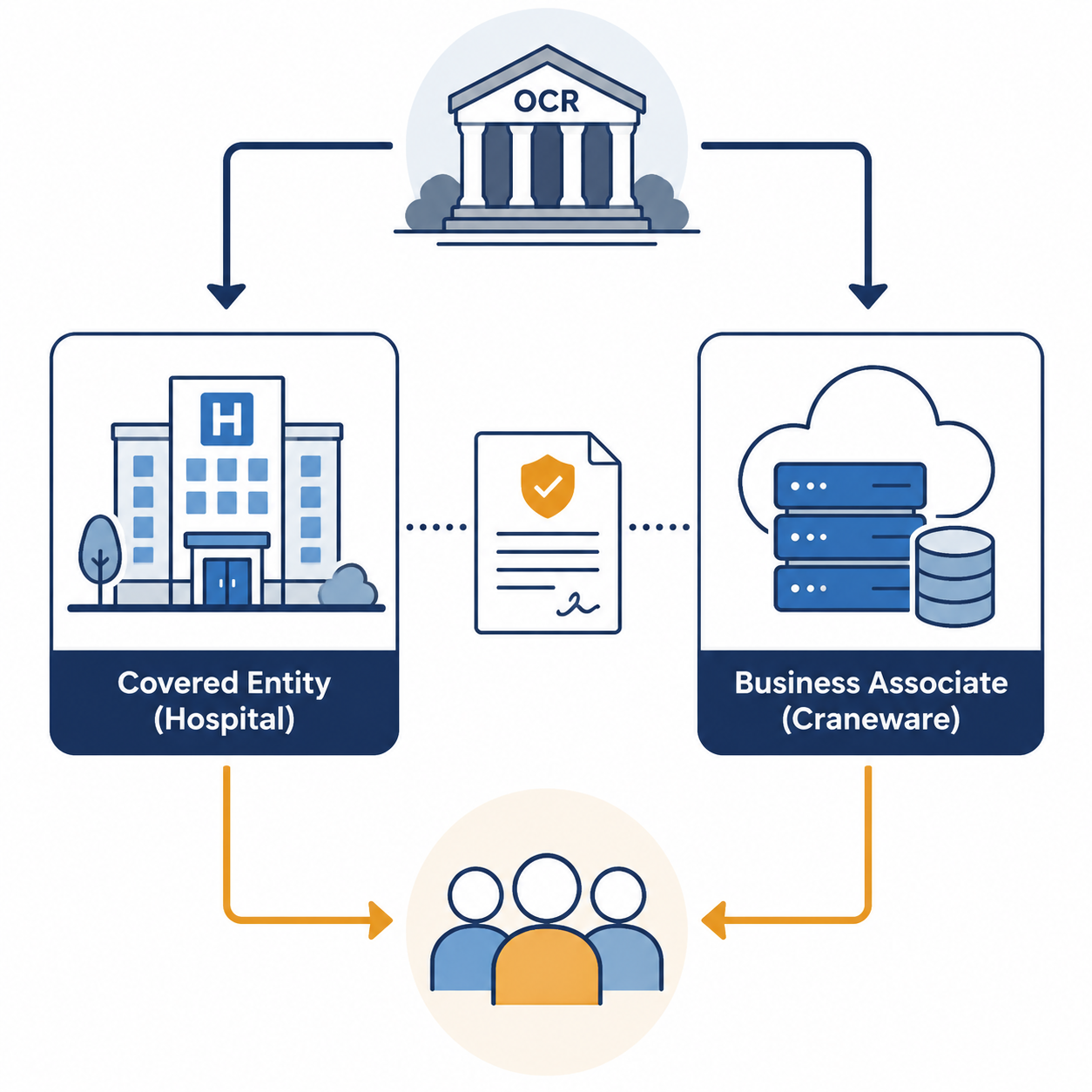
The Covered Entity Still Owns the Notification Problem
After the Change Healthcare cyberattack, OCR’s public posture made one point difficult to miss: covered entities may delegate breach notification tasks, but they do not delegate away ultimate responsibility for HIPAA breach notification compliance. ArentFox Schiff’s alert on OCR’s May 2024 Change Healthcare guidance emphasized that providers still faced HIPAA compliance questions even where a major vendor was at the center of the incident.[4]
That distinction is the one hospital teams should keep in front of executives. Craneware may send notices if the BAA permits or requires it. Craneware may provide substitute notice content, call-center scripts, affected-population files, or draft regulator submissions. None of that automatically means the hospital has no remaining duty to confirm that notice is timely, complete, and directed to the correct people and agencies.
The hospital’s legal risk therefore turns on execution as much as doctrine. If PHI was involved, someone must decide whether the incident meets the HIPAA breach definition, whether any exception applies, whether a risk assessment is defensible, whether media notice is required, and whether HHS notice is due. A vendor can supply inputs. The covered entity usually cannot treat those inputs as a substitute for its own legal judgment.
The BAA May Decide How Much Responsibility Sticks
The business associate agreement is not a filing-cabinet document in this scenario. It is the working map for who must do what, by when, with whose approval, and at whose cost. Counsel should pull the Craneware BAA immediately and read it against the facts already known, not against the reassuring general idea that “the vendor will notify us if needed.”
| BAA provision | Why hospital counsel should care now |
|---|---|
| Incident and breach notice deadline | A vague “without unreasonable delay” clause creates different operational pressure than a fixed short notice period. |
| Data-identification obligations | The hospital needs affected-patient fields, data categories, and entity-level segmentation, not a generic assurance that review is ongoing. |
| Delegation of individual notice | If Craneware sends notices, the hospital still needs approval rights, proof of mailing, call-center readiness, and regulator-facing documentation. |
| Control over methods and content | Control language can affect whether the hospital appears to have retained authority over the vendor’s conduct. |
| Indemnity, cooperation, and cost allocation | These clauses do not eliminate HIPAA duties, but they shape who pays for forensic support, notices, credit monitoring if offered, and defense costs. |
Compliancy Group’s analysis of covered-entity liability for business associate conduct focuses on a point that is easy to miss in the first week of a breach: OCR may look at whether the BAA and actual relationship gave the covered entity control over the business associate’s performance.[5] That does not mean every business associate breach becomes a covered-entity violation. It means the contract language and operating reality can affect whether vicarious liability is plausible.
For hospitals, the risk is usually not one bad clause in isolation. It is the combination of retained approval rights, detailed instructions, delegated notice mechanics, weak audit follow-through, and an incident record showing that the hospital knew enough to act but did not press for the information needed to discharge its own duties. The BAA can help, but it can also become Exhibit A in explaining why the hospital remained in the middle of the response.
Do Not Turn the $4.8 Million Example Into a Rule
There is a useful cautionary illustration in Kelley Kronenberg’s attorney-authored discussion of a vendor data breach costing a covered entity $4.8 million.[6] It is useful because it reflects the kind of costs hospital teams actually see after vendor incidents: outside counsel, forensic support, notification work, regulator response, possible settlement pressure, and internal disruption. It is not useful if treated as a damages schedule, regulatory benchmark, or prediction for Craneware customers.
The right lesson is narrower and more practical. A vendor breach can become expensive for the covered entity even when the vendor is the compromised party. That cost may come through compliance work before any lawsuit exists. It may come through regulator questions before any penalty is proposed. It may come through board reporting, patient communications, and contract enforcement long before anyone can estimate litigation exposure.
As of July 22, 2026, no class action lawsuit has been filed against Craneware based on the materials reviewed for this analysis. Any class-action risk assessment is therefore inferred from parallel healthcare data-breach litigation, not from an existing Craneware complaint. Counsel should track that risk, but not let speculative pleadings distract from the obligations already ripening under HIPAA and the BAA.
What In-House Teams Should Do in the First Response Window
The safest response is to manage the incident as shared exposure until facts and contract language prove otherwise. That does not mean assuming PHI was breached. It means assuming the hospital must be able to show how it tested that question, supervised delegated tasks, and preserved its own decision-making record.
1. Force the PHI Question to the Front
Ask Craneware for a written data-impact statement that separates confirmed facts from ongoing review. The response should identify whether any PHI was accessed or exfiltrated, the categories of data at issue, the systems involved, whether data can be mapped to specific covered entities, and what evidence supports any conclusion that the data was non-sensitive or already public regulatory information.
A broad statement that most data was not sensitive is not enough for breach-notification analysis. “Most” does not answer whether any patient-specific billing, encounter, account, payer, coding, or demographic information was included. The hospital needs a yes, no, or still-under-review answer tied to its own data.
2. Read the BAA Before Agreeing to the Response Structure
The legal team should not wait for a vendor-prepared response plan before checking the BAA. Start with notice timing, breach determination authority, cooperation duties, indemnity, subcontractor provisions, audit rights, and who controls communications to patients, regulators, and media. If Craneware proposes to send notices centrally, the hospital still needs to know whether the contract permits that approach and what approval rights the hospital retains.
The BAA review should also be operational. If a clause says Craneware must provide information necessary for the hospital to satisfy HIPAA, assign an owner to press for that information. If the agreement requires prompt notice but Craneware has not provided affected-entity files, document the gap and escalation. The record should show active supervision, not passive waiting.
3. Preserve Privilege Without Freezing the Business Response
Hospital counsel should establish a privileged response channel for legal advice on HIPAA duties, contract rights, regulatory exposure, and potential claims. That channel should include the people who need to make decisions: privacy, compliance, security, revenue cycle, patient relations, communications, and vendor management. The point is not to label every operational message privileged. The point is to keep legal analysis, risk assessment, and board advice from being scattered through ordinary project traffic.
At the same time, do not let privilege discipline become an excuse for slow collection. The hospital still needs a clean chronology, copies of Craneware notices, internal decision logs, patient-impact assumptions, and a list of open questions. If OCR asks what the covered entity did after learning of the incident, the answer should not depend on memory.
4. Map the Duties That Cannot Be Outsourced
Create a short regulator-facing responsibility map. It should identify who will make the breach determination, who will approve patient notice content, who will submit any required HHS notice, who will coordinate state-law analysis, who will brief the board or audit committee, and who will maintain evidence of vendor cooperation. Some of those tasks may be performed by Craneware or outside counsel. The hospital should still know who is accountable internally for confirming completion.
- Do not assume Craneware’s notification plan satisfies the hospital’s HIPAA obligations without reviewing the BAA and the affected-data evidence.
- Do not issue patient-facing statements that imply PHI exposure before that fact is established.
- Do not accept entity-wide population estimates when the hospital needs patient-level or account-level impact analysis.
- Do not let indemnity discussions delay breach assessment, notice preparation, or regulator-response planning.
The Practical Legal Posture
The Craneware incident is best treated as a dual-liability event unless the data review proves that no PHI was involved. Craneware may face direct HIPAA business associate exposure. Hospitals and pharmacies that rely on Craneware may still retain breach-notification responsibility and may face vicarious-liability arguments depending on the BAA and the degree of retained control.
References
- Hackers stole significant amount of data from tech firm relied on by thousands of US hospitals and pharmacies, TechCrunch, July 20, 2026
- Craneware health care data breach, Cybersecurity Dive
- Craneware Cyberattack and Data Breach, HIPAA Journal
- Providers Face HIPAA Compliance Questions After Change Healthcare Cyberattack, ArentFox Schiff
- When is a Covered Entity Liable for a Business Associate Breach?, Compliancy Group
- Your Vendor’s Data Breach Just Cost You $4.8 Million: Why Your Business Bears Full Legal Liability, Kelley Kronenberg
Comments
Join the discussion with an anonymous comment.