
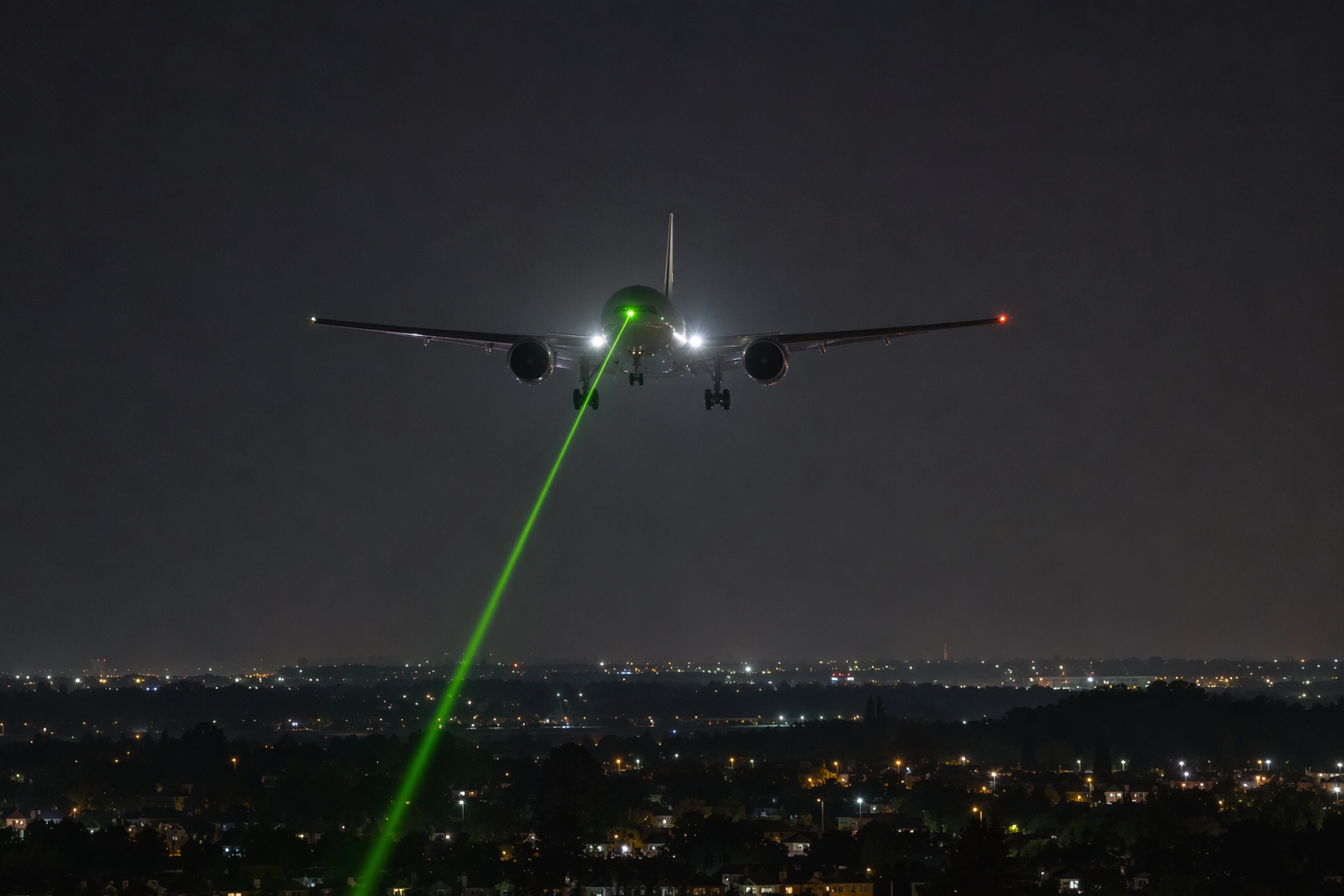
Nicholas Crapsi’s sentencing for pointing a laser at Delta Flight 2334 ended with an 18-month federal prison term, not probation, time served, or the five-year statutory ceiling. That placement matters. The conduct lasted roughly 60 to 90 seconds on the night of March 2, 2024, as a Delta Air Lines flight from Fort Myers was on approach to Buffalo Niagara International Airport; the cockpit was illuminated, and the first officer reported temporary vision disruption.[1]
The government asked for 18 to 24 months. Judge Richard J. Vilardo imposed the bottom of that requested range in July 2026. The available record suggests a sentence driven by general deterrence and cockpit-effect facts, but tempered by mitigation concerning Crapsi’s autism spectrum diagnosis and profound deafness.[2]
That is the useful way to read the sentence. It was not a maximum-punishment case. It was also not a case in which disability mitigation displaced aviation-safety concerns. Once the record contained a named commercial flight, final-approach timing, cockpit illumination, and a reported vision disruption by a flight officer, the sentencing question became how much prison, not whether the event could be treated as ordinary impulsive mischief.
The Conduct That Framed the Sentence
The laser strike occurred at approximately 10:15 p.m. on March 2, 2024. According to reported federal case materials, Crapsi aimed a green laser at Delta Flight 2334 while the aircraft was about one mile south of the approach path to Buffalo Niagara International Airport. Pilot reports described the laser as visible through the cockpit windows from more than 10 miles away.[1]
Those facts carried more sentencing weight than the word “laser” does in the abstract. Federal courts do not need to treat every bad decision involving a handheld device as equally dangerous. A laser aimed at a commercial cockpit during final approach narrows the margin for error at the moment when the crew is already managing altitude, runway alignment, air traffic communications, and landing procedures.
The government’s public account used broad danger language. U.S. Attorney Trini E. Ross said, “This conduct is incredibly dangerous and cannot be tolerated. Not only did the defendant endanger the lives of the passengers and crew, but he did so without any regard for the consequences.”[1] At sentencing, though, the more important feature was not the adjective. It was the sequence: illumination of the cockpit, temporary disruption to the first officer’s vision, and a commercial aircraft near landing.
Why the Suppression Challenge Failed
Before sentencing, Crapsi challenged the evidence recovered after police responded to the reported laser strike. The suppression issue matters for future cases because laser-strike investigations often begin with a compressed chain of information: a pilot report, an approximate location, a ground witness, and officers trying to act before the person inside a residence can hide or discard the device.
PEOPLE, which reported that it obtained copies of the suppression ruling and sentencing memoranda, described a record in which a neighbor reported seeing a green laser beam coming from Crapsi’s bedroom window. Police responded, observed the laser from outside, and later found the laser device in plain view on his bed after entering the residence. The parties disputed the legality of the entry, including whether consent or exigency justified it.[2]
The court denied suppression. As reported, the ruling treated the neighbor’s observation and the pilot’s timing-and-location information as enough to establish probable cause.[2] That is a practical holding for this category of case. Officers did not have to begin with a laboratory-grade beam trace or a perfect map. They had a contemporaneous aircraft report, a ground-level witness tying the beam to a particular window, and their own observation of a laser before the device was recovered.
- The neighbor report supplied a residential source point rather than a generalized neighborhood suspicion.
- The pilot timing and location data connected that source point to the aircraft incident.
- Police observation from outside reduced the case’s dependence on the neighbor alone.
- The device’s plain-view location on the bed mattered only after the court accepted the legal basis for police presence inside.
Because that account rests on reported case materials, future defense use should be cautious. Still, the reported ruling is notable because it shows how quickly probable cause can form in a laser-strike investigation when aircraft data and a civilian source observation line up.
The Statute Was Brief; the Sentencing Fight Was Not
Crapsi pleaded guilty in December 2025 to one count under 18 U.S.C. § 39A, the federal statute prohibiting aiming a laser pointer at an aircraft or its flight path.[3] The statute carries a maximum sentence of five years in prison and a $250,000 fine, and it was enacted as part of the FAA Modernization and Reform Act of 2012.[4]
That maximum did not drive the actual result. In most federal sentencing practice, the ceiling mainly marks congressional seriousness and bargaining leverage. The contested issue is where the defendant belongs below it. Here, the government’s proposed range of 18 to 24 months supplied the operative band, and the imposed sentence landed at its floor.[2]
Civil enforcement also sits in the background. The FAA’s 2026 adjusted maximum civil penalty for laser violations can reach $32,646 per violation.[5] But Crapsi’s case was not treated as a civil-penalty matter. The federal criminal statute supplied the vehicle, and the sentencing hearing became a contest over deterrence, culpability, and mitigation.
Deterrence Did Real Work, but Not Mechanical Work
The government’s sentencing memorandum cited 12,840 reported laser strikes in 2024 as part of its general-deterrence argument.[2] That number is easy to misuse. It does not prove that this defendant’s conduct was more injurious than the record shows. It does not convert every identified laser-strike defendant into a prison candidate by arithmetic alone.
Its sentencing function was narrower and more powerful: it made a noncustodial sentence harder to justify. A court facing a national incident count can reasonably ask what message probation sends when the particular case also includes a commercial aircraft, a final-approach setting, cockpit illumination, and a crew member’s temporary vision disruption. The statistic supplied context for general deterrence; the flight-specific facts supplied the reason this defendant was a useful vehicle for it.
That distinction is important for defense counsel. Attacking the national figure as too general may not be enough if the defendant’s own facts give the court a clean deterrence narrative. The stronger defense move is often to separate the national pattern from the case-specific consequence: yes, laser strikes are common enough to concern the FAA and federal prosecutors, but this client’s sentence still must turn on what happened in this cockpit, during this flight phase, with this defendant’s mental state and history.
Disability Mitigation as a Ceiling-Limiting Argument
The defense sought time served and relied on Crapsi’s autism spectrum disorder diagnosis and profound deafness.[2] That kind of mitigation is not cosmetic. It can affect culpability, communication with police, comprehension of risk, custodial hardship, and the kind of supervision plan a defendant can realistically follow.
But disability mitigation has to be made legible without asking the court to pretend the cockpit event did not occur. That is the difficult line in a case like this. If counsel frames disability as an excuse for the conduct, the argument collides with aviation safety. If counsel frames it only as sympathy, it risks sounding unrelated to the sentencing factors. The more useful framing is functional: what did the diagnoses affect, what did they not affect, and what sentence is sufficient without being greater than necessary?
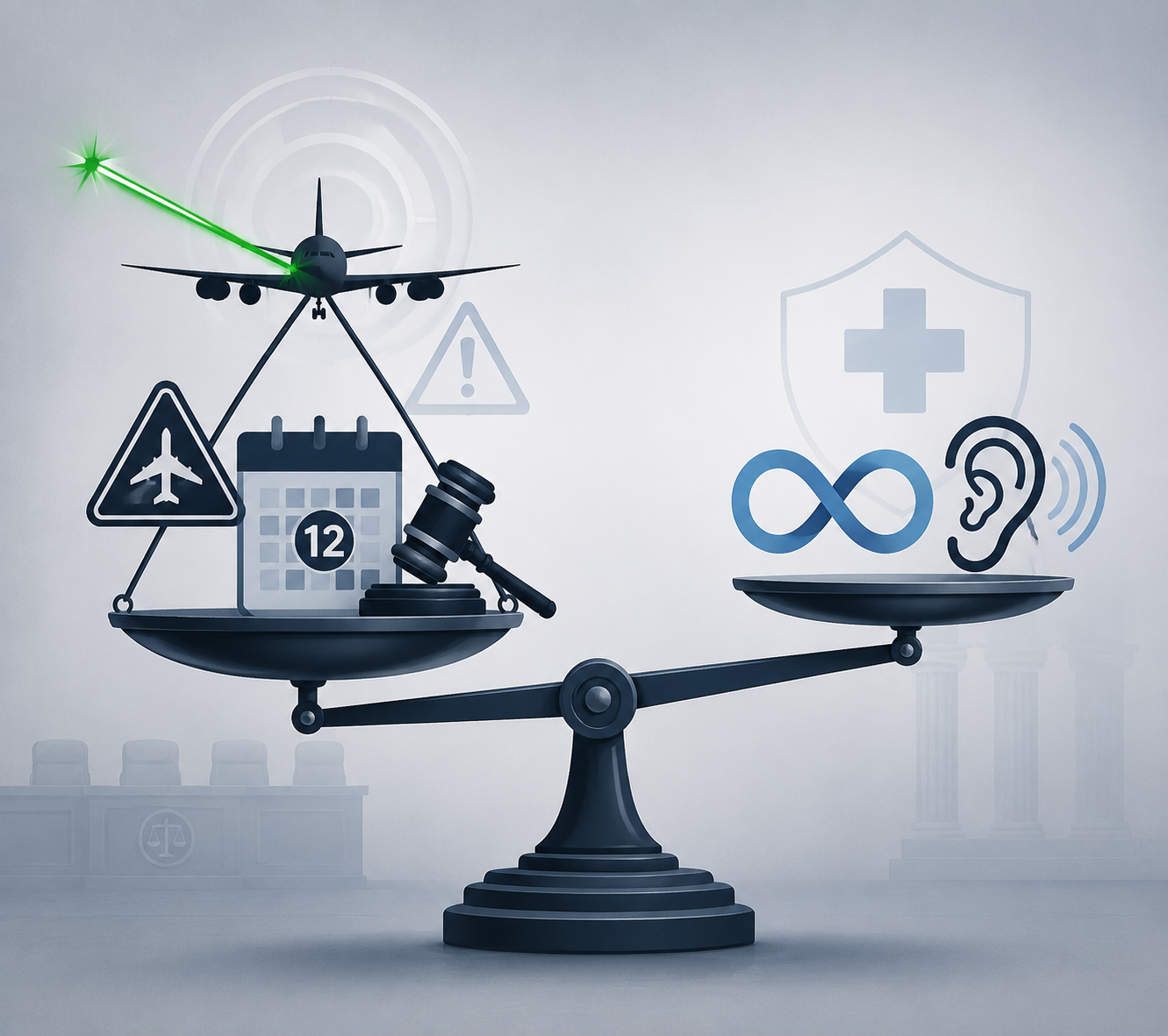
The 18-month sentence suggests the court credited mitigation, but as a ceiling-limiting factor rather than a departure engine. The government asked for as much as 24 months. The court imposed 18. That leaves room to infer that Crapsi’s disabilities helped prevent the upper-end sentence while not overcoming the court’s view that actual imprisonment was needed.[2]
That inference should be kept modest. Without the full sentencing transcript and memoranda, it would be too strong to say exactly how Judge Vilardo weighed each fact. The better-supported reading is that the sentence sits between two rejected positions: it refused the defense’s time-served request, and it refused the government’s upper-end request.
How Crapsi Compares With Other § 39A Sentences
The sentence also makes more sense when placed beside other first-time commercial-aircraft laser cases. A sentencing compilation maintained by Laser Pointer Safety lists 18-month sentences in cases such as Hendricks and Sahagun, a 24-month sentence in Link where the defendant had an extensive criminal record, and a 51-month sentence in Shorey where pilot injury was present.[6]
| Comparison Point | Why It Matters |
|---|---|
| Hendricks and Sahagun: 18 months | Crapsi’s sentence aligns with reported first-time commercial-aircraft custodial outcomes. |
| Link: 24 months with extensive criminal record | Criminal history can move a laser-strike case above the 18-month benchmark. |
| Shorey: 51 months with pilot injury | Documented injury changes the sentencing gravity substantially. |
| Belen, Loven, and Salazar-Leija: probation-only outcomes | Probation has appeared where defendants demonstrated genuine ignorance of the hazard. |
These comparisons are calibration tools, not binding rules. The database is a sentencing compilation, not a guidelines manual, and case records differ in detail and accessibility. Still, the pattern is useful. Crapsi’s 18 months is not an outlier if the comparison set is first-time defendants who aimed lasers at commercial aircraft and produced cockpit effects.
The probation-only cases are the more interesting defense comparison, but also the harder one. They involved defendants who demonstrated genuine ignorance of the hazard.[6] Crapsi’s reported record, by contrast, included a prolonged strike, a cockpit illumination event, and a first officer’s temporary vision disruption. Those facts make ignorance a less stable foundation for a noncustodial sentence, even if the defendant presents unusually serious disability mitigation.
The Practical Signal for Future Laser-Strike Cases
Crapsi does not establish that every identified § 39A defendant should receive prison. The available record is not broad enough for that, and the underlying suppression ruling and sentencing memoranda should be reviewed directly through PACER before anyone treats their wording as settled authority.
It does support a narrower and more practical proposition: when the government can prove a commercial-aircraft laser strike during final approach, cockpit illumination, crew vision effects, and a national deterrence record, a court is likely to view the case as more than impulsive misconduct. In that setting, the key sentencing fight is often over the height of the custodial term.
The 18-month term is best read as a lower-half deterrence sentence. The court appears to have recognized Crapsi’s autism and deafness, but not as reasons to erase prison from the sentencing options. They limited the ceiling; they did not become the engine for time served.
References
- Cheektowaga Man Going To Prison For Pointing A Laser At An Aircraft — U.S. Attorney’s Office, Western District of New York
- Man Who Aimed Laser at Delta Flight Sentenced to 18 Months in Prison — PEOPLE
- Upstate NY man sentenced to 18 months in prison for pointing laser at airplane — Syracuse.com
- 18 U.S.C. § 39A — Cornell Law School Legal Information Institute
- FAA Laser Incidents — Federal Aviation Administration
- Laser Pointer Safety sentencing compilation — Laser Pointer Safety
Comments
Join the discussion with an anonymous comment.