
The useful question after a mechanical-failure cruise stranding is not whether passengers “have rights.” They usually do. The harder question is whether those rights can be enforced, in time, in the required forum, for damages that justify the effort. For most non-injury stranding claims, the first serious document is not the Coast Guard report, the news footage, or the cruise line’s apology. It is the passenger ticket contract.
This article is informational legal analysis for research and news-analysis purposes. It is not legal advice, and it does not substitute for reviewing the governing ticket contract, itinerary, incident facts, and controlling law in a specific matter.
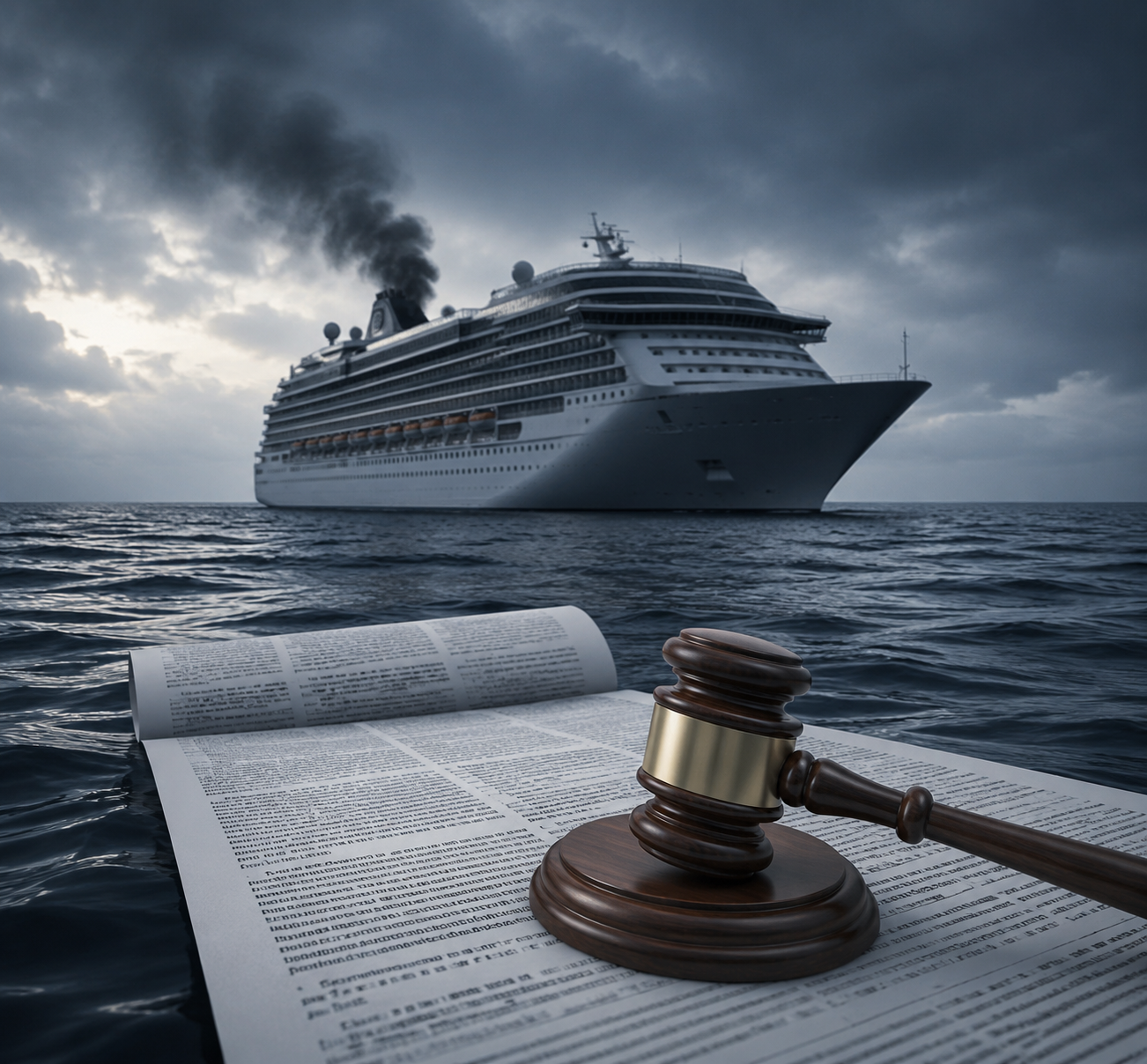
The claim starts broad, then narrows quickly
A disabled ship looks like a public maritime event. Passengers may be frightened, hot, sleep-deprived, delayed, embarrassed, or stranded far from home. Some may miss flights, work, medical appointments, or family obligations. Those harms feel immediate and personal. In litigation terms, however, they often sit in an awkward zone: serious enough to matter, but not always enough to overcome contract limits, proof problems, and the cost of litigating in the selected forum.
Several bodies of law may be nearby. General maritime law supplies the negligence backdrop. The Death on the High Seas Act matters when a death occurs beyond the statutory maritime boundary. The Cruise Vessel Security and Safety Act addresses vessel safety and reporting obligations. The Cruise Lines International Association Passenger Bill of Rights supplies voluntary industry commitments. The Federal Maritime Commission has a role in certain cruise service complaints. None of those, by itself, should be mistaken for a clean private damages pathway for every stranded passenger.
The practical narrowing usually happens through the contract. Practitioner discussions of cruise litigation repeatedly identify the passenger ticket as the document that shortens the time to act, selects the forum, limits procedural options, and frames what the cruise line has agreed to provide or disclaim.[1][2]
The ticket contract does much of the liability work
In ordinary maritime personal injury litigation, a plaintiff may think first about negligence and a three-year limitations period. Cruise passenger tickets commonly change that litigation posture. Plaintiff-side maritime lawyers describe provisions requiring written notice of a claim within six months, suit within one year, and venue in the Southern District of Florida or another specified forum tied to the cruise line’s principal place of business.[1][2]
Those terms are not ornamental. The Eleventh Circuit is a recurring venue for cruise disputes because major cruise lines use South Florida ticket provisions, and practitioner commentary treats forum-selection clauses, shortened limitation periods, and class-action waivers as routinely consequential in passenger cases.[1][2] A passenger who waits for a customer-service negotiation to run its course may discover that the legally relevant clock was already running from the date of injury or incident, not from the date the cruise line finished considering a goodwill payment.
| Issue | Why it matters in a stranding claim |
|---|---|
| Presuit notice | A ticket may require written notice within six months, making informal complaints an unsafe substitute for contract-compliant notice. |
| Limitations period | A ticket may require suit within one year, shorter than the default maritime personal injury period discussed by practitioners. |
| Forum selection | A passenger from another state or country may have to litigate in South Florida or another selected forum. |
| Class waiver | Passengers with modest individual damages may lose the practical leverage of aggregate litigation. |
| Disclaimers and exclusions | The contract may limit theories based on itinerary changes, delays, emotional distress, or nonphysical inconvenience. |
This is why “Can I sue?” and “Where?” are the same question in many cruise cases. A claim that might be economically plausible in a passenger’s home state can become uneconomic if it must be filed in Miami, governed by a one-year contractual deadline, supported by admissible proof of compensable damages, and pursued individually rather than as a class.
That does not mean every provision wins in every case. Contract formation, notice, statutory compliance, ambiguity, public policy, and the passenger’s status can all matter. But an intake memo that begins with the news story instead of the ticket risks putting the least decisive facts first.
Maritime law supplies the frame, not always the recovery
For physical injury, the familiar maritime negligence questions still matter: duty, breach, causation, notice, damages, and comparative fault. A disabled vessel can produce conventional injury claims if a passenger falls in darkness, suffers a medically documented condition, or is harmed during evacuation. Those claims should not be collapsed into the weaker category of discomfort-only stranding claims.
Non-injury cases are harder. Delay, spoiled vacation time, unpleasant conditions, anxiety, and humiliation are real passenger harms, but they often run into contract exclusions, maritime limits on emotional-distress recovery, and proof problems. A lawyer can be sympathetic and still have to explain that a week of miserable facts does not automatically produce a high-value claim.
Death cases occupy a different legal category. The Death on the High Seas Act may govern when a death occurs beyond the relevant statutory boundary, and it has its own remedial structure. A mechanical-failure stranding with no death or bodily injury should not borrow the gravity of DOHSA analysis unless the facts actually support it.
The CLIA Passenger Bill of Rights is operationally important but legally limited
The CLIA Passenger Bill of Rights is often cited after high-profile cruise incidents because it speaks in passenger-facing terms. It includes commitments concerning disembarkation from a docked ship when essential provisions cannot adequately be provided, full refunds for mechanical-failure cancellations, partial refunds for voyages terminated early due to mechanical failures, emergency power, medical care, timely information, transportation to the scheduled port of disembarkation or home city in certain mechanical-failure circumstances, and lodging where disembarkation and overnight stay are required.[3]
Those commitments can matter enormously in the moment. A stranded passenger may care more about transportation home, hotel arrangements, medication access, toilets, air conditioning, and accurate information than about a later damages theory. Cruise lines also have reputational and operational reasons to honor public commitments quickly.
But voluntary commitments are not the same thing as a private right of action. Waks & Barnett’s passenger-rights discussion states that the CLIA bill does not create an enforceable private cause of action for passengers.[4] That distinction should stay visible. A promise may shape conduct and compensation offers without giving a plaintiff an independent lawsuit if the promise is not incorporated into an enforceable contract term or supported by another legal theory.
The FMC is not a general cruise tort court
The Federal Maritime Commission is another place where passengers may look for help, but its jurisdiction should not be overstated. The FMC’s cruise-service page states that the agency does not adjudicate personal injury, emotional distress, wrongful death, or other maritime tort claims against cruise lines; its role is directed to certain contractual cruise service issues.[5]
That boundary matters for triage. A complaint about refunds, cancellation terms, or cruise service performance may fit differently from a negligence claim for bodily injury or a tort claim arising from evacuation. Treating the FMC as a general venue for stranded-passenger damages will mislead clients and delay more time-sensitive contract or court deadlines.
Recent reporting and notice developments improve visibility more than private leverage
Recent commentary has described 2025 changes affecting cruise accident practice, including expanded incident reporting expectations, digital ticket notice rules, and updated international safety standards.[6] Those developments are useful for compliance review, evidence preservation, and passenger notice analysis. They should not be turned into a broad claim that stranded passengers now have a dramatically stronger private damages remedy unless primary regulatory materials and the governing ticket language support that conclusion.
For official reporting context, the U.S. Department of Transportation maintains cruise line incident reports.[7] DOT visibility can help counsel identify reported incidents, compare public descriptions, and evaluate whether a cruise line’s disclosures are consistent. It is not, by itself, a damages award.
The evidentiary value is still real. If an incident is reportable, the existence, timing, and content of a report may help establish chronology, notice, or operational response. But a passenger still has to connect that record to a viable cause of action, a timely filing, a proper forum, and recoverable damages.
Carnival Triumph remains the clearest compensation benchmark
The Carnival Triumph incident remains the most concrete public benchmark for mechanical-failure stranding compensation. In February 2013, an engine-room fire left the ship without normal power, and the vessel was towed across the Gulf of Mexico while passengers endured widely reported unsanitary and uncomfortable conditions.[8][9]

Carnival’s voluntary compensation offer, as reported by Perkins Law Offices and Lipcon, Margulies & Winkleman, included a full refund, transportation expenses, reimbursement of onboard purchases other than casino and gift shop charges, a future cruise credit, and $500 per person.[8][9] Perkins also reports that Carnival later spent $115 million refurbishing the ship and $500 million on fleet-wide improvements.[8]
The litigation result is the part that should discipline expectations. Perkins reports that passengers who pursued lawsuits averaged settlements under $3,000 each.[8] That figure should be treated as a law-firm-reported outcome, not an independently verified courtwide damages database. Even with that caveat, it is a useful corrective to the assumption that a notorious incident necessarily produces large individual recoveries.
The Triumph comparison also shows why voluntary compensation and legal damages must be separated. A refund-plus-cash package may arrive faster than litigation and may exceed what some passengers would net after individualized proof, contractual defenses, travel to forum, and attorney time. For passengers with bodily injury or distinct economic loss, the calculation may differ. For discomfort-only claims, the benchmark is sobering.
Other strandings show visibility, not guaranteed recovery
Norwegian Pearl provides a more modest voluntary-compensation example. Mannello Law Group reported that, after a mechanical issue derailed a voyage and stranded passengers, Norwegian Cruise Line offered affected passengers 50% cash and 50% future cruise credit.[10] That kind of offer may be commercially meaningful while still leaving open the legal question of whether passengers could prove additional enforceable damages.
Viking Sky is useful for a different reason. ABC News reported that a $10 million class action was filed after the March 2019 Viking Sky incident off Norway.[11] The filing amount is not the recovery. A complaint can frame allegations, preserve claims, and attract attention, but it does not establish liability, class certification, settlement value, or passenger-by-passenger damages.
That distinction is especially important in public-facing cruise stories. The first reported number is often the demand, the class-action caption, or the cruise line’s announced operational spend. A risk memo needs the resolved passenger outcome, the settlement structure if available, and the defenses that survived motion practice. If those are not public, the conclusion should stay narrow.
What changes when there is physical injury or independently actionable conduct
The analysis changes when a passenger has a documented physical injury, a diagnosable medical exacerbation, a dangerous evacuation event, assault, contaminated conditions tied to illness, or other facts that support a conventional negligence or statutory theory. Cruise cases are not all vacation-disappointment cases. The problem is that a mechanical stranding by itself does not answer the damages question.
Outbreak litigation is a useful nearby comparison because it forces courts and counsel to separate generalized exposure from individual proof. A June 2026 Daily Business Review article on cruise ship outbreaks discusses contemporary maritime litigation dynamics around illness claims, an area where passenger injury allegations may be more concrete than delay or discomfort but still require causation and proof.[12]
For a stranded-passenger matter, the intake questions should therefore stay fact-specific: Who was injured? What diagnosis was made? When was medical care requested and provided? What did the ship know before departure or before the failure worsened? Were passengers confined, evacuated, deprived of essential services, or exposed to conditions that caused identifiable harm? Which losses are documented rather than inferred from the ordeal?
A practical hierarchy for counsel
The cleanest sequence is not complicated, but it is unforgiving. Start with the ticket, not the press release. Then decide whether the facts support more than a voluntary-compensation dispute.
- Obtain the complete passenger ticket contract, including incorporated terms, forum clause, notice clause, limitations clause, class waiver, refund language, itinerary-change provisions, and liability exclusions.
- Calendar the shortest plausible deadline, including any six-month notice requirement and any one-year contractual suit limitation described in the ticket.
- Identify the required forum before valuing the claim; a modest claim changes materially if it must be litigated far from the passenger.
- Separate voluntary compensation from enforceable damages; refunds, credits, hotel arrangements, and cash offers may resolve practical harm without establishing legal liability.
- Classify the harm: bodily injury, documented economic loss, emotional distress, delay, lost vacation value, evacuation trauma, or service failure.
- Check regulatory records and reporting obligations for chronology and compliance context, while avoiding the assumption that a report creates a private damages remedy.
This hierarchy is also a client-communication tool. It prevents the lawyer from validating the passenger’s outrage in the abstract and then retreating later when the contract, forum, and damages analysis become unavoidable. The unpleasant advice is better delivered early: a visible maritime failure may produce a refund, credit, cash payment, or small settlement, but not necessarily a case worth filing.
The enforceable right is often smaller than the experience
Stranded cruise passengers are not rightless. They may have contract rights, refund rights, negligence claims, reporting-related evidence, voluntary industry commitments, and, in serious cases, injury or death claims under maritime law. The point is narrower: for a mechanical-failure stranding without physical injury or independently actionable conduct, the passenger’s remedy is usually modest, procedural, and contract-shaped.
The practitioner’s first task is to resist the scale illusion. A large ship, many passengers, ugly conditions, and national coverage do not automatically create a high-value private claim. The controlling questions are smaller and more durable: what the ticket requires, whether notice was timely, where suit must be filed, what damages can be proved, whether aggregation is barred, and whether the cruise line’s voluntary compensation already exceeds the likely practical recovery.
References
- Rough Seas: The Truth Behind Cruise Line Liability, Breakstone, White & Gluck
- What Are My Legal Rights as a Cruise Ship Passenger?, Super Lawyers
- Passenger Bill of Rights, Princess Cruises
- Cruise Ship Passengers Bill of Rights, Waks & Barnett
- Cruise Service Issues, Federal Maritime Commission
- Cruise Ship Accident Law in 2025: Your Complete Guide to Recent Changes and Legal Rights, Brais Law
- Cruise Line Incident Reports, U.S. Department of Transportation
- The “Poop Cruise” Nightmare Aboard the Carnival Triumph, Perkins Law Offices
- How Much Will Carnival Triumph Passengers Be Compensated?, Lipcon, Margulies & Winkleman
- Mechanical Issue Derails Norwegian Cruise Ship, Strands Passengers, Mannello Law Group
- Viking Cruises faces class-action lawsuit after high-seas rescue, ABC News
- The Uninvited and Unwanted Passenger: Cruise Ship Outbreaks and Maritime Litigation, Law.com/Daily Business Review, June 25, 2026
Comments
Join the discussion with an anonymous comment.