
The Unique Proof Challenge in 2026 Cyclospora Lawsuits
Cyclospora's long incubation window, specialized testing requirements, and significant surveillance gaps create unusual evidentiary barriers compared to other foodborne illness cases. This article examines how litigators are navigating these proof challenges in the 2026 outbreak linked to Taylor Farms iceberg lettuce and Taco Bell.
- Hallucination rate
- Not measured / undisclosed
Freshness note: This legal news analysis reflects materials available on July 18, 2026. It is not legal advice.
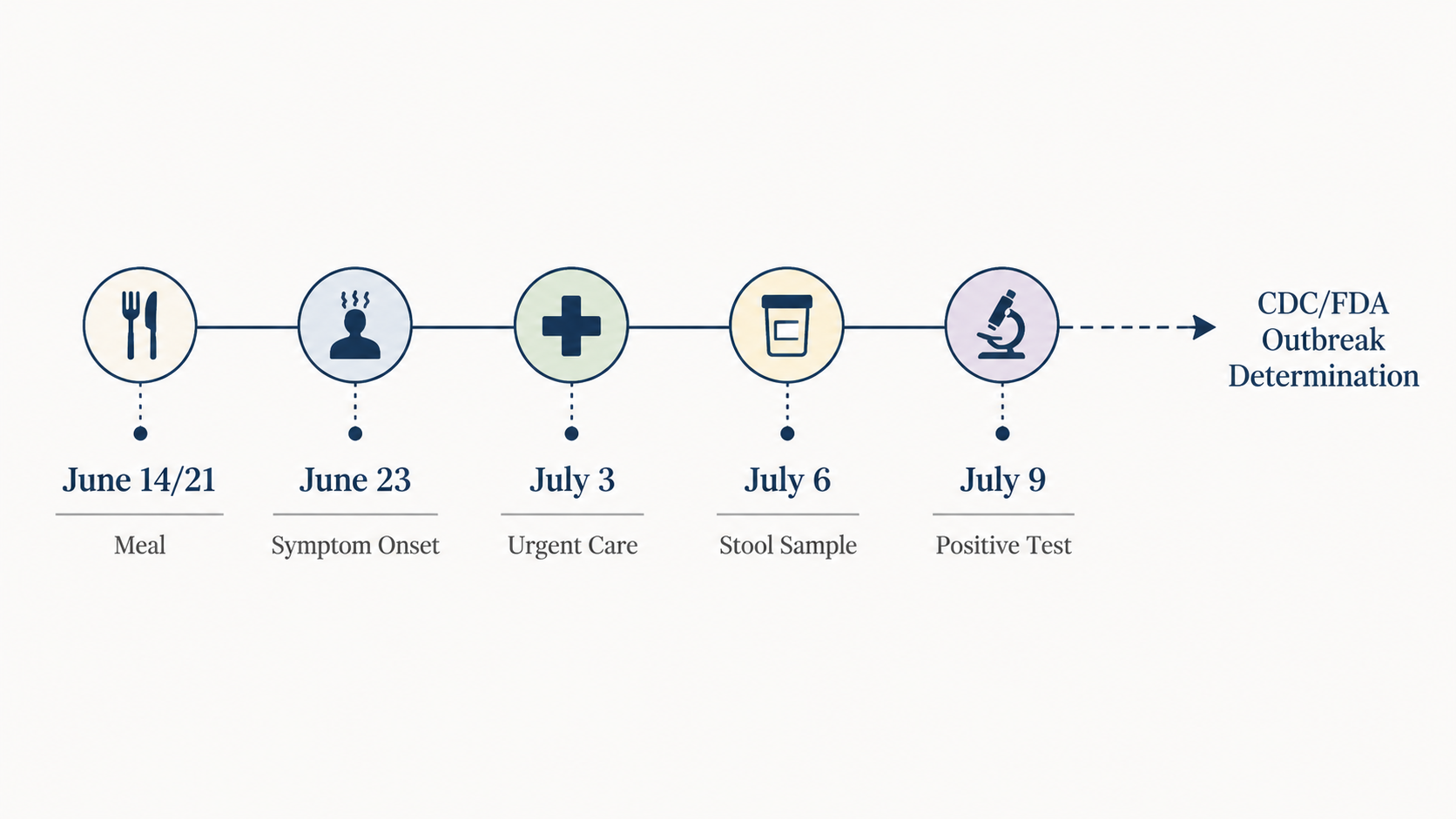
The first filed complaint in the 2026 multistate Cyclospora outbreak does not begin with a contaminated lettuce leaf preserved in a bag, a positive test from a restaurant prep line, or a lab-confirmed product pulled from a plaintiff’s refrigerator. It begins with dates: alleged Taco Bell meals on June 14 and June 21, symptoms beginning June 23, an urgent care visit on July 3, a stool sample collected on July 6, and a positive Cyclospora result on July 9. From there, the complaint relies on public outbreak determinations by CDC and FDA to connect the illness to the broader investigation involving Taco Bell and iceberg lettuce supplied into the restaurant system.[1][2]
That is the real legal center of the developing iceberg lettuce Cyclospora actions: not whether a sick person can describe a miserable gastrointestinal illness, and not whether public agencies have identified an outbreak, but what kind of proof remains after the food is gone, the memory of meals is imperfect, and the diagnostic system catches up only after the most useful physical evidence has disappeared.
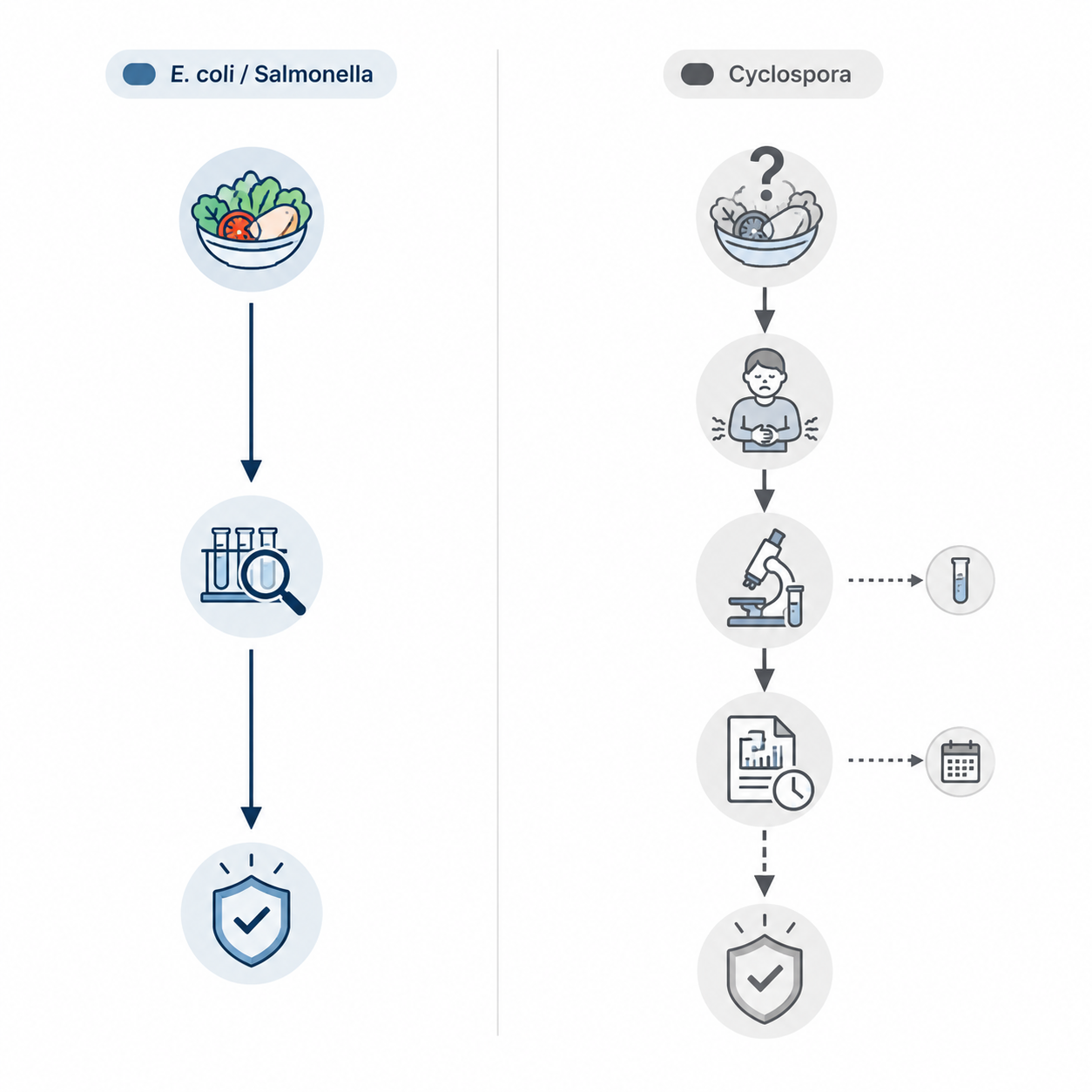
For an E. coli or Salmonella case, the proof path is often difficult but familiar: identify the exposure, match the timing, confirm the organism, compare isolates where possible, and test the implicated product or environment if evidence still exists. Cyclospora litigation is less tidy. The parasite’s biology, the way laboratories test for it, and the way public health surveillance records it all push the case away from direct product proof and toward reconstruction.
The Ayyad timeline shows the proof problem before the doctrine begins
The Ayyad complaint, filed against Pacific Bells, LLC in the Northern District of Ohio, is useful because it compresses the whole evidentiary problem into one sequence. The alleged exposure dates are separated by a week. Symptom onset follows two days after the second alleged meal. Medical care comes ten days after symptoms begin. The stool sample comes three days after that. The positive result arrives July 9.[1][2]
Those dates may support a plausible theory. They also give defense counsel multiple pressure points. What exactly was eaten on June 14 and June 21? Were both meals remembered before the outbreak was publicized, or reconstructed afterward? Were there other produce exposures in the same window? Did other household members eat the same items? Was the stool test ordered specifically for Cyclospora, or was it part of a broader diagnostic workup? The complaint’s timeline matters because each answer affects whether the case looks like disciplined inference or after-the-fact fitting.
None of that makes the plaintiff’s claim weak by definition. Foodborne illness cases often depend on reconstruction, especially when the implicated food is perishable. But Cyclospora makes the reconstruction do unusually heavy work. The meal history is not a small supporting detail; it is one of the central pieces of evidence left.
The incubation window expands the field of possible exposures
CDC’s Health Alert Network notice identifies Cyclospora’s incubation period as typically 2 to 14 days.[3] That range is manageable for clinicians deciding what to test for, but it is awkward for litigators trying to prove a specific food exposure. Two weeks of meals, snacks, restaurant visits, grocery purchases, workplace lunches, travel, and shared produce can become relevant.
The Ayyad dates sit inside that medically recognized window. If symptoms began June 23, both alleged Taco Bell meals fall within the possible incubation range.[1][3] That is helpful to pleading. It is not the same as proving causation. A timing match can exclude some exposures and elevate others, but it rarely does the whole job by itself.
This is where articles that say simply “linked to lettuce” can mislead. An agency outbreak notice can be strong evidence of a common source. It is not a substitute for asking whether this plaintiff’s illness, this plaintiff’s food history, and this plaintiff’s diagnosis align with that source closely enough to survive challenge.
Testing is not routine, and the delay is not incidental
The diagnostic issue is more than a medical footnote. CDC has warned clinicians that Cyclospora requires specific laboratory testing and that routine ova and parasite examinations might not detect it reliably.[4] The HAN notice likewise states that diagnosis requires specific testing, such as molecular methods or modified acid-fast staining, and that Cyclospora may not be detected by routine ova and parasite exams.[3]
That changes litigation in a practical way. A plaintiff may seek care while symptomatic and still not receive a Cyclospora diagnosis if the right test is not ordered. A negative or non-diagnostic early workup may not rule out Cyclospora. A later positive result may confirm infection but still leave the source question dependent on memory and epidemiology.
| Proof issue | Why it matters in Cyclospora litigation |
|---|---|
| Long incubation window | The relevant food-history period can include many meals and produce exposures. |
| Specific testing requirement | Routine stool testing may miss the organism unless Cyclospora testing is explicitly ordered. |
| Perishable product | The implicated lettuce is usually consumed or discarded before litigation begins. |
| Reporting lag | Public health confirmation can arrive after direct evidence is unavailable. |
| Agency traceback dependence | Plaintiffs often need outbreak findings to bridge the gap between illness and source. |
The July 3 urgent care visit and July 6 stool collection alleged in Ayyad illustrate the point. By the time a specific positive result exists, the meals at issue are weeks old.[1] The plaintiff has a diagnosis, but the product evidence is likely gone. The lawyer is then left to build from medical timing, a recalled food history, and the public-health investigation.
That is not a defective way to litigate if the epidemiology is strong. It is the honest way to litigate many Cyclospora cases. But it requires careful language. A positive stool test proves infection. It does not, standing alone, prove which restaurant meal caused it.
The reporting system creates a second lag
CDC’s HAN notice states that Cyclospora cases are reported to CDC about six weeks after illness onset, on average.[3] For litigation, that lag matters because traceback investigations are often most useful when product movement, purchase records, restaurant inventory, and supplier lots can still be reconstructed with confidence.
A six-week average reporting delay does not mean every case is lost. Restaurants may preserve invoices. Suppliers may retain distribution records. Public agencies may identify common exposures across clusters. But the delay shifts the evidentiary posture. The plaintiff is less likely to have retained food for testing and more likely to rely on records held by defendants, distributors, public agencies, and laboratories.
The national surveillance picture is also uneven. CDC’s HAN notice says cyclosporiasis is nationally notifiable in 47 states.[3] That leaves room for reporting friction even before considering differences in case definitions, laboratory confirmation, and the speed with which state data move into national counts.
The Michigan-versus-CDC count discrepancy is a concrete example of why outbreak numbers should be read carefully. NBC News reported Michigan’s 5,002 cases alongside CDC’s 1,645 confirmed national cases, a difference that reflects, at least in part, the gap between probable and confirmed counting and the lag in surveillance systems.[5] That discrepancy should not be used casually to inflate or minimize the outbreak. It is better understood as a warning about what case counts measure at a given moment.
There is one additional surveillance point that should be handled with caution. CDC’s Cyclospora surveillance materials identify FoodNet surveillance as optional as of July 2025, a policy detail that may matter to future arguments about undercounting and weakened pattern detection.[6] Before treating that point as a settled litigation premise, counsel should verify it against current FoodNet program materials and any jurisdiction-specific reporting rules.
Agency determinations become the bridge, not the decoration
In a Cyclospora case, CDC and FDA outbreak findings are not background color. They may be the bridge between an individual illness and a suspected food vehicle. That is why the Ayyad complaint’s movement from personal chronology to public agency determinations is so important.[1] The plaintiff’s case is not just “I ate there and got sick.” It is closer to “my exposure and diagnosis fit the timing and facts of an outbreak identified by public-health authorities.”
That is a legitimate mode of proof, but it is vulnerable to overstatement. If FDA or CDC has identified a vehicle category, that does not necessarily mean every supplier detail circulating in press coverage has been officially confirmed. Reports naming a particular supplier should be separated from on-record agency findings unless the agencies themselves confirm the sourcing. That distinction matters because supplier naming can affect pleading strategy, indemnity disputes, preservation demands, and reputational harm.
The same caution applies to the word “linked.” In public health usage, a link may rest on epidemiologic clustering, traceback, laboratory evidence, or some combination of those. In litigation, the difference is not semantic. A lab-confirmed contaminated product from the plaintiff’s home is different from a statistically supported outbreak association. Both may be probative. They are not the same kind of proof.
What plaintiffs can plead, and what defendants can attack
A plaintiff’s lawyer in this setting will usually try to lock down four categories of evidence: the food history, the symptom timeline, the specific diagnostic test, and the public-health linkage. The complaint can plead those facts in sequence. Discovery can then seek restaurant transaction records, ingredient invoices, supplier records, employee illness logs, sanitation records, and communications with health agencies.
Defense counsel has a predictable but serious response. Memory is contestable, especially when multiple exposures fall inside a 2-to-14-day incubation window. Alternative sources of fresh produce may exist. A late diagnosis may make it harder to establish the precise exposure. The absence of retained product testing leaves room to challenge whether the agency-level outbreak finding proves this plaintiff’s case.
Supply-chain pleading adds another layer. Pritzker Hageman’s guidance on Cyclospora produce claims notes that potential defendants may include entities across the chain, not only the restaurant or retailer that sold the food.[7] That is directionally right as a litigation concept. It does not solve the proof problem. Naming growers, processors, distributors, franchise operators, or restaurant entities still requires a factual basis tying the plaintiff’s exposure to the relevant product stream.
This is where early preservation work matters. If counsel waits until an outbreak notice is final, some records may still exist, but witness memory, inventory detail, and routine business data may be harder to retrieve. Conversely, premature defendant naming based on incomplete sourcing reports can create its own problems. The better practice is not to pretend uncertainty away, but to identify exactly which links are supported by medical records, which are supported by purchase or location evidence, which are supported by agency findings, and which remain allegations for discovery.
The narrow lesson from the 2026 cases
Cyclospora claims are not impossible, and epidemiological inference is not second-class evidence merely because it is not a positive test from a leftover container of lettuce. For this pathogen, epidemiology may be the only realistic way to connect illness to source. But the inference has to be built, not assumed.
The litigation posture turns less on broad statements about an outbreak and more on the strength of each plaintiff’s reconstruction: whether the alleged exposure fits the incubation window, whether Cyclospora-specific testing confirmed the diagnosis, whether public-health traceback supports the food vehicle alleged, whether supplier allegations are official or merely reported, and whether alternative exposures can be reasonably addressed.
The evidentiary architecture is therefore narrower than the public narrative. A sick plaintiff may have a real injury. A public agency may have identified an outbreak. A restaurant meal may fit the timing. The legal work is proving that those facts join in this case, for this person, with enough discipline to withstand attack.
References
- First Lawsuit in 2026 Multistate Cyclospora Outbreak Filed Against Taco Bell Operator in Ohio Federal Court, Marler Clark
- Taco Bell Franchisee Sued Over Cyclospora Outbreak Illness, Bloomberg Law
- HAN00531, Centers for Disease Control and Prevention
- Cyclospora Outbreak, Centers for Disease Control and Prevention
- Cyclosporiasis cases in U.S., NBC News
- Cyclosporiasis Surveillance, Centers for Disease Control and Prevention
- Can I Sue for Cyclospora Food Poisoning from Produce?, Pritzker Hageman
Chronological incident history
No sanction cases have named this tool in the tracked record set to date. This does not imply the tool is safe — see Risk Digest for ongoing monitoring.
← Compare peer toolsReport a correction or tip
Spotted an outdated figure, a misstated fact, or a ruling this tool profile should reflect? Public comments are disabled for this content given the professional cost of a misreported case outcome, penalty amount, or rule text — use the structured correction channel instead.
Report a correction or tip for this record →